
In God's own jungle - birding in B.R. Hills
In God's own jungle
Whoever named Butea monosperma the Flame of the Forest was undoubtedly a poet. And it is poetry that this magnificent tree lends to the forest landscape of Biligiri Rangaswamy Betta (B.R. Hills).
However, the morning on which Sahastra, Arun and I landed in B.R. Hills was not one that inspired poetry. Reflecting now on the vistas of mist-draped hilltops and the fresh scent of vegetation that welcomed us, maybe it was – but we were not in the mood to appreciate it.
Leaving from Mysore at 4 AM on Saturday, we encountered rain within half an hour. First a few specks on the windshield, but as we drove on it turned into a daunting downpour. Our much-awaited birding trip, the excitement of which had kept me awake for the past week, appeared to be imperiled.
A chance encounter
Somewhere past Nanjangud, we stopped to ask for directions. On the rain-darkened thoroughfare, no one appeared to be awake except one soul with a sack pulled over his head to brave the deluge. We pulled up beside him and shouted askance above the din of the downpour. In a strangely accented Kannada, he said something to the effect of drive straight ahead and pointed to what appeared to be the source of the rain. We mumbled our thanks and hoped for the best.
It was past six by the time we reached Yelandur, where we were to collect entry permits from the Range Forest Officer. Having made a number of calls and confirmed with everyone concerned over the past week, we expected our entry to be a breeze. But we were met with a peculiar kind of hostility – I was asked to come in and make myself comfortable in the RFO’s veranda but refused an entry permit. He said he had no idea about the fax we had sent him and that he had not heard from his superiors.
After some parleying and an impassioned speech that I should have written down for posterity, I was told that we could drive right up to the Soliga shrine of Kyatha Devarayana Gudi or K. Gudi (where Jungle Lodges runs a very profitable eco-tourism lodge) but we were not to enter the forest trails. We were disappointed but pressed ahead. Our accommodation had been arranged at Vivekananda Girijana Kalyana Kendra (VGKK), an NGO founded by the eminent doctor and social worker Dr. H. Sudarshan. We decided to stay the night and do what we could.
Once we began driving, it seemed idiotic to have wasted an hour seeking permission where none was required. A motorable road ran all the way from Yelandur to K.Gudi via B.R. Hills through a beautiful forest. But for two check posts, there was nothing to stop us from entering.
The jungle begins
The downpour had been replaced by a fine, powdery rain. We passed a watering hole where a flock of peafowl (mostly peahens) seemed to be engaged in some sort of saas-bahu spat, presided over by a solitary Grey Junglefowl. Pied Bushchats and Oriental Magpie-Robins sang from the wayside. As we entered scrub jungle, we saw bulbuls and Indian robins. Laughing doves fluttered up from the muddy road. We had a glimpse of a pipit that we could not identify.
The scrub jungle gradually grew denser. At one point we stopped beside a flowering Flame of the Forest, which seemed to have the effect on a flock of purple sunbirds (yes, a flock, if eight to ten individuals can be counted as one) that one of Bangalore's pubs would have on beer-guzzlers. The rain let up briefly. Just as we passed a bend in the road, Sahastra signaled me to stop. All he said was "a blue bird". We clambered out of the car and our eyes picked out a wintering Verditer Flycatcher, its aquamarine plumage gaudy against the murky foliage.
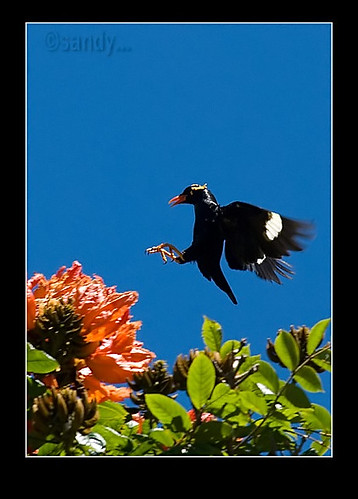
The rain continued, varying from fine spray to a discomfortingly cold, ungentle drizzle. But the sight of the changing forest topography had us transfixed. In moderately dense deciduous forest, we heard that most fascinating of calls, one that tells you instantly that you are now breathing oxygen manufactured by the Western Ghats - the exuberant call of the Hill Myna. Looking up through the rain we saw a flock of seven birds perched on what in sunny times would have been a nice dry tree. Near them was a flock of Rosy Starlings, accompanied by a few Yellow-footed Green Pigeons blinking away the rain. A bronzed drongo fluttered about them, cackling away its soliloquies.
At VGKK
There are a number of water bodies en route to B.R. Hills from the forest check post (where the guard had immodestly asked us for "tipsu"). One of them lies opposite the gates of VGKK. The hospital and school run by the NGO occupy an entire hillside. Rows of neat buildings with tiled roofs welcomed us. After conversations with the administrative officers, we were shown to our room, a functional, no-frills three-bed unit (any place sans TV is only a few steps from heaven). We were ravenous but were gently told that we give the hospital canteen a pass and try Giridarshini, the only eating house in the region for about 20 kilometers.
The food turned out to be decent. No complaints at all. We dispatched 14 dosas among ourselves, a move that served us well through the day when we skipped lunch (we had no option) and chomped on our provisions of biscuits, chikkies, etc.
The rain's appetite, however, was unsatisfied. With a cruel sense of humor, it strengthened every time we stopped to investigate a woodpecker or warbler. Lorikeets, Plum-headed Parakeets and Malabar Parakeets kept up a constant clamor. Rufous babblers squabbled noisily in the undergrowth. Suddenly it got very foggy and birding in these conditions seemed fruitless. We pressed on, slowly driving ahead and birding on the way. Coral trees and flame of the forest offered bright respite from the murkiness.
A change of weather, and luck
A little past two, the rain stopped. The sky was still overcast but a few holes appeared in the dank grey sheet above us. The presence of a lurking sun was often revealed in spurts of brightness. The jungle was getting thicker and the tarred road turned to mud. Past a bend in the road, we came upon herds of chital and a few sambhar. A coral tree lavished its colorful bounty upon us. And enjoying a great nectar feast were coppersmith barbets, white-cheeked barbets, ashy drongos, bronzed drongos, great tits and a pair of brown-capped pygmy woodpeckers. Among them, velvet-fronted nuthatches flitted about on the trunk like little trapeze artists.
At a turn in the road, we came across a magnificent male Asian Paradise Flycatcher. Splendid milky white with trailing streamers and a bright black crested head. I fumbled about with my nearly dysfunctional handycam to get some record shots, with moderate success. The sun sent out a few miserly rays and suddenly the forest around us seemed to come alive in a feeding frenzy.
A little ahead of us, a coral tree played host to a big post-lunch nectar session. Chestnut-tailed Starlings, White-cheeked Barbets and Bronzed Drongos notwithstanding, there was a Racket-tailed Drongo. And high above, on the topmost level, was a solitary Spangled Drongo, the twirled half-streamers on its tail diagnostic. Lifers for Arun and Sahastra. Noticing a few eucalyptus trees in the area (planted benevolently by the forest authorities, no doubt), I recalled that in the winter of 1992, I had observed Spangled Drongos (then known to us as Hair-Crested Drongos) feeding on the nectar of Eucalyptus blossoms in Bannerghatta National Park. We had also seen the Nilgiri flycatcher on that occasion.
A sneaky safariA tame elephant and a herd of wild pigs welcomed us to the Jungle Lodges encampment. While Sahastra and Arun rushed to investigate a Blue-capped Rock Thrush, my mind was set on how to sneak a safari. We spoke to the JL manager and he agreed to let us pile on for Rs. 350 apiece. And that's how we found ourselves trundling along in JL's four-wheel drive along the deep jungle tracks. Not much reward in terms of wildlife, though Sahastra and Arun managed a good sighting of a Streak-throated Woodpecker. We saw plenty of chital, a few wild pigs, a langur or two, and a small herd of gaur. No elephants, and certainly no big predators. A pair of Stripe-necked Mongooses beside a waterhole obliged us for a long time, and I got some decent, if somewhat shaky, footage.
Two rounds of coffee, courtesy Jungle Lodges, proved very invigorating and as we started back towards VGKK, it was already dark. Wildlife was active in the jungle, and our high-beams revealed deer on both sides of the road like friezes in a surrealist art gallery. At one point, we stopped to let a Sambhar fawn, a proverbial doe in headlights, cross the road as her mom watched anxiously. Traffic is not allowed to enter or leave the park after 6, and we were lucky to have the road to ourselves. As we drove ahead, a Small Indian Civet crossed the road, stopped to stare at us and melted into the jungle (Kalyan Varma's picture of a civet roadkill haunted me and I urged Sahastra to drive slowly). Further ahead, we saw a large dumpy shape on the road. We slowed down, thinking it was a hare. But it turned to stare at us indignantly and flew up into a tree. A large owl - pale with dark barring. And we have no idea what it was. Wish we were born with night vision.
We stopped for dinner at Giridarshini where we devoured at least six chapatis apiece and passed up the rice. The rain was a distant memory and the stars were out when we reached VGKK. A herd of wild pigs welcomed us in, and we knew the adventure was not quite over.
At long last, a good night's sleep
We had to move rooms - downgraded a bit, no attached loo - but we did not complain. For the first night in over a week, I slept, and it was the sleep of the accomplished. We had overcome a number of obstacles to get here to B.R. Hills, we had sneaked ourselves into the Jungle Lodges safari, and we had enjoyed a great day's birding. The stripe-necked mongoose was a treat. And the Spangled Drongo on the coral tree was a framed picture in the gallery of my unconscious. As I drifted off to sleep, I thought of the man we saw in Nanjangud, the man whose directions got us to Yelandur through driving rain. Driven away by my snoring, my soul must have wandered off to the surrounding forest to consort with the denizens of the night...
I woke at half past five to a sky spangled with stars. Even after some acrobatics in the clean but very cramped common loo (I actually considered doing the business standing sideways), my back gave me little trouble - perhaps it was the yogic position.
The good folks at VGKK are inspiring and hospitable. On Sunday morning, we walked about the campus with its rows of small, even buildings, and the Soliga children murmuring their lessons in the classrooms. I was touched by the look of eagerness on their faces. The story goes that Dr. Sudarshan braved the threats of Veerappan to carry on his meaningful work. Dr. Prashanth, whom I met online via Ulhas Anand, had helped us with the contacts at VGKK. In his email, had told me: "Enjoy your stay, and dont expect too much luxury at VGKK. Please do see the work we do as you appreciate the birds. I spent a good 4 years of my life there!"
Fulvetta and other sightings
We left VGKK on a cool, glorious morning. Yesterday's dank, foggy impersonation of a cloud forest was forgotten. Shafts of sunlight lit up the glades and gilded the canopy. Langurs catching an early bite in the forest scooted at the sight of us, amid a frenzied trembling of treetops. We skipped breakfast to finish whatever little birding we could accomplish before dropping Arun off at Chamarajnagar. In a forest pool, a large wader (sandpiper-like) flew around in circles, giving us no time to identify it. A Common Kingfisher hung around a fallen tree, cheeping merrily.
Further down the road, we stopped at a breathtakingly beautiful tree (no id, sorry) that grew beside a stream. Drongos - Ashy and Racket-tailed - cavorted about it merrily. A wintering Grey Wagtail hopped about the wet stones at the foot of the tree. A small, dispersed flock of Brown-cheeked Fulvettas (which I still know better as Quaker Babblers) revealed the source of the call that had been a mystery to us until then. We had confused it with the Grey-headed Canary Flycatcher. But no longer, my friends. Quiz me now, and I'll whistle you the difference.
As we approached the coral tree near Jungle Lodges, we saw a White-bellied Drongo and a wintering Asian Brown Flycatcher. Good views of both. The Blue-capped Rock Thrush was still there, and so was a juvenile male Asian Paradise Flycatcher. We had a fantastic view of a Chestnut-bellied Nuthatch but it was too nimble for my camera. A flock of Common Rosefinches fluttered through the canopy. A few lifers for Arun there.
Predator!
It was almost nine. The view was grand - an amphitheatre of hills unfolded ahead of us - the rest of B.R. Hills and M.M. Hills in the distance, and the shimmer of a large water body. We could not stop to savor it long enough, as we had to make it to Chamarajnagar, 27 km away, to get Arun on a bus to Mysore. Well, it was all downhill and we drove as fast as third gear would let us.
In time, the road leveled out and we reached dry deciduous forest with golden grass and undergrowth that was ready tinder for a forest fire. A few kilometers before the park gate, we heard a Red-wattled Lapwing's alarm call. And to the left of the road, we saw a Dhole, better known as the Indian wild dog and the most efficient hunter of the Indian jungles. We stopped the car and looked on, as I filmed the animals greedily past the shoulders of my friends.
The dhole, a female, crossed the road, gave us a long, lingering look and sauntered across the road. To its left, away from our direct view, another individual sat on his haunches, observing us. There must be a pack, we reasoned, and they seemed to be coming this way from a waterhole. Which might mean they had just killed and eaten. Arun identified the dog on our right as the alpha male by the pale patch around its throat and chest. He appeared to be the leader all right, watching over his tribe. A third dhole appeared, then a fourth, and the two bolted across the road. Finally, our alpha male got up and walked unhurriedly across the road, turning around to look at us. We chattered about it all the way to Chamarajnagar where we dropped Arun to a Mysore-bound bus and turned towards Kollegal en route to Bangalore.
That was our reward. So the man at Nanjangud may have been god after all...
Our thanks to:
Ulhas P.A.
Dr. Prashanth N.S.
Dr. Sudarshan, Mr. Ramachar, Mr. Bindu and the good folks at VGKK
Photo: Southern Hill Myna - copyright Sandeep Somasekharan
B.R. Hills - bird list
Feb. 9-10, 2008
Arun Menon, Sahastrarashmi, Bijoy
- Jungle Babbler
- Brown-capped Pygmy Woodpecker
- Large Pied Wagtail (White-browed)
- Indian Rufous Babbler
- Quaker Tit-Babbler (Brown-cheeked Fulvetta)
- Tickell's Flowerpecker
- Common Tailorbird
- Purple Sunbird
- White-headed Babbler
- Grey Wagtail
- Common Rosefinch
- Red Spurfowl (female)
- Indian Peafowl
- Rufous Woodpecker
- Little Scaly-bellied Green Woodpecker (Streak-Throated)
- Blyth's Reed-Warbler
- Malabar Grey-headed Starling (Chestnut-tailed)
- Lesser Golden-backed Woodpecker (Black-rumped Flameback)
- Greater Golden-backed Woodpecker (Greater Flameback)
- Grey Junglefowl
- Jungle Myna
- Black-headed Cuckoo-Shrike
- White-cheeked Barbet
- Asian Brown Flycatcher
- Verditer Flycatcher
- Oriental Magpie Robin
- Indian Robin
- Pied Bushchat
- Common Myna
- Rosy Starling
- Oriental White-eye
- Southern Hill Myna
- Chestnut-bellied Nuthatch
- Velvet-fronted Nuthatch
- Great Tit
- Common Swallow
- Red-whiskered Bulbul
- Red-vented Bulbul
- Yellow-browed Bulbul
- Malabar Whistling Thrush
- Bar-winged Flycatcher-Shrike
- Black-hooded Oriole
- Indian Pond Heron
- Golden-fronted Leaf Bird
- Rufous Treepie
- Jungle Crow (Large-billed)
- Eurasian Golden Oriole
- Large Cuckoo-Shrike
- Median Egret
- Scarlet Minivet
- Little Egret
- Black Drongo
- Ashy Drongo
- White-bellied Drongo
- Bronzed Drongo
- Spangled Drongo
- Greater Racket-tailed Drongo
- Asian Paradise-Flycatcher
- Blue-capped Rock Thrush
- Small Minivet
- Emerald Dove
- Common Kingfisher
- White-breasted Kingfisher
- Small Bee-eater
- Common Hawk Cuckoo
- Indian Hanging-Parrot
- Plum-headed Parakeet
- Blue-winged Parakeet
- Cattle Egret
- Spotted Dove
- Coppersmith Barbet
- Yellow-legged Green Pigeon
- Mountain Imperial Pigeon
- White-breasted Waterhen
- Red-wattled Lapwing
- Black-shouldered Kite
- Crested Serpent Eagle
- Shikra
- Little Cormorant
- Laughing Dove
- Greenish Leaf Warbler
- Unid. Owl (large, pale with dark bars)
- Unid. Pipit (Black tail with white line across the middle)
- Unid. Flycatcher (Slaty blue head, brownish-rufous back, pale bluish grey)
Mammals
Unidentified Hare (Indian Hare?)
Axis Deer/ Chital
Sambar
Gaur
Stripe-necked Mongoose
Small Indian Civet
Hanuman Langur
Bonnet Macaque
Wild Pig
Dhole/ Wild Dog (10-02-08) - pack of 5
The milk of human blindness
Hard to imagine that the near extinction of three species of Gyps vultures has to do with something mammalian.
Milk.
Medicine to mammals, toxin to vultures, the antibiotic drug Diclofenac was widely administered to livestock. When vultures fed on animal carcasses as they have been doing for millennia, traces of the drug crept into their digestive systems and, over time, caused renal failure, slowly wiping out whole populations of the raptors. Finally in 2006, Diclofenac was banned, perhaps 15 years too late. Now, the worrying part is that Diclofenac has moved to Africa, where it poses a huge threat to vultures and other raptors of that continent.
Just as with the gharial crisis that is unfolding in the Chambal River Sanctuary, theories abounded but the solution came late. Conservationists are now waiting with bated breath - some fear the damage is too deep; others are hopeful that the vultures will make a comeback.
Tehelka has a good opinion piece on the subject by conservationist Neeta Shah.
Crocodile tears... on IBN blogs
Couldn't take it any more...
I have vented my angst over the reportage of the gharial crisis on IBN blogs. Here's the text:
Paper packs a punch
Via Google Reader:
Awesome, innit?
 We’re big fans of packaging done right, and we really hate packaging done wrong. It’s no wonder then that we were intrigued when Mark Appleford of Varden contacted us about their new Ecopak packaging solution that “combines elements of pulp paper thermoforming with a specialized printing technology to create highly original and sustainable packaging.” According to Mark, the process uses recycled paper and cardboard pulp, but is finished to the same standard as regular card...
via TreeHugger on 2/4/08
We’re big fans of packaging done right, and we really hate packaging done wrong. It’s no wonder then that we were intrigued when Mark Appleford of Varden contacted us about their new Ecopak packaging solution that “combines elements of pulp paper thermoforming with a specialized printing technology to create highly original and sustainable packaging.” According to Mark, the process uses recycled paper and cardboard pulp, but is finished to the same standard as regular card...The Gharial and the TV reporter
The more I read about the gharial episode in the Indian media, the more I am disgusted with the petty politicking that has driven me away from a career in that industry. And just for that, I am grateful.
So it was refreshing to read Janaki Lenin's opinion piece in Tehelka and her blog on the media coverage of the issue on Wildlife Almanac.
I saw some ridiculous coverage on the websites of NDTV and CNN-IBN (where one journalist has posted an idiotic blog) - and they all try to skirt the issue and fabricate connections that are irrelevant, irresponsible and dangerously speculative.
The principal points - that of possible pollution of the Chambal and Yamuna rivers, at whose confluence these ancient reptiles breed, and the clear evidence of disease and the urgent need for authorities and experts to work together to control it - have been swept aside. I know from friends who are wildlife researchers that the Yamuna-Chambal confluence is perhaps the last stand not just for the gharial, but for otters, many species of waterbirds and quite likely even the Gangetic Dolphin.
All this lobbying could put the wrong kind of pressure on the wrong authorities who will, inevitably, blunder with their decisions. And so, instead of investigating the issue and finding a timely and scientific solution to it, we will see the activism over this issue again deteriorate into the sad charade of appeasing vote-banks.
And what of the gharial? Well, time will tell.
Postscript: Some nut has stolen my copy of Tehelka from my postbox. I hope he/she/it develops a decent opinion on the Gharial crisis.
Don't crush that used soda can
Campers, don't crush that soda can.
I came across this interesting stove that is made from used Pepsi cans. It takes a little tinkering, if you're the tinkering type. But sounds like a good idea. If it works for you, please make me one!
More here: http://www.pcthiker.com/pages/gear/pepsistove.shtml
With a wave of his hand, the Panamanian golden frog...
BBC reports:
The Panamanian golden frog communicates with other frogs by semaphore in the form of gentle hand waves.
It has evolved the mechanism to signal to rivals and mates above the noise of mountain streams.
Shortly after filming for the BBC One series Life In Cold Blood, the frogs had to be rescued from the wild, due to the threat of chytrid fungus.
Hilary Jeffkins, senior producer of Life In Cold Blood, said the semaphoring behaviour of the Panamanian golden frog was very unusual.
"Normally, frogs would croak to get their message across but it's too noisy," she said. "An extra mechanism they've evolved is to wave to each other."
The frogs (Atelopus zeteki) were filmed at a remote location in the Panamanian rainforest. The population had all but disappeared because of a fungus that grows on the amphibians' skin and suffocates them.
The film crew was disinfected - to stop them from carrying the disease - and managed to capture unique footage of the frogs in the wild. Just after filming was completed in June 2006, the location was overtaken by the chytrid fungus. Scientists were forced to remove the remaining frogs from the wild and keep them in captivity.
Hilary Jeffkins added: "The whole species is now extinct in Panama - this was one of the last remaining populations. It's its final wave in our programme." Chytrid fungus (Batrachochytrium dendrobatidis) is a major contributor to the decline of amphibian populations around the world, threatening many species with extinction.
http://news.bbc.co.uk/2/hi/science/nature/7219803.stm
My friend Gopi Sundar sends an update: "In the Western Ghats, there is an endemic genera called Micrixalus that also has intricate leg-waving. It's quite amazing to watch."
In a 2004 article, BBC had warned that "as many as 122 [amphibian] species may have become extinct since 1980 and a third of known amphibians face oblivion."
First tigers, now polar bears
It's curious how people who are nothing but voracious consumers for the most part suddenly develop an interest in the environment. Better still, they become experts and spokespeople for ecological issues.
Nearly everyone worth their page three partywear is "doing something about the environment" - mostly attending glitterati-infested soirees and taking home souvenirs made out of 'green' material that helps "regenerate forests" and "cut down carbon emissions". My, my... what a lot of pillow talk among the strangest bedfellows.
In India, everyone is batting for the tiger. No matter what measures real experts like Dr. Ullas Karanth advocate, everyone from the Prime Minister's uncle to some nut generating bites for a TV channel is campaigning for tigers.
Now, everyone of the aforesaid ilk who is doing his or her bit for the planet is obsessed with polar bears. As late as last month, many of these people couldn't tell a polar bear from a grizzly. So much that Ursus maritimus poses a big threat to Barack Obama if he runs for president.
Since a lot of our new converts to conservation cannot be ignored, WWF has released Polar Bear Facts and Fallacies, a publication that attempts to lay bare (bad pun, I know) the facts about polar bears.
Worth the download, and worth circulating while you read it.
Go to the ant
 My mind's been besieged by ants. I used to watch ants a lot all of the time, but now I'm watching the ground beneath my feet with a new, ever-growing sense of alarm: there just aren't enough ants.
Which is why, last week, when I saw a tattered single file of little black ants threading their way across the floor, complete with their cargo of white larvae, I was consoled. My home still has a touch of tolerable biodiversity.
I wish I were more like Ajay Narendra. The magnificent site he maintains provides a wealth of information on ants. And not long ago, he co-authored the book, On a trail with ants. No mean feat, this is a handbook of the ants of the Indian subcontinent.
I have hunted all over the place for it, without joy. Know where I can find a copy?
My mind's been besieged by ants. I used to watch ants a lot all of the time, but now I'm watching the ground beneath my feet with a new, ever-growing sense of alarm: there just aren't enough ants.
Which is why, last week, when I saw a tattered single file of little black ants threading their way across the floor, complete with their cargo of white larvae, I was consoled. My home still has a touch of tolerable biodiversity.
I wish I were more like Ajay Narendra. The magnificent site he maintains provides a wealth of information on ants. And not long ago, he co-authored the book, On a trail with ants. No mean feat, this is a handbook of the ants of the Indian subcontinent.
I have hunted all over the place for it, without joy. Know where I can find a copy?
Subscribe to:
Posts (Atom)