We’ve moved! Here’s where you can find us

The Green Ogre is now at https://www.greenogreindia.org

Olive Ridley Turtles need a push in the right direction


Light, especially of the artificial kind, is a no-no for nesting Olive Ridley turtles. In fact, artificial light distracts young hatchlings, which make their way to the sea at night, and attracts predators. However, metaphorically speaking, the turtles need a guiding light.


Sahyadri Nisarga Mitra, a non-governmental organisation based in Maharashtra, has been working to conserve the nesting sites of the Olive Ridley Turtles. The NGO has so far protected over 16,000 hatchlings in about 30 coastal villages in the region. To facilitate their work, SNM recently called for donations to procure a GPS navigation system. A donor promptly responded to their call.


That's just a baby step. As the nesting season approaches, more work remains for these dedicated volunteers. In March last year, SNM organised a Turtle Festival in Velas, Maharashtra jointly with the Forest Department and the Velas gram panchayat. About 250 visitors from across Maharashtra participated in the roadshows, film screenings and book release ceremonies. Over 120 hatchlings were released safely into the sea over the two days of the festival. An important outcome of the festival was that the residents of the village were awakened to the urgency of the issue of conserving marine turtles. The festival also brought in Rs 50,000 in funds, which will be used for stepping up conservation efforts. SNM also works for the conservation of the White-bellied Sea Eagle, Indian Swiftlet and the White-backed Vulture.


Photographs: Courtesy Sahyadri Nisarga Mitra/Laxmikant Deshpande. 
More information and photographs of the Turtle Festival at http://www.snmcpn.org/photos_festival.html

With warmer winters, migrants shift north

A study among North American birds shows that more and more species are moving their winter migration grounds further north as a possible outcome of global warming. The Audubon Society has published a report (download) that clearly shows that species such as the Purple Finch (top), Wild Turkey, Marbled Murrelet, Red-breasted Merganser (below) and Spruce Grouse have moved their winter migration grounds northward by hundreds of miles. The trend may be similar the world over. Winter bird records in India have indicated that some wintering species have arrived later than usual in some of their wintering grounds. Photographs: Purple Finch - © Ashok Khosla Red-breasted Merganser - © USFWS, Dave Menke Audubon Birds and Climate Change Press Room

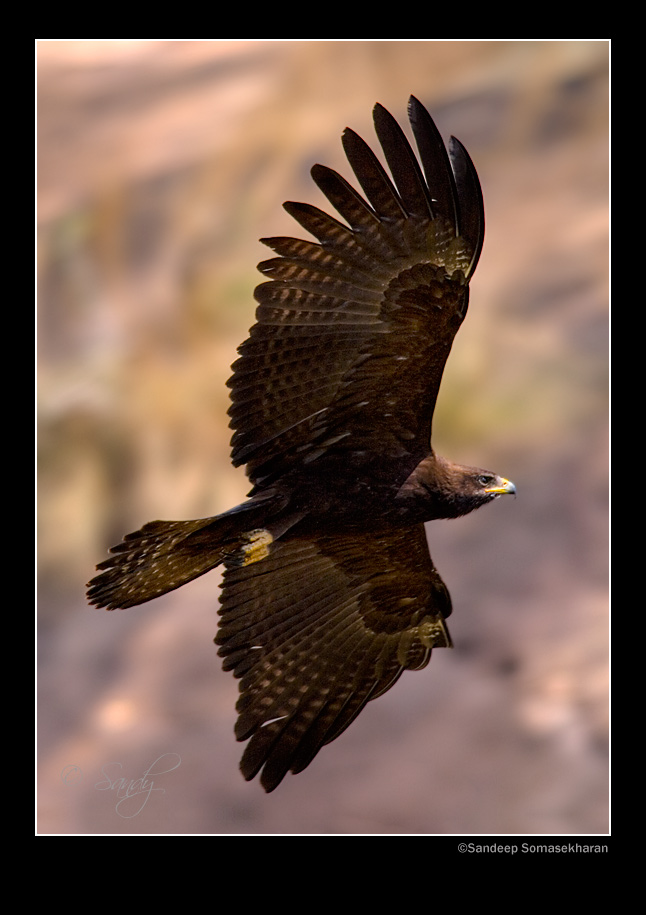
Encounter - Indian Black Eagle

To the Soliga people, the Indian Black Eagle is known by the evocative name of kaanana katthalu - the darkness of the forest


The Mighty Black. For most of my birding career, this majestic forest raptor has been elusive. My first sighting of the Indian Black Eagle (Ictinaetus malayensis) was not in the Western Ghats where it is more commonly seen, but in Horsley Hills, in the Eastern Ghats. We had a view of a distant, unmarked dark eagle alighting on a rock. And so it stayed until we found this magnificent hunter again, soaring above the treetops at BR Hills. 


Dr. Prashanth, who has spent a great part of his career at VGKK and knows the Biligirirangans very well, accompanied us on one of our best visits to his "home" forest. We saw the Black Eagle several times on that visit, most memorably when we were driving up to Bedaguli. Our eyes were already full of Blue-bearded Bee-eaters and Fairy Bluebirds, but the sight of the day was, quite literally, waiting round the bend. Just before the coffee estate began, a large individual chose to melt out of the dark canopy into the blazing blue sky ahead of us. It must have been about 50 metres from the car, and we gasped in unison. 


Imposing in its size and carriage, and soaring majestically into the valley. Later, Prashanth told me that the Soligas call the bird Kaanana-katthalu (literally, 'Darkness of the Forest'). Wondrously poetic and founded on the Soligas' unparalleled jungle wisdom. Sandy (Sandeep Somasekharan) has been particularly lucky company as far as raptors are concerned. As with the Changeable Hawk Eagle, with him I have had some fabulous views of the Black Eagle. He was with us at Bedaguli but things happened too quickly to bring in the photographic evidence. He caught this guy (in the picture) at Ramanagaram when he went there looking for vultures. The vultures were AWOL, but this compensated for Sandy's bad day. And how!  


Photograph © Sandeep Somasekharan. All rights reserved.