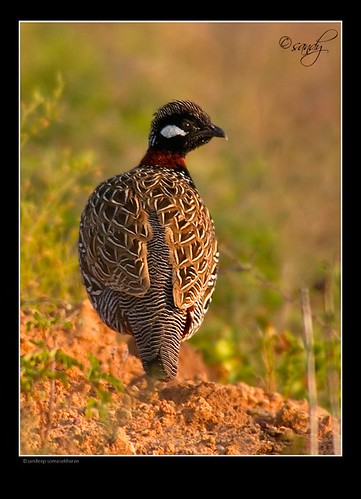
 All right, shoot me. I have never had any luck with the Black Francolin. When other birders talked of it as if it were domestic poultry, I would clear my throat and look west until the conversation had drifted past.
Not any more.
Kutch offered me the best-ever sighting of this handsome fowl. The CEDO folks drove us towards the Naliya grassland and all the while we looked for the elusive bustards. This, they told us, was the habitat of the Great Indian Bustard and the MacQueen's Bustard. We combed the grassland but saw none.
But in the early morning light, as we trailed a large flock of Eurasian Griffons, we saw a movement in the shin-high grass. As our driver Mangal cut the engine, the suspect emerged from his cover and lorded over the path ahead of us for a glorious three seconds. Then he obliged us by moving into the light and showing off for a bit, completely unperturbed. Sandy, who was in the passenger seat next to the driver, fired away.
And that's how we got this picture. And that's how when the Black Francolin comes up in conversation, it's my turn to gloat.
Photograph © Sandeep Somasekharan. All rights reserved
All right, shoot me. I have never had any luck with the Black Francolin. When other birders talked of it as if it were domestic poultry, I would clear my throat and look west until the conversation had drifted past.
Not any more.
Kutch offered me the best-ever sighting of this handsome fowl. The CEDO folks drove us towards the Naliya grassland and all the while we looked for the elusive bustards. This, they told us, was the habitat of the Great Indian Bustard and the MacQueen's Bustard. We combed the grassland but saw none.
But in the early morning light, as we trailed a large flock of Eurasian Griffons, we saw a movement in the shin-high grass. As our driver Mangal cut the engine, the suspect emerged from his cover and lorded over the path ahead of us for a glorious three seconds. Then he obliged us by moving into the light and showing off for a bit, completely unperturbed. Sandy, who was in the passenger seat next to the driver, fired away.
And that's how we got this picture. And that's how when the Black Francolin comes up in conversation, it's my turn to gloat.
Photograph © Sandeep Somasekharan. All rights reserved

Encounter - Black Francolin
All right, shoot me. I have never had any luck with the Black Francolin. When other birders talked of it as if it were domestic poultry, I would clear my throat and look west until the conversation had drifted past.
Not any more.
Kutch offered me the best-ever sighting of this handsome fowl. The CEDO folks drove us towards the Naliya grassland and all the while we looked for the elusive bustards. This, they told us, was the habitat of the Great Indian Bustard and the MacQueen's Bustard. We combed the grassland but saw none.
But in the early morning light, as we trailed a large flock of Eurasian Griffons, we saw a movement in the shin-high grass. As our driver Mangal cut the engine, the suspect emerged from his cover and lorded over the path ahead of us for a glorious three seconds. Then he obliged us by moving into the light and showing off for a bit, completely unperturbed. Sandy, who was in the passenger seat next to the driver, fired away.
And that's how we got this picture. And that's how when the Black Francolin comes up in conversation, it's my turn to gloat.
Photograph © Sandeep Somasekharan. All rights reserved
Encounter - The Indian Desert Cat
Meet a shy and secretive felid of the Indian deserts
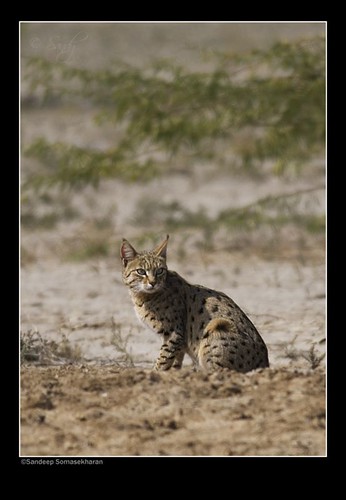
In January, the Banni grassland of Kutch rustles like a tinderbox. The tussocks of grass are dry, the soil is powdery and fine, and mirages turn the horizon into a kaleidoscope of illusions. You can, therefore, be forgiven for seeing things that do not exist here. It is exactly this illusion that the creatures that inhabit this arid wonderland hope you will succumb to. Rub your eyes and they're gone. And so, while our Tata Sumo cross-countried through the fringes of the Great Rann of Kutch, we saw bustards that were actually common cranes, and wild asses that were anything but. After a while, we learned not to let our hearts stop at the sight of Indian gazelles (chinkaras) loping through the fawn-coloured landscape like motion grabs from Animal Planet. And while we peeled our eyes for the endemic Desert Fox, another creature crossed our path. Felis silvestris ornatus - the Indian Desert Cat. It melted out of the stippled earth and slunk away towards its burrow, apparently borrowed from an Indian fox. We gasped. And clicked away.
Photograph © Sandeep Somasekharan. All rights reserved. Used with permission.
Unforgetting Exxon Valdez
On the eve of the 20th anniversary of one of the world's great ecological catastrophes - the Exxon Valdez oil spill - The New York Times has carried a telling editorial. Excerpt:
More than $2 billion has been spent on cleanup and recovery. Exxon has paid at least $1 billion in damages. Supertankers have been made safer with double hulls, emergency teams given better equipment. Some fish species, though not all, have recovered. Yet the Exxon Valdez still sends a powerful cautionary message: oil development, however necessary, is an inherently risky, dirty business — especially so in the forbidding waters of the Arctic.More here
Agriculture and bird diversity - some findings
The winter of 08-09 has now packed away its woollies and headed off into the southern hemisphere to cool things off. But while we argued about the patterns of bird migration, the late arrival of migrants (some entirely absent) and blamed global warming for our frustrations, a biologist I know has braved the odds and conducted one of the most comprehensive bird surveys conducted in Uttar Pradesh in recent times.
 Streams in the agricultural landscape make excellent foraging grounds for a variety of waterbirds.
The man (not in picture) is Gopi Sundar, whom readers of this blog have met virtually many times over. Gopi, as the International Crane Foundation's research associate and principal coordinator of the Indian Cranes and Wetlands Working Group, is well known for his study of Sarus cranes and their habitat in the rice-dominated agricultural landscape of Uttar Pradesh. Gopi spent the winter braving dense fog and the political mafia to execute a painstaking survey of the bird diversity in this ecosystem. He used a grid-based sampling design with space-for-time replication to test for variations in "observed patterns of bird species richness and abundance due to four different intensities of rice cultivation". His study documented 198 bird species in 160 transects.
Streams in the agricultural landscape make excellent foraging grounds for a variety of waterbirds.
The man (not in picture) is Gopi Sundar, whom readers of this blog have met virtually many times over. Gopi, as the International Crane Foundation's research associate and principal coordinator of the Indian Cranes and Wetlands Working Group, is well known for his study of Sarus cranes and their habitat in the rice-dominated agricultural landscape of Uttar Pradesh. Gopi spent the winter braving dense fog and the political mafia to execute a painstaking survey of the bird diversity in this ecosystem. He used a grid-based sampling design with space-for-time replication to test for variations in "observed patterns of bird species richness and abundance due to four different intensities of rice cultivation". His study documented 198 bird species in 160 transects.
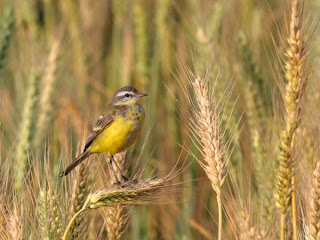 Yellow Wagtails are a relatively common species in Uttar Pradesh's cultivated areas. They are one of the last migrants to leave and can be seen feeding on insects in ripening wheat fields in early summer.
Gopi's report begins with this arresting declaration: "Agriculture is the biggest threat to bird diversity worldwide." The Hindu published a report based on his work in its national edition. It opens with the very same statement.
Gopi's findings suggests that agriculturists hark back to traditional land-use methods, which preserved natural habitats and enabled bird diversity. Preserving islands of natural habitat and avoiding mono-cropping or monocultures can be important steps in this direction.
The Hindu report can be read here.
PHOTOGRAPHS: © K. S. GOPI SUNDAR/ ICF. USED WITH PERMISSION. ALL RIGHTS RESERVED.
Yellow Wagtails are a relatively common species in Uttar Pradesh's cultivated areas. They are one of the last migrants to leave and can be seen feeding on insects in ripening wheat fields in early summer.
Gopi's report begins with this arresting declaration: "Agriculture is the biggest threat to bird diversity worldwide." The Hindu published a report based on his work in its national edition. It opens with the very same statement.
Gopi's findings suggests that agriculturists hark back to traditional land-use methods, which preserved natural habitats and enabled bird diversity. Preserving islands of natural habitat and avoiding mono-cropping or monocultures can be important steps in this direction.
The Hindu report can be read here.
PHOTOGRAPHS: © K. S. GOPI SUNDAR/ ICF. USED WITH PERMISSION. ALL RIGHTS RESERVED.
 Streams in the agricultural landscape make excellent foraging grounds for a variety of waterbirds.
The man (not in picture) is Gopi Sundar, whom readers of this blog have met virtually many times over. Gopi, as the International Crane Foundation's research associate and principal coordinator of the Indian Cranes and Wetlands Working Group, is well known for his study of Sarus cranes and their habitat in the rice-dominated agricultural landscape of Uttar Pradesh. Gopi spent the winter braving dense fog and the political mafia to execute a painstaking survey of the bird diversity in this ecosystem. He used a grid-based sampling design with space-for-time replication to test for variations in "observed patterns of bird species richness and abundance due to four different intensities of rice cultivation". His study documented 198 bird species in 160 transects.
Streams in the agricultural landscape make excellent foraging grounds for a variety of waterbirds.
The man (not in picture) is Gopi Sundar, whom readers of this blog have met virtually many times over. Gopi, as the International Crane Foundation's research associate and principal coordinator of the Indian Cranes and Wetlands Working Group, is well known for his study of Sarus cranes and their habitat in the rice-dominated agricultural landscape of Uttar Pradesh. Gopi spent the winter braving dense fog and the political mafia to execute a painstaking survey of the bird diversity in this ecosystem. He used a grid-based sampling design with space-for-time replication to test for variations in "observed patterns of bird species richness and abundance due to four different intensities of rice cultivation". His study documented 198 bird species in 160 transects.
 Yellow Wagtails are a relatively common species in Uttar Pradesh's cultivated areas. They are one of the last migrants to leave and can be seen feeding on insects in ripening wheat fields in early summer.
Gopi's report begins with this arresting declaration: "Agriculture is the biggest threat to bird diversity worldwide." The Hindu published a report based on his work in its national edition. It opens with the very same statement.
Gopi's findings suggests that agriculturists hark back to traditional land-use methods, which preserved natural habitats and enabled bird diversity. Preserving islands of natural habitat and avoiding mono-cropping or monocultures can be important steps in this direction.
The Hindu report can be read here.
PHOTOGRAPHS: © K. S. GOPI SUNDAR/ ICF. USED WITH PERMISSION. ALL RIGHTS RESERVED.
Yellow Wagtails are a relatively common species in Uttar Pradesh's cultivated areas. They are one of the last migrants to leave and can be seen feeding on insects in ripening wheat fields in early summer.
Gopi's report begins with this arresting declaration: "Agriculture is the biggest threat to bird diversity worldwide." The Hindu published a report based on his work in its national edition. It opens with the very same statement.
Gopi's findings suggests that agriculturists hark back to traditional land-use methods, which preserved natural habitats and enabled bird diversity. Preserving islands of natural habitat and avoiding mono-cropping or monocultures can be important steps in this direction.
The Hindu report can be read here.
PHOTOGRAPHS: © K. S. GOPI SUNDAR/ ICF. USED WITH PERMISSION. ALL RIGHTS RESERVED.
Subscribe to:
Posts (Atom)