
Knights of the Western Ghats - Kalyan Varma's photoessay
Kalyan Varma has relaunched his website, and with it, some very absorbing new features. His photo-essay on the Lion-tailed Macaques (Macaca silenus) of the Western Ghats is beautifully captured and enchantingly told.
Ok, ok, I know I'm going wild with the superlatives, but great photography often does that to me. And by great photography, I don't refer only to images that dazzle with their excellent composition and perfect lighting. You know, the kind that has a congregation of fellow-shutterbugs go 'ooh' and 'aah' and launch into impromptu discourses on F-stops, and finally sign off with the intriguing three-letter acronym (TLA) 'TFS' (fans of India Nature Watch will know what that means).
Kalyan inspires more than that. As I have said in these pages before, I admire his prowess for telling stories with his photographs, to capture interesting and insightful aspects of animal behaviour, and more than ever, to underscore the imperative for conservation.
And finally, because the Lion-Tailed Macaque (or LTM, if you prefer TLAs) is itself a species very dear to me. And because on my visit to Valparai, Divya Mudappa of the NCF told me the heart-rending story of a roadkill involving a pregnant female. And because Kalyan's camera was there, without blinking, to grieve that grisly death, this story must be told.
And no one but Kalyan can tell it like it is.
Kalyan Varma's photoessay>>
Encounter - the Indian Desert Jird
 In January, on our visit to Kutch, we drove 300 km from the CEDO camp to Dholaveera, where the remnants of a Harappan archaeological site quietly awaits visitors amid the salty drifting dust of the Great Rann of Kutch. The site is fabulous, and I was miffed that the caretaker did not allow me to videograph it. But photographs were allowed, and our dear shutterbug Sandy lost no opportunity to snap up the excavated ruins.
On our way back, we noticed a warren of little burrows in the loose earth. Like little tricks of light, puffs of dust grew beady black eyes and scurried out of the ground. Everybody else caught sight of the culprit and sighed sighs of discovery. I rubbed my eyes, missed the target, and rubbed my eyes again. I took my glasses off, put them on again, took them off again and rubbed my eyes again. Still, nothing.
And then, as suddenly as I had missed it, I saw it - a little, fawn, rat-like fellow chomping on a green leaf and dragging it into the burrow - the Indian Desert Jird (Meriones hurrianae). This diurnal rodent lives in huge colonies and is a great food source for many predators, including desert cats, jungle cats, jackals, mongooses and many raptors.
In January, on our visit to Kutch, we drove 300 km from the CEDO camp to Dholaveera, where the remnants of a Harappan archaeological site quietly awaits visitors amid the salty drifting dust of the Great Rann of Kutch. The site is fabulous, and I was miffed that the caretaker did not allow me to videograph it. But photographs were allowed, and our dear shutterbug Sandy lost no opportunity to snap up the excavated ruins.
On our way back, we noticed a warren of little burrows in the loose earth. Like little tricks of light, puffs of dust grew beady black eyes and scurried out of the ground. Everybody else caught sight of the culprit and sighed sighs of discovery. I rubbed my eyes, missed the target, and rubbed my eyes again. I took my glasses off, put them on again, took them off again and rubbed my eyes again. Still, nothing.
And then, as suddenly as I had missed it, I saw it - a little, fawn, rat-like fellow chomping on a green leaf and dragging it into the burrow - the Indian Desert Jird (Meriones hurrianae). This diurnal rodent lives in huge colonies and is a great food source for many predators, including desert cats, jungle cats, jackals, mongooses and many raptors.
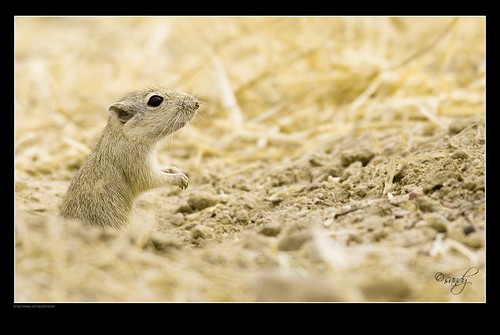 Indian Desert Jird (Meriones hurrianae)
All photographs copyright Sandeep Somasekharan. Used with permission.
Indian Desert Jird (Meriones hurrianae)
All photographs copyright Sandeep Somasekharan. Used with permission.
The Sarus blogger is finally online
 IMAGE: SARUS AND NILGAI (FROM K S GOPI SUNDAR'S SARUS SCAPES)
My dear friend Gopi Sundar has finally lifted the veil on his stupendous insight into bird behaviour. His blog 'Sarus Scape' is now online and abuzz. He tags his blog 'Random Observations of a Wandering Naturalist' but that entire line is a euphemism for what he does best. His observations are far from random - they are marked by extraordinary scientific precision. And though he may like to imagine himself as a peripatetic hobo, his journeys are anything but wanderings - well, if you and I marked an entire state into little squares and transected each one to document its birdlife, we wouldn't call that wandering. But my friend has a yen for understatement.
Enough said. Please enjoy Sarus Scape.
IMAGE: SARUS AND NILGAI (FROM K S GOPI SUNDAR'S SARUS SCAPES)
My dear friend Gopi Sundar has finally lifted the veil on his stupendous insight into bird behaviour. His blog 'Sarus Scape' is now online and abuzz. He tags his blog 'Random Observations of a Wandering Naturalist' but that entire line is a euphemism for what he does best. His observations are far from random - they are marked by extraordinary scientific precision. And though he may like to imagine himself as a peripatetic hobo, his journeys are anything but wanderings - well, if you and I marked an entire state into little squares and transected each one to document its birdlife, we wouldn't call that wandering. But my friend has a yen for understatement.
Enough said. Please enjoy Sarus Scape.
Snake
The first time I brought a snake home I was seven. More ignorant than now, and more innocent.
It wasn't the warmest welcome. I gave the folks full points for maximum vocal decibel capacity.
It turned out to be a saw-scaled viper. Didn't hurt me at all. I like to think the snake must have understood that in snake years, I was younger and meant no harm.
Subscribe to:
Posts (Atom)