
It makes itself scarce. Its call is so enmeshed in the thickets and brambles of forest undergrowth that it is part of the sound you take back with you from the jungle. But few first-time birders I have escorted on their maiden outing have come away after a good look at this fellow.
The bird in the picture is the White-browed Bulbul (
Pycnonotus luteolus). It has one of the longest and most exuberant of songs - bursting out in a rush of joyous chuckling notes. One of my early birding mentors described it to me, quite memorably, as a marble being shaken in a bottle. But look in that direction, and the stage-shy songster would have dived for cover.
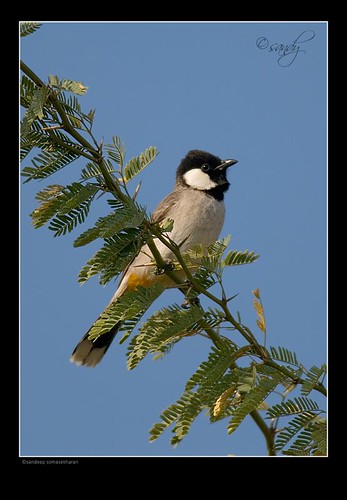
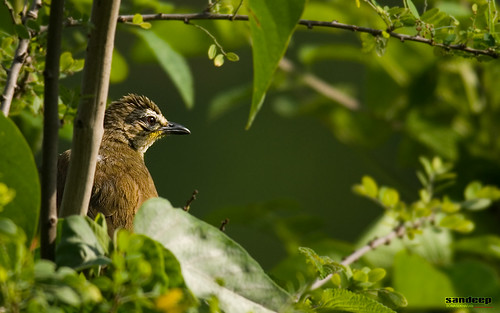
So, take a good look at this guy here and memorise the sight - the bright white supercilium is diagnostic. A crestless bulbul, unlike the Red-vented and Red-whiskered Bulbuls, this fellow's dietary habits have been observed to be similar to that of its cousins, which means it feeds largely on fruit, insects and flower nectar. When it's breeding time, the White-browed Bulbul makes a cup-shaped nest in a short tree, where it lays two to four eggs in a clutch.
So, the next time you hear that bubbly song, you know whom to look out for.
Photograph: © Sandeep Somasekharan
 Or this?


 It makes itself scarce. Its call is so enmeshed in the thickets and brambles of forest undergrowth that it is part of the sound you take back with you from the jungle. But few first-time birders I have escorted on their maiden outing have come away after a good look at this fellow.
The bird in the picture is the White-browed Bulbul (Pycnonotus luteolus). It has one of the longest and most exuberant of songs - bursting out in a rush of joyous chuckling notes. One of my early birding mentors described it to me, quite memorably, as a marble being shaken in a bottle. But look in that direction, and the stage-shy songster would have dived for cover.
So, take a good look at this guy here and memorise the sight - the bright white supercilium is diagnostic. A crestless bulbul, unlike the Red-vented and Red-whiskered Bulbuls, this fellow's dietary habits have been observed to be similar to that of its cousins, which means it feeds largely on fruit, insects and flower nectar. When it's breeding time, the White-browed Bulbul makes a cup-shaped nest in a short tree, where it lays two to four eggs in a clutch.
So, the next time you hear that bubbly song, you know whom to look out for.
Photograph: © Sandeep Somasekharan
It makes itself scarce. Its call is so enmeshed in the thickets and brambles of forest undergrowth that it is part of the sound you take back with you from the jungle. But few first-time birders I have escorted on their maiden outing have come away after a good look at this fellow.
The bird in the picture is the White-browed Bulbul (Pycnonotus luteolus). It has one of the longest and most exuberant of songs - bursting out in a rush of joyous chuckling notes. One of my early birding mentors described it to me, quite memorably, as a marble being shaken in a bottle. But look in that direction, and the stage-shy songster would have dived for cover.
So, take a good look at this guy here and memorise the sight - the bright white supercilium is diagnostic. A crestless bulbul, unlike the Red-vented and Red-whiskered Bulbuls, this fellow's dietary habits have been observed to be similar to that of its cousins, which means it feeds largely on fruit, insects and flower nectar. When it's breeding time, the White-browed Bulbul makes a cup-shaped nest in a short tree, where it lays two to four eggs in a clutch.
So, the next time you hear that bubbly song, you know whom to look out for.
Photograph: © Sandeep Somasekharan