We’ve moved! Here’s where you can find us

The Green Ogre is now at https://www.greenogreindia.org

Review : Voyage of the Turtle: In Pursuit of the Earth's Last Dinosaur

Carl Safina’s mellifluous prose evokes the beauty and mystery of the sea and its ancient denizen, the Leatherback turtle


Voyage Of The Turtle: In Pursuit Of The Earth's Last Dinosaur
by Carl Safina
Published by Henry Holt and Co.; 1st edition (May 30, 2006)
Rs 689 on Flipkart


Carl Safina is a marine scientist and the founder of the Blue Ocean Institute. This is his third book after the much acclaimed and award winning Song for the Blue Ocean: Encounters Along the World's Coasts and Beneath the Seas and Eye of the Albatross: Visions of Hope and Survival.


Safina starts his travels in Trinidad where this noble giant,  survivor of more than 100 years of evolution, is giving birth on a dark beach, and then takes us on a trip through Florida, South Carolina, Cape Breton Islands in the ice-cold waters off the Canadian coast, Malaysia, Costa Rica, Mexico and finally New Guinea – all the remaining (and sadly former) habitats of the Leatherback Turtle (Dermochelys coriacea). In the course of his travels he meets scientists, law enforcers, poachers turned conservationists, resort owners, fishing boat captains and gives us an intimate view into the life and biology of this beautiful creature – in the ocean, on land, at the moment of its first swim and washed up carcasses. What results is a compelling, passionate but honest account of the species and the mesh of attitudes, laws (or their absence), threats (including destructive fishing techniques that have depleted the oceans) and research that may eventually pull it back from the brink.


The book is full of facts and data that can come from intimate contact and close study alone. For instance, the Leatherback is the only turtle that, after laying almost seven dozen billiard-ball-sized eggs, lays another two dozen embryo-less eggs on top, their purpose yet unknown. It is conjectured that they may play a role in providing air-space on the top of the nest, stabilize humidity or protect against fungal infection.


In another place Safina writes about the failure of the initial TEDs (turtle exclusion devices) since the opening size allowed only the juveniles to escape and it took years to enforce a larger opening by law. Or, for instance, that well into the 1990s, the Japanese imported turtle shells – 30,000 kg of it (amounting to almost 30,000 adult Hawksbill turtles harvested annually) to be carved into hair ornaments for ladies – a craft called bekko.


Through his travels Safina cites several cases that underscore how difficult (and counter-intuitive) it can be to formulate a sustainable and effective conservation strategy. For example, in Malaysia, the Leatherback population has plummeted from 10 to 15 thousand adult females and 3,000 annual nesters in the 1950s to virtually zero today. For 50 years almost every egg was taken and when finally artificial incubation was tried out wrong temperature control produced either all females or sterile intersex individuals. 


In Florida, beachfront high-rises and luxury condos that adhere to a strict night-time “light curfew" offer a safe backdrop for hatchlings crawling towards the sea. The open beaches close to the towns disorient them, the hatchlings mistaking the light-polluted land horizon for the real one. Having evolved on Earth where for millions of years the horizon is the brightest pre-dawn area, for the turtles such disorientation means almost certain death. Clearly, there is no substitute for accurate scientific knowledge, more often than not gained painstakingly on the field. Romantic greenhearts take note. Throughout the book Safina succeeds in seamlessly relating the plight of the species to the larger issues and threats that plague the oceans and touches upon the other surviving sea turtles as well – the Green Sea Turtle (Chelonia mydas), Hawksbill (Eretmochelys imbricata), Flatback (Natator depressus), Loggerhead (Caretta caretta), Kemp's Ridley (Lepidochelys kempii) and Olive Ridley (Lepidochelys olivacea).


Safina’s prose is mellifluous and evokes the beauty and mystery of the sea. One of the most poignant passages in the book, just after he has described the newly hatched Leatherbacks on their first swim, full of life and oblivious to the threats that await them every single moment of their lives, summarizes the moment of extinction, “The end of a species comes as tranquilly as this gentle sunrise. There’s no final struggle, no valorous last stand or terminal flourish. Just one final puff of breath, then mere absence. No creature mourns its own passing. The grief and the consequence lie solely with us, but few feel the loss.”


The book is one of the finest on natural history I have read and a must-read. It is guaranteed to make you fall in love with the oceans and their denizens especially the large brooding  vagabonds of the blue – the Leatherback.


Reviewed by Sahastrarashmi

Le Question: What colour is the eye of the Sarus?

Seeing eye to eye with the Sarus Crane evokes a host of questions and the answers aren't exactly simple

Shashwat and I were driving along a small arterial road in Rae Bareli, checking out the pairs of Sarus Crane (Grus antigone) among the paddy fields on either side. It was the end of a relatively warm November day, and dusk was imminent. We came across a beautiful female near a clump of reeds by the roadside -- though sexes are almost alike, I could tell since it was smaller than the male, which was foraging a few metres away.

Me: What colour is the Sarus?
Shashwat: Grey, White.
Me: What is the colour of its face?
Shashwat: Red
Me: And the color of its beak?
Shashwat: White, Grey
Me: And the eye?
Shashwat: The Sarus has no eye!
The Sarus hadn’t lost an eye but we were looking into the setting sun with the clump of reeds and the bird in the foreground. Its bright red eye was hidden in the glowing red skin of its head -- you actually could not see it. I knew the eye existed and that he was only telling me what he saw. We were both right, as a Zen master might say, but he was in the "moment"; the unconditioned observer.

Odyssey to Bedni Bugyal - A Day at Didana

To derive joy from the simple act of birdwatching, all you need to do is wait, watch and listen. Jennifer Nandi reveals the Birding 101 in the third episode of her travelogue on Bedni Bugyal
A Blue Whistling Thrush, ever the skulker, trails us as we walk its wooded paths
Lots of little surprises greet us the next morning. The Pied Thrush and his companion are in full view; so are the rock thrushes, the blackbirds and the Mistle Thrushes. A new visitor to the campsite is the Variegated Laughing Thrush. A very secretive bird; keeping close to the shrubbery, it hops in and out of sight to forage on the ground. We pursue it and it flies off with a rapid squeaking ‘qweek-qweek-qweek’ -- out of sight and reach of the binoculars. 

The ubiquitous Red-vented Bulbul against a Himalayan valley
Sahastra, our group leader, has scheduled an ‘all-day birding day’ today. We walk towards the village and select a little plateau of grass overlooking fallow fields and shrubbery. It is a simple morning; but we concoct magic from it by waiting, watching and listening. There are a whole kaleidoscope of reasons to invest in an activity as simple and as magical as birdwatching. Tiny details vie for attention – is the hind-collar of the Whiskered Yuhina pale yellow or a more buttery yellow? Is the bright orange-yellow on the forehead of the warbler a field characteristic or a matter of circumstance – it could’ve stuck its head into a pollen-bearing Rhododendron blossom! On the warbler, over there - one and a half wing bars or two? Any coronal stripes? Is that harsh ‘churr’ an alarm call? It’s a warning -- a bird of prey perhaps? Or unmindful birders? In John Hay’s words, “A bird is not valued because it is ‘beautiful’. It delights by the way it exemplifies the universe working so well, so coherently, and with such endless individuality.” 

I looked at our group of men with an IT background, from Bangalore and Chennai with an urge to watch birds. I imagine that the atmosphere in their workplaces can be highly manipulative, perversely efficient. It was laudable that their concerns about wilderness were not just about making personal risk and physical exertion the hallmarks of a wilderness experience, but about falling into resonance with a system of unmanaged, non-anthropocentric relationships that can be as fulfilling as rappelling down a steep face of rock.
Didana, less than a one-mule town, was deserted as everyone was attending a wedding in the valley 
There is no denying that wilderness travel can be extremely taxing and dangerous. You can fall into a crevasse, lose your way, become hypothermic, de-hydrate, run out of food, or walk in a delirium as Bijoy will shortly so eminently demonstrate! However, the common experience of those who travel in the wild are far less violent events. They encounter the most essential attribute of wilderness – that wild lands preserve complex biological relationships that represent a gene pool vital for the resiliency of plants and animals. Surely we have an ethical obligation to provide animals with a place where they are free from being impinged upon by civilization. Moreover, we have a historical responsibility to preserve these kind of landscapes from which modern man emerged. 

Balcony Bugwatch - Love song of the Carpenter Bee

Nikolai Rimsky-Korsakov might have feted the Bumblebee in music but it is the domestic life of the Carpenter Bee that inspires a fitting paean. How about one by the Carpenters?


My wife and I had seen the Carpenter Bee buzz past us as we stole a furtive smoke on the balcony, but we never imagined that it lived there. Until, with a menacing hum of blurry wings, the walnut-sized insect drove our little daughter back into the house in a frenzy of sheer terror.

Of our two balconies, the one adjoining the bedroom is narrower and shaded most of the time by a bamboo chik curtain. For many days we had noticed a trail of fine, powdery wood dust, along with enigmatic yellow stains that stippled the floor. What might they be, we wondered.

Slowly, the curtain lifted on our little mystery.


It appeared that the bee, true to nature, favoured the circular hole of the bamboo poles that anchored the curtain. Several times during the day, we'd see it approach the hole at the far end, landing gear at the ready. Even when the curtain was lowered, the metallic blue-black flying machine would have no trouble locating it.

Now, it helps to know that the Carpenter Bee, despite its appearance, is not the same as the Bumblebee. The latter insect is social and lives in colonies but our Carpenter Bee maintains a nuclear family. Also, the Bumblebee's hairy abdomen sets it apart from the smooth, shiny bottom-parts of the Carpenter.

Heard the laugh track of the Nilgiris?

While walking in the Nilgiris, listen closely for the guffaw of the Nilgiri Laughingthrush. And treasure it, for you'll hear it nowhere else on earth
When I had first laid my hands on a Sony prosumer camera I found I could photograph birds within reach, and the target of one of my first attempts was a Nilgiri Laughingthrush, otherwise called the Rufous-breasted Laughingthrush or the Black-chinned Laughingthrush (Trochalopteron cachinnans). I first saw the bird on a trip with my parents to Doddabetta, a peak near Ooty. Kannada for 'the large hill', Doddabetta is the second highest peak in south India and the highest point in the Nilgiris.
As we walked about like regular tourists, bracing against the strong chill wind, I saw a unique bird -- with bushy white eyebrows and captivating, red eyes -- hop about on the macadam not far from the tourists. Incredibly, it didn't seem perturbed by the crowd - something you can observe only in Doddabetta.

Odyssey to Bedni Bugyal - Loharjung to Didana

Walking in the Himalaya offers the pleasure of a constant flirtation with epiphany, learns Jennifer Nandi
A stream en route to Didana from Loharjung
A morning of magic greets us. Arrogant blue skies goad us onwards. The rugged hill road from the village leads us past an anarchy of rampant secondary growth that stretches into the valley below. This riot of plant and animal life owes its fecundity to hillsides that once supported lush forests of oak and rhododendron. Sandstone country with its covering of alluvium and glacial clays evidently suited oaks and rhododendron allowing them to grow to glorious maturity. But the oak trees were much harvested to supply the British Naval construction of the 18th century. 

Sporadic secondary growth of oak and rhododendron dot the higher hills and if you closed your eyes you could hear a Blue-capped Rock Thrush pouring out its rather monotonous undulating and fluty song. It is easily identifiable being the only rock thrush with a white patch on the wing. And if you look closely enough you can see the contrasting cobalt-blue throat. The largest of the rock thrushes, the Chestnut-bellied, is common enough, perched high up on tall trees, sometimes slowly jerking its tail up and down and on occasion uttering its softer and more subdued song.
A Blue-capped Rock Thrush showing off the 'mirrors' on its wings

Life notes from a sea of green

A bad day of birding need not be a bad day with nature, not when you have a lush green paddy field to adore

Another routine morning trip to see if I could catch some birds on the wing took me to a remote corner of Mandya, along a paddy field. Skies were clear from the rain that had cleansed everything the night before, and a September sun jovially smiled upon us. But birding luck didn't. All we got to see were a few egrets and black headed ibis, and a few weavers. 

Sneaking up on them, I lost my footing and fell amidst the paddy. As I hauled up my overweight frame from the (thankfully dry) paddy field floor, something tiny caught my eye. This orange insect clung to a paddy leaf, the tip of which held a glowing crown -- a tiny drop of water. It held onto the leaf, as if guarding the drop from being stolen, its eyes fixed on it.
Intrigued, I looked around for more and was rewarded by scores of other insects. No two were alike. A tiny white moth sat on another blade, wings spread as if in penance.
Another orange moth sat on a straight blade, looking down, possibly pondering over life's intricacies.
As if to test its resolve, Providence let a gust of wind blow another blade across, giving an illusion to the moth that it is on the crossroads of life. Yet, it preferred to stick to its blade.
More careful inspection showed many other life forms. A pied paddy skimmer dragonfly, a robberfly, a ground skimmer dragonfly, and some other teeny rock stars I couldn't identify. As I spent time observing and clicking them, this tiny ladybug materialized in a sea of green.
My day was made. Birds or no birds.

Text and photos by Sandeep Somasekharan

No porking please, we're boared

Thoughtlessly constructed and idiotically placed dustbins in a tiger reserve can turn a well-intended sanitation initiative into a howling travesty. How do you keep wild boar from scattering the trash you've conscientiously thrown away?


It was a beautiful afternoon in Bandipur. The sun was tucked into the skirt-folds of dark, purple-rimmed clouds and so many busloads of busy tourists had made sure to fill up the dustbins (and places within 500 metres of them) with all kinds of interesting garbage. There were fruit peels, corn cobs, half-eaten takeaways, packets of crisps with neglectfully wasted leftovers, et cetera. To perform a complete inventory, you needed to stick your head into the dump and rummage hard. Only a creature with a snout deserving of this luxury could get to the bottom of this mysterious treasure trove. 


Along came a pig. Not any ordinary pig. This, a large female wild boar (Sus scrofa cristatus) fattened habitually on human excess, sauntered by, snorted and regarded the dustbin with greedy curiosity, snivelling all over it. Its object of interest was a large, deep bucket of concrete, larger and heavier than itself, and made even more so, encumbered as it was with aromatic treasures.


As Arun and I watched, the pig sniffed around, tried to knock over the bin, and then gave up. Then the sow walked a short distance away and charged at the dustbin -- her belly-girdle of teats a-swinging -- and knocked it over. Satisfied with her effort, she tucked into the buffet that was now spread at her feet. Talk of pearls before swine!


A younger male sashayed over, eager to gate-crash her party. He tucked his snout into the lopsided bin, but the sow would have none of it. She grunted sharply and nudged him -- a little too hard for comfort. The aspiring usurper, whose relationship with her we could not quite fathom, crouched submissively and let her continue feeding. 


She munched away, undisturbed, while the other pig remained in position until the dustbin's original claimant had eaten her fill. Then, without ado, the sow walked away, leaving the bin to the younger pig.


And that's when we looked up and saw the sign.


Okay, we get the message.


So, how does one get wild boar to stop the annoying habit of scattering the litter that we have so conscientiously disposed of in dustbins? Simple: make the bins taller, of course, as the thoughtful officials at Parambikulam have done. 


Don't let their pitiable deprived expressions melt your heart -- or your resolve to dispose of garbage responsibly. Dustbins in a forest are for humans, not for wild boar.


Text and photos: Beej

Odyssey to Bedni Bugyal - Part 1

Traipsing in Lord Curzon's footsteps, we embarked for Bedni Bugyal knowing little of what to expect, and least expecting what was in store for us...


Editor's Note: In April-May 2007, six of us made a trek to the Garhwal Himalaya. Sahastrarashmi, Sunita, Jennifer, Satish, Rajeev and Bijoy walked from Loharjung to Bedni Bugyal, then descended to Wan from where we walked to Kunol and then journeyed onward to Nandprayag. For many of us it was the most intimate encounter with the beauty and power, the fury and the sagacity of the elements in the Himalayan microclimate. Jennifer Nandi wrote a penetrating account of that journey shortly afterward and shared it with us. It has been salted away in our inboxes and archives for a long time. We thought it should come out for air. Serialised over the weeks to come, Jennifer's account of the trek to Bedni Bugyal will appear on Saturdays. Make time for weekend reading. Here's part 1:
A great wall of permanently snow-capped mountains rises beyond Bedni Bugyal
Part 1 - Loharjung

Walking down the platform at Old Delhi Railway Station and trying to keep a wary eye out for the coolie burdened with my baggage, I fail to see a gesticulating hand wallop me in the face. The man shields his mouth apologetically and I smile a weak smile and walk on. I can still see, but there’s something amiss. I’m not quite sure -- until my specs fall off my face!

"Well, here’s a blind beginning to a Himalayan trek," I think, while I pull out my prescription dark glasses. On the train, none of my newly met fellow trekkers asks, “What’s with the glares at night?”

It was going to be a very long night to Kathgodam -- a reservation faux pas ensured we had one berth amongst the six of us! Sunita and I had age, gender and shamelessness on our side and so we sequester it for our sleeping space. The unearned penalty of sleeping on the floor and in linen bunkers falls to the four gentlemen! The station rears itself out and we are off. The lodestone of an adventurous attitude deeply planted within me shifts and I know that now there is no looking back.
Wheat fields en route to Loharjung
For the uninitiated, a trip into the Himalaya is merely to enumerate its thousand quirks or to act as a scribe. But the journey is always too full of diversions, digressions and distractions to merit such commonplace attention. Years of excursions into the Himalaya finely hones one’s spirit to search for yet another way of looking at the landscape. 

Where does the beauty of India reside? In the contrasts between its regions. And in the multiplicity of those regions. It was to such multiple contrasts of scenery that six of us -- Sahastra, Satish, Bijoy, Rajeev, Sunita and I -- endeavoured to climb part of the old pilgrimage route known as the Raj Jaat Yatra; the same route that King Yashdhawal’s ill-fated royal entourage with queen and nautch girls undertook over 600 years ago to the glacial shores of mysterious Roop Kund. Victor Banerjee’s award-winning film Roopkund and the Splendour of Garhwal was based on this story. A route known for its bad weather, thunder and lightning, of people perishing in cloudbursts…

Our trail would take us from Mundoli Village, across the Loharjung Pass to Didana, along the ridge of Ali Bugyal to Bedni Bugyal. On our return we would trek down to Wan and then on to Kunol, further downhill to Sitel from where we hoped to secure a vehicle to take us to Ghat and beyond to Nandprayag. We would have to make it in time to catch the train at Haridwar. 

But first, we must undertake a nine-hour gut-wrenching car journey through crowded Himalayan towns of diminished diversity. Here was a monoculture if ever there was one -- brick-and-mortar constructions built intrusively, pushing the uniformity of cement into every corner of the land where there should be rock or stone. How easy it is to obscure the character of our land by simply showing a complete disregard for the past, an ignorance of context. Are we not aware that in the fragility of a high-energy environment such as that of the Himalaya, such constructions have the shelf life of a banana!
The trail to Didana
How many of us travelling in the mountains feel compelled to be aware of the monumental history contained in the rocks? The immutable character of our country is governed by its geology, and determined by the rocks. This is an exciting notion. It means that events that happened hundreds of millions of years ago still control the lie of the land and the plants that grow on it. Those events underpin the natural history of our land – the history of the plants, animals, insects, and birds. This is the hidden landscape. Knowing this can enrich one’s awareness of our extraordinary past.

The first half of our car journey takes us through the Shivaliks; foothills formed as detritus and sediment from the rising Himalaya were deposited in a skirt at the base of the growing chain. These sediments were themselves up thrust in the last major folding event as the Indian plate pushed and ground against the Eurasian continent. This narrow skirt of the Himalaya’s own waste is about 2,000 kilometers long, forming a continuous chain. 
A blooming rhododendron beside the paved road to Wan, from which we descended into a shepherd's trail toward Didana
The now-degraded Shivaliks have an interesting ecological history. Prior to the Anglo-Sikh wars of 1845 and 1849, the hills were covered with thick acacia and pine forests. The lush tangle of undergrowth on the forest floor was home to a variety of pheasant species and deer. Crystal clear streams drained this region. Until recently, in the valley of the Ramganga in Corbett National Park it was still possible to observe species which were once fairly prevalent across the entire Shivalik belt. Thick grasslands clothed the valley floor and verdant Sal forests, the slopes. Goral could be found on the precipitous slopes, tigers in the jungles and the rivers were flush with Mahseer and the occasional Gharial.

Sadly, once the Sardars and Rajahs who owned the hunting land in the Shivaliks were evicted and the forests handed over to the villagers free of any regulatory mechanism, tree-cutting and overgrazing stripped the area. Heavy rains, poaching and a slew of ill-conceived forest policies did the rest. The loosely cemented alluvial soils of clay conglomerates were washed away. Now, under constant threat of erosion and floods, most of the Shivalik regions are a scene of dusty, rolling topography, knife-edged ridges, devoid of vegetative cover.

Northward, the Shivalik Range abuts against a 120 km wide massive mountainous tract, the Lesser Himalaya. Somewhere along the route we leave this seismic tremor and earthquake-prone foothills zone and gradually ascend the greatest concentration of mountains on earth. The topography alters. Persian Lilac and Sal give way to Horse-chestnut in full bloom. Scarlet blossoms adorn pomegranate trees and the apple has found its way here far from its ‘centre of diversity’ in the forests of Kazakhstan.
Leaving Loharjung. The meadow of Bedni Bugyal is tucked into the valley just shy of the farthest visible peak on the horizon
Late in the afternoon the car journey mounts its toll. Our empty stomachs churn and we swallow bile. We are all slightly nauseated but share aloo parathas and look for rainbows in the rain-cleared sky. If only we knew that that was going to be our last meal before we reach Didana, 24 hours later. In the GMVN room that we share in Loharjung, we rearrange luggage, pocket next morning’s ration of two energy bars each, and prepare for the trek. Sahastra, having located some super glue enroute, uses it and Bijoy’s digital dexterity to fix my spectacles for good! 

We hire four ponies to carry our baggage and a reed-thin man implores us to hire him as a guide. He is unwashed, unkempt with his meager belongings tied up in string, attached to his back. He reeks of a combination of beedi and bourbon, a local brew. Sahastra's soft heart hires him in a jiffy. The Brainfever Bird calls all night long living up to its ill-gotten name.


Photographs: Sahastrarashmi and Beej

Encounter: Looking up the Moose's nose

Someone once told not to look a gift horse in the mouth checked the dental signature of a Moose instead and discovered 12 molars, 12 premolars, 6 incisors and 2 canines. Oh dear, a moose is actually a deer, as Ogden Nash evidently knew!

Confronted by a mouse or moose,
You turn green, she turns chartroose.


- OGDEN NASH
From "GOOD-BY NOW OR PARDON MY GAUNTLET"


My first encounter with the Moose (Alces alces) was in the Rockies in Colorado. It was mid-September and Fall was round the bend. We chanced upon a bull while driving through the Rocky Mountain National Park. As we clicked pictures it was joined by a cow.

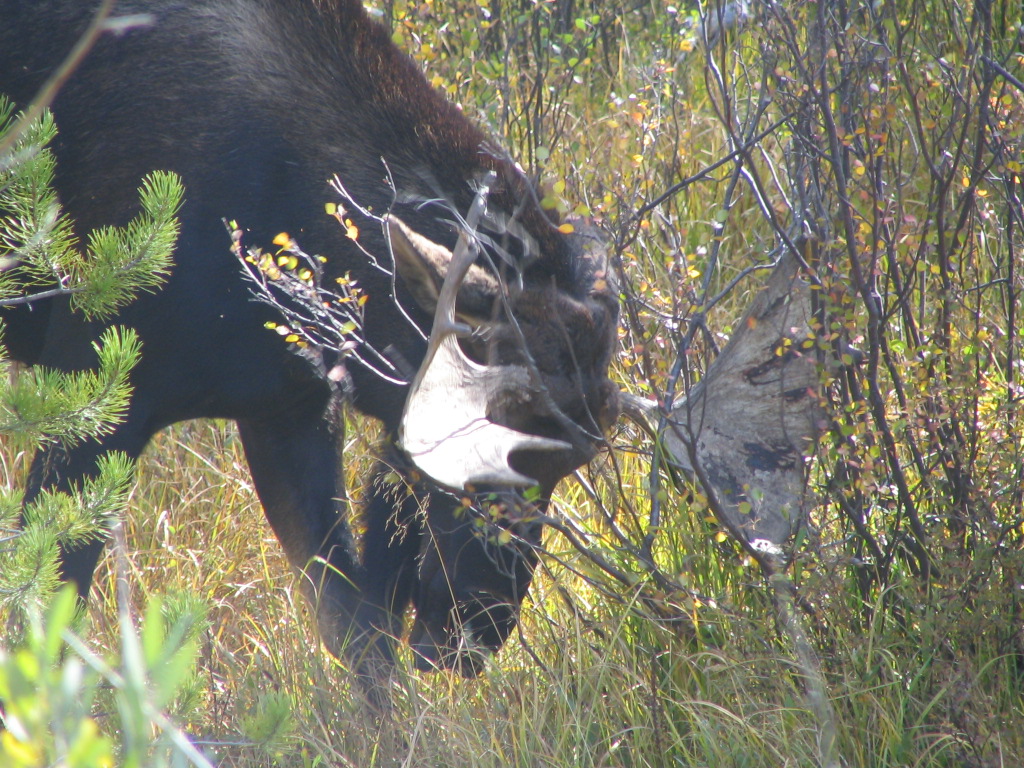
Moose rubbing its antlers against the brush signifying the beginning of the breeding season
Four years later I encountered the moose again in and around Denali National Park, Alaska, around Labor Day. Fall arrives early in the northern reaches and the park officials warned that it was rutting season for the moose and any close encounters with a bull were fraught with risk as the beasts are most aggressive then. We saw a few moose from a distance (not including a skull at one of the interpretation centers).

Moose are the largest deer and often the personification of raw power. They are even considered dim-witted if I were to go by a character in a comic series I used to read two decades ago. They are widely distributed in the northern reaches of USA, Canada, Scandinavia and Siberia. A race known as the Shiras Moose is found in the higher altitudes of America's lower latitudes. Once the bull moose has mated it sheds its antlers to conserve energy for winter and regrows them next season. Cows do not sport antlers.


A bull moose
Someone once told not to look a gift horse in the mouth decided to check the dental signature of the moose instead and discovered 32 teeth – 12 molars, 12 premolars, six incisors and two canines. Add to that formidable palmate antlers and a thousand pounds in body weight, and we have a beast we do not want to mess with. The moose also has a pendulous appendage called the “bell” -- a loose flap of dewlap-like skin that hangs below its throat. 

Moose are herbivores and their natural predators are bears and wolves. They have been hunted and humans have found use for everything from their meat to their scat -- which, believe it or not, is often used in making jewelry.

Natural predation and game hunting has had little impact on moose population and this majestic beast continues to roam the northerly landscapes of the northern hemisphere.


And just by the way, Ogden Nash, who wrote those lines about the moose, also wrote this one about the elk, in which, of course, he also referred to the caribou -- and the moose! 


Enjoy!


Moose makes me think of caribou,
And caribou of moose,
With, even from their point of view,
Legitimate excuse.
Why then, when I behold an elk,
Can I but think of Lawrence Welk?


Text and lead photo: Anand Yegnaswami
Other photos: Wikimedia Commons

Wordless Wednesday: Babbler thumbs its nose

Photograph: Sahastrarashmi
Enjoy all Wordless Wednesdays

Immersing Ganesha - An ode to broken things?

The Chilean poet Pablo Neruda may well have been talking of the immersion of Ganesha, thinks Sahastrarashmi as he presents a tableau of pictures from the beach at Pondicherry


Let's put all our treasures together
-- the clocks, plates, cups cracked by the cold --
into a sack and carry them
to the sea
and let our possessions sink
into one alarming breaker
that sounds like a river.
May whatever breaks
be reconstructed by the sea
with the long labor of its tides.
So many useless things
which nobody broke
but which got broken anyway.


~ PABLO NERUDA
From Ode to Broken Things


Photographs by Sahastrarashmi
Text from a poem by Pablo Neruda

Heads and Tails: The Snake and the Lizard

Pankil Desai recounts a most amazing and suspenseful encounter between a Green Vine Snake and a Calotes lizard


It was a regular sunny day and I was in my hostel room at the National Institute of Technology Karnataka, Surathkal. At around 11:30, I got a call from an unknown number informing me of a snake spotted nearby. It was not new for me to get such a call. I had volunteered with the Gujarat Society for the Prevention of Cruelty to Animals (GSPCA) earlier and many people knew that I rescue snakes from human-reptile conflict zones. Since the snake was in the open, I carried my camera hoping to capture some nice portraits.


I was delighted to see it was a Common Vine Snake (Ahaetulla nasuta) -- it was the first time I was seeing an adult up close. Going closer I saw that it was holding a Garden Lizard (Calotes versicolor) by the neck. 
Trying to capture the scenario from all possible angles, I tried to get as close as possible to the snake without disturbing it. Under no circumstances did I want it to abandon its prey. I dispensed with my kit lens and put on a 28-135 mm lens to get better close-up shots without the risk of scaring away the snake.
I wondered why the snake had not yet started swallowing the lizard though its prey had stopped moving for the last ten minutes. Curious, I carefully moved some twigs for a better look. I was amazed at what I saw. The snake had a firm grip round the lizard’s neck; at the same time the lizard was holding on to the Vine Snake’s tail. I had never before seen anything like that!
The snake desperately tried to free its tail; at the same time it tried not to loosen its grip on the lizard. I think the lizard was very much dead by this time but its jaw muscles had contracted in its bite and remained so even in death. The snake had even started to bleed from the bite wound inflicted by the lizard. The struggle to release its tail from the lizard’s mouth went on for over one and a half hours. 
Finally, after a great struggle, the snake freed its tail and pulled the kill into the nearby bushes to enjoy a well-earned and much-deserved meal. 


Pankil Desai is an engineer with Linde engineering in Vadodara, Gujarat. After his BE, he completed his M Tech from National Institute of Technology, Karnataka in Surathkal, near Mangalore. During a year's break between degrees he volunteered for the Gujarat Society for Prevention of Cruelty to Animals (GSPCA). His work included feeding injured birds and animals, administering basic healthcare, as well as rescuing reptiles from human conflict zones and releasing them back into the wild. During his stint there, he honed his affection for snakes and developed an interest in photographing them.  


Text and photos: Pankil Desai 
Love/ hate/ creeped out by snakes? Enjoy all our snake posts

On the Wing: Black-shouldered Kite

An attractive raptor even while perched, the Black-shouldered Kite is hard to forget once spotted hovering

For a long time after I learned to identify this bird, also called the Black-winged Kite to differentiate it from the Australian  Black-shouldered Kite (Elanus axillaris), I did not witness its flight. During the winter dusk near my village in Rae Bareli, I always saw it hover over potential prey that it had spotted on the ground. All you needed was to scan the horizon and, eight times out of 10, you could spot this bird hovering. The kite hovers over open scrub or grassland patches with its wings held high up and with slow wingbeats, beginning quite high up and gently gliding lower before it starts hovering again. This, presumably, is a tactic to get closer to its prey and fix its location on the ground. Sometimes the bird shifts sideways while still hovering. The action is repeated 2-5 times after which the raptor either swoops down or flies off to locate another quarry - usually lizards and rodents.
Its flight is similar to its hover -- gentle wing-beats punctuated by long glides. On this occasion, I first saw it perch on a tree stump as the wind gently caressed its soft white down feathers. It fixed me with its sparkling red eyes and after a beat took off gently, skimmed the tops of the thorny acacias and flapped out of view.
This elegant raptor, with its diagnostic grayish-black shoulder patch and red, owl-like iris, is found throughout India except for the country's extremities.

Text and photos by Sahastrarashmi
Read all posts in our On the Wing series