We’ve moved! Here’s where you can find us

The Green Ogre is now at https://www.greenogreindia.org

What Little Grebes learn at Sunday School

Family entertainment for this family of Little Grebes might be, in all seriousness, a training session for the future. Notes from a morning well spent...


Early one Sunday morning, a fortnight after I got my new lens, I headed out to Madiwala Lake. Roaming around, I encountered a family of four Little Grebes (Tachybaptus ruficollis). The chicks, more like subadults, were almost adult size; only their plumage was different. I watched the adults do their usual stuff -- swimming, followed by quick, silent dives for food. The chicks also followed suit.


Adult grebe displaying
As the grebes were quite shy, I sat myself down beside the water so that they got used to me. Although they kept their distance, they went about their business. Suddenly, one adult raised itself up, called and, literally, started running over the water. A chicks immediately responded by doing just the same. 

The adult picking up speed
The adult bird was always first to start the sprint after a short, quick call, with the chick in hot pursuit.  They would run rapidly for a distance and then slide back onto the water on their bellies before coming to a stop.

End of the sprint
This behavior continued for a while, with multiple 'walking sessions' extending for almost half an hour.


The grand finish - the belly slide
Only one adult and chick exhibited this particular behavior; the others kept to themselves all the while.

The adult watches the chick come to stop
All I could assume was that this was some kind of training session for the chick. It was a grand spectacle to behold, with the two birds beating their wings and running together over the water, splashing it in every direction!


Text and Photos: Arun 

Encounter: God, Darwin, Ali and the Blue-capped Rock Thrush


In the foggy ruins of time, most memories can get blurred, or muddied entirely. But not a birder's remembrance of a cherished bird. The story of me and the Blue-capped Rock Thrush involves God, Darwin and Salim Ali -- playing significant bit-parts.


Back in the day when I believed that God had created the world, I honoured periodically a votive my mother had made to send me with my father to Sabarimala, a hill shrine in the southern Western Ghats reached after a half-day pilgrimage on foot from a check-dammed river that curls sluggishly at its feet. I loved the vagabonding, and the uncustomary walk in the forest. It’s been two decades since I last went. That temple – now among this land’s richest, and visited by 300,000 pilgrims daily in the season – occupies more acreage than it did then, what with the permanent habitation enveloping it. That sorrowing forest river, Pamba, swirls now with plastic, detritus and the excrement of pilgrims too blinded by devotion to consider what their ecological footprint has stamped out. It’s another matter altogether that somewhere between then and now Messrs Darwin, Sagan and Dawkins interrupted my religiosity with questions of pressing urgency, eroding it first with guilty discomfort but eventually washing it away albeit without disrespect to the forces worshipped by those who had brought me up. 


That said, some nights when I attempt to command my mind to sleep as effortlessly as I did as a child, the temple and the forest surrounding it surface from my subconscious, embellished with shards of innocuous untruth, deliberate fictions that soothe and console the pangs of losses irreparable in this lifetime.


When that comforting reverie takes hold, I feel the moist trampled earth comfort my aching bare feet, the damp of the forest condense on my shirtless back, the overwhelming scent of vegetation. I hear a faraway chuckle, then see the bough of a forest tree bend and swing as it receives the crashing burden of a leaping Malabar Giant Squirrel. I always hear birdsong – the jubilant squeals of Hill Mynas, the sweeching of Scarlet Minivets, the percussion of White-bellied Woodpeckers, the squabbling of Rufous Babblers, the trilling of Chestnut-headed Bee-eaters...


Sans field guide or binoculars, my birding was incidental and a touch surreal. Sometimes the shadowy shape of a bird would announce its presence urgently, fleet past and melt into the jungle. Malkoha? Drongo-Cuckoo? I’d peer, I’d dither, but I could not afford to linger: A pilgrim must stick with his flock. Thus, many sightings were approximated, assumed and, not unwittingly, concocted.


Yet, one encounter I remember clearly. It was December, a few weeks before Makara Jyoti, and our pilgrim party was camped in the muggy shade of a tin-roofed shelter, open on three sides, with the bare ground for a floor. Gruel was cooking on an open fire. Robber-flies were hunting winged things infatuated with my fragrant preteen sweat. Bitten by both, scratching, and tolerating the misery of that tropical afternoon (and dreading the imminent night that would tempt airborne roaches out of uncharted crevices), I gazed longingly towards the tops of trees in the forest verge that began about twenty metres from the shack.


Jungle Crows, sparrows and mynas abounded. Red-whiskered bulbuls overreached to filch morsels. As I watched lethargically, an unfamiliar bird flew into view. It was smaller than a myna, dull, slaty-blue with a rusty brown breast. It lingered, unafraid, doing nothing. It just perched there on the steel beam and looked idly about.


My birder’s eyes, schooled on Collins and field guides of suchlike Imperialistic abstraction, tagged the bird as a thrush. I noticed the aspect, the overall blue appearance, large black eyes, rich rufous chest and belly, white patches on the wings, and the bluish grey head. I watched the bird for a good five minutes before it flew away into the forest. I didn’t see it again until I embarked on informed birding a few years later. I made a mental note then and later an entry in my diary: “Blue-headed Thrush”.


In 1989, when I got my first legitimate field guide – Salim Ali’s 'The Book of Indian Birds' – this was the first bird I looked up. Turning the page feverishly, I was pleasantly surprised to discover that I was almost correct. This was Monticola cinclorhynchus, the Blue-capped Rock Thrush.


Every time I see the Blue-capped Rock Thrush – and I have seen it frequently in southern India in winters and in the Himalaya in late spring and early autumn – I am reminded of myself at twelve, a scruffy, itchy pilgrim gazing in rapture at a sprite, a vision, a gift of the forest.


Thank God, or whoever is in charge, for that epiphany.


Text: Beej
Photo: Sandeep Somasekharan


Read all Encounter posts

Two hoots in a deserted quarry

My love of owls has made me peer into abandoned quarries, tree hollows, rafters of old barns, and dilapidated houses. Last year, I watched three Indian Eagle Owl chicks grow from featherballs to subadults. We waited a whole year to publish this report, assured that they are now relatively safe


In India, where kids grow up with superstitions whispered into their ears, owls are much maligned. An owl hooting at night is said to bring death. Barn owls (Tyto alba) fetch lakhs in the black market as they are believed to have magical powers that aid in black magic. And some say if you starve and beat an Indian Eagle Owl (Bubo bubo bengalensis), it will start talking like a human and predict your future. For a nature-watcher, however, these hunters of the night are graceful and elegant. And the more you watch them, the more you fall in love.
the beauty with large eyes!
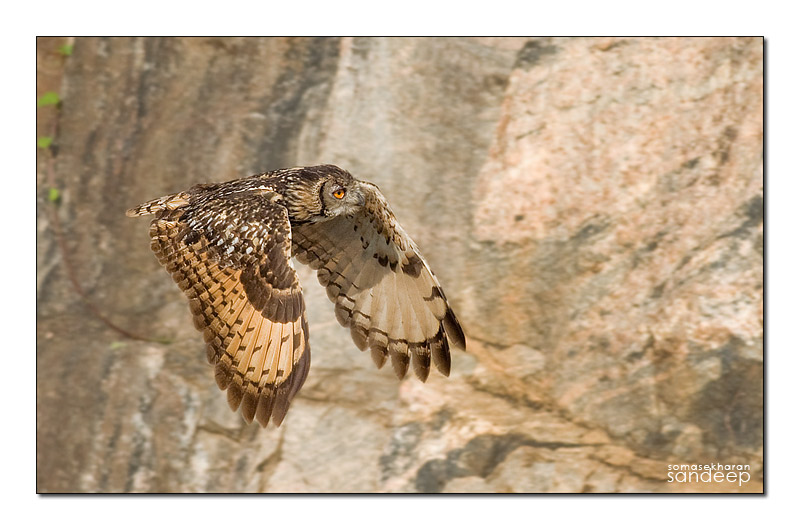
My love of owls has made me peer into abandoned quarries, tree hollows, rafters of old barns, and dilapidated houses. In one such quarry in the outskirts of Mysore I saw a fully grown female Indian Eagle Owl, which perched on the least noticeable ledges and watched us with her large, all-perceiving eyes. The spell she cast on us was unbreakable, so much that we continued to pay her frequent visits.


Generally she would be quite shy, taking off to distant inaccessible corners of the quarry if we got close. But on one visit in January last year, she didn't leave her perch, however close we approached. The ledge, though, was inaccessible - it was about 10 feet high and about 7 feet away from the edge of the deep rainwater pool at the bottom of the quarry. We imagined the reason for her perceived acquiescence was that she might be nesting. We left her alone.
Momma squints a warning
A few weeks later, in February, we returned. The mother was nowhere to be seen. Scanning the ledge carefully corroborated our guess: three tiny feather-balls. My heart thumped. The sun was coming up, and the chicks were pushing against the farthest corner of the quarry wall, seeking protection from the early morning sunlight that was now turning harsh. The nest was a humble setup -- a ledge with sand at the bottom and some grass growing at the edges. Mommy showed up presently, her stern stare radiating a warning: “Keep off!”

Huddled in the nest and vulnerable.

Momma plays sentinel

When we next visited the quarry a month later, in March, we couldn’t spot any chicks. Dismayed that they might have died of illness or fallen to predators, we prepared to leave when we spotted a chick behind the grass stalks that jutted out of a ledge. It appeared to be three times larger than we had last seen it. Another sat a few feet away on another ledge. There was no sign of the third (we never saw it again). Mommy occupied another ledge, watching us intently with the same stern schoolteacher expression. Since the chicks were on a different ledge from her, it was pretty obvious that they had started to fly.
Well concealed

And the second chick on another ledge
Our next trip to the quarry happened only in May as something or the other interfered with our plans. All we saw were two adults: The larger mother and the other was probably one of the chicks, which had by now grown large enough to be on its own. The second chick had probably left the quarry (or maybe it was dead -- we would never know), and I had a feeling that I would not see this one for long either.
The little one takes flight...

The last glimpse that I got of the young owl
As expected, on later visits we found only the mother owl. Since Eagle Owls are voracious eaters and require a large area to hunt in, it is likely that the grown chicks had left to set up their own fortresses elsewhere. I do think about them once in a while, wondering where they would be now, whether they managed to survive and found happy hunting grounds of their own beyond the reach of superstitions or predators. 


After all, when babies grow up before your eyes, you get attached to them!


Further reading:


  1. An excellent technical documentation of Eagle Owl chicks [PDF], by Eric Ramanujam and T Murugavel, is available at the Journal of Threatened Taxa website. 
  2. Sad, Wise Eyes, an article about owl trafficking by Shruti Ravindran, appeared in the March 2009 issue of Outlook magazine.


Text and photos by Sandeep Somasekharan


More on The Green Ogre:


Read more about Indian Eagle Owls and Barn Owls 
Read more about threats to Mysore's scrubland habitats
 

What's cooking in Khichan?

Journeying in another Green Ogre's footsteps, this wild crane chase off the beaten track culminated in an immensely rewarding avian spectacle. The Demoiselles of Khichan are alive and well, and numerous and beautiful as ever!


The Demoiselles of Khichan

Heading from Jodhpur to Jaisalmer we took the road less travelled towards Phalodi. You don't have to be born with a compass in the head to realize that the route you are taking is circuitous. Yet, our quest justified this digression. Fewer tyre treads had ensured the roads were in better shape, yet it was not our ride that purchased our concentration but the scenes outside. Though this was not my first visit to a desert, the Thar compelled us with a different sensuality, dotted as it was with settlements of thatch-roof huts (called jhopdis). 


Desert Cafe on the way to Khichan

Catching our attention from time to time were Black Shouldered Kites, Indian Rollers, Grey Francolins, Shikras and Grey Shrikes. We passed camels feasting on acacias, which evoked the question (to our driver Kailash): "Yeh oonth paltu hain ya jungli?" (Are these camels domesticated or wild?), to which his answer was always in favour of the former. 


Camels were not the only mammals we saw. There were Chinkaras aplenty at one desert enclave before Osiyan; we spent a quarter of an hour with the herd getting pictures. We passed Osiyan and its famous Jain temple, a desert cafe, more camels, more questions on their social life, more curt responses from Kailash and one final, all-settling retort: "Yahaan sirf paltu oonth miltein hain!" (You only get domesticated camels here!). Kailash had presented an iceberg that wrecked my interest in the ship of the desert.

A Chinkara on the way to Khichan
We opened packets of savories and I reflected on the reason that had brought us on this path. A few years ago my good friend and fellow Green Ogre Sahastra had visited a little-known village in Rajasthan, Khichan, famous for the flocks of Demoiselle Cranes (Anthropoides virgo) it hosts every winter. In a two-part post published on this blog he had piqued my interest in this spectacular avian congregation (whetted by the fact that the species had been christened by Queen Marie Antoinette herself). While I firmed up my itinerary I got yet another reminder from Sahastra: "Don't miss Khichan." And so we sped north by northwest while our eventual destination lay northwest of Jodhpur. A signpost for Khichan pointed right and a sense of guilt crept in for I had dragged my friends along on this wild crane chase. However, I was confident that we would take back something special from this detour.


A Nilgai showed up on the pale arid patch as we arrived close to Khichan and soon we heard the clamour that the flock of Demoiselles presented. Stepping out of the car for better shots, I saw a flock hurriedly take off and then turn back and land. Thrilled, I counted 50 to 70 birds and went trigger happy on the shutter release. Our driver said there were more ahead. Up ahead was a water body, beyond which was a larger flock of Demoiselles with smaller flocks joining them every few minutes. Circumnavigating the water body we got closer to the flock and my mental algorithm kicked in, giving me an estimate ten times the previous number.
A growing flock of Demoiselle Cranes
I had never come across such a large gathering of any living species, not even ants or termites, and it appeared that the cranes weren't done gathering. Tiny specks appeared on the horizon, growing in size. They assumed the shape of a line, then a triangle, then descended towards the field with vigorous, almost violent flapping of wings in the manner of air brakes, hopped and settled as drops in that ocean of grey. More cranes joined the flock in coordinated victory formations. The awe-inspiring atmosphere thus created might have seemed to some octogenarians like a repeat of the Battle of Britain with the RAF and Luftwaffe squadrons swarming the sky for aerial supremacy. 
An approaching cloud of Demoiselle Cranes


And they kept coming....
A chat with young Jethmal from the village taught us that there are four such large water bodies in Khichan. At the appointed time, 10 AM, the birds arrive to feed at the feeding house, where they roost. Jethmal said the birds were fed 10 to 15 quintals of grain a day. 


We turned back to get more pictures of the cranes while maintaining a respectful distance in order to avoid disturbing them. Some of the cranes acted like sentries -- they formed the front line of the flock and seemed edgy. I nicknamed one Long John Silver as it was missing a foot. The last thing we wanted was an alarm call from one of these lookouts. We couldn't have enough of the sea of grey at Khichan, yet we had a schedule to keep up. The numbers kept swelling and my last estimate was about two thousand cranes in the area, though more of them were still flying in. 
Flying in formation


Long John Silver, the crane without a foot
As we were leaving, a group of foreign tourists arrived. Indeed, the Demoiselle Cranes had put Khichan on the tourist map. I won't be surprised if more and more wayfarers choose the road less travelled from Jodhpur to Jaisalmer via Khichan. Promising to return, I left for Jaisalmer.


The platform in the background from where tourists can enjoy views of this magnificent congregation
Text and Photos: Anand Yegnaswami