 “Eye, gazelle, delicate wanderer,
Drinker of horizon’s fluid line.”
– Stephen Spender
Very near the end of a long, fruitless afternoon tailing invisible bustards in Naliya grassland of Kutch, we were in no mood to savour the sunset muddying the windmill-stippled horizon. Forget the fact that we had, during that day, picked out chestnut-bellied sandgrouse camouflaged among the tinder-dry tussocks. Or watched a jungle cat hunt a spiny-tailed lizard. Or, as dusk neared, blinked our eyes to the silhouettes of nearly fifty or so Pallid and Montagu's harriers settling down to roost in the grass.
Such selfish ingrates!
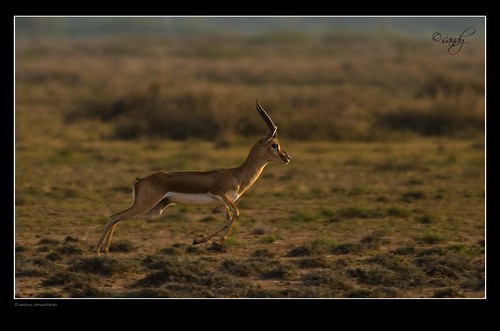
But then, our eyes were drawn to a troika of little ungulates chasing each other in single file across the yellow grass. The Chinkara or Indian Gazelle (Gazella bennettii), more of a newsmaker for its association with a certain trigger-happy Bollywood hunk. We saw them on more than one occasion, and always in groups of three - we couldn't quite ascertain if the ménage à trois was the regular marital arrangement with the Chinkaras, or if they were just respectable double-income one-kid family parties.
Males are slightly larger than females and have longer, thicker horns. Mostly they trot, but when approached they break into a light, easy lope that chews up the miles faster than you can count them.
The dipping sun lit this fellow nicely, gilding his fawn coat to a glaze as Sandy's shutter whirred and clicked greedily. Something to remember the evening by.
Photo copyright: Sandeep Somasekharan. All rights reserved
“Eye, gazelle, delicate wanderer,
Drinker of horizon’s fluid line.”
– Stephen Spender
Very near the end of a long, fruitless afternoon tailing invisible bustards in Naliya grassland of Kutch, we were in no mood to savour the sunset muddying the windmill-stippled horizon. Forget the fact that we had, during that day, picked out chestnut-bellied sandgrouse camouflaged among the tinder-dry tussocks. Or watched a jungle cat hunt a spiny-tailed lizard. Or, as dusk neared, blinked our eyes to the silhouettes of nearly fifty or so Pallid and Montagu's harriers settling down to roost in the grass.
Such selfish ingrates!
But then, our eyes were drawn to a troika of little ungulates chasing each other in single file across the yellow grass. The Chinkara or Indian Gazelle (Gazella bennettii), more of a newsmaker for its association with a certain trigger-happy Bollywood hunk. We saw them on more than one occasion, and always in groups of three - we couldn't quite ascertain if the ménage à trois was the regular marital arrangement with the Chinkaras, or if they were just respectable double-income one-kid family parties.
Males are slightly larger than females and have longer, thicker horns. Mostly they trot, but when approached they break into a light, easy lope that chews up the miles faster than you can count them.
The dipping sun lit this fellow nicely, gilding his fawn coat to a glaze as Sandy's shutter whirred and clicked greedily. Something to remember the evening by.
Photo copyright: Sandeep Somasekharan. All rights reserved

Encounter: Chinkara or Indian Gazelle
“Eye, gazelle, delicate wanderer,
Drinker of horizon’s fluid line.”
– Stephen Spender
Very near the end of a long, fruitless afternoon tailing invisible bustards in Naliya grassland of Kutch, we were in no mood to savour the sunset muddying the windmill-stippled horizon. Forget the fact that we had, during that day, picked out chestnut-bellied sandgrouse camouflaged among the tinder-dry tussocks. Or watched a jungle cat hunt a spiny-tailed lizard. Or, as dusk neared, blinked our eyes to the silhouettes of nearly fifty or so Pallid and Montagu's harriers settling down to roost in the grass.
Such selfish ingrates!
But then, our eyes were drawn to a troika of little ungulates chasing each other in single file across the yellow grass. The Chinkara or Indian Gazelle (Gazella bennettii), more of a newsmaker for its association with a certain trigger-happy Bollywood hunk. We saw them on more than one occasion, and always in groups of three - we couldn't quite ascertain if the ménage à trois was the regular marital arrangement with the Chinkaras, or if they were just respectable double-income one-kid family parties.
Males are slightly larger than females and have longer, thicker horns. Mostly they trot, but when approached they break into a light, easy lope that chews up the miles faster than you can count them.
The dipping sun lit this fellow nicely, gilding his fawn coat to a glaze as Sandy's shutter whirred and clicked greedily. Something to remember the evening by.
Photo copyright: Sandeep Somasekharan. All rights reserved
An elephantine storm in a teacup
The Nature Conservation Foundation's EcoLogic blog has been around for some time now and its content is on my reading list. NCF does so well what other eco-research blogs fail to do - present great, relevant scientific information in a thought-provoking and easy-to-read way. Not to mention some high quality writing.
"An apology to the Iyerpadi gentleman", T R Shankar Raman's recent blog post on the problem of human-animal conflict, is a great example of science writing - the science is solid but not overwhelming, and it is extremely easy to read. If there are any J-school kids out there who want to take up a career in science writing (still a very, very nascent field here in India), this blog post is a mandatory cut-and-keep.
Raman (those close to him know him better as Sridhar) and his wife Divya work with NCF in Valparai. On this fragile but disturbed plateau in the Anamalais stand some of the last pristine Western Ghats rainforests, fragmented and continuously usurped by tea gardens and eco-tourism that's heavier on tourism than eco.
Tea gardens are not quite elephant-friendly - they offer little by way of cover, and the bushes grow densely. Elephants use ancient routes to water bodies, on which they depend. Of course, much has been changed (by humans) on these ancient routes. Ergo, the pachyderms occasionally trample through tea gardens and the settlements among them. The animals are also accused by local people of raiding their provision shops. While this, on occasion, has been documented as true by NCF researchers, investigations have shown that many 'raids' have been instances of villagers taking advantage of the situation at hand, and conveniently blaming the elephants. In a fragile and sensitive ecosystem such as that in Valparai, the conflict for space and resources between man and elephant is a screenshot of a larger systemic problem - proverbially, an elephantine storm in a teacup.
Carbon footprint - what a feat!
 It's that day of the year when everyone gets excited about their carbon footprint, only to have nothing to do with it when the day is done. So far, the hubbub was restricted to corporates who chose the occasion of World Environment Day to make a grand pretence of atoning for their misdeeds - clever shareholder communication, in other words. But now, our otherwise unapologetic government has also jumped in.
The tone of advertisements issued by government departments in India have always been a half-hearted, halfway effort between bone-numbing pedantry and pedagogic inanity festooned with mugshots of the irascible rascals responsible for siphoning off public money for their private interests. That's a lot of superlatives, yes.
But consider this ad published today in The Times of India by the Karnataka Pollution Control Board:
It's that day of the year when everyone gets excited about their carbon footprint, only to have nothing to do with it when the day is done. So far, the hubbub was restricted to corporates who chose the occasion of World Environment Day to make a grand pretence of atoning for their misdeeds - clever shareholder communication, in other words. But now, our otherwise unapologetic government has also jumped in.
The tone of advertisements issued by government departments in India have always been a half-hearted, halfway effort between bone-numbing pedantry and pedagogic inanity festooned with mugshots of the irascible rascals responsible for siphoning off public money for their private interests. That's a lot of superlatives, yes.
But consider this ad published today in The Times of India by the Karnataka Pollution Control Board:
- It says 'Don't leave your carbon footprint on the earth'. Ah, how evocative. Now, will they please suggest a list of places where we can leave it? And isn't this whole business about reducing the carbon footprint since it's impossible not to leave behind one at all. It's clear that the gurus at the KPCB are latecomers into the talk. So don't even expect them to walk it.
- Now, the only recycled material in this ad is the content, which is clearly lifted from any other public service noise that just anyone else in the world is making about 'carbon footprint', viz:
a) Use bicycles/ make cycling a habit: Cute, but the only cycling I get to do is in the gym. Because if I venture out into the real world on a bicycle, there is no guarantee of returning home alive riding it. Are there bicycle lanes anywhere in India? Of course, the KPCB can say that they are not the "concerned department", in more than one sense of the term. b) Plant and nurture trees: Try telling this to the Bruhat Bengaluru Mahanagara Palike (BBMP), which has to date connived with the state Forest Department to rid the city of its green cover under the pretext of development works. And in the place of our banyans and peepals have come fast-growing copper pods, rain trees and gulmohurs - introduced species that are ornamental but otherwise practically useless. And so easily felled by a good gale.That said, it's a good gesture. Even if the Board's responsibility ends here. Talking of pollution control, every month the Bangalore Traffic Police embarks on a conscientious mission to enforce discipline among Bangalore's polluting vehicles. They stop vehicles (apparently at random) and demand to see an emission test certificate - you know, the ones issued by those shady little booths attached to fuel stations. It's a High Court Order, they will tell you if you argue, and brandish in your face a faded photostat copy of something Devanagari. Now, this certification is a mere formality for most Euro II and Euro III vehicles but somehow, something magic happens and turns the attention of our devoted men in uniform from the smoke-belching and utterly un-roadworthy trucks, buses and three-wheeled tempos grunting past you with impunity to your own uncertified but otherwise unpolluting Euro II vehicle. Of course, you don't have to flex your cerebral muscles to deduce that the constables' discretion extends only to drivers of vehicles who look like they are carrying the requisite amount payable as fine. And yes, in the end everyone is fine with that and nobody raises an alarm. Such good citizens. As for carbon footprint - I know plenty of enraged drivers who'd like to leave a nice sooty one on the faces of those cops. It's World Environment Day. Enjoy it while it lasts.
Furious Aila and prescient Amitav
The minutes crept by and the objects flying through the air grew steadily larger. Where first there had been only twigs, leaves and branches there were now whirling coconut palms and spinning tree trunks. Piya knew that the gale had reached full force when she saw something that looked like a whole island hanging suspended above their heads: it was a large clump of mangroves, held together by the trees' intertwined roots. - Amitav Ghosh The Hungry Tide
Ghosh makes the spectacle of the whirling wind seem as enchanting as in The Wizard of Oz but infinitely more threatening. His writing is magical - as if he has seen it all. Or perhaps, as people of the Sunderbans might say, if you have seen one cyclone and lived to tell the tale, you have seen them all. In these parts, do they measure the longevity of their lives by the storms they have survived? The Sunderbans and their neighbourhood have been battered time and again by the most furious and bloodthirsty of storms. Each cyclone whips up a seemingly unending wave of suffering that generation after generation of people must endure. Their wretched homes torn asunder, their emaciated livestock drowned, and their meagre savings gone to seed, the survivors are perhaps unluckier than the victims. They are faced with the crushing and intimidating prospect of beginning their lives all over again. As if this were not sorrow enough, they are encumbered by the absence of family members who were once their sustenance and stay.
Number-obsessed statisticians are auditing assets gone to waste and counting bodies - human, mostly. Environmentalists are mourning the loss of habitats, which have either wiped out or displaced the region's fauna: dolphins, gharials, tigers... and these are only the charismatic species. How much has been lost forever we can only tell when the hungry tide is satiated. Of these sinister storms, Cyclone Aila was the most recent. And she certainly won't be the last. Despite all the technology at our command (and our consequent hubris), we will never be capable of stopping natural disasters in their tracks. Meteorologists can issue warnings. Governments can cry out for aid. Relief workers can mop up the mess. And the media can weep and wail, insinuate and blame, and generally prolong the suffering for as long as public sentiment lasts. But despite all of that, we cannot predict the weight of nature's wrath. We can only measure its aftermath. And count our dead.
Ghosh makes the spectacle of the whirling wind seem as enchanting as in The Wizard of Oz but infinitely more threatening. His writing is magical - as if he has seen it all. Or perhaps, as people of the Sunderbans might say, if you have seen one cyclone and lived to tell the tale, you have seen them all. In these parts, do they measure the longevity of their lives by the storms they have survived? The Sunderbans and their neighbourhood have been battered time and again by the most furious and bloodthirsty of storms. Each cyclone whips up a seemingly unending wave of suffering that generation after generation of people must endure. Their wretched homes torn asunder, their emaciated livestock drowned, and their meagre savings gone to seed, the survivors are perhaps unluckier than the victims. They are faced with the crushing and intimidating prospect of beginning their lives all over again. As if this were not sorrow enough, they are encumbered by the absence of family members who were once their sustenance and stay.
Number-obsessed statisticians are auditing assets gone to waste and counting bodies - human, mostly. Environmentalists are mourning the loss of habitats, which have either wiped out or displaced the region's fauna: dolphins, gharials, tigers... and these are only the charismatic species. How much has been lost forever we can only tell when the hungry tide is satiated. Of these sinister storms, Cyclone Aila was the most recent. And she certainly won't be the last. Despite all the technology at our command (and our consequent hubris), we will never be capable of stopping natural disasters in their tracks. Meteorologists can issue warnings. Governments can cry out for aid. Relief workers can mop up the mess. And the media can weep and wail, insinuate and blame, and generally prolong the suffering for as long as public sentiment lasts. But despite all of that, we cannot predict the weight of nature's wrath. We can only measure its aftermath. And count our dead.
Subscribe to:
Posts (Atom)