When the dim, shadowy silence of the leaf-litter suddenly takes wing, it's either a ghost or a nightjar that sets your heart racing. Our search that began in the hunt for a peacock feather took us to the adorable Large-tailed Nightjar
 |
| The Large Tailed Nightjar wrapped up in silence. Notice the white frill on the throat; in some individuals it is supposedly prominent enough to be called a throat patch |
"The first bird I searched for was the nightjar, which used to nest in the valley. Its song is like the sound of a stream of wine spilling from a height into a deep and booming cask. It is an odorous sound, with a bouquet that rises to the quiet sky. In the glare of day it would seem thinner and drier, but dusk mellows it and gives it vintage. If a song could smell, this song would smell of crushed grapes and almonds and dark wood.
The sound spills out, and none of it is lost. The whole wood brims with it. Then it stops. Suddenly, unexpectedly. But the ear hears it still, a prolonged and fading echo, draining and winding out among the surrounding trees".
 |
| The peafowl feather that led us to the nightjar |
It all started over a feather.
It was a nice November afternoon, hotter than usual, and I along with four kids, including two of my own, was looking for bird feathers in an overgrown corner of the garden. I located a peacock feather, not the regular ornate one that Krishna prefers but one from the bird's flanks – a lovely feather with alternating bands of white and darkest grey. As I proceeded to inform everyone the name of the feather’s owner a voice called out from the deepest bushes.
Voice from the bushes: “This feather does not belong to the peacock”
Me: “Then?”
Voice from the bushes: “It belongs to a brown bird!”
Me: (Convinced he has seen a Peafowl fledgling) “It’s the young one you are looking at.”
Voice from the bushes: “No, it flew.”
Peafowl fledglings do not fly. They make a beeline behind their mother and tirelessly move about the garden, in perennial awe of the marvelous world around them. So that’s what we had - a brown bird that flew from the ground under the bushes one fine November noon!
 |
| Excellent camouflage - the bird is strongly patterned yet merges with the leaf litter |
I did not have to wait long. The very next day as I walked down a garden path, crunching leaves underfoot, a pigeon-sized brown bird took off from near my feet. Before I could recover and take the next step another flew. Then another. It suddenly dawned on me that I had seen my first nightjar, specifically the Large-tailed Nightjar (Caprimulgus macrurus) by inadvertently disturbing its roost. Henceforth, the afternoons were occupied.
It soon became clear that the nightjar preferred regular roosts. Also, if disturbed, it flew in pre-set hops to other roosts. So, actually, it had a few favorite roosting spots. Every afternoon I would know I could look for it at any of the four locations and if I was careful enough, it allowed a close enough approach for naked eye observation. There was something mesmerizing about the way it sat crouched amidst the litter. Never did it ever betray a slightest hint of movement, not even a blink of its eye. Neither did it take undue alarm at my approach (except when I got too close it flew to another of its roosts). The camouflage was perfect – if I did not know it was there, I could never have located it except when it flew. Quite often I would scan a roost knowing it is around and miss it completely. The silence it wrapped itself in made the camouflage perfect.

The first thing that struck me was its flight. Except for the sharp rustle of the dry leaf litter at takeoff the flight was absolutely silent. It was not slow, it was quick enough for a getaway but as the feathers cut the air there was no audible sound – no swoosh, rustle or whisper. The flight itself was a bit awkward – like a drone dipping sideways, alternating on each side, revealing prominent white wingbars -- which really are the buff tips of the coverts. The noontime flights were always short – they were more like quick darts to another roost.

Usually, as soon as the bird took off, it quickly gained height and descended to another roost barely 50-70 m away, most often on the other side of a wall or barrier, but sometimes below another bush and occasionally in the open but always in abundant leaf litter. Sometimes, it perched briefly on a branch, always along its length (never crosswise) and then quickly descended to roost. So eager was it to get to a roost that, occasionally, it descended too soon, discovered a barrier and had to turn sharply to evade it.
 |
| The beautiful liquid eye, the thin broad bill and the whiskers |
Other times the bird remained quiet, well concealed and well camouflaged, but looking out with large, oval liquid eyes, which certainly gave it excellent peripheral vision and remained ever open. The wide gape of the bill reminded me of the Frogmouth, as also the small whiskers near the beak -- which was wafer-thin and enormously broad at the base, resembling an equilateral triangle.
 |
| The breast has a neat parting and a mottled appearance. The buff edges of the scapulars create the side wing-bars. |
The tail was thick and square; the primaries crossed over the back had thick rounded ends. A very prominent white stripe ran from the base of the beak across the face and below the eye. The feathers of the chest were neatly cloven and gave off a very mottled appearance (the general pattern being close to that of Mottled Wood Owls). The colors were shades of grays, buff and browns, with some black on the scapulars prominently edged with buff. There was a very prominent horizontal frill or “white beard” just above the parting of chest feathers. This is also described as a prominent white throat patch in some accounts but it appeared more as a frilly bib to me.
The roosts were all in well-sheltered places -- the sort of nooks where one might walk past without peering in.
 |
| This roost is against a masonry wall and below a thick bush. There is no approach from three sides. |
 |
| A neat nook amid reeds - thick vegetation covers it almost entirely. The Nightjar was in the small cave-like opening in the middle. |
 |
| Against an overgrown bank -- this was my best view. The first and the third picture from the top are from this roost. |
 |
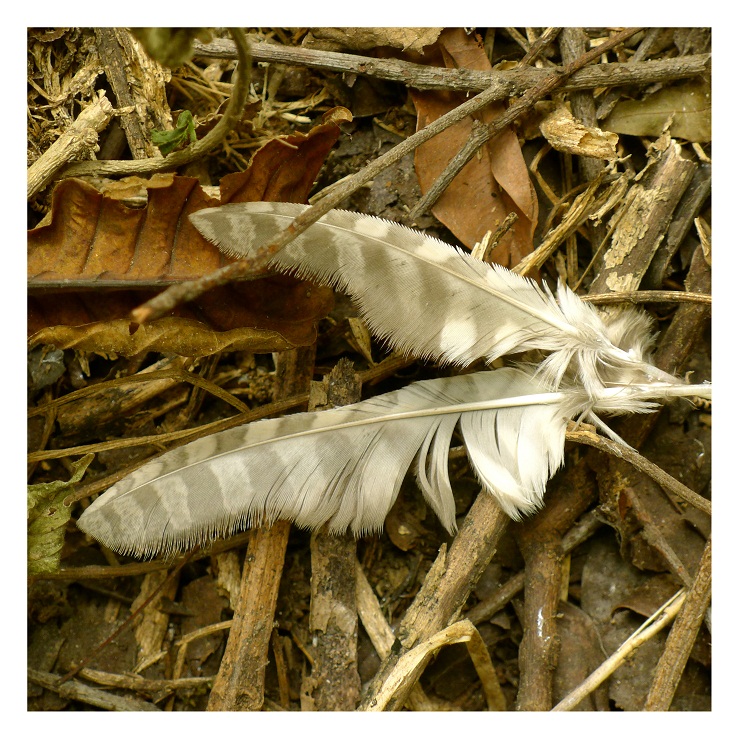
| This may be a nigh jar feather -- can't be certain, though. Any guesses?
|
Towards the end of the week I saw the Large-tailed Nightjar much better, especially if it was present in one of the roosts. I tried to locate more individuals in the garden but had no luck before alarming the birds into flight. Also, I never spotted it at night. Some nightjars are known to sit on roads at night but I never encountered the Large-tailed Nightjar along the roads near the garden, or any path in the garden itself. It's quite possible that this species does not take to the roads -- though I will have to continue to look.
Text and photographs by Sahastrarashmi
Read all Encounter posts on The Green Ogre