We’ve moved! Here’s where you can find us

The Green Ogre is now at https://www.greenogreindia.org
Showing posts with label lammergeier. Show all posts

Odyssey to Bedni Bugyal - In another world

In the charming alpine meadow of Bedni Bugyal life goes on as if on another planet, though Jennifer Nandi notes that our inexorable worldliness has preceded our arrival here 
Life's symmetry, reflected in Bedni Kund
Trishul peeks fleetingly behind scudding cloud and the earth is white. I can hear melt- trickles from beneath the snow. Here, at its source, the Bedni Ganga trickles from under an overhang of ice. The upper reaches of this river are clear, rich in oxygen but poor in nutrients. Yet its narrow bed and fast-flowing waters possess considerable erosive abilities – both by chemical weathering of the rocks over which they pass and by the abrasive action of rock particles. 

Nanda Ghunti peeks through a veil of mist
Last night’s hail and snow has buried all irrelevant detail. The bright yellow flowers of a cluster of Marsh Marigold – of the Buttercup family – spring silently by the brook, nestling against a boulder. Such flimsy things they seem, just a step up from the leaves, with no heft. Yet last night’s blast of cold wind has neither withered nor shrivelled it. Frost failed to kill its basal, toothed, shining blades. It sits an easy prey to hail, storm and blizzard, a miracle of growth. What strength in fragility! Some mountain species resist becoming frozen solid because of the sluggish liquid moving in their cells acting like antifreeze. The fragrant, lavender-coloured flowers of Primula atrodentata lift their compact globular head from their icy bed. The whole flower vibrates with the attention it’s getting. The true miracle in the mountains is the manner in which every vestige of decay is seized upon by the roots of plants. 
Marsh marigolds are a burst of vibrant colour against the bleakness of the landscape
The Bedni springs from hidden aquifers under the earth. It will serve us during our brief stay here. I gargle and spit and wash and pollute this spring at its source. I hurry down to the ‘kitchen,’ with visions of hot porridge. Devidutt is warming himself in a blazing fire. There is an unusual amount of light streaming through. I look up – more rafters are missing… I take our entire ration of dalia, cook it with some vermicelli, milk and sugar – the result, a whole load of very appetizing nourishingly sweet porridge. The men arrive and devour the breakfast with great relish. They let us know, much later of course, that they had already swallowed the morning’s quota of energy bars! Sunita and I sit outside, hands cupped around our comfort food, and decide that as wonderful as this is, we are too old to trek with the cooking left to us. Devidutt is a guide with no training, content to lie back like some Old World nawab, one knee cocked, a cigarette (Sunita’s preferably) dangling from his thin lips. His small and subtle artifices to absent himself from volunteering a service exasperated Bijoy. The pony-owners are always ahead of us in one-third or one-fourth the time we take to arrive camp. With a fee I’m sure they could’ve been entrusted to make tea, cook us some breakfast and a meal at the end of the day. 

We turn to look upon the mountain peaks of Trishul and Nanda Ghunti. Thick, irregular and scattered clouds float past the peaks, between us and the sun. The thinner edges of the clouds, more efficient at scattering light forward toward our eyes, shine brightly giving them a silver lining. For this moment of pure magnificence, all is worth it – our hunger, pain, suffering, fatigue, our insecurities and anxieties – all fall away. It is true that the wilderness can revitalize. We fill ourselves with wonder and awaken the genius in us that can infer the vanished past from a hint of rock. 

‘Let’s go birding’, we say, with energy anew. 

Where eagles dare... to soar!

Honorary Ogre Anand Yegnaswami is mystified by the phenomenon of soaring after watching raptors do their thing

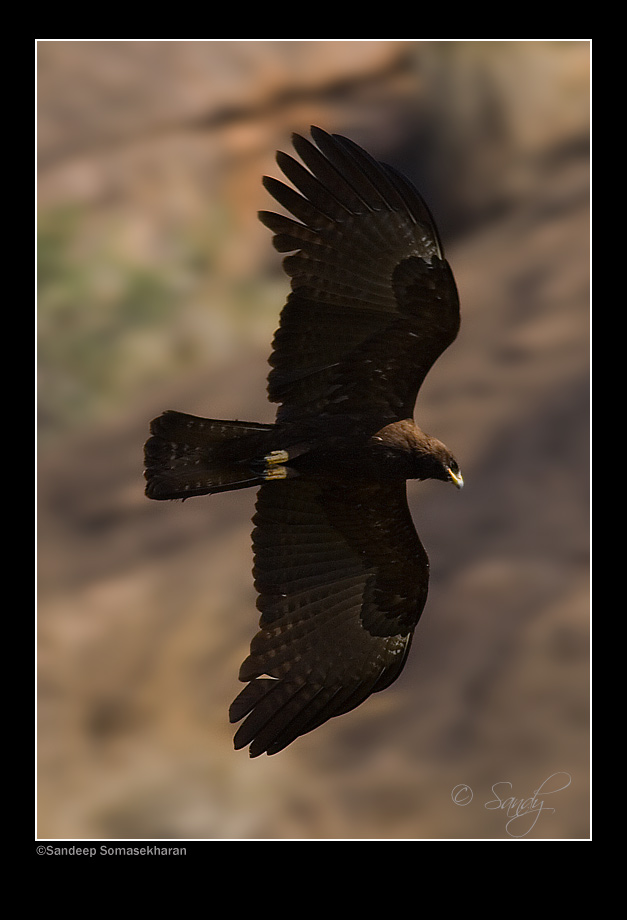
A Black Eagle on outstretched wings
Our recent trip to Dandeli with the Ogres got me acquainted with a majestic flyer. We were walking up the Nagzari trail, which leads to a waterfall of the same name, when a raptor appeared overhead. “Black Eagle!” exclaimed Bijoy. What followed was one of the closest and memorable up-close experiences with the bird. We strained our necks trying to keep our eyes on the raptor, which played hide-and-seek as it circled high above the tall trees of the Nagzari Valley. Our irises followed the Black Eagle (Ictinaetus malayensis) wherever it went, held together as though by an invisible glue. And then it perched upon a tree with regal poise. We were indeed fortunate to have observed this bird of prey from so close.

I felt a tingling sensation, awestruck by the bird's aerial performance against the azure backdrop. I asked Sahastra: “Why do they fly around in circles?”


“Thermals,” he said, and went ahead to explain about the air columns that are formed by the uneven heating of the ground. I wondered: I have been looking at these birds soaring high in the sky for aeons, yet never did it occur to me to delve into the science behind their flight.


Watching a raptor, like this Black Eagle, negotiate thermals is an education in itself
For me large birds circling above had come to signify death – I had come to assume that the birds circled above because they had spotted some carrion below. Such an assumption was excusable during the days when I had not claimed an interest in birding, but not anymore for I have understood that the soaring flight is yet another classic example of how our avian friends have adopted a natural phenomenon to their advantage.

This short tête-à-tête with Sahastra gave me an important insight – what would have been a fleeting glance turned out to be a marveling experience and the reason for it was “interest”. Reminded me of the story of a lady who threw away an old saucer when an archaeologist walking by the trash pile jumped up in joy shouting “Ming”. The interest in the Black Eagle’s flight turned out to be my “Ming” experience, which helped me understand and appreciate the phenomenon of thermals, which I wish to share with you.


Vultures, such as this Himalayan Griffon, offer an excellent demonstration of the phenomenon of soaring, traversing long distances with barely a flap of their enormous wings
Thermals are rising drafts of air produced due to the solar heating of the surface of the earth – the air in contact with the hot surface rises until it loses the heat energy and descends to the surface of the earth, only to rise again. Thermals are usually observed from late in the morning (when the sun starts heat up the cold air) until late in the afternoon (when the sun begins to set). The fact that thermals are a localized phenomenon helps explain why the soaring birds are seen circling – the swirling updraft of air gives the birds the circular flying pattern. Once done soaring, the birds can move out of the air column and descend by gliding with the cold downward draft of air.

I chewed on the thought for a while when a question popped up in my head: Why is it that only certain species of birds have a soaring flight pattern?  As a bird becomes larger in size, it needs larger wings to produce the forces required to keep it airborne. For instance, a Griffon vulture weighing close to 10 kg would need a wingspan of almost 3 metres to sustain flight. Flapping such enormous wings would require colossal calories of energy (now it is easy to imagine why ostriches don’t fly) and hence these large birds use thermals (convection air currents/air columns) to soar.
Wide wingspans enable large birds of prey like vultures to take advantage of thermals to soar
Thermals don’t have any particular direction, so it is possible to observe the birds soaring in either direction – clockwise or anticlockwise. It depends on factors such as wind direction, the contours of the surface where the thermals originate, etc. The Coriolis Effect that guides the directions of hurricanes does not apply here due to the insignificant air mass of the thermals.

I began writing about my newfound wisdom on the soaring flight pattern, emphasizing the “hot” air currents facilitating the ascent of large birds when an email from Sahastra provided an interlude to my incessant keystrokes.


He shared an experience from his Himalayan trek with Bijoy where he had observed Griffons and Lammergeiers (Bearded Vultures) rising up against cliff faces on misty/rainy days. He went ahead to explain the concept of obstruction currents - which are essentially updrafts of air caused by obstructions such as hills, cliffs or tall buildings. This kind of soaring is called slope-soaring or ridge-soaring. This brought back memories of my office in Houston (I was on the 19th floor of the 20-storey building) where I used to see American Black Vultures (Coragyps atratus) flying outside the windows and occasionally colliding against the panes. I wish I had known about obstruction currents then -- I would have been able to better appreciate the presence of these vultures.

The Black Eagle experience at Dandeli that brought me a learning (better late than never) would have eluded me had I not heeded to my birder friends’ advice: “When you spot a bird, don’t just see. Observe!”


Video: Lammergeier soaring

Lammergeier Descent from Sahastra Rashmi on Vimeo.


Video: Himalayan Griffon soaring

Himalayan Griffon's Soaring Flight from Sahastra Rashmi on Vimeo.

Text and info-graphic by Anand Yegnaswami
Photographs by Sandeep Somasekharan
Videos by Sahastrarashmi