We’ve moved! Here’s where you can find us

The Green Ogre is now at https://www.greenogreindia.org
Showing posts with label andaman and nicobar islands. Show all posts

Rendezvous with the Narcondam Hornbill

Atul Jain, who has ticked 989 species of birds in the Indian subcontinent, ventured to the remote Andaman island of Narcondam and was rewarded with many prize sightings


The Narcondam Hornbill is found nowhere else except on the remote Narcondam island
The Andamans conjure a mystic image of a forgotten land with turbulent history and exotic flora and fauna. It lived up to its reputation and rewarded us with some excellent bird sightings. It took six months of planning to organise a trip to Narcondam Island and the Andamans. Five intrepid birder-photographers (Harkirat Sangha, Manoj Sharma, Vinay Das, Aparna Jain and I) joined hands to visit this endemics hotspot. Each traveler brought a different skill-set to the table. Harkirat’s incisive knowledge about birds (and bees!) was helpful in cracking some of the most difficult identification issues and his word was taken as the final answer on any ornithological query. Manoj entertained us with his excellent sense of humour and was the de-facto group leader. He pushed us hard to go for more birds. Our lifer list would have been 50 percent fewer had he not shown rigour and doggedness. Vinay came prepared with background material on Andaman birds and it came handy very often. Aparna was the official “non-bird” photographer and provided feminine stability to the group.
The Andaman islands from the air
We had our ups and down while organising this trip. A few birders came on board and then dropped out due to various personal reasons. We took all this in stride and did not let our trip go haywire. We must admit that Ramki’s support was unstinting and he ensured that the trip remain viable. The inspiration to explore the Narcondam and Barren islands came from a similar trip organized by Janaki et al last year. We tread the same path and got in touch with Nick Band, proud owner of the sailing boat Emerald Blue. He is of British origin and is based out of Phuket. He has an enviable sailing experience of more than 39 years, has lived a bohemian lifestyle, and loves sailing to far-flung islands.
The Emerald Blue at anchor
We arrived in Port Blair two days before the actual sailing date with the objective of ticking as many lifers as we could. We even budgeted two additional days after we finished our Narcondam trip. We had the services of the only local birding guide in Port Blair, Vikram Shil. Vikram has good knowledge of birding hotspots and can claim to be an owl expert. We covered most of the birding areas under his tutelage -- Chiriya Tapu, Mount Harriet, Sippi Ghat, Burma Bridge, Obara Barrage, Veterinary College and Wondoor. A few of these sites were visited many times to ensure that we did not miss any specialties. We were able to get most of the endemics and a few more interesting birds.
Catch of the day
We set sail on February 27 early in the morning. Our boat was moored at a slight distance from the jetty and we were quickly ferried by Nick in his inflatable dingy. We were greeted by Al, our Thai cook and only crew member besides Nick. The boat was neat and tidy and gave an appearance of prudence with space. Every nook and corner was used to store something or other. The living space was a little cramped and left us wondering what would have happened with three more people on board. Not to get bogged down with trivial issues, we all quickly settled down to the ways of a sailing boat including a hand-operated toilet flush. The food was Thai and was peppered with the catch of the day. We had endless supply of drinks and snacks and never felt short of good food. Harkirat was picked by Nick as his second-in-command. He kept vigil on the boat when Nick had to catch up on sleep.
Pigeon Island
Approaching Narcondam Island

The journey to Narcondam took approximately 36 hours and it was almost dark when we arrived. The island gives an impression of an extinct volcano -- biggish with lush green forest cover. Nick quickly found a suitable place to drop anchor and we settled for the evening. All of us were very happy and agreed that it would be difficult to sleep. 
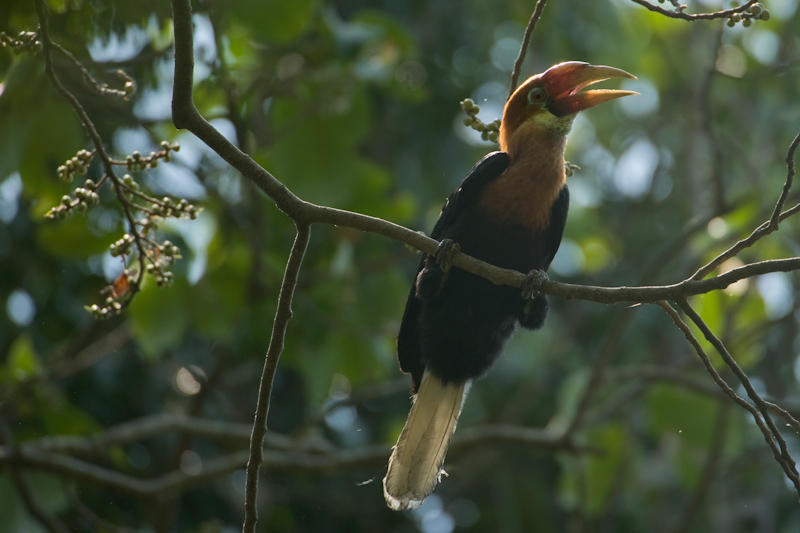
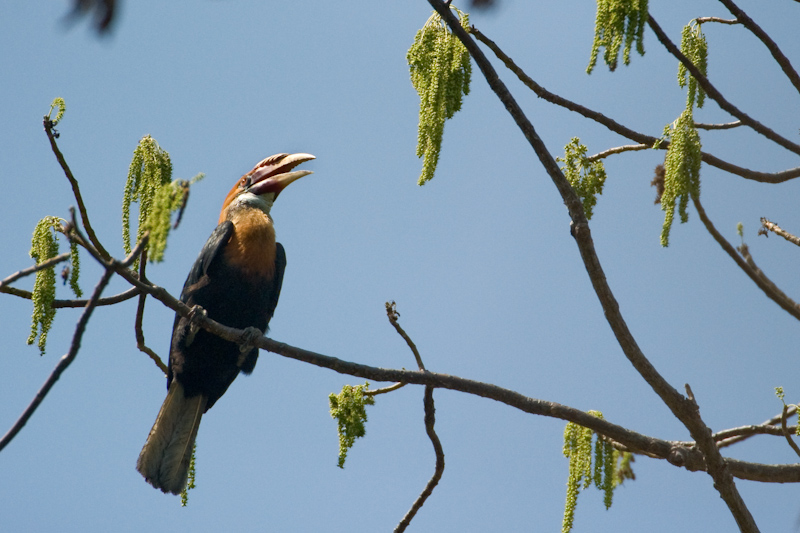
Narcondam Hornbill (Rhyticeros narcondami)
We woke up to the calls of Pied Imperial Pigeons, which were abundant on the island. The excitement was palpable and with each flight of the pigeon, minute physiological details were discussed and lots of hi-fives exchanged. And then, a sudden war cry went up in the air. Somebody had pointed out a Narcondam Hornbill. And yes, indeed it was one! It was flying majestically from one tree to another. It is a small hornbill and reminded us of a smaller version of the Rufous-necked Hornbill. The tail is striking white and the rufous on the neck is resplendent. We decided to circle the island by boat and were able to see a few more hornbills. Besides hornbills and pigeons, we identified Alexandrine Parakeets, Hill Mynas and Asian Koels. Satiated, we decided to head back in the evening.
Barren Island has the only active volcano in Indian territory

Our next port of call was Barren Island, which has the distinction of being the only active volcano in Indian territory. True to its image, it was spewing ash and gases when we arrived the next day in the afternoon. Barren Island is not fully barren and does support sparse vegetation on its side. Pied Imperial Pigeons were seen hopping from one tree to another and a White-bellied Sea Eagle was sitting guard on a rock face. We again decided to circle the island by boat and observed that the volcano was active every 15-20 minutes. The whole experience of watching a live volcano was magical, though surreal. We made further stopovers at Neil and Havelock Island for a recce and were amply rewarded with good sightings of the White-breasted Woodswallow and the Andaman Serpent Eagle.
The volcano on Barren Island erupts every 15 to 20 minutes
Watching a live volcano at work was at once magical and surreal

We finally reached Port Blair on March 4 with a good six days on the high seas. Most of us were philosophical and were raving about the exhilarating experience of visiting remote islands in our country. Goodbyes were said and a promise to return some day was made.
White-breasted Woodswallow
Oriental Scops Owl

The next two days were as hectic as could be. Manoj was a man possessed and he mercilessly pushed us from 5 am - 9 pm. And it helped! We stumbled on a flock of 100 Daurian/Purple Backed Starlings. The starlings are vagrant and very few sightings have been reported from the subcontinent. Harkirat was of the view that A O Hume collected a single sample from this Island. Another significant sighting was of the Mangrove Whistler at Sippi Ghat.

Triplist:


White-bellied/Glossy Swiftlet, Asian Glossy Starling, Edible-nest Swiftlet, Olive-backed Sunbird, Pacific Reef-heron, Andaman Green Pigeon, Pied Imperial Pigeon (Narcondam Island), Narcondam Hornbill (Narcondam Island) and Andaman White-headed Starling are in good numbers and can easily be seen. Brown Coucal, Andaman Flowerpecker, Andaman Hawk-owl, Hume’s Hawk-owl, Oriental Scops-owl, Andaman Teal, Slaty-breasted Rail, Andaman Wood Pecker, White-breasted Woodswallow, Andaman Serpent Eagle, Andaman Bulbul, Andaman Shama and Andaman Cuckooshrike, Pacific Swallow are scarce but gettable with some effort. Oriental Reed-warbler, Mangrove Whistler, Andaman Cuckoo-dove, Andaman Woodpigeon, Andaman Treepie and Long-toed stints are rare and may pose a good challenge. A flock of Daurian/ Purple-backed Starlings!
Vernal Hanging Parrot
Photographs by Aparna Jain
Photographs of Narcondam Hornbill by special courtesy of Kalyan Varma
All rights reserved

Andamans Diary - A dash to Havelock Island


Jennifer Nandi makes a quick dash to Havelock Island to peer into a world of colourful fish named after parrots and butterflies


Introduced in November 2009, the Makruzz is a hovercraft. It leaves at 7.30 in the morning for Havelock Island and, well ahead of time, we are at the ferry ready to board. Meanwhile our guide graphically describes the day the earthquake hit, the scars of which are still visible. He remembers running home to coax his parents to take to the hills. Little did they know that the worst was yet to come and their decision to move to higher ground probably saved their lives. 


We stare at the unbelievable calmness of the water. The once-seismic sea hides its tale of woe – the endless movement of its rocked waters that uncaringly threw to alien places with total indifference to animal, human or thing. 

Our First Class fares offer us a cabin to ourselves. There isn’t a soul on board our section. We are greeted by a welcoming party, the head of which is a friend of mine and we stare at each other in total disbelief. It’s a wonderful surprise to be ushered in and commended into the trusted hands of the ‘Incharge’. 


It’s just over an hour to Havelock. Gulls and terns skim, dive and flit by the water. At the jetty we are duly searched and then we begin negotiations to rent a car. We cruise along the road running parallel to the pearly-white beach. We stop to photograph Collared Kingfishers, to look up at the endemic Olive-backed Sunbird, and to generally step aside into thick jungle until lunchtime is upon us.


Havelock is even less developed than Port Blair; the pace of life is slower. ‘Resorts’ are mud-shacks -- extremely cheap. Over a meal of fish and prawns we arrange for a glass-bottomed boat to take us to the reef. We are then ushered into a boat which chugs for an awful length of time. After an hour, we stop and tow another boat which happens to be our glass-bottomed boat. 


The scenery is beautiful all along; the water is crystal clear. When we finally arrive at the island -- which is nothing but a bit of sand with waiting passengers to board our boat -- we step into the towed glass-bottomed boat. Immediately we are in another world of parrotfish and butterfly-fish and all the exotics of the reef. It is beautiful but we cannot dally, for time is racing against us. 


The Makruzz is scheduled to depart at 4 pm and we have barely an hour to get back. The crew assures us that the speedboat will come, but I know that is a huge lie. It will never come. We must chug back in this glass-bottomed vessel and make it to the jetty in time. It is too horrific to think of the consequences if we miss the ferry. We have a flight to catch to Kolkata the next day. The day after that we leave for Orissa. Our trip has only just begun and I’m already running a huge risk. I am exposing my client to unwarranted delays and dangers too horrible to contemplate. With my stomach churning and bidding the boat crew to go faster and faster, we reach the jetty in a scramble. There is no time to wear our shoes. Security at the gate stops us to check passports -- how unnecessary! We run to the boat, board the gangway, and then pay the lying boatmen and cab driver their money. We are soaking wet, out of breath and very relieved. The air-conditioning in our First Class cabin chills me to the bone and I close my eyes thinking this is no way to get well!

Previously in Jennifer Nandi's Andamans Diary:


Text and photos by Jennifer Nandi

Andamans Diary - Mount Harriet National Park


Antibiotic-addled Jennifer Nandi is awestruck by the avian diversity at Mount Harriet National Park


Excitement keeps us on high alert as we leave the hotel at 5.30 am to take a ferry across the bay to visit Mount Harriet National Park. Our car snakes its way toward the seemingly lush hill that beckons with promise; I warn myself against another spasm of disappointment. In low gear, we drive uphill and the world falls away. Rainforest resilience presses on both sides of the road compelling us to get out and walk. This is what I’ve been waiting for -- a rainforest of my dreams where the vegetation vibrates for attention; where butterflies are the different colours of sunlight; where one must search for birds amidst an anarchy of rampant growth. Unlike in the Himalaya where ferns and woody shrubs are invitingly recumbent, here the erect vegetation bars your every step. 

I hesitate to reach out and grasp a large tree, my eyes searching simultaneously for snakes and scorpions along its bole. Then, embracing the liana-covered trunk, I work myself around it. A stream of sunlight falling through an open window in the ceiling of the jungle alters the temperature of my cap-covered head. I look up instinctively to behold a halo of Pompadour Green Pigeons. Courting male Fairy Bluebirds call and chase their females distracting the more docile Black-naped Orioles. We pursue the Andaman Woodpecker, a striking black bird with a flaming red crown. We play cat and mouse with the Brown Coucal and dismiss the Drongo as a mainland species until we notice that the shallow fork of its tail twists inwards at the tip! The beautiful blue Black-naped Monarch Flycatcher is everywhere. 


The Andaman Tree Nymph (Idea agamarschana cadelli), one of the many butterflies at the Mount Harriet National Park
Walking towards the peak of Mount Harriet is truly pleasurable. We don’t encounter anyone else so we seem to have the park to ourselves! But the exertions of the previous days catch up with me so I sit in the middle of the road to recoup. Ken and the guide forge ahead. They get to see the Bar-tailed Cuckoo-Shrike, an endemic which I miss. But I’m weakened by the antibiotics I’ve been taken over the past 10 days. I’m only 12 days into the trip and am already complaining of tiredness. I can’t afford to have the feeling of being drained. I push away any debilitating thoughts and scrape myself off the road to look at the Andaman Cuckoo-Dove. When we reach the summit, a beautiful sight awaits us. The verdant green falls away into the sea. We sit in silence and watch, as is our habit. But a green bomb with red on its tail whizzes past us tracking the same trail over and over again. More watching, and we identify the Lorikeet (now called the Vernal Hanging Parrot). Above, flying close by and low are swifts – Brown-backed Needletails. We sit under a fruit-laden Ficus tree for an uninspiring packed lunch. But it’ll do. We’ve had an enjoyable day.

On the way back, I let my eyes rest on the ferry, scrutinising the World-War II vintage contraption. There seems to be no decisive effort on the part of the government to improve conditions on this Island. Its immense potential as a tourist resort is crippled by stagnant bureaucracy. Mediocrity is the rule here. The next day we decide to do what is distinctly not on the itinerary.


Previously in Jennifer Nandi's Andamans Diary: 
Leaving for Chiriya Tapu (Birds Island)


Text and photos by Jennifer Nandi

Andamans Diary - Leaving for Chiriya Tapu (Birds Island)

Jennifer Nandi's Andaman dream almost crash-lands before it takes off again, wobbly but steady


As a child, I remember a photograph of my father being garlanded by an elephant on the Andaman Islands where he had been surveying using the old plumb-line technology that Indian Naval officers in the hydrographic branch used. Few people I knew had visited those far-flung islands. The dream to go there one day was, over the years, pushed back, giving precedence to other seemingly more interesting ventures. But that dream-day was upon us and I was besides myself with excitement. So the disappointment, when it came, was deafening. 

Ken was one of the two foreign tourists on the plane; the rest of the passengers were families of those workers employed in factory construction. Even at the airport of Port Blair, it was apparent that other planes arrived here having ferried families mostly from South-Indian states. Tourists, Indian or otherwise, were in short supply. 

As we drive away from the airport, I stick my head out of the window into the balmy air to look for an effulgent wildness. Instead, I find a scatter of shanty towns that sit like a slur on the scarred hills. Between the heaps of scrapped vehicles, rust and oil remnants of industrial corrosion line the narrow roads. Port Blair is worse than an overgrown Indian village, little better than when it was first established as a British penal colony in 1858. There is no nature here, I sadly admitted to myself, only a world of bankrupt development. 


The Fortune Bay Resort, a name more impressive than the hotel itself
The Fortune Bay Resort, a name more impressive than the hotel itself, offers a miserable breakfast. Not even our sea-facing rooms do anything to revive my drooping spirits. I quickly go to pieces. A sore throat affliction that I was nursing exacerbates into a chest cold, and cements my general malaise. In order for me to be healthy and happy I have to affiliate with nature. I believe the phenomenon is called ‘biophilia’. 

After breakfast we plan the day’s activities with our guide Vikram. I had spoken to him from Kolkata first suggesting and then telling him that we needed a bird list of the area; what we intended to see, so on, and so forth. My persistent requests for the bird list falls on deaf ears. He’s a nice enough guy, but without a clue. 

We drive out of Port Blair to a patch of water where Sunda Teal hang out. They are drab brown birds with white around their eyes and under their necks. My spirits pick up instantly. It’s a bird I’ve never seen before, and I feel we are off to a good start. We set up the spotting scope to view other exotics but just get good views of common Indian birds. Our Guide walks on ahead and we linger at some reeds and bushes on the other side of the road, knowing that whatever we see is going to be exotic. Sure enough, we see an Oriental Reed Warbler, a winter visitor to North-east India. We refer to my bird book and see that the distribution-arrows also point to the Andaman and Nicobar Islands. Once again, I’m ecstatic. I’m already feeling better as I watch a Yellow Bittern work the reeds and on occasion show itself. 

Much later, still on an upbeat mood, we search for a restaurant to eat and maybe have a beer. Our guide takes us to a really grimy place. I leave Ken in the car to do some scouting. It’s filthy. I try to explain to our guide the conditions of a restaurant conducive to eating! He mulls over what I have to say, then points across the road. Somewhat bewildered as to why he had made an unsuitable suggestion when a better alternative was staring at him right across the road, I run across, once again, leaving Ken to his own devices. Up the stairs to an air-conditioned room, there are fairly decent tables and chairs and waiters. I read the menu, look at the tank of live fish and crustaceans and decide that we’ll be safe. In fact, it turns out to be quite satisfactory indeed. 

After lunch we dismiss the invitation to look at the Cellular Jail, constructed between 1896 and 1906 to house Indian convicts and political prisoners, and opt instead for a visit to Chiriya Tapu or Birds Island, a tiny fishing village, some 25 km from Port Blair. This involves a walk on the main road. Looking up at the wall of trees with occasional windows, we discern the Long-tailed Parakeet, another endemic. The bird looks very much like the Blossom-headed of the Northeast but with a green crown. It also lacks the red shoulder patch. There are swifts in the sky and we peer through our binoculars to look for the detail that would identify the Glossy Swiftlets -- tiny birds with square-ended tails and a white belly. We do indeed see them and other more familiar birds. 


In the fading light we take a short drive to end of the road and look out at the now grey sea. Upturned trees lie on the beach, mute reminders of the tsunami. We would’ve liked to have walked here but it’s too late now. Perhaps another time.


Text and photographs: Jennifer Nandi