|
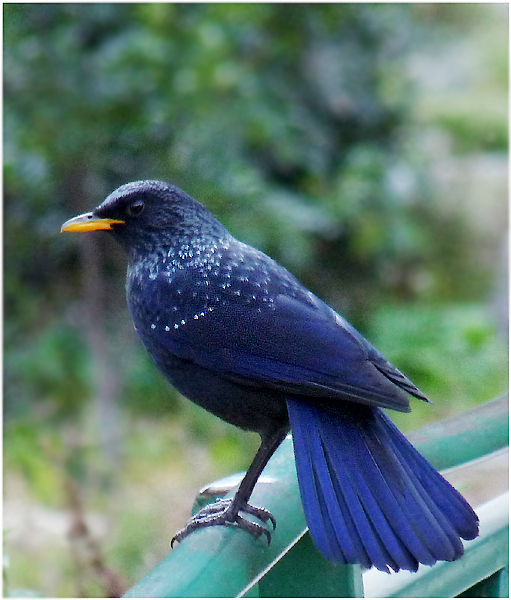
| A Blue Whistling Thrush, ever the skulker, trails us as we walk its wooded paths |
Lots of little surprises greet us the next morning. The Pied Thrush and his companion are in full view; so are the rock thrushes, the blackbirds and the Mistle Thrushes. A new visitor to the campsite is the Variegated Laughing Thrush. A very secretive bird; keeping close to the shrubbery, it hops in and out of sight to forage on the ground. We pursue it and it flies off with a rapid squeaking ‘qweek-qweek-qweek’ -- out of sight and reach of the binoculars.
 |
| The ubiquitous Red-vented Bulbul against a Himalayan valley |
Sahastra, our group leader, has scheduled an ‘all-day birding day’ today. We walk towards the village and select a little plateau of grass overlooking fallow fields and shrubbery. It is a simple morning; but we concoct magic from it by waiting, watching and listening. There are a whole kaleidoscope of reasons to invest in an activity as simple and as magical as birdwatching. Tiny details vie for attention – is the hind-collar of the Whiskered Yuhina pale yellow or a more buttery yellow? Is the bright orange-yellow on the forehead of the warbler a field characteristic or a matter of circumstance – it could’ve stuck its head into a pollen-bearing Rhododendron blossom! On the warbler, over there - one and a half wing bars or two? Any coronal stripes? Is that harsh ‘churr’ an alarm call? It’s a warning -- a bird of prey perhaps? Or unmindful birders? In John Hay’s words, “A bird is not valued because it is ‘beautiful’. It delights by the way it exemplifies the universe working so well, so coherently, and with such endless individuality.”
I looked at our group of men with an IT background, from Bangalore and Chennai with an urge to watch birds. I imagine that the atmosphere in their workplaces can be highly manipulative, perversely efficient. It was laudable that their concerns about wilderness were not just about making personal risk and physical exertion the hallmarks of a wilderness experience, but about falling into resonance with a system of unmanaged, non-anthropocentric relationships that can be as fulfilling as rappelling down a steep face of rock.
 |
| Didana, less than a one-mule town, was deserted as everyone was attending a wedding in the valley |
There is no denying that wilderness travel can be extremely taxing and dangerous. You can fall into a crevasse, lose your way, become hypothermic, de-hydrate, run out of food, or walk in a delirium as Bijoy will shortly so eminently demonstrate! However, the common experience of those who travel in the wild are far less violent events. They encounter the most essential attribute of wilderness – that wild lands preserve complex biological relationships that represent a gene pool vital for the resiliency of plants and animals. Surely we have an ethical obligation to provide animals with a place where they are free from being impinged upon by civilization. Moreover, we have a historical responsibility to preserve these kind of landscapes from which modern man emerged.