We’ve moved! Here’s where you can find us

The Green Ogre is now at https://www.greenogreindia.org
Showing posts with label malabar whistling thrush. Show all posts

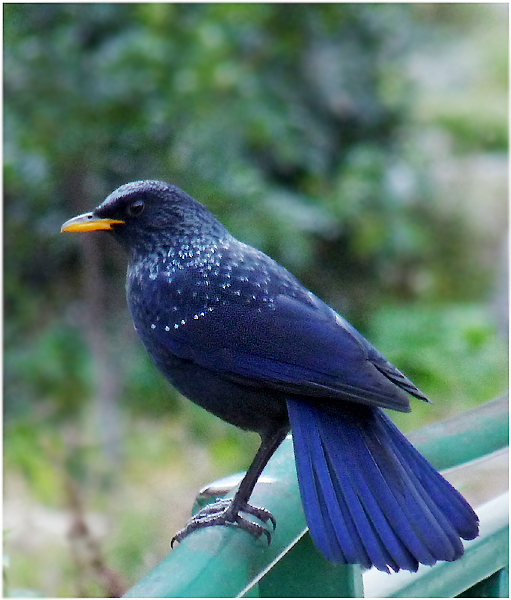
Encounter: Blue Whistling Thrush

Relatively dowdy, screechy and less musical than its cousin, the Malabar Whistling Thrush of the Western Ghats, the Blue Whistling Thrush is nonetheless a character. 


To reach any destination in the Himalaya -- from anywhere that you may venture to do so -- you must first impatiently transect the purgatory of dust and grit posed by successive urban habitations. Those are the trials of the pilgrimage that you must endure to be deserving of a holiday in the hills. Climbing up towards Himachal from the plains of the Punjab or journeying to the snowy heights of Uttarakhand via Kathgodam or Haridwar, you know instantly that the hills are near when you catch the first glimpse of that ubiquitous Himalayan inhabitant -- the Blue Whistling Thrush (Myophonus caeruleus). 


Relatively dowdy, screechy and less musical than its cousin, the Malabar Whistling Thrush of the Western Ghats, the Blue Whistling Thrush is nonetheless a character. Walking a trail, you may feel eyes burning into your back. Turn around and you may see a shadowy crow-like bird rearranging itself nonchalantly on a tree or skulking away into the shelter of the shrubbery. Around mountain streams, you are sure to find two or more males settling territorial differences acrimoniously. 

It's perhaps one of the most wide-ranging of our hill birds -- my friends and I have seen Blue Whistling Thrushes from 5000 feet to 11,000 feet up in the Himalayas. Apart from inhabiting our northern hills, these thrushes, the largest of their family, are known to occur widely from Central Asia eastwards to China and south to the Sundas (courtesy: Wikipedia). 

This guy was photographed a few hundred metres from the entrance of the Valley of Flowers National Park in Uttarakhand, India. I had just photographed a rainbow glistening in the spray of a waterfall when I turned to my right and saw that I wasn't enjoying the spectacle alone. So I snapped up my fellow-aesthete, too.


Encounter: Malabar Whistling Thrush

Sálim Ali didn't call it the Idle Schoolboy for nothing. If, uninitiated, you hear its song in a damp nook of the forest, you may be pardoned for suspecting the presence of spirits, or maybe goat-hoofed Pan playing his merry pipes. The call is eerily like human whistling, so much that it wanders up and down the scale and has a deep, penetrating quality that carries it afar. That said, the Malabar Whistling Thrush (Myophonus horsfieldii) is more often heard than seen. To say it is shy would be an understatement. Most first-time birders are content to catch a glimpse of a dark, crow-like bird in quick, darting flight. Or perhaps skulking away into the undergrowth. But then, Luck sometimes knows how to gift-wrap a Whistling Thrush. I saw my first individual in the Nilgiris. It was perched on a low tree overhanging a stream, and pouring out its song. I have heard it several times since, most memorably one moonlit dawn in Muthodi. And then, once, we saw it briefly in BR Hills. But the best sighting of all produced this picture. Sahastra, Sunita, Sandy and I were driving through BR Hills. I was at the wheel, and we were approaching K Gudi when Sahastra hissed 'Dark bird, dark bird' from the back seat and asked me to stop. Sandy had already got his lens lined up. I switched off the engine and we coasted slowly around the bend. I braked, and the bird emerged from the shrubbery. The bird was closer than any of us have ever seen a Malabar Whistling Thrush. The blue-black spectacle was breathtaking, and behind my head I could hear Sandy clicking away. When we resumed breathing, the bird opened its pink mouth to screech, then scuttled back into the undergrowth. It wasn't a lifer for any of us, yet it was the sighting of a lifetime. Photo: © Sandeep Somasekharan. Used with permission