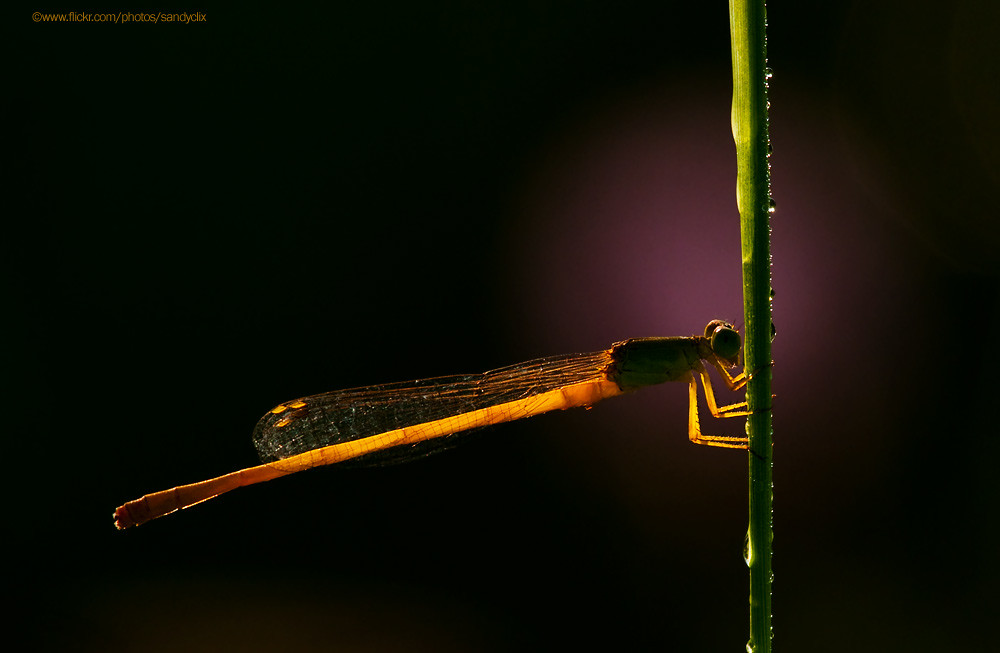
Photo: Sandeep Somasekharan
See all Wordless Wednesdays
We’ve moved! Here’s where you can find us
The Green Ogre is now at https://www.greenogreindia.org
Showing posts with label damselflies. Show all posts
Encounter: Stream Glory, a dazzling tropical damselfly
A day of tired wandering in a forest ends with an intimate rendezvous with a stunning damselfly. It's often the little things in life that give you the biggest highs...
After almost a full day's walk along the Chalakudy river on an abandoned tramway, seeing nothing much but a few birds high up on teak trees, perspiring all over thanks to the humidity, we ended our trek in the forest guest house somewhere deep within Parambikulam Wildlife sanctuary. The Chalakudy river spread out over a wide, rocky terrain next to the guest house, and we decided to take a dip. Little did we know that we would spend quality time with a couple of lifers, as we got into the stream to cool off...
I have already blogged about the first lifer, the Common Albatross butterfly, here. Now let me tell you about another strikingly beautiful insect. As I kept my camera on a rock and lowered myself into the water, I saw a gleam of metallic blue-green on a rock textured with dried algae, right next to me. A closer observation revealed a strikingly beautiful, sleek damselfly.

I stepped to the other side of the damselfly to take a better look at it and photograph it with the sun behind my back, and I was surprised to discover that it wasn't really blue-green. It was a dazzling metallic emerald green, with incredible patterns in green, copper and gold on its wings. Later, we would identify the stunning damselfly as a male Stream Glory (Neurobasis chinensis).

The Stream Glory is a common resident in forest streams, and the female looks a rather dull version of the male. Unfortunately, though I did see her, she didn't oblige to my request for a photoshoot. The male was very cooperative and I spent almost 15 minutes photographing him, until my calf muscles started cramping up from standing in waist-deep water for so long, and I got out of the river just as the light faded.
First the albatrosses, then the stream glory. What an evening!
Text and photos by Sandeep Somasekharan
First the albatrosses, then the stream glory. What an evening!
Text and photos by Sandeep Somasekharan
Dragonfly or damselfly? Get this free field guide to find out
The first-ever layman's guide to the dragonflies and damselflies of peninsular India, published in 2005, is the result of a collaborative project of the Centre for Ecological Sciences, Indian Institute of Science, Bangalore and Indian Academy of Sciences, Bangalore.
The author, K A Subramanian, and the series editor Madhav Gadgil, along with all the photographers and researchers who contributed to this immensely useful and usable field guide, must be heartily commended. Democratising this wealth of information, adopting technology to produce it affordably, and distributing it by means of free downloads are outstanding steps on the part of the scientific community, which is often accused of being insular and aloof.
The book is illustrated with excellent photographs and putting it all together must have been a painstaking exercise. The field guide is available as downloadable PDF files in three parts - an introduction (2.5 MB) and a section each on dragonflies (2.5 MB) and damselflies (2 MB).
The initiative is part of Project Lifescape, which aims to enhance the quality of science education. The project has produced four books so far. The others are Butterflies of Peninsular India, Freshwater Fishes of Peninsular India and Amphibians of Peninsular India. These are not offered for free download.
Subscribe to:
Posts (Atom)