We’ve moved! Here’s where you can find us

The Green Ogre is now at https://www.greenogreindia.org
Showing posts with label insects. Show all posts

Balcony Bugwatch - Love song of the Carpenter Bee

Nikolai Rimsky-Korsakov might have feted the Bumblebee in music but it is the domestic life of the Carpenter Bee that inspires a fitting paean. How about one by the Carpenters?


My wife and I had seen the Carpenter Bee buzz past us as we stole a furtive smoke on the balcony, but we never imagined that it lived there. Until, with a menacing hum of blurry wings, the walnut-sized insect drove our little daughter back into the house in a frenzy of sheer terror.

Of our two balconies, the one adjoining the bedroom is narrower and shaded most of the time by a bamboo chik curtain. For many days we had noticed a trail of fine, powdery wood dust, along with enigmatic yellow stains that stippled the floor. What might they be, we wondered.

Slowly, the curtain lifted on our little mystery.


It appeared that the bee, true to nature, favoured the circular hole of the bamboo poles that anchored the curtain. Several times during the day, we'd see it approach the hole at the far end, landing gear at the ready. Even when the curtain was lowered, the metallic blue-black flying machine would have no trouble locating it.

Now, it helps to know that the Carpenter Bee, despite its appearance, is not the same as the Bumblebee. The latter insect is social and lives in colonies but our Carpenter Bee maintains a nuclear family. Also, the Bumblebee's hairy abdomen sets it apart from the smooth, shiny bottom-parts of the Carpenter.

Life notes from a sea of green

A bad day of birding need not be a bad day with nature, not when you have a lush green paddy field to adore

Another routine morning trip to see if I could catch some birds on the wing took me to a remote corner of Mandya, along a paddy field. Skies were clear from the rain that had cleansed everything the night before, and a September sun jovially smiled upon us. But birding luck didn't. All we got to see were a few egrets and black headed ibis, and a few weavers. 

Sneaking up on them, I lost my footing and fell amidst the paddy. As I hauled up my overweight frame from the (thankfully dry) paddy field floor, something tiny caught my eye. This orange insect clung to a paddy leaf, the tip of which held a glowing crown -- a tiny drop of water. It held onto the leaf, as if guarding the drop from being stolen, its eyes fixed on it.
Intrigued, I looked around for more and was rewarded by scores of other insects. No two were alike. A tiny white moth sat on another blade, wings spread as if in penance.
Another orange moth sat on a straight blade, looking down, possibly pondering over life's intricacies.
As if to test its resolve, Providence let a gust of wind blow another blade across, giving an illusion to the moth that it is on the crossroads of life. Yet, it preferred to stick to its blade.
More careful inspection showed many other life forms. A pied paddy skimmer dragonfly, a robberfly, a ground skimmer dragonfly, and some other teeny rock stars I couldn't identify. As I spent time observing and clicking them, this tiny ladybug materialized in a sea of green.
My day was made. Birds or no birds.

Text and photos by Sandeep Somasekharan

No teeth, no claws, but very much a Tiger!

Not the cuddliest tiger around but certainly the safest to introduce your kids to, this one is best chased with a camera on a sunny spring morning. If your intentions are evil, back off or you'll be left with a bad taste in the mouth!


The Plain Tiger Butterfly (Danaus chrysippus) carries all the glory of a tiger. The bright orange wings are often left spread flaunting their brilliance, and the butterfly can be identified by its nonchalant flutter. It is the friendliest for a butterfly lover to start with, and we shall soon find out why...
The Plain Tiger has orange wings bordered with black and white on the inside and paler orange with black spots on the outside. The male can be distinguished from the female by the hindwing: The female has three black spots while the male has an additional black-and-white spot. It is probably the first butterfly that I ever photographed since I took up photography in any seriousness.
So what makes Plain Tigers so friendly and easy to photograph? The secret lies in the butterfly's childhood dietary habits -- yes, while it was a wee caterpillar sucking its little pinky-toes (well, not literally!). As a caterpillar, the Plain Tiger gorges on leaves that are rich in alkaloids. These contribute to making them unpalatable, leaving them with few natural enemies. When attacked by an ignorant predator that does not know how bad a taste it can leave in its mouth, the creature switches to plan B - it secretes a foul-smelling fluid that deters the by-now-repulsed predator.
These interesting defense mechanisms end up being very beneficial for other butterflies. For example, the female Danaid Eggfly (Hypolimnas misippus) mimics the Plain Tiger butterfly and this offers it protection from predators. With a little training, you can tell the mimic from the model (as the mimicked butterfly is called). The mimic has a more elaborate black-and-white pattern at the edge of the wingtips, but only to higher life forms like you and me. For relatively one-track-minded predators, it is another plain tiger butterfly that ought to be shunned.


Before you flip the page, read Arun's detailed photo-documentation of the metamorphosis of the Plain Tiger Butterfly


Text and photos by Sandeep Somasekharan
All rights reserved

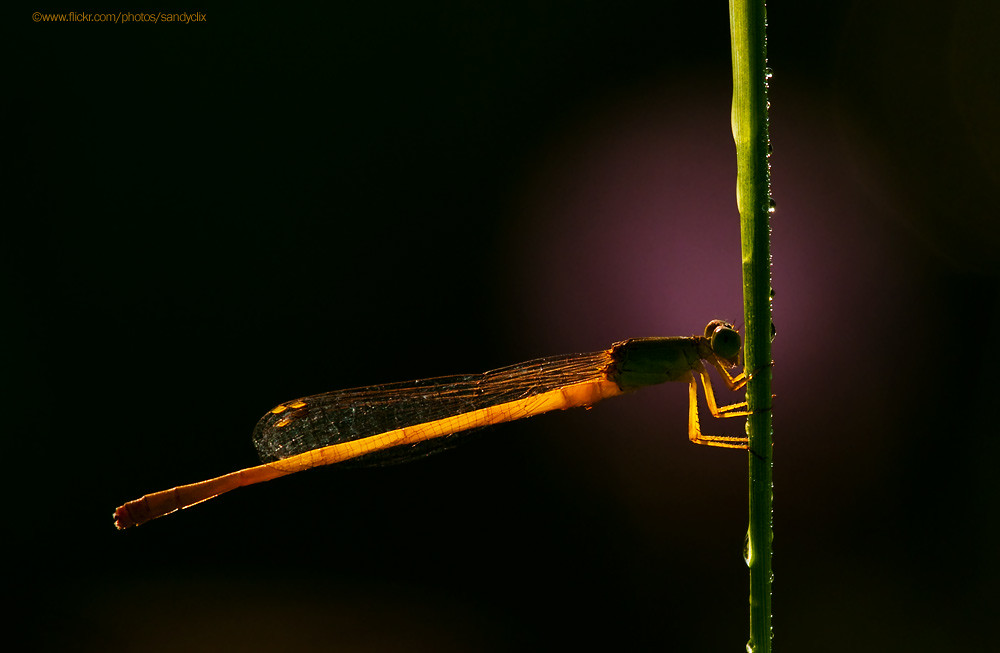
Wordless Wednesday: Damsel drunk on daylight

See all Wordless Wednesdays

We don't need no thought control!

Anand Yegnaswami witnesses a bizarre encounter between a spider and a wasp and stumbles into a freakish discovery of manipulation in animals


Mind manipulation is not new to many of us, considering we have watched Jedi Mind Tricks, read about suicide bombers, and seen cricket-playing teams sledge players to get them dismissed. Over time we grow wiser and often recognise patterns that are a prelude to manipulation. But wait, these are just external factors. Imagine a far more malevolent form where we are manipulated from within and would not even be aware of it.
The spider, after it was stung by the wasp
On a trip to Ranganathittu Bird Sanctuary (near Mysore, India), my brother and I chanced upon a rather distinctive encounter between a wasp and a spider. A wasp stung a spider crawling on the ground and the spider turned upside down and “seemed” to be dead; the wasp sat beside the spider “observing” it.


It was a rather singular sight because wasps have no business going about stinging spiders. My brother then explained that the spider was just paralyzed and that the intent of the wasp was to lay its egg in the spider’s abdomen. Once the larva emerges it would feed on the spider’s body until they develop into the wasp. The Pompilidae family of wasps, known as the spider wasps, lay their eggs in the body of the spider after paralyzing it with a sting tipped with venom.


Okay, so what is all this hoopla about mind manipulation?


There exists a species of wasps, the Hymenoepimecis sp., which lays its eggs in the belly of the Plesiometa argyra spider. After being temporarily paralyzed, the spider recovers and goes about its routine unaware of the fact that it is now being eaten from within by the wasp larva. When the larva is ready to pupate it releases a chemical to manipulate the spider into building a web to enable the creation of a cocoon. This web is different from the usual web that the spider weaves. The wasp larva then feeds on the spider and builds its cocoon with the web. 


Was that spooky enough for you? 


Hang on, that's not all. There are other such parasites in the animal world that alter the phenotype (essentially an organism's characteristics of behavior, development, morphology etc.) of the host species.


A cat-and-mouse game is thrilling to watch because the cat never gets to catch the mouse – a reason that can be attributed to the popularity of the cartoon series Tom and Jerry. It would be an anticlimax if the mouse were to walk up to the cat, pull its whiskers and say: “Eat me.”  


No, this is not a chimera. At the most it is an exaggeration because there exists a parasite -- the Toxoplasma gondii -- that infects rats and mice and alleviates their fear of the scent of cats, thus drawing them to their predators. Okay, I made up that bit about pulling the whiskers and demanding to be eaten for I haven’t yet come across a mouse that speaks English (except Stuart Little maybe). 


The parasite attacks only the specific characteristic of the mouse that relates to the fear of cats, so it is unlikely that the you might find the rat climbing up the table to share a meal with you (with the exception of Remy from Ratatouille).
The spider now carries the wasp's egg inside it
Toxoplasma gondii is just one example of the mind-manipulating parasites. Then there is the Gordian Worm, which infects crickets and induces them into the suicidal act of jumping into a water body so that the worm can swim away. Flukes -- parasitic flatworms belonging to the class Trematoda -- are known to wreak havoc on the phenotype of aquatic species like cockle and coral polyps. In these aquatic species the Trematodes impair the ability of the host to evade the host’s natural predators (such as aquatic birds and coral-feeding butterfly-fish). Lancet flukes are known to cause an unusual behavior in ants, where they cause the ants to cling to the top of grass blades from dusk to dawn and risk being consumed by grazing animals. 


Isn’t that suicidal behaviour, you may ask? For the intermediate host, yes. For the parasite the effects are beneficial, for it continues its life-cycle inside the body of the grazing herbivore that ingested it.

Many parasitic relationships mentioned above deal with the intermediate host. Given this information we can understand that the intermediate host is just a vehicle for the parasite to enter the body of its preferred host. The parasite manipulates the intermediate host to gain access to the preferred host, which is higher up in the food chain. Once consumed by the preferred host the parasite too reaches its ultimate destination, with the intermediate host sacrificed in the process. There can also be more than one intermediate host. Lancet Flukes first reside inside snails, followed by a stint inside the ant, and eventually in the liver of grazing animals like sheep. In the case of the spider and cricket the manipulations ensure the safe exit of the parasite from the host’s body.

All forms of manipulations are driven by a purpose and in the natural world manipulation is as essential for the survival of the fittest as fitness itself.


Text and photos by Anand Yegnaswami
Read more posts in our Encounter series

Encounter: The Dung Beetle's Crappy Life

For the dung beetle, crap doesn't just happen. It's very happening!
The dung pat is attacked and rolled into balls. Note that a tunnel has already been dug
Nature works in cycles. What is created must be consumed, only to be created again. What arrives must leave only to return. What rises must ebb, only to rise again. 


The Dung Beetle we encountered at Agumbe is nature’s waste management agency. It plays a role similar to that of vultures in cleaning up rotting flesh. The Dung Beetle’s role, though it may seem unpleasant to us, is a significant one and may have been the reason why the Scarab figured prominently in ancient Egyptian lore. Whether the dung comes from an elephant, gaur or domesticated cattle, the Beetles work fervently to break it down. While the dung of omnivores does show up on the menu of a Dung Beetle Bistro, the creature's preference is for herbivore dung.
The beetle changes direction and rolls the dung into the tunnel
There are more than 5,000 species of Dung Beetle and they are found across continents. However, they can be categorised into three groups based on how they carry out their functions. First, there are the rollers – beetles of this kind are usually the first to arrive at the scene of the dropping and set to work rolling the dung into a ball. This ball, while serving as a source of food, is also the chamber where the brood is placed. The rollers typically roll the ball away from the scene of the dropping. It is consumed by the beetle's larva when the egg laid inside it hatches. The rollers leave as the dung starts to dry up. Then there is the tunneler, the second kind of Dung Beetle that pulls out chunks of dung only to bury them underground. The third kind is the dweller, which thrives on the dung pat while making its home in it. 


These Dung Beetles may approach the dung differently, the work they do might come across as appalling, and the conditions under which they work may appear obnoxious and it is not surprising that these fascinating creatures are frowned upon by humankind with disgust. Show a dung beetle to a city-slicker and she'll go: Ewwww, gross! But you might change your view if I tell you that a dung beetle does far more good to the environment than any other creature you might know of.
Work done, and ready to enter the tunnel
First, dung beetles clean up dung from the feeding grounds of herbivores, effectively increasing their foraging expanse. Further, they help release nitrogen, which might otherwise have been lost to the atmosphere, into the soil by burying chunks of dung in it. Dung is a habitat for a variety of parasites and Dung Beetles help in reducing the density of these pests and parasites by effective reducing their habitat. 

The Dung Beetle is nature’s cleanup crew, and a classic reminder (to all who think lowly of it) of how every kind of flora or fauna, no matter how seemingly insignificant, has a role to play in maintaining ecological balance. 


Now, do you envy the Dung Beetle's crappy life?


Before you go, watch a video of this dung beetle at work. Don't miss how it changes direction like a tiny earthmover.


The Dung Beetle's Crappy Life from Green Ogre on Vimeo.

Text and Photographs by Anand Yegnaswami 
Video by Bijoy Venugopal 
Read more Agumbe Diaries

Wordless Wednesday: Muddling, Puzzling Mud-puddling

Photograph: Arun Menon

Monsoon Mating Mania

Monsoon in top gear is a season for an unabashed green orgy, and we voyeuristic Green Ogres clicked away shamelessly. So much for the birds and bees...


"On the earth the broken arcs; in the heaven a perfect round."
- Robert Browning
Crimson-tailed Marsh Hawks form little earthly arcs as they clasp. Often, when mating dragonflies take wing together, they resemble some large composite monster
The phrase 'Sex and the City' brings to mind too many limp television romances but here we were in Agumbe, so far removed from anything urban that our cell phones barely twitched. Distractions were therefore not going to trouble us. So, absently, perhaps the single (and deprived?) among us must have pondered the question: "What was sex away from the city going to be like?"


I assure you that it was not on our agenda to find out, but without our asking the rainforest's little denizens put on an unabashed show just for us. Even a prude would have stopped to watch, and marvel at the minuscule arcs being etched in the great circle of life. 
Doing it on the hop...
...or on a twig
The sex lives of animals are intriguing but they don't always make for pleasant breakfast conversation. How many embarrassed parents have hurried their confused children away from friendly neighbourhood dogs making an amatory spectacle of themselves in full view of 132 apartments? 


Truth be told, I learned the facts of life long before my parents had the opportunity to tell me about the birds and bees. Ironically, I learned what I had to just by watching birds and bees, and other animals. By age seven, I had some very viable theories on reproduction, most of which led to "Aha, I told you so!" moments later on in life. 


Something about animals (or was it something about me?) led them to perform without restraint before my eyes. And so, before I was myself of reproductive age I had witnessed, both in the wild and in captivity, the private moments of (in no particular order) chickens, quail, partridges, butterflies, dragonflies, mynas, peafowl, cats, crabs, squirrels, geese, donkeys, horses, elephants, monkeys, guinea pigs, rats, mice, pigeons, parakeets, sparrows, snakes, buffalos, cattle, pigs, goats, sheep, deer, gaur, nilgai, blackbuck, agamas, frogs, cockroaches, leopards, waterhens, fish...  


Watching their complex (and, in some cases, extremely uncomplicated) courtship rituals was always fascinating, even if not in a voyeuristic way. With every year, I began to look forward to the monsoon that awakened a deep-seated love rush in all living things. 


Three days and nights in Agumbe brought back so many childhood discoveries that it was like falling in love with love all over again.


While grasshoppers whirred underfoot, crickets kept up the chorus at night. In the murky nooks of the rainforest where we ventured gingerly, half-excited and half-fearful for the vipers that we were told lurked there, frogs were awake and lovesick enough to sing by day. At dusk their chorus mounted to a din above which you had to raise your voice to be heard. Frogs and toads clasped in the stagnant pools of rainwater. Grass stalks at the bottom of clear-flowing runnels were braided with spawn.


Wherever we looked, insects mated. Amorous flies buzzed love songs in our ears. Tiger Beetles tumbled on the ground, looking mean and aggressive even as they coupled. Katydids and grasshoppers hurried away to quieter corners at our approach. 


Whether it was the unusual beauty of two bodies in harmony, or sheer zoopornographic glut, we the paparazzi stalked these lovelorn creatures and made a photographic feast of it. Here are the spoils for your vicarious enjoyment.
Or in brazen defiance of gravity like these Handmaiden Moths
Clearly, we were not the only voyeurs
Text by Beej
Photos by Sahastrarashmi, Sandeep Somasekharan and Beej


Read more Agumbe Diaries


Encounter: The Malaysian Moon Moth

This lovely moth we were admiring was probably in the last hours of a life spent in sleeping and making love
An epicurean life peppered with hints of bacchanal experiences is one that many of us would envy, and it’s interesting how insects live such a perfect life. 


It had been a week since the monsoon arrived in Agumbe and we had landed at ARRS hoping to have three field days spotting the region's famed herpetofauna. The amphibians and reptiles must have been well camouflaged and the repetitive pattern of green and brown had put me in a state of trance. That's when an apparition appeared.


Bright yellow, almost 12 inches long and half a foot across, it seemed almost artificial among the bright green leaves where I found it. I wondered first if it was a life-like miniature kite that was stuck in the leaves. I called out to the Green Ogres and exclaimed “Butterfly!” and got a curt rap on the knuckles. “Moth!” Well, most of the moths I had come across hardly had the vivid patterns I was looking at, so I knew this one was special.


We were looking at the Malaysian Moon Moth (Actias maenas) which occurs in South and Southeast Asia.  This specimen was a male, as it had brown markings on its wings with two circles resembling eyes that we might find on paper kites. The female of the species does not sport these wing markings. It is light green with a shorter tail. Striving not to disturb the moth we photographed it from a distance. When the moth did not take umbrage at our intrusion we got as close as a foot for clear shots. The moth stayed put and we found it at the same spot even when we returned that evening. 


Malaysian Moon Moths are hard to find primarily because they limit their habitat to thick forests. Further, they live in the imago stage for only 7-10 days. That would strike many as an unusually short lifespan for a attractive species of a significant size. However, it would seem entirely logical if I were to explain that these moths do not have mouths through which they can feed. All the feeding happens during the larval stage when the caterpillars go on a feeding frenzy to prepare themselves for the cocoon phase. 


Once they emerge from the cocoon the males wait until they can catch a whiff of the pheromones from the female, which they can sense even from six miles away. Female Actias maenas take flight before emitting pheromones, and this behaviour make them different from the other females of the Saturniidae moths, which emit the pheromones before taking flight. The reason for the moths' rather lethargic disposition is that they have less than 10 days to find a mate, which may involve flying a significant distance while starving.


The moth's sole mission is to mate. Now who wouldn’t envy a moth’s hedonistic lifestyle for all it involves – eat, sleep and make love!


Text by Anand Yegnaswami
Photographs: Sahastrarashmi and Sandeep Somasekharan
Thanks to Gopi Sundar for ID help


Read more Agumbe Diaries


The Cicada's Night Out

Cicadas are diurnal, so what was this one doing up late at night?


Lo! on the topmost pine, a solitary cicada
Vainly attempts to clasp one last red beam of sun.
- Unknown Japanese poet


Nearly everyone has heard cicadas but most people confuse their music (some think it is noise) with the nocturnal chatter of crickets and tree frogs. But there's an easy tip to never be mistaken again, for in most cases cicadas never sing at night. Unless perhaps they've had a bad day, or maybe if the moon is too full, or if artificial lighting so intensely mimics daylight.

Cicada music varies with the species but usually, it resembles a gradual crescendo of violas and violins played in shrill, frenetic unison. The sound has nothing to do with the cicada's mouth. Like all insects, it does not have vocal chords. So how does a cicada rustle up that loud, penetrating din? The sound one hears is made not by one cicada but by thousands of them. These forest fiddlers rub together their ribbed membranes, called tymbals, which envelop hollow abdominal chambers that amplify the noise. Some species have been measured at over 100 decibels.

And it's almost always a love song.

An obscure Greek ode, translated roughly, goes thus: “We call you happy, O Cicada, because after you have drunk a little dew in the treetops you sing like a queen.” Certainly, that Hellenic bard didn't mean Freddy Mercury? For notwithstanding the poetic license to ascribe femininity to any creature or thing that makes music, cicada musicians are males serenading their mates. Females, unlike in our species, are relatively quiet.

And it's not dew that cicadas drink but tree sap. They have mouthparts adapted for piercing and more than a few people have complained that they've been bitten. Odd, because cicadas have no need for blood – they'd probably die of indigestion or food poisoning if they consumed it. Neither are they unreasonably aggressive. The only plausible reason is that the hungry cicada mistook the victim for a tree. Or it could be a case of mistaken identity – they were probably stung by the Cicada Killer Wasp, which predates on cicadas.

I've had many close encounters with cicadas since childhood when I used to wander about groves and grope the barks of avenue trees to locate the source of the phantom noise. But they were all daytime encounters. A couple of months ago, on a visit to the Kulgi Nature Camp in Dandeli, we were ambling about after dinner in pitch darkness with only the cold white beam of our headlamps illumining the path ahead. Suddenly, one of us stepped on something and it made an angry buzzing noise, prompting the offender to spring back in shock. Curious to know what it was, we shone our lights on it and the grumpy fellow buzzed a little more.

It was a cicada, but how very unusual to discover it at night. Now, now, do cicadas have a night life? Was he exiled, like Cacophonix, from the great village banquet? Or had some visitors from Bangalore taken the infectious BPO lifestyle a little too far? Or maybe it just fell off a tree?

We had no clear idea. So we took some pictures and let the guy go. Have you any theories or explanations of the cicada's night out? We'll be glad and grateful for any information you can share.

Text and photo by Beej

Wordless Wednesday - Symmetrical Suckers


Photo: Beej

Encounter: Robber Fly, raptor of the insect world

With the mean looks and businesslike patience of an assassin, the Robber Fly captures its prey on the wing


Robber Fly. The first time I heard that, I thought, "Why does it have such a name?" I learned that they stay on a perch waiting for any unlucky victim to pass by and quickly catch them on the wing, just as highway robbers waylay and attack passing vehicles.


I saw my first Robber Fly quite recently. While birding, something caught my eye. A large insect flew low, carrying something equally big in its legs. As I watched, it landed on a log. I looked through my camera and zoomed for a good look without spooking the insect. The fly-like predator was holding onto a cicada. I wrote it off immediately as a scavenger feeding on dead insects. Only later did I learn the true identity of this mean-looking fly.


Robber fly with its dinner, a Cicada
Robber flies are also known as Assassin Flies -- makes them sound more vicious, doesn't it? Vicious or not, they are voracious eaters, willing to eat almost any insect or small vertebrate that they can overpower, including other Robber Flies! Their hunting strategy is to wait on a perch from where they can scan the surroundings. When some unfortunate insect flies past, the Robber Fly intercepts and attacks it. The victim is then carried off to be consumed at leisure.


Robber Flies, which include around 7,000 species distributed worldwide, are grouped under the family Asilidae in the order Diptera, comprising 'two-winged' flies. They have strong spiny legs which help them grab their prey. Their huge compound eyes help them detect movements quickly. These eyes are protected from the thrashing wings or legs of their prey by outwardly projecting hairs located between their eyes. After pinning down the prey, Robber Flies use their strong and sharp proboscis to inject neurotoxic venom and digestive juices, which immobilize the prey and start liquefying its body from the inside. This slurry is then sucked up by the fly using its proboscis.


Beej adds: Robber Flies deliver painful bites. While trekking in Brahmagiri, Coorg, I made the mistake of using deodorant and then wearing a sleeveless vest while walking the forest trail. For some reason this attracted Robber Flies. I deduced later that the deodorant had attracted a number of flies and other winged insects and the Robber Flies were in hot pursuit of easy targets. Occasionally, the Robber Flies bit me when I tried to fend them away with my hand. The bites turned into fluid-filled vesicles that hardened into bubble-shaped cysts on the skin between my knuckles and refused to go away for many weeks.


Text and photo by Arun Menon

Encounter: Stream Glory, a dazzling tropical damselfly

A day of tired wandering in a forest ends with an intimate rendezvous with a stunning damselfly. It's often the little things in life that give you the biggest highs...


After almost a full day's walk along the Chalakudy river on an abandoned tramway, seeing nothing much but a few birds high up on teak trees, perspiring all over thanks to the humidity, we ended our trek in the forest guest house somewhere deep within Parambikulam Wildlife sanctuary. The Chalakudy river spread out over a wide, rocky terrain next to the guest house, and we decided to take a dip. Little did we know that we would spend quality time with a couple of lifers, as we got into the stream to cool off...


I have already blogged about the first lifer, the Common Albatross butterfly, here. Now let me tell you about another strikingly beautiful insect. As I kept my camera on a rock and lowered myself into the water, I saw a gleam of metallic blue-green on a rock textured with dried algae, right next to me. A closer observation revealed a strikingly beautiful, sleek damselfly.
I stepped to the other side of the damselfly to take a better look at it and photograph it with the sun behind my back, and I was surprised to discover that it wasn't really blue-green. It was a dazzling metallic emerald green, with incredible patterns in green, copper and gold on its wings. Later, we would identify the stunning damselfly as a male Stream Glory (Neurobasis chinensis).

The Stream Glory is a common resident in forest streams, and the female looks a rather dull version of the male. Unfortunately, though I did see her, she didn't oblige to my request for a photoshoot. The male was very cooperative and I spent almost 15 minutes photographing him, until my calf muscles started cramping up from standing in waist-deep water for so long, and I got out of the river just as the light faded. 


First the albatrosses, then the stream glory. What an evening!


Text and photos by Sandeep Somasekharan

Balcony Bugwatch - The moron, the lightbulb and the Potter Wasp


You must be familiar with that old joke: How many morons does it take to change a lightbulb? The answer shall be illumined presently to the patient reader of this post. 

But first, the story of a sting operation. 

Apart from a long line of little black ants bearing whitish larvae to the safety of another crevice in the wall, there are other insects at work in my balcony. One is a species of Potter Wasp. Sometime in December, my daughter (to her utter alarm) observed an adult wasp fashioning a nest with damp earth. It buzzed in and out of the balcony tirelessly bearing bits of wet mud in its jaws. Over several days this building material was adeptly patted down into a hollow structure with many tubular chambers. One of these cells remained open at one end even after the nest was finished. The structure was cemented to the base surface with mud, which I suspect had been mixed with the insect's saliva and possibly something else that acts as a resilient binding agent. 

The moist part that you see in your picture (above) dried up in a few hours and turned to quite the same colour and texture as the rest of the nest. The adult soon disappeared and has not been seen for over two months now. I assumed she had fulfilled her corporeal assignment and ended up in the food chain of the bee-eaters often heard trilling about nearby.


Enter the moron with the mission of changing a lightbulb. Since the wasp had fastened its nest to the clamp of the lampshade in the balcony, I couldn't change the lightbulb even if I wanted to. Having seen no action for over two months, I decided to inspect the shade. I couldn't do that without disturbing the nest. Presuming it to be empty, I chipped away at it with an old kitchen knife, hoping to detach it cleanly and add it to my collection of souvenirs taken (without menace, may I add) from the natural world. 

Chipping away the nest proved more challenging than I had expected. At one butter-fingered juncture, the blade of the knife bent at the tip. At the next barbarous hack, the nest gave way and fell to the floor, smashing into two or three uneven fragments with catacomb-like  innards.


From one of the cells, a very agitated-looking adult wasp emerged with a rustle of eager wings, shaking off slivers of pupal sheath. Inside the tube from which it emerged were the wispy carcasses of spiders, flies, beetles and other food that the parent wasp had stashed long before its offspring had hatched. After loitering about the balcony muttering revenge, the wasp flew away into the bleak and hostile afternoon.

Assuming the rest of the nest to be empty, I decided to pry some more with my bent knife.


There were two cells remaining in the nest. The one to the left in the picture contained a dead wasp, which had pupated. But I could find only bits of its legs and a hollowed-out thorax. Since the cells didn't seem to have any vestibular passages between them, which ruled out cannibalism by one of the same brood, what had eaten the rest of it? And, since the remains were quite desiccated, how long ago?


The cell to the right vibrated with angry, impatient whirring. As I trained my camera on it, an adult wasp slipped out, deposited small grains of white faeces, and began to explore the territory around it. Then, with a sudden flourish of its new wings, it took off abruptly into the great wide open. My hacking of the nest had yielded two ready-to-fly adults and one dead-on-arrival pupa. Had I not opened the nest, how long would it have taken before they would come out on their own? 

Other questions remain: Did the parent wasp know how many eggs it was going to lay? Or did she build the cells one by one as she laid her eggs, taking breaks to hunt and provide for her brood? Was she able to provide for all the cells? Did one of the larvae die of inadequate nutrition? What about the empty cells? Would the new adults survive? Would the bee-eaters get them?

At the end of the afternoon, only one question was answered: It takes only one moron to change a lightbulb.

Text and photos by Beej

Encounter - Antlions and the pit of death

An ant's minefield of death. In each of these pits lurks a very hungry antlion larva

For as long as I can remember this killing field has been around at the same spot, sheltered under the arch of our ancestral home in Uttar Pradesh, northern India. The present colony sits on the mud collected between the wall of the arch and the road. What used to be a mud road running into the courtyard of the house was upgraded to a brick road and then to a tarred road, but the colony (not really a "colony" since the individuals have little to do with each other in a communal sense) has thrived. This minefield of inverted volcanoes has been home to several generations of antlions and its near permanence is testimony to their adaptation and survival instincts.

As kids this colony of antlions fascinated my brother and me endlessly. It was the place for macabre experimentation in complex predator-prey relationships fueled by both curiosity and frenzied betting (involving marbles for coveted currency), though not necessarily in that order. The basic level was to introduce a hapless ant in a selected pit and place bets on its fate. The antlion would indicate its presence by throwing up puffs of dust, almost as if the inverted volcano was erupting. It served to confuse the ant and collapse the steep pit slopes, blocking the ant's escape. The ant would become absolutely still, perhaps sensing its fate. Then in sudden fateful and much anticipated moment it would vanish, pulled in by the still unseen predator. Bets involved both presence and capture; mostly they were both settled with the presence. Escape was rare.

Then there were the variations. The next level was to catch the antlion by scooping off the entire pit just at it had grabbed the ant. We would then carefully sort through the mud and locate the guy – a tiny bug with menacing jaws (for its size) and otherwise, to our eyes, unremarkable. This tiny predator is actually the larva of the antlion, the next stage being the pupa which metamorphoses into a damselfly like adult. I have rarely seen any ants or small insects in the vicinity of the colony so the food supply is not really abundant but then I guess it does not need to eat a lot. The colony has always had pits of different sizes to suit the size of the larva and newer pits keep coming up, so by all means the colony is prospering.

Other game variations involved introducing more than one ant, ants of different sizes, and an especially morbid one where an antlion was introduced in another’s lair. The variations kept coming, fuelled by a steady supply of ants and helped along by weak incipient conscience and imaginative betting odds.


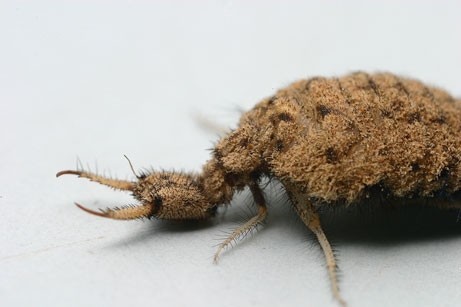
The Antlion larva's menacing jaws
Photo: Jonathan Numer (Wikimedia Commons)
Close up, the antlion is a fierce-looking character. Wikipedia gives the following description, “The life cycle of the antlion begins with oviposition (egg-laying). The female antlion repeatedly taps the sand surface with the tip of her abdomen. She then inserts her abdomen into the sand and lays an egg. The antlion larva is a ferocious-appearing creature with a robust, fusiform, a very plump abdomen the thorax bearing three pairs of walking legs. The prothorax forms a slender mobile "neck" for the large, square, flattened head, which bears an enormous pair of sicklelike jaws with several sharp, hollow projections. The jaws are formed by the maxillae and mandibles, which in each pincer enclose a canal for injecting venom between them. Depending on species and where it lives, the larvae will either hide under leaves or pieces of wood, in cracks of rocks, or dig pits in sandy areas. Antlion larvae are unusual among the insects as they lack an anus. All the metabolic waste that is generated during the larval stage is stored and is eventually emitted as Meconium near the end of its pupal stage.” 


Antlions belong to the insect family Myrmeleontidae comprising about 2,000 species. I have encountered them in several locations especially below rock outcrops (quite a number are to be found in Ramanagaram near Bangalore).

After spending their larval stages as pit hunters, the ant-lions metamorphose into a damselfly-like adult that some know as the Doodlebug (the long antennae are telltale). Arun Menon shot this adult in Bangalore
While the larval stages may last 2-3 years based on the food supply, the damselfly-like adult with transparent wings (an effective camaouflage since during the day it lies motionless) lives for about a month alone. Its main job is reproduction. That achieved, it dies. It must wait for a few minutes after emerging from the cocoon (emergence is mainly at dusk) for its wings to expand and toughen but it is never a very good flier -- compared to dragonflies and damselflies. The adult is mainly active at dusk and the usual wingspan is 8 inches but can reach up to 16 cm in the African genus Palpares. The body length is typically 4 cm.

The website Antlion Pit has this interesting bit of information on the antlion being host to another species: "Of the documented relationships between antlions and other animals, perhaps the most interesting is the relationship in which antlion larvae serve as hosts to parasitic insects. For example, the larvae of the Australian horsefly (Scaptia muscula) live inside antlion larvae pits, where they share the spoils of the antlions' trapping abilities".

This year, as I introduced my son to this master predator, I realized I had lost a fair amount of skills in dealing with them. It was time for him to take over but he seemed reluctant. My wife attributes it to a more evolved conscience; I privately disagree and am convinced that it has to do with lack of appropriate betting stimuli.

These pits were the scene of many childhood games


Text by Sahastrarashmi
Photographs by Arun Menon (adult ant lion) and Sahastrarashmi
Antlion larva photograph courtesy of Wikimedia Commons
For further information please see http://www.antlionpit.com/what.html