We’ve moved! Here’s where you can find us

The Green Ogre is now at https://www.greenogreindia.org
Showing posts with label garden. Show all posts

Assassins in the Garden - Part 2 - The King must die

Though far from unique as coconut palms go, this tree had the character of a pioneer settler, in that it had been planted at a time when the surroundings were overgrazed, fallow and barren. No surprise then, that it announced itself as king of the garden. Growing in stature and girth, it ruled the garden for thirty years, meting out light, shade and rain to its subjects - the many smaller plants and trees. To kill it was like overthrowing a king. Regicide, we discovered, was not easy.


When my father constructed his house in 1980 in what would not be called BTM Layout for another decade, we didn't have much of a neighbourhood to speak of. The colony itself -- or "layout", in parlance -- stood on several hectares of scrubland intersected by the rudiments of roads. The gutters, lined with slabs of unpolished granite, sheltered Rock Agamas (Psammophilus dorsalis) and "bloodsucker" (Calotes versicolor) lizards. Snakes and scorpions abounded. So did kestrels and black-shouldered kites, and shrikes, bushchats and robins. Grasshoppers whirred by day, giving up their shifts to crickets at dusk. Those who owned houses on the fringe of the layout reported jackals yapping at dusk. On one occasion a hare interrupted our cricket match. 


The overgrazed land supported few trees. To the south stood a grove of eucalyptus and guava, beyond which a stately banyan hosted an "apartment complex" that predated the concrete ones to follow two decades later. From the rank, guano-stained ground I have stood for hours gazing into the canopy at a heronry of Little Cormorants, Grey Herons, Pond Herons and Night Herons, along with koels, crows and Spotted Owlets. The park that is now the colony's green lung existed in an undrafted vision document (or probably not). An enormous open well stood at its centre, its cavernous depths echoing with the guttural murmurs of pigeons, and the luminous circle of water deep down below rippled by an opportunistic keelback or cobra in pursuit of frogs.


Ever the constant gardener, my father wasn't content with twiddling his green thumbs. In the corner of the front yard he planted two spindly Ashoka trees, which sheltered small bats and doves. There was a curry tree (Murraya koenigii) and a sugar apple/ Seetaphal tree (Annona squamosa) at the back of the house. He also planted a clump of plantains, a green pomegranate tree, and a number of papaya trees (he was the first to show me the difference between male and female papaya trees). On one side of the house, he planted one of my favourite trees -- a beautiful champak (Michelia champaca), whose blossoms perfumed the air and whose ripening fruits with their hard red seeds attracted mynas, barbets and the occasional flock of starlings. The front of the house was smothered by a bougainvillea thicket. To its right was a white climbing rose (in their flowers lived delicate crab spiders of matching hue), and a creeper that had star-shaped lavender flowers. 


In the sunny garden my parents grew roses -- there were as many as 25 varieties including green roses, button roses and one that was so dark that it was almost black. In the shade my mother tended to orchids, begonias and African violets. Nearly a hundred varieties of potted cacti sunned themselves around rocks and stones. The flowerbeds boasted orange nasturtiums, as well as asters, zinnias, gerberas, anthuriums and dahlias. 


Flanking the rose patch, hedged by crotons, stood two young coconut saplings planted in deep pits. In southern India, the coconut tree is treated with extraordinary respect. And it's not just for the economic value of the fruit, which finds utility in culinary and religious rituals. According to Vaastu Shastra, it is auspicious to plant a coconut tree in the yard. Ergo, every house has one.


One of our coconut trees wilted away within a year (in its place my father planted an Areca palm) but the other grew steadily until it started messing with the electric cables. After causing power outages for many years, it outgrew the electric post and since caused no further damage. 


The tree supplied coconuts for innumerable chutneys, avials, fish curries and desserts. Sometimes we had so many that my father just gave them away to anyone who asked. Since every neighbour had at least one coconut tree, it was pointless to try and gift them to those next door. 


Thirty years into its life, the tree stood nearly 60 feet tall, still heavy with fruit. It was the king of our garden, but every now and then it ruled with a heavy hand. In the summer, dried branches and the occasional overripe coconut succumbed to gravity and came hurtling down, missing passersby by a whisker. Having grown straight for most of its life, it now leaned threateningly. In a storm it would list and creak, its crown trembling. 


The king was now an intemperate, moody despot whose wrath was unpredictable. My father made enquiries to see if someone would uproot the tree and cart it away to be transplanted alive. For free, he added. But no one deigned to rise to his bait. 


One day, steadying his voice, he declared that the king shall go. But regicide isn't simple. While killing a mango tree might bleed the heart, bringing down a coconut tree is akin to stuffing a genie back into a bottle. It is a process fraught with potential collateral damage.


The assassins hired to kill our mango tree were also enlisted to fell the coconut palm. But their reverence in this case was far less subtle. They performed an elaborate puja, lighting incense sticks, burning camphor and offering flowers and sanctified water to the tree (it didn't matter that the " head priest" had already sanctified himself with alcohol).


First, the king had to be uncrowned. One of the men shinnied up the tree and began the slow, agonising ritual of lopping off the tender nuts. His comrades and several hangers on fell upon the fruit greedily. Refreshed by the tender coconut water, they hacked away the fronds one by one.


Ropes were fastened to the bare crown. Another man started to incise the trunk midway after the first man descended. The woody bark was prised open, revealing the fleshy heartwood still moist with sap. 


Reduced to half its height, the trunk was marked into segments and chopped down. That once-tall tree, king of the garden, lay in a sorry dismembered mess of fronds and woody trunk. The men chopped away inexpertly at the curly mop of roots, which had drilled deep into the earth. Finally, the base of the tree was excavated. They were finished only when they had pulled down the slender Areca palm, too.


For the next few days, we were silenced by inexplicable grief. In the garden, sunlight streamed abundantly into the yawning wound where once the coconut tree had stood.


The King was dead. Long he had lived. But the uneasy thought gnaws at us still: Could he have lived longer?


READ PART 1: Assassins in the Garden


Text: Bijoy Venugopal
Photos: V Venugopal and Bijoy Venugopal

Assassins in the Garden - Part 1

For 20 years the mango tree that my father planted had stood its ground. It took less than 20 hours to bring it down. 


"The mango trees are in flower," my father said two weeks ago with an ache in his voice. I caught my breath. On my way to Parambikulam last month, so close to the village in northeastern Kerala where I spent the summer vacations of my childhood, I had noticed that the orchard trees we passed wore glossy crowns of red leaves adorned with sprays of new flowers. Usually, I would have reported that to my father. This time I didn't, because I knew it would break his heart.


My father's love for mangoes borders on the pathological -- though he has no other vices, mangoes weaken his hold on his wallet. He spends like a gambler, seeking out the last fruit from the market long after the season has officially ended. He would save the seeds from the best mangos (after chafing off the last of the flesh) and encourage them to germinate. His experiments didn't quite bear fruit.


Twenty years ago he brought home a sapling and planted it a few feet away from the western compound wall. He tended it lovingly until it asserted its place in the garden. It occupied a flank between the vegetable patch and the little copse formed by the pomegranate tree next to it, separated from the underground sump by a compost pit. In the shade of the neighbour's gooseberry tree, which hogged most of the sky, the sapling remained stunted and undernourished. A thicket of plantains, nearly always burdened with fruit, flourished nearby. 


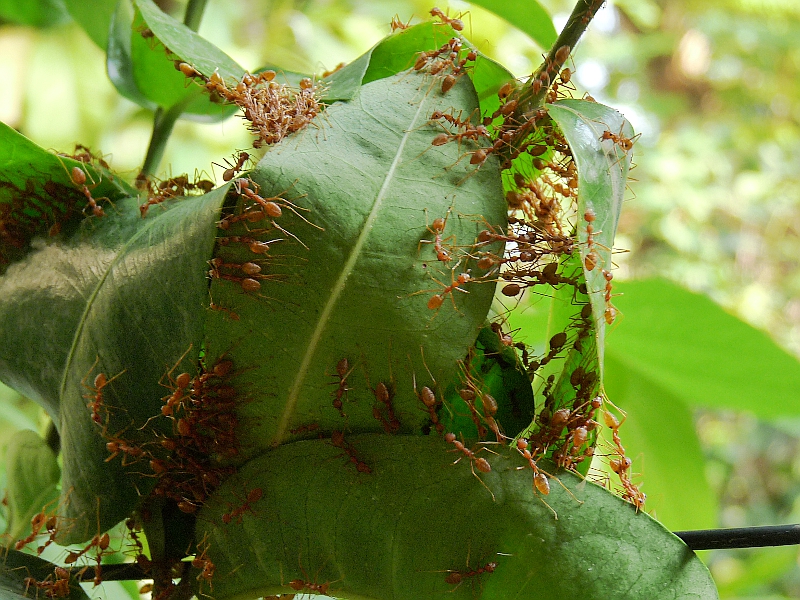
Many summers passed. The house next door changed owners and the gooseberry tree became a casualty of renovation activity. Thriving on the sudden gift of sun our tree grew taller than the house. The bedroom upstairs, where I slept, offered a vantage into its dark canopy. From this comfortable indoor hide I'd watch tailorbirds and warblers flick away the dead bark for insects. Slithery vines gripped the trunk, threatening to strangle it, but the tree held its own. Columns of weaver ants marched along the boughs, their translucent bodies glistening a threatening shade of orange-red. Koels took refuge from crows after violating their nests. Shikras perched in the tangle of branches, dismembering rodents, lizards and the occasional pigeon. Squirrels raised broods of fluffy youngsters that chased each others' tails through the jungle-gym of boughs. Rats used it as an escape route. One year, a storm-tossed male Paradise Flycatcher strayed into our garden and flitted about the tree. Crows were already mobbing it.


Even as other mango trees flowered in the neighbourhood, our tree remained fallow. With homemade vegetable compost my father encouraged the tree to fruit but to no luck. One day he wondered aloud if it was time to cut down the mango tree. The tree heard him. That year it flowered. Just a few, scattered blooms but enough to evoke a celebration. We had no fruits but the following year we got a handful of mangoes after the birds and squirrels had eaten their fill. The yield got better with the years and my father proudly gifted his hard-won mangoes to friends and relatives. A few Bonnet Macaques trooped in once and polished off a few but we still had enough to spare.


A tree plunges roots, seeking out water veins. A crack in the wall of the sump demonstrated that our tree was rather thirsty. Roots were also wedged in the foundation of the house, threatening its durability. After years of painful procrastination, my father made a decision: The tree would have to go.


Last year it fruited copiously. We ate its offering with guilty gratitude, quiet but for noisily licking the dense yellow juice as it dribbled over our fingers. That, as it were, was the funeral feast. 


A party of three hired assassins arrived to cut the tree. One was punch-drunk, as executioners often are. Hacking, sawing, chopping... they went about their jobs with businesslike detachment, but not before offering obsequies to the spirit of the tree they were about to fell. Still, the job took four days to accomplish. As the assassins invaded the tree with axes and picks, its defenders burst out in a last savage attack to defend its sovereignty. The men hollered with pain as the weaver ants set upon them, stinging as if there was no tomorrow. In fact, there wasn't. Stung to sobriety, the men relented. In due course, the canopy came crashing down. Then the trunk was hewn away and eventually, the stump was hacked off.


I could not but be reminded of Gieve Patel's immemorial poem, On Killing A Tree:

It takes much time to kill a tree,
Not a simple jab of the knife
Will do it.
It has grown
Slowly consuming the earth,
Rising out if it, feeding
Upon its crust, absorbing
Years of sunlight, air, water,
And out of its leprous hide
Sprouting leaves...

Coward that I am, I stayed away from the gruesome scene, pretending to be otherwise occupied. My father phoned when the end came. I shut my eyes and let the truth sink in, and allowed a swathe of childhood to slip into the dark swirl of memory. This year the mango tree will flower in our consciences alone.


Photos by V Venugopal and Bijoy Venugopal

Test-driving the FZ28

Snapped these up with the new box on a walk in the park 
Calotropis gigantea
Calotropis gigantea - one of my favourite weeds, because there's always much happening on its leaves and flowers
Lunch?
See - what did I tell you? This chap was sitting here waiting for brunch
Spider on milkweed
Closer crop. I need a macro lens for any more detail. Donors, listening?
Tulip Tree
'Tis the season for Tulip Trees
.