We’ve moved! Here’s where you can find us

The Green Ogre is now at https://www.greenogreindia.org
Showing posts with label Calotes versicolor. Show all posts

Heads and Tails: The Snake and the Lizard

Pankil Desai recounts a most amazing and suspenseful encounter between a Green Vine Snake and a Calotes lizard


It was a regular sunny day and I was in my hostel room at the National Institute of Technology Karnataka, Surathkal. At around 11:30, I got a call from an unknown number informing me of a snake spotted nearby. It was not new for me to get such a call. I had volunteered with the Gujarat Society for the Prevention of Cruelty to Animals (GSPCA) earlier and many people knew that I rescue snakes from human-reptile conflict zones. Since the snake was in the open, I carried my camera hoping to capture some nice portraits.


I was delighted to see it was a Common Vine Snake (Ahaetulla nasuta) -- it was the first time I was seeing an adult up close. Going closer I saw that it was holding a Garden Lizard (Calotes versicolor) by the neck. 
Trying to capture the scenario from all possible angles, I tried to get as close as possible to the snake without disturbing it. Under no circumstances did I want it to abandon its prey. I dispensed with my kit lens and put on a 28-135 mm lens to get better close-up shots without the risk of scaring away the snake.
I wondered why the snake had not yet started swallowing the lizard though its prey had stopped moving for the last ten minutes. Curious, I carefully moved some twigs for a better look. I was amazed at what I saw. The snake had a firm grip round the lizard’s neck; at the same time the lizard was holding on to the Vine Snake’s tail. I had never before seen anything like that!
The snake desperately tried to free its tail; at the same time it tried not to loosen its grip on the lizard. I think the lizard was very much dead by this time but its jaw muscles had contracted in its bite and remained so even in death. The snake had even started to bleed from the bite wound inflicted by the lizard. The struggle to release its tail from the lizard’s mouth went on for over one and a half hours. 
Finally, after a great struggle, the snake freed its tail and pulled the kill into the nearby bushes to enjoy a well-earned and much-deserved meal. 


Pankil Desai is an engineer with Linde engineering in Vadodara, Gujarat. After his BE, he completed his M Tech from National Institute of Technology, Karnataka in Surathkal, near Mangalore. During a year's break between degrees he volunteered for the Gujarat Society for Prevention of Cruelty to Animals (GSPCA). His work included feeding injured birds and animals, administering basic healthcare, as well as rescuing reptiles from human conflict zones and releasing them back into the wild. During his stint there, he honed his affection for snakes and developed an interest in photographing them.  


Text and photos: Pankil Desai 
Love/ hate/ creeped out by snakes? Enjoy all our snake posts
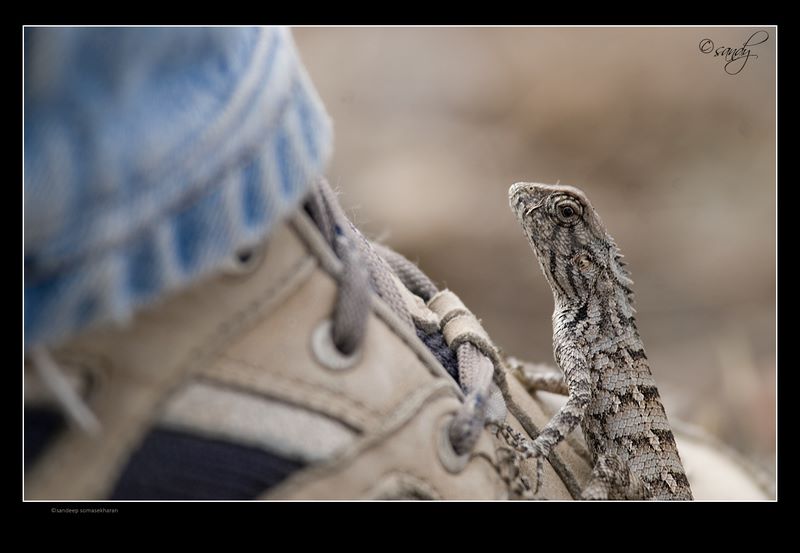
Wordless Wednesday - Don't shoe me away!


Photograph: Sandeep Somasekharan
All rights reserved
View all Wordless Wednesday posts at The Green Ogre
View Sandeep's Flickr photostream

Assassins in the Garden - Part 2 - The King must die

Though far from unique as coconut palms go, this tree had the character of a pioneer settler, in that it had been planted at a time when the surroundings were overgrazed, fallow and barren. No surprise then, that it announced itself as king of the garden. Growing in stature and girth, it ruled the garden for thirty years, meting out light, shade and rain to its subjects - the many smaller plants and trees. To kill it was like overthrowing a king. Regicide, we discovered, was not easy.


When my father constructed his house in 1980 in what would not be called BTM Layout for another decade, we didn't have much of a neighbourhood to speak of. The colony itself -- or "layout", in parlance -- stood on several hectares of scrubland intersected by the rudiments of roads. The gutters, lined with slabs of unpolished granite, sheltered Rock Agamas (Psammophilus dorsalis) and "bloodsucker" (Calotes versicolor) lizards. Snakes and scorpions abounded. So did kestrels and black-shouldered kites, and shrikes, bushchats and robins. Grasshoppers whirred by day, giving up their shifts to crickets at dusk. Those who owned houses on the fringe of the layout reported jackals yapping at dusk. On one occasion a hare interrupted our cricket match. 


The overgrazed land supported few trees. To the south stood a grove of eucalyptus and guava, beyond which a stately banyan hosted an "apartment complex" that predated the concrete ones to follow two decades later. From the rank, guano-stained ground I have stood for hours gazing into the canopy at a heronry of Little Cormorants, Grey Herons, Pond Herons and Night Herons, along with koels, crows and Spotted Owlets. The park that is now the colony's green lung existed in an undrafted vision document (or probably not). An enormous open well stood at its centre, its cavernous depths echoing with the guttural murmurs of pigeons, and the luminous circle of water deep down below rippled by an opportunistic keelback or cobra in pursuit of frogs.


Ever the constant gardener, my father wasn't content with twiddling his green thumbs. In the corner of the front yard he planted two spindly Ashoka trees, which sheltered small bats and doves. There was a curry tree (Murraya koenigii) and a sugar apple/ Seetaphal tree (Annona squamosa) at the back of the house. He also planted a clump of plantains, a green pomegranate tree, and a number of papaya trees (he was the first to show me the difference between male and female papaya trees). On one side of the house, he planted one of my favourite trees -- a beautiful champak (Michelia champaca), whose blossoms perfumed the air and whose ripening fruits with their hard red seeds attracted mynas, barbets and the occasional flock of starlings. The front of the house was smothered by a bougainvillea thicket. To its right was a white climbing rose (in their flowers lived delicate crab spiders of matching hue), and a creeper that had star-shaped lavender flowers. 


In the sunny garden my parents grew roses -- there were as many as 25 varieties including green roses, button roses and one that was so dark that it was almost black. In the shade my mother tended to orchids, begonias and African violets. Nearly a hundred varieties of potted cacti sunned themselves around rocks and stones. The flowerbeds boasted orange nasturtiums, as well as asters, zinnias, gerberas, anthuriums and dahlias. 


Flanking the rose patch, hedged by crotons, stood two young coconut saplings planted in deep pits. In southern India, the coconut tree is treated with extraordinary respect. And it's not just for the economic value of the fruit, which finds utility in culinary and religious rituals. According to Vaastu Shastra, it is auspicious to plant a coconut tree in the yard. Ergo, every house has one.


One of our coconut trees wilted away within a year (in its place my father planted an Areca palm) but the other grew steadily until it started messing with the electric cables. After causing power outages for many years, it outgrew the electric post and since caused no further damage. 


The tree supplied coconuts for innumerable chutneys, avials, fish curries and desserts. Sometimes we had so many that my father just gave them away to anyone who asked. Since every neighbour had at least one coconut tree, it was pointless to try and gift them to those next door. 


Thirty years into its life, the tree stood nearly 60 feet tall, still heavy with fruit. It was the king of our garden, but every now and then it ruled with a heavy hand. In the summer, dried branches and the occasional overripe coconut succumbed to gravity and came hurtling down, missing passersby by a whisker. Having grown straight for most of its life, it now leaned threateningly. In a storm it would list and creak, its crown trembling. 


The king was now an intemperate, moody despot whose wrath was unpredictable. My father made enquiries to see if someone would uproot the tree and cart it away to be transplanted alive. For free, he added. But no one deigned to rise to his bait. 


One day, steadying his voice, he declared that the king shall go. But regicide isn't simple. While killing a mango tree might bleed the heart, bringing down a coconut tree is akin to stuffing a genie back into a bottle. It is a process fraught with potential collateral damage.


The assassins hired to kill our mango tree were also enlisted to fell the coconut palm. But their reverence in this case was far less subtle. They performed an elaborate puja, lighting incense sticks, burning camphor and offering flowers and sanctified water to the tree (it didn't matter that the " head priest" had already sanctified himself with alcohol).


First, the king had to be uncrowned. One of the men shinnied up the tree and began the slow, agonising ritual of lopping off the tender nuts. His comrades and several hangers on fell upon the fruit greedily. Refreshed by the tender coconut water, they hacked away the fronds one by one.


Ropes were fastened to the bare crown. Another man started to incise the trunk midway after the first man descended. The woody bark was prised open, revealing the fleshy heartwood still moist with sap. 


Reduced to half its height, the trunk was marked into segments and chopped down. That once-tall tree, king of the garden, lay in a sorry dismembered mess of fronds and woody trunk. The men chopped away inexpertly at the curly mop of roots, which had drilled deep into the earth. Finally, the base of the tree was excavated. They were finished only when they had pulled down the slender Areca palm, too.


For the next few days, we were silenced by inexplicable grief. In the garden, sunlight streamed abundantly into the yawning wound where once the coconut tree had stood.


The King was dead. Long he had lived. But the uneasy thought gnaws at us still: Could he have lived longer?


READ PART 1: Assassins in the Garden


Text: Bijoy Venugopal
Photos: V Venugopal and Bijoy Venugopal