We’ve moved! Here’s where you can find us

The Green Ogre is now at https://www.greenogreindia.org
Showing posts with label arachnids. Show all posts

Arachnography: A photo essay from Dandeli

As a child they were the stuff of nightmares. My spider sense still tingles, but no longer in fear


I remember having always kept my distance from Arachnids as a child. Quite often have tarantulas turned up in the toilet, and quite often have I persuaded my parents to smash them with a broom. A few have scampered over my body while I was asleep, and many have invaded my nightmares. But since I turned to photography and nature watching, I have made my peace with spiders, and yet retained my curiosity about them. Including those that intruded my personal space.
Spiders to most are justifiably creepy. They crawl, spin webs and drink their victims' juices...
They were everywhere when we went out for a stroll in the forests of Dandeli two weeks ago. And all kinds of them. There were Giant Wood Spiders (Nephilia maculata) and the handsome Black Wood Spiders (Nephilia kuhili), and a couple of (suspected) Leucauge spiders, and several unidentified ones. Mostly, I enjoyed watching and photographing those amazing Giant and Black Wood Spiders, and here is what I saw.
Lady Blackwood?
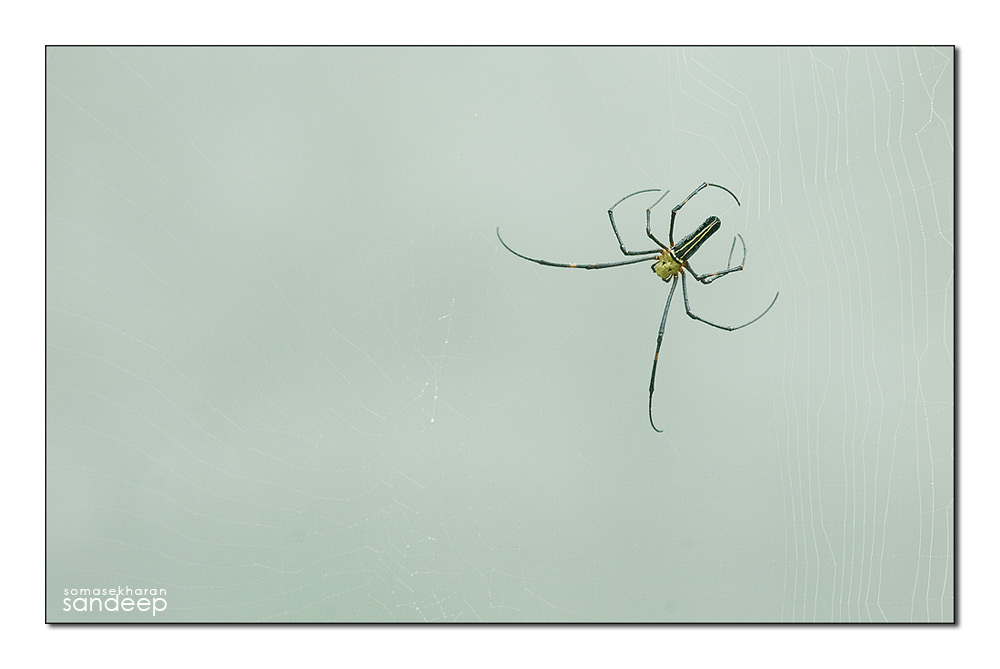
Giant Wood Spider enjoys the quiet of a misty morning
The Lady and her tramp (the tiny black speck to the right is Mr Giant Wood Spider). Talk about equality for women...
Possibly a Leucauge spider - can someone confirm?
The underside of a Giant Wood Spider. Is the red funnel a vent?
Another Leucauge spider performing a high wire walk
Topsy turvy
End of show. That's all, folks!

Text and photos by Sandeep Somasekharan

We don't need no thought control!

Anand Yegnaswami witnesses a bizarre encounter between a spider and a wasp and stumbles into a freakish discovery of manipulation in animals


Mind manipulation is not new to many of us, considering we have watched Jedi Mind Tricks, read about suicide bombers, and seen cricket-playing teams sledge players to get them dismissed. Over time we grow wiser and often recognise patterns that are a prelude to manipulation. But wait, these are just external factors. Imagine a far more malevolent form where we are manipulated from within and would not even be aware of it.
The spider, after it was stung by the wasp
On a trip to Ranganathittu Bird Sanctuary (near Mysore, India), my brother and I chanced upon a rather distinctive encounter between a wasp and a spider. A wasp stung a spider crawling on the ground and the spider turned upside down and “seemed” to be dead; the wasp sat beside the spider “observing” it.


It was a rather singular sight because wasps have no business going about stinging spiders. My brother then explained that the spider was just paralyzed and that the intent of the wasp was to lay its egg in the spider’s abdomen. Once the larva emerges it would feed on the spider’s body until they develop into the wasp. The Pompilidae family of wasps, known as the spider wasps, lay their eggs in the body of the spider after paralyzing it with a sting tipped with venom.


Okay, so what is all this hoopla about mind manipulation?


There exists a species of wasps, the Hymenoepimecis sp., which lays its eggs in the belly of the Plesiometa argyra spider. After being temporarily paralyzed, the spider recovers and goes about its routine unaware of the fact that it is now being eaten from within by the wasp larva. When the larva is ready to pupate it releases a chemical to manipulate the spider into building a web to enable the creation of a cocoon. This web is different from the usual web that the spider weaves. The wasp larva then feeds on the spider and builds its cocoon with the web. 


Was that spooky enough for you? 


Hang on, that's not all. There are other such parasites in the animal world that alter the phenotype (essentially an organism's characteristics of behavior, development, morphology etc.) of the host species.


A cat-and-mouse game is thrilling to watch because the cat never gets to catch the mouse – a reason that can be attributed to the popularity of the cartoon series Tom and Jerry. It would be an anticlimax if the mouse were to walk up to the cat, pull its whiskers and say: “Eat me.”  


No, this is not a chimera. At the most it is an exaggeration because there exists a parasite -- the Toxoplasma gondii -- that infects rats and mice and alleviates their fear of the scent of cats, thus drawing them to their predators. Okay, I made up that bit about pulling the whiskers and demanding to be eaten for I haven’t yet come across a mouse that speaks English (except Stuart Little maybe). 


The parasite attacks only the specific characteristic of the mouse that relates to the fear of cats, so it is unlikely that the you might find the rat climbing up the table to share a meal with you (with the exception of Remy from Ratatouille).
The spider now carries the wasp's egg inside it
Toxoplasma gondii is just one example of the mind-manipulating parasites. Then there is the Gordian Worm, which infects crickets and induces them into the suicidal act of jumping into a water body so that the worm can swim away. Flukes -- parasitic flatworms belonging to the class Trematoda -- are known to wreak havoc on the phenotype of aquatic species like cockle and coral polyps. In these aquatic species the Trematodes impair the ability of the host to evade the host’s natural predators (such as aquatic birds and coral-feeding butterfly-fish). Lancet flukes are known to cause an unusual behavior in ants, where they cause the ants to cling to the top of grass blades from dusk to dawn and risk being consumed by grazing animals. 


Isn’t that suicidal behaviour, you may ask? For the intermediate host, yes. For the parasite the effects are beneficial, for it continues its life-cycle inside the body of the grazing herbivore that ingested it.

Many parasitic relationships mentioned above deal with the intermediate host. Given this information we can understand that the intermediate host is just a vehicle for the parasite to enter the body of its preferred host. The parasite manipulates the intermediate host to gain access to the preferred host, which is higher up in the food chain. Once consumed by the preferred host the parasite too reaches its ultimate destination, with the intermediate host sacrificed in the process. There can also be more than one intermediate host. Lancet Flukes first reside inside snails, followed by a stint inside the ant, and eventually in the liver of grazing animals like sheep. In the case of the spider and cricket the manipulations ensure the safe exit of the parasite from the host’s body.

All forms of manipulations are driven by a purpose and in the natural world manipulation is as essential for the survival of the fittest as fitness itself.


Text and photos by Anand Yegnaswami
Read more posts in our Encounter series

Encounter with the tiny giant - The Giant Wood Spider


Male and female spiders are not exactly lovey-dovey. The female ends up feeding on the male soon after mating or, in some cases, even before he mates with her.


Posted by Arun

Spiders have always fascinated me. These arachnids, even though they are considered a lesser order of creatures, have always been the awe-inspiring tigers of the miniature world to me. Among them there are tiny spiders the size of ants (or even smaller) and big ones that can hunt and devour birds. But until recently I did not have the good fortune to see the Giant Wood Spiders, which are commonly found in forests, wasteland and gardens.


The D-day came when I had gone for spotting vultures at Ramnagara. It was a cloudy morning with slight drizzle when I started climbing Ramadevarabetta. As I started searching for birds in the canopy, all I could find was spiders. Spiders all around -- big ones with equally big webs. They were the wood spiders, the giants themselves. I soon lost count of how many there were. In some areas where the canopy opened up, it was criss-crossed with the spiders and their webs. It was more than I could ask for!


A sky full of spiders!
While observing them, I found individuals of the same size and shape but different colours -- one was black and yellow, and the other black and reddish-brown/orange. Although I found this interesting, I didn't bother much, thinking that they could be just morphs and went on to take a few snaps of both. A couple of days after the trip, this difference in colour was still at the back of my mind. So I went ahead and did a little digging on the web (not the spiders', but the Internet). That's how I found that they were not just morphs but two different species of the genus Nephila. Nephila maculata and Nephila kuhlii Doleschall (courtesy: http://www.southindianspiders.org/).


Female Giant Wood Spiders (Nephila maculata) have a white carapace (upper front part) and a black abdomen with yellow longitudinal bands. Their legs are long, thin and black with yellow markings near the joints.


A female Giant Wood Spider
Female Black Wood Spiders (Nephila kuhlii Doleschall) have a black carapace and abdomen with thin, reddish-brown/orange and black legs.


Female and male Black Wood Spiders
Males of both species have the same colour -- reddish-brown/orange and are much smaller than the females. The male of the black wood spider can be seen in the above picture, perched on top of the female.


Speaking of sexes, male and female spiders are not exactly the 'lovey-dovey' type. Sexual cannibalism is very common among spiders; that is, the female ends up feeding on the male soon after mating or, in some cases, even before he mates with her. In the case of the giant and the black wood spiders, the males always linger around the female, usually at the edge of her web, waiting for the right opportunity. He gets just enough time to approach, entice and mate with her and make a hasty retreat or risk becoming one of her meals (check out "Safer sex with feeding females: sexual conflict in a cannibalistic spider" at http://beheco.oxfordjournals.org/).


Here, among the tiny giants, are the dwarfs -- the males among the females!


Text and Photographs: Arun Menon 
Arun also blogs at Idle Mind

Walking in the sky


Against the backdrop of the friendly neighborhood, this funambulist climbed steadily into the sky, dwarfing birds and other passing aircraft.