We’ve moved! Here’s where you can find us

The Green Ogre is now at https://www.greenogreindia.org
Showing posts with label encounter. Show all posts

Encounter: God, Darwin, Ali and the Blue-capped Rock Thrush


In the foggy ruins of time, most memories can get blurred, or muddied entirely. But not a birder's remembrance of a cherished bird. The story of me and the Blue-capped Rock Thrush involves God, Darwin and Salim Ali -- playing significant bit-parts.


Back in the day when I believed that God had created the world, I honoured periodically a votive my mother had made to send me with my father to Sabarimala, a hill shrine in the southern Western Ghats reached after a half-day pilgrimage on foot from a check-dammed river that curls sluggishly at its feet. I loved the vagabonding, and the uncustomary walk in the forest. It’s been two decades since I last went. That temple – now among this land’s richest, and visited by 300,000 pilgrims daily in the season – occupies more acreage than it did then, what with the permanent habitation enveloping it. That sorrowing forest river, Pamba, swirls now with plastic, detritus and the excrement of pilgrims too blinded by devotion to consider what their ecological footprint has stamped out. It’s another matter altogether that somewhere between then and now Messrs Darwin, Sagan and Dawkins interrupted my religiosity with questions of pressing urgency, eroding it first with guilty discomfort but eventually washing it away albeit without disrespect to the forces worshipped by those who had brought me up. 


That said, some nights when I attempt to command my mind to sleep as effortlessly as I did as a child, the temple and the forest surrounding it surface from my subconscious, embellished with shards of innocuous untruth, deliberate fictions that soothe and console the pangs of losses irreparable in this lifetime.


When that comforting reverie takes hold, I feel the moist trampled earth comfort my aching bare feet, the damp of the forest condense on my shirtless back, the overwhelming scent of vegetation. I hear a faraway chuckle, then see the bough of a forest tree bend and swing as it receives the crashing burden of a leaping Malabar Giant Squirrel. I always hear birdsong – the jubilant squeals of Hill Mynas, the sweeching of Scarlet Minivets, the percussion of White-bellied Woodpeckers, the squabbling of Rufous Babblers, the trilling of Chestnut-headed Bee-eaters...


Sans field guide or binoculars, my birding was incidental and a touch surreal. Sometimes the shadowy shape of a bird would announce its presence urgently, fleet past and melt into the jungle. Malkoha? Drongo-Cuckoo? I’d peer, I’d dither, but I could not afford to linger: A pilgrim must stick with his flock. Thus, many sightings were approximated, assumed and, not unwittingly, concocted.


Yet, one encounter I remember clearly. It was December, a few weeks before Makara Jyoti, and our pilgrim party was camped in the muggy shade of a tin-roofed shelter, open on three sides, with the bare ground for a floor. Gruel was cooking on an open fire. Robber-flies were hunting winged things infatuated with my fragrant preteen sweat. Bitten by both, scratching, and tolerating the misery of that tropical afternoon (and dreading the imminent night that would tempt airborne roaches out of uncharted crevices), I gazed longingly towards the tops of trees in the forest verge that began about twenty metres from the shack.


Jungle Crows, sparrows and mynas abounded. Red-whiskered bulbuls overreached to filch morsels. As I watched lethargically, an unfamiliar bird flew into view. It was smaller than a myna, dull, slaty-blue with a rusty brown breast. It lingered, unafraid, doing nothing. It just perched there on the steel beam and looked idly about.


My birder’s eyes, schooled on Collins and field guides of suchlike Imperialistic abstraction, tagged the bird as a thrush. I noticed the aspect, the overall blue appearance, large black eyes, rich rufous chest and belly, white patches on the wings, and the bluish grey head. I watched the bird for a good five minutes before it flew away into the forest. I didn’t see it again until I embarked on informed birding a few years later. I made a mental note then and later an entry in my diary: “Blue-headed Thrush”.


In 1989, when I got my first legitimate field guide – Salim Ali’s 'The Book of Indian Birds' – this was the first bird I looked up. Turning the page feverishly, I was pleasantly surprised to discover that I was almost correct. This was Monticola cinclorhynchus, the Blue-capped Rock Thrush.


Every time I see the Blue-capped Rock Thrush – and I have seen it frequently in southern India in winters and in the Himalaya in late spring and early autumn – I am reminded of myself at twelve, a scruffy, itchy pilgrim gazing in rapture at a sprite, a vision, a gift of the forest.


Thank God, or whoever is in charge, for that epiphany.


Text: Beej
Photo: Sandeep Somasekharan


Read all Encounter posts

Encounter: Large-tailed Nightjar

When the dim, shadowy silence of the leaf-litter suddenly takes wing, it's either a ghost or a nightjar that sets your heart racing. Our search that began in the hunt for a peacock feather took us to the adorable Large-tailed Nightjar
The Large Tailed Nightjar wrapped up in silence. Notice the white frill on the throat; in some individuals it is supposedly prominent enough to be called a throat patch
"The first bird I searched for was the nightjar, which used to nest in the valley. Its song is like the sound of a stream of wine spilling from a height into a deep and booming cask. It is an odorous sound, with a bouquet that rises to the quiet sky. In the glare of day it would seem thinner and drier, but dusk mellows it and gives it vintage. If a song could smell, this song would smell of crushed grapes and almonds and dark wood. 


The sound spills out, and none of it is lost. The whole wood brims with it. Then it stops. Suddenly, unexpectedly. But the ear hears it still, a prolonged and fading echo, draining and winding out among the surrounding trees".


J.A. Baker (The Peregrine)
The peafowl feather that led us to the nightjar
It all started over a feather.


It was a nice November afternoon, hotter than usual, and I along with four kids, including two of my own, was looking for bird feathers in an overgrown corner of the garden. I located a peacock feather, not the regular ornate one that Krishna prefers but one from the bird's flanks – a lovely feather with alternating bands of white and darkest grey. As I proceeded to inform everyone the name of the feather’s owner a voice called out from the deepest bushes.


Voice from the bushes: “This feather does not belong to the peacock”
Me: “Then?”
Voice from the bushes: “It belongs to a brown bird!”
Me: (Convinced he has seen a Peafowl fledgling) “It’s the young one you are looking at.”
Voice from the bushes: “No, it flew.”


Peafowl fledglings do not fly. They make a beeline behind their mother and tirelessly move about the garden, in perennial awe of the marvelous world around them. So that’s what we had - a brown bird that flew from the ground under the bushes one fine November noon!
Excellent camouflage - the bird is strongly patterned yet merges with the leaf litter
I did not have to wait long. The very next day as I walked down a garden path, crunching leaves underfoot, a pigeon-sized brown bird took off from near my feet. Before I could recover and take the next step another flew. Then another. It suddenly dawned on me that I had seen my first nightjar, specifically the Large-tailed Nightjar (Caprimulgus macrurus) by inadvertently disturbing its roost. Henceforth, the afternoons were occupied.


It soon became clear that the nightjar preferred regular roosts. Also, if disturbed, it flew in pre-set hops to other roosts. So, actually, it had a few favorite roosting spots. Every afternoon I would know I could look for it at any of the four locations and if I was careful enough, it allowed a close enough approach for naked eye observation. There was something mesmerizing about the way it sat crouched amidst the litter. Never did it ever betray a slightest hint of movement, not even a blink of its eye. Neither did it take undue alarm at my approach (except when I got too close it flew to another of its roosts). The camouflage was perfect – if I did not know it was there, I could never have located it except when it flew. Quite often I would scan a roost knowing it is around and miss it completely. The silence it wrapped itself in made the camouflage perfect.
The first thing that struck me was its flight. Except for the sharp rustle of the dry leaf litter at takeoff the flight was absolutely silent. It was not slow, it was quick enough for a getaway but as the feathers cut the air there was no audible sound – no swoosh, rustle or whisper. The flight itself was a bit awkward – like a drone dipping sideways, alternating on each side, revealing prominent white wingbars -- which really are the buff tips of the coverts. The noontime flights were always short – they were more like quick darts to another roost. 
Usually, as soon as the bird took off, it quickly gained height and descended to another roost barely 50-70 m away, most often on the other side of a wall or barrier, but sometimes below another bush and occasionally in the open but always in abundant leaf litter. Sometimes, it perched briefly on a branch, always along its length (never crosswise) and then quickly descended to roost. So eager was it to get to a roost that, occasionally, it descended too soon, discovered a barrier and had to turn sharply to evade it.
The beautiful liquid eye, the thin broad bill and the whiskers
Other times the bird remained quiet, well concealed and well camouflaged, but looking out with large, oval liquid eyes, which certainly gave it excellent peripheral vision and remained ever open. The wide gape of the bill reminded me of the Frogmouth, as also the small whiskers near the beak -- which was wafer-thin and enormously broad at the base, resembling an equilateral triangle.
The breast has a neat parting and a mottled appearance. The buff edges of the scapulars create the side wing-bars.
The tail was thick and square; the primaries crossed over the back had thick rounded ends. A very prominent white stripe ran from the base of the beak across the face and below the eye. The feathers of the chest were neatly cloven and gave off a very mottled appearance (the general pattern being close to that of Mottled Wood Owls). The colors were shades of grays, buff and browns, with some black on the scapulars prominently edged with buff. There was a very prominent horizontal frill or “white beard” just above the parting of chest feathers. This is also described as a prominent white throat patch in some accounts but it appeared more as a frilly bib to me.
The roosts were all in well-sheltered places -- the sort of nooks where one might walk past without peering in.
This roost is against a masonry wall and below a thick bush. There is no approach from three sides.


A neat nook amid reeds - thick vegetation covers it almost entirely. The Nightjar was in the small cave-like opening in the middle.


Against an overgrown bank -- this was my best view. The first and the third picture from the top are from this roost.


This may be a nigh jar feather -- can't be certain, though. Any guesses?
Towards the end of the week I saw the Large-tailed Nightjar much better, especially if it was present in one of the roosts. I tried to locate more individuals in the garden but had no luck before alarming the birds into flight. Also, I never spotted it at night. Some nightjars are known to sit on roads at night but I never encountered the Large-tailed Nightjar along the roads near the garden, or any path in the garden itself. It's quite possible that this species does not take to the roads -- though I will have to continue to look.
Text and photographs by Sahastrarashmi
Read all Encounter posts on The Green Ogre

Hail to the leopard, spirit of the forest

In the presence of two regal cats we watched mesmerised and awestruck. Some of that aura rubbed off on us


I have wandered only a handful of forests. Most wildlife enthusiasts might have traveled more in one year than I have over the last five. So I never complain about not having seen most of our mammals including the nation's heartthrob, the tiger.


But I have always worried about not having met His Highness the Leopard. The jungles I have roamed have plenty of leopards and I have come across ample evidence that pointed towards their activity. In some cases I have missed the beast by a hair's breadth: scores of pug marks, plenty of scat, but no leopard.


While I think of the tiger as a samurai -- bold, always in the limelight and powerful -- I equate the leopard to a ninja -- silent, cunning, unseen and deadly. Maybe I'm getting carried away here so let me cut to the chase and tell you about my first leopard! It's kinda obvious by now that I finally did see one, right?


A few weeks ago I was on safari in Mudumalai (it was in fact the first safari of the trip) along with some like-minded friends. Around 4:45 in the evening we were inside the tourist zone of the park looking at chital and gaur. We were talking in hushed whispers when, suddenly, the watcher who accompanied us called our attention to the other side of the vehicle exclaiming softly, "Leopard, leopard!" 


At the sound of the word the adrenalin rush I felt must have clocked 240 kph. I frantically scanned the area to which he pointed. I was afraid that the cat would slink away into the undergrowth.


Then, through the dense clump of bushes I spied rosettes. The driver inched the vehicle forward. And there it was -- a magnificent leopard bathing in the evening sun!
Half asleep and sunbathing
The scene was magical. The yellowish leopard dozing in orange sun-glow just a few yards away. Unbelievable. Unexpected. Lazing nonchalantly, it lifted its head and aimed a penetrating stare straight at us, or should I say through us!
In the leopard's piercing gaze
With the vehicle now silent, we sat watching and photographing the leopard for more than ten minutes. It regarded us as if to say, "I know you are ogling but I don't care" and continued basking. The cat was relaxed and seemed least bothered by our presence. We were relaxed because the leopard was.


While we gazed mesmerized, we were shaken back to reality by a sound from the other side. The distant roar of a tiger. The leopard looked in the direction of the sound. We took in the magical suspense of the moment: A leopard on one side and a tiger calling from the other. After a few minutes, before we realized it, the leopard melted into the undergrowth.


We moved on and completed the safari. We did not see the tiger that roared. And whatever we saw after the leopard hardly registered any impact. My thoughts had fastened to the glowing rosetted coat I had gazed upon for ten minutes, and its owner. I remembered the words of the veteran wildlife photographer TNA Perumal: "The leopard is like the spirit of the forest." And I had been blessed by it.
The spirit in all its glory
Text and photos: Arun

Encounter - Chestnut-headed Bee-eater

In the deciduous forests fringing the Western Ghats, look out for the charming Chestnut-headed Bee-Eater


Bee eaters are probably a bird-lover's (and photographer's) favourite birds -- breathtakingly beautiful, amazingly acrobatic and acquiescent. Early into my birding days, I ran into the Chestnut-headed Bee Eater (Meropus leschenaulti) when I had imagined that the Green Bee-eater (Merops orientalis) was the end of the road to birding bliss.
A Chestnut-headed Bee-eater looks out from its vantage near Valparai, Tamil Nadu

The chestnut head and crown are definite pointers to identification. A chestnut-and-black line runs horizontally at the base of the neck, under the off-white/ cream-coloured cheeks and chin. The chestnut on the head tapers back, well beyond the shoulders to blend into the rich foliage-green of the wings and tail. The body, breast down to the vent, sports a lighter shade of green, and the inner tail-feathers are a dull olive.
Perched on a mud bank, maybe near a nest, near Valparai, Tamil Nadu

Quite a few people, in my experience, confuse the European Bee Eater (Merops apiaster) and the Green Bee-eater for the Chestnut-headed. The chestnut head in this species is darker in comparison to the golden-yellow of the Green Bee-eater in breeding plumage, and the cheeks are off-white, compared to the blue cheeks of the Green Bee-eater. The European Bee-eater, too, sports a chestnut crown, but it ends a little above the forehead, and then a dark band like a highwayman's hood runs over the eyes. In the Chestnut-headed Bee-eater the chestnut runs all the way to just above the beak and over the eyes, and ends in a dark line under the eye.
Showing off the bold brown collar
If you are straining against the bright sky, unable to discern the colors, the tail is an easy giveaway. The long spike, present in most bee eaters, is absent and the Chestnut-headed Bee-eater's tail ends in a shallow w. The call is a repetitive 'trill' -- gruffer than the Green Bee-eater's -- while perched and in flight.


Chestnut-headed Bee-eaters are agile on the wing, capable of swift flight and spectacular aerial sallies. They wait on open perches, tossing their heads from side to side, keeping a keen eye out for insect movement. A patient observer may be rewarded with the sight of them snapping up wasps, dragonflies or butterflies at arm's length. Then the birds return to the perch, repeatedly beating the prey, which is still clasped in the bill, against the perch to separate the stings.
This is typically how you might encounter the Chestnut-headed Bee-eater - on an open perch in a forest glade

The Chestnut-headed Bee-eater nests in holes on sand embankments. They are common in south India, and I have spotted them in several places in the Western Ghats including the Anamalais. I have heard stories about village children raiding the nests with playful curiosity, but thankfully those occasional incidents remain the only threats to these lovely birds, loss of habitat and natural predators notwithstanding.


Text and photos: Sandeep Somasekharan
See all posts in our Encounter series

Encounter: Indian Silverbill

If coochicooable was a word, it would fit the Indian Silverbill


My first memories of fellow Ogre Sahastra are tied to a photograph he posted in the Infosys photography club. The first was of a group of tiny, brown birds with beautiful conical beaks shining like metal, perched on a plant reduced to sticks by harsh summer. And the bird's name sounded like a wind chime tinkling.


Indian Silverbill.
If 'coochicooable' was a word, it would fit the Indian Silverbill
Immediately, I was intrigued by the Indian Silverbill or White-throated Munia (Euodice malabarica) and recognized it the moment I saw it in Mysore. The birds, always in a flock, perched on tall grass stalks, flitting from one to another, stealing an occasional private moment to plant tiny kisses on each other.

The Indian Silverbill blends into its surroundings thanks to its dull plumage
Since then I have seen them everywhere in small groups, feeding on tiny seeds of grass in scrublands. Often, their small size renders them invisible -- they are even smaller than sparrows -- and when you step into the grass, you can see ten or twenty suddenly take flight, making soft cheeping noises.
The birds huddle close and whisper gossip
At times they huddle together on a single stalk perhaps to share body heat in a cold breeze, or face each other and peer at something far beyond, their tiny eyes tinkling.

Text and photos by Sandeep Somasekharan
Read more posts in our Encounter series

Balcony Bugwatch - Love song of the Carpenter Bee

Nikolai Rimsky-Korsakov might have feted the Bumblebee in music but it is the domestic life of the Carpenter Bee that inspires a fitting paean. How about one by the Carpenters?


My wife and I had seen the Carpenter Bee buzz past us as we stole a furtive smoke on the balcony, but we never imagined that it lived there. Until, with a menacing hum of blurry wings, the walnut-sized insect drove our little daughter back into the house in a frenzy of sheer terror.

Of our two balconies, the one adjoining the bedroom is narrower and shaded most of the time by a bamboo chik curtain. For many days we had noticed a trail of fine, powdery wood dust, along with enigmatic yellow stains that stippled the floor. What might they be, we wondered.

Slowly, the curtain lifted on our little mystery.


It appeared that the bee, true to nature, favoured the circular hole of the bamboo poles that anchored the curtain. Several times during the day, we'd see it approach the hole at the far end, landing gear at the ready. Even when the curtain was lowered, the metallic blue-black flying machine would have no trouble locating it.

Now, it helps to know that the Carpenter Bee, despite its appearance, is not the same as the Bumblebee. The latter insect is social and lives in colonies but our Carpenter Bee maintains a nuclear family. Also, the Bumblebee's hairy abdomen sets it apart from the smooth, shiny bottom-parts of the Carpenter.

Heard the laugh track of the Nilgiris?

While walking in the Nilgiris, listen closely for the guffaw of the Nilgiri Laughingthrush. And treasure it, for you'll hear it nowhere else on earth
When I had first laid my hands on a Sony prosumer camera I found I could photograph birds within reach, and the target of one of my first attempts was a Nilgiri Laughingthrush, otherwise called the Rufous-breasted Laughingthrush or the Black-chinned Laughingthrush (Trochalopteron cachinnans). I first saw the bird on a trip with my parents to Doddabetta, a peak near Ooty. Kannada for 'the large hill', Doddabetta is the second highest peak in south India and the highest point in the Nilgiris.
As we walked about like regular tourists, bracing against the strong chill wind, I saw a unique bird -- with bushy white eyebrows and captivating, red eyes -- hop about on the macadam not far from the tourists. Incredibly, it didn't seem perturbed by the crowd - something you can observe only in Doddabetta.

Encounter: Looking up the Moose's nose

Someone once told not to look a gift horse in the mouth checked the dental signature of a Moose instead and discovered 12 molars, 12 premolars, 6 incisors and 2 canines. Oh dear, a moose is actually a deer, as Ogden Nash evidently knew!

Confronted by a mouse or moose,
You turn green, she turns chartroose.


- OGDEN NASH
From "GOOD-BY NOW OR PARDON MY GAUNTLET"


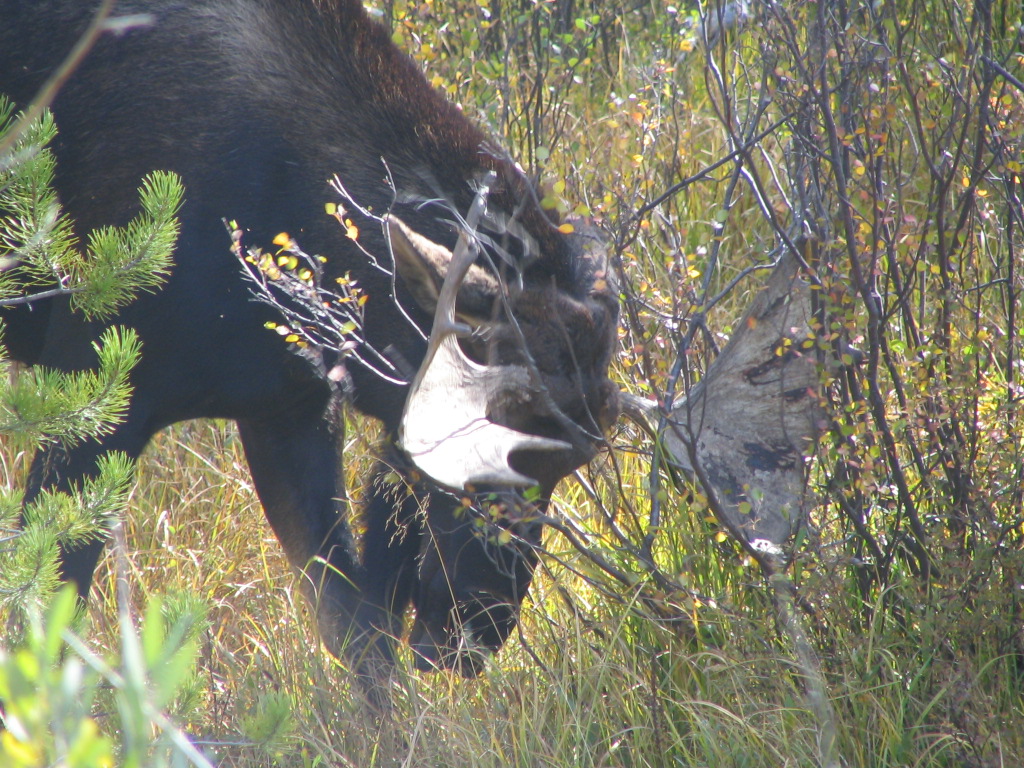
My first encounter with the Moose (Alces alces) was in the Rockies in Colorado. It was mid-September and Fall was round the bend. We chanced upon a bull while driving through the Rocky Mountain National Park. As we clicked pictures it was joined by a cow.

Moose rubbing its antlers against the brush signifying the beginning of the breeding season
Four years later I encountered the moose again in and around Denali National Park, Alaska, around Labor Day. Fall arrives early in the northern reaches and the park officials warned that it was rutting season for the moose and any close encounters with a bull were fraught with risk as the beasts are most aggressive then. We saw a few moose from a distance (not including a skull at one of the interpretation centers).

Moose are the largest deer and often the personification of raw power. They are even considered dim-witted if I were to go by a character in a comic series I used to read two decades ago. They are widely distributed in the northern reaches of USA, Canada, Scandinavia and Siberia. A race known as the Shiras Moose is found in the higher altitudes of America's lower latitudes. Once the bull moose has mated it sheds its antlers to conserve energy for winter and regrows them next season. Cows do not sport antlers.


A bull moose
Someone once told not to look a gift horse in the mouth decided to check the dental signature of the moose instead and discovered 32 teeth – 12 molars, 12 premolars, six incisors and two canines. Add to that formidable palmate antlers and a thousand pounds in body weight, and we have a beast we do not want to mess with. The moose also has a pendulous appendage called the “bell” -- a loose flap of dewlap-like skin that hangs below its throat. 

Moose are herbivores and their natural predators are bears and wolves. They have been hunted and humans have found use for everything from their meat to their scat -- which, believe it or not, is often used in making jewelry.

Natural predation and game hunting has had little impact on moose population and this majestic beast continues to roam the northerly landscapes of the northern hemisphere.


And just by the way, Ogden Nash, who wrote those lines about the moose, also wrote this one about the elk, in which, of course, he also referred to the caribou -- and the moose! 


Enjoy!


Moose makes me think of caribou,
And caribou of moose,
With, even from their point of view,
Legitimate excuse.
Why then, when I behold an elk,
Can I but think of Lawrence Welk?


Text and lead photo: Anand Yegnaswami
Other photos: Wikimedia Commons

Heads and Tails: The Snake and the Lizard

Pankil Desai recounts a most amazing and suspenseful encounter between a Green Vine Snake and a Calotes lizard


It was a regular sunny day and I was in my hostel room at the National Institute of Technology Karnataka, Surathkal. At around 11:30, I got a call from an unknown number informing me of a snake spotted nearby. It was not new for me to get such a call. I had volunteered with the Gujarat Society for the Prevention of Cruelty to Animals (GSPCA) earlier and many people knew that I rescue snakes from human-reptile conflict zones. Since the snake was in the open, I carried my camera hoping to capture some nice portraits.


I was delighted to see it was a Common Vine Snake (Ahaetulla nasuta) -- it was the first time I was seeing an adult up close. Going closer I saw that it was holding a Garden Lizard (Calotes versicolor) by the neck. 
Trying to capture the scenario from all possible angles, I tried to get as close as possible to the snake without disturbing it. Under no circumstances did I want it to abandon its prey. I dispensed with my kit lens and put on a 28-135 mm lens to get better close-up shots without the risk of scaring away the snake.
I wondered why the snake had not yet started swallowing the lizard though its prey had stopped moving for the last ten minutes. Curious, I carefully moved some twigs for a better look. I was amazed at what I saw. The snake had a firm grip round the lizard’s neck; at the same time the lizard was holding on to the Vine Snake’s tail. I had never before seen anything like that!
The snake desperately tried to free its tail; at the same time it tried not to loosen its grip on the lizard. I think the lizard was very much dead by this time but its jaw muscles had contracted in its bite and remained so even in death. The snake had even started to bleed from the bite wound inflicted by the lizard. The struggle to release its tail from the lizard’s mouth went on for over one and a half hours. 
Finally, after a great struggle, the snake freed its tail and pulled the kill into the nearby bushes to enjoy a well-earned and much-deserved meal. 


Pankil Desai is an engineer with Linde engineering in Vadodara, Gujarat. After his BE, he completed his M Tech from National Institute of Technology, Karnataka in Surathkal, near Mangalore. During a year's break between degrees he volunteered for the Gujarat Society for Prevention of Cruelty to Animals (GSPCA). His work included feeding injured birds and animals, administering basic healthcare, as well as rescuing reptiles from human conflict zones and releasing them back into the wild. During his stint there, he honed his affection for snakes and developed an interest in photographing them.  


Text and photos: Pankil Desai 
Love/ hate/ creeped out by snakes? Enjoy all our snake posts

Encounter: Indian Giant Squirrel

Fluffy and tubby, the Indian Giant Squirrel is a treat to watch anywhere you may wander in the forests of peninsular India from the Western Ghats all the way to Madhya Pradesh


The first tell-tale giveaway of its presence is a crashing and rustling of treetop branches followed, sometimes, by a glimpse of a ruddy brown shape scampering through the high branches. Occasionally, you might hear a loud, percussive call that you can't match to any bird you know of. There's your culprit -- the Indian Giant Squirrel (Ratufa indica).

Popularly called the Malabar Giant Squirrel in the south, it is the largest species of squirrel in the world. Placed in the family Sciuridae in the order Rodentia, these furry mammals can grow up to 3 feet long (including the extremely long tail) and weigh up to 2 kg. This arboreal creature is found in deciduous, moist deciduous and evergreen forests of peninsular India.

Though the squirrel is fairly common throughout the Western Ghats and its foothills, until my trip to Dandeli in northwestern Karnataka I'd had only two fleeting glimpses of the giant squirrel. At the Kulgi Nature Camp (where we Ogres stayed) and at the timber depot in the town centre, the squirrels were so unafraid that they went about their activities without a second look at us. After a while I grew getting tired of their antics. Showoffs!

The Indian Giant Squirrel is usually found in the upper canopy and rarely leaves the comfort of trees. It moves along the canopy from one tree to another through interconnecting branches and, in situations where there are gaps in the canopy, it leaps from the end of one branch to a neighboring tree. They have been known to leap 5 to 6 meters from one tree to another. It uses its long tail for balance. When frightened, this squirrel has the habit of lying flat on a branch, motionless, or hiding behind the trunk. These squirrels are mostly active during morning and evening, avoiding the heat of the day. They can be seen lying flat on a branch catching up on their siesta. They are also known to sleep in the nest if the weather is too cold or rainy.


The Indian giant squirrel is heard more often than seen. Its call is a loud and penetrating series of chucks. Thanks to the other Ogres, I recognized the call for the first time in Dandeli. although I had heard it before.

Indian giant squirrels are omnivorous, feeding on fruits, berries, flowers, bark, eggs, insects etc. Adults are solitary and sometimes found in pairs. The female gives birth to two pups after a month's gestation period. The nests are large and spherical, made with twigs and leaves, and are built on the thin branches for safety from larger predators. According to Prater, an individual squirrel may build several nests within a small area and use them as sleeping quarters.

Two individuals we saw at Dandeli perched low on a (barely) leafless tree and fed on berries. They did not appear to be disturbed by us standing directly below and observing them. They seemed oblivious to aerial attack as well. It was amusing to watch them grasp the berries in their front paws and chomp away while they clung to the branch with their hind-paws.


The squirrels' coats may vary from red to brown to black on the upperparts while underparts may be light cream or white.  Their populations are so fragmented and isolated that several races can be distinguished by colour schemes. This has also given rise to disagreement among biologists regarding subspecies.

Even though the giant squirrel is fairly common in our forests, the most immediate threat to the species is habitat degradation due to logging and encroachment of forest land for agriculture. Sensing the threat, the 130 sq km Bhimashankar Wildlife Sanctuary was created in 1984 at Ambegaon near Pune, Maharashtra.


As we left the squirrels to eat in peace, I couldn't help but imagine that, with their paws clasped together, they were imploring us to help save their kind.


Text and photos: Arun
Read all Encounter posts

Would they kill the keelback?

Did that curious crowd know, or care, that the snake we were trying to see off to safety was a harmless albeit aggressive Checkered Keelback?


Here's how to tell a Checkered Keelback from its venomous relatives: Round eyes, checkered scale pattern, keeled scales and the oblique stripes behind and beneath the eye
I didn't really plan to make a habit of writing about snakes and the human folly of mistaken identity, but it appears that the subject seeks me out. Remember the young cobra I had written about some time ago? And the harmless rat snake that could easily have been mistaken for a venomous snake by the ignorant and the fearful?

Heading back from Bandipur last week after a tour organised by the Kumble Foundation (more on that in upcoming posts), we had not yet reached Mysore when a peculiar spectacle beside the highway compelled us to pull over. Two bikes were parked on the verge. The rider of one appeared to be staring hard at something his companion was holding. One chap perched on the pillion of the first bike cradled a live chicken in a cloth bag, its thirsty mouth ajar as it clucked comically in innocent contemplation (perhaps, of its gastronomic destiny). The first rider held in his hands what looked like a snake. By happy accident or design, he gripped it securely behind the head, and the snake did not appear to resist. In fact, it seemed so limp that Arun and I feared it was dead. 

We stepped out of the taxicab to look. Arun, adept at identification, pointed out immediately that the snake was a Checkered Keelback (Xenochrophis piscator), also known as the Asiatic Water Snake. It was olive green overall with checkered markings, which were not as pronounced as in some other individuals that I have seen. True enough, there was the diagnostic oblique black stripe/ band below the round eyes, and the scales on the snake's back were rough. It was almost four feet long and amply muscular.

Questioning the riders, we learned that they had found it on the road in a stunned condition and picked it up to prevent it from being run over. Good move. But now, the folks had no clear idea what it was and what to do with it. I guess they must have assumed the snake was dead. I took it from him, still gripping it securely at the back of the neck.

Keelbacks can bite, and how. As a child I'd seen a cousin savaged as he foolhardily attempted to handle one swimming in a tank. The snake champed hard on his big toe, repeatedly reaffirming its grip even as he tried without joy to release it. He was left with an unsightly sore and ample insult as onlookers jeered his inopportune bravado. Naturalist Rahul Alvares has written about one snake that left a tooth behind in his bite wound!


Memory had not eluded me even as Arun gingerly reminded me of the keelback's propensity for biting. I held the snake gently but firmly behind its thick muscular neck, which felt tough but offered little resistance to my grip. Some scales had been chafed near the right side of the head but there were no flesh wounds, no haemorrhage and no obvious tissue damage. That was a relief. But the snake was in trauma and needed to recuperate safely before it made off. Initially, I suspected it was gravid but given my inexperience, I assume it was only food in its stomach that I was feeling under its skin. Arun pointed out that a fully fed snake would usually disgorge its meal to lighten up before taking flight.


Placing the snake on the ground, I hoped it would shoot off into the bushes, but it stayed put flicking its tongue. Arun and I, as well as some of our fellow-travellers, exchanged worried glances. If the snake didn't flee, it would become an easy target for humans zealous for a show of heroism. A crowd of passing motorists had collected by now and clearly, they anticipated action. I caught wind of conversation -- one expert pronounced that it was a cobra I was holding. In despair, I appealed to the crowd to disperse and informed them that it was only a water snake. I bent down and picked up the snake again, half-hoping that it would turn and bite, as that would offer assurance of its ability to fend for itself. But the keelback was still sluggish.


Diinesh, Arati, Radha and others who were travelling with us suggested that we leave the snake in a quieter place away from the highway. Idiotic as it may appear, anyone picking up a 4-feet-long snake by the tail looks like a superhero to the gawking bystander and I found it hard to shake off the crowd trailing me. Happily, the snake in my hands was now starting to resist, whipping at me with its tail and veering its head around. When I placed it at the foot of a hedge beside some farmland, the snake began to crawl forward but still not at satisfactory speed. Were we within sight of a water body, we could have released the snake into it without fearing for its fate.


Much of the crowd had now dispersed but a few persistent men followed me to investigate this most questionable rescue operation, among them the swaggering stud whose better judgement informed him that the snake was a cobra. "Nagara haavu," he pronounced in Kannada to those about him; they nodded agreement. I pleaded with them to leave the snake alone but they lingered. I was also concerned about holding up the rest of our group so we left the snake, which was now slithering away from the road with what I hoped was renewed determination. 


A pang of guilt gnawed at me for the rest of the journey. Sure, we had averted a roadkill, but would the snake evade that crowd before its idle curiosity turned to ignorant fear, and then possibly to murderous rage? 


I'd rather not know...


Text by Beej
Photos by a very focused Arun (who happily decapitated me in his zeal to photograph the snake)


Love snakes? Read all our snake posts