We’ve moved! Here’s where you can find us

The Green Ogre is now at https://www.greenogreindia.org
Showing posts with label flowering trees. Show all posts

Burning Bright - In praise of the Flame of the Forest


Devoid of flower through the year it is like any other tree pale of trunk and green of leaf. But come March, when the Flame of the Forest burns up the landscape for far furlongs, its incendiary sight you can neither ignore nor forget


I remember Beej telling me about his first visit to BR Hills on damp, foggy morning, and how the Flame of the Forest in full bloom had studded the landscape like the faces of smiling children in a sea of glum grownups. When I saw the spectacle for myself it was an epiphany in itself. 


It was in March last year, when mornings had ceased to be bone-chilling and moved on to what one might call mild and pleasant, that I was on a customary stroll along the bund of the now “ruined for renovation” Hebbal Lake in Mysore. Just next to a fig tree of which I have written some time ago), I noticed a breathtaking transformation. There had materialized a tree, with branches that looked like bare muddied bones covered with orange-red flowers like glowing upturned claws. The morning sun rendered the numerous flowers yellow with gleaming edges. It looked like the tree was smiling - nay, I should say beaming. The name of the tree dawned upon me automatically – from my memory of Beej describing it on one of our trips. Flame of the Forest. Butea monosperma.


A hundred glowing claws
I realized at that moment that I had passed the tree a thousand times without giving it a second glance. I have photographed parakeets and herons perched on its branches without a care for what it may have been. It was just another tree with brown branches and green leaves, innocuous to the extent of being invisible. All of a sudden this tree had transformed into a sight: Its branches conquered by bright orange flowers, as if the tree had gone up in flames. Does spontaneous combustion occur in trees, too?
Tongues of Flame
This year, after returning to Kerala, I had another chance to visit Mysore. My heart bled as I walked along the Hebbal Lake bund, which was razed of the lantana vegetation that grew on its banks (these bushes once resounded with the rapturous calls of White-browed Bulbuls every time we passed them). The only consolation was that the larger trees on the other side of the bund had been left alone. The Flame of the Forest beamed at me, as if glad to see me again.
A closer look at the flowers
Orange flowers like upturned claws, with tiny yellow stamens protruding like snake tongues. In some branches the flowers had given way to fruits – green pods that carry the seeds.  
Look closely and you can't miss the pods that encapsulate the seeds
Numerous Chestnut-headed Starlings, uttering shrill cries, hopped from branch to branch, looking for nectar and drinking themselves to a state of inebriation. Beej had likened the trees he had seen in BR Hills to happy-hour bars in the forest – with so many feathered patrons swilling their free drinks and paying scant regard to the ogling birdwatchers. Could they be blamed? Such a feast is on offer only once a year! 
The hardy tree, which thrives in a variety of climates and topographies, is a medicinally important plant as extracts from it are used in various drugs. Now I am on the lookout for a sapling for my tiny yard. I’d love to have a Flame of the Forest right next to the mango, guava and sapodilla saplings that I have planted.


Text and photos: Sandeep Somasekharan
Smitten with flowering trees? You have to check out The Green Ogre's archive of posts celebrating them!


When Sky Jasmine rained down

The Indian Cork Tree's expended blossoms infuse rare magic into the morning after a stormy monsoon night

I stay on the coast in Pondicherry. My sense of infinity is linked to the sea. It is not confined to poignant gazing at the horizon but often it attains a physical dimension -- like infinite solar energy, pumping up infinite moisture-soaked clouds and, eventually, the infinite deluge.

Often this happens during the Diwali holidays. 

Not surprisingly, the question on the returning monsoon is my favorite weapon to stump a studious class X smart-ass.

Luckily, the second flush of the Indian Cork Tree (Millingtonia hortensis) coincides with the monsoon here. Sometimes, the rains pause to take a breath. One such pause was on the morning after Diwali when I took these pictures.


Five days later...

Three hundred kilometres away in Bangalore, the city's tireless chronicler, Peter Colaco, wrote of the Cork Tree:
It was late in the year, most of the flowering trees had no blossoms. Clinging to the sides of the bowl were tall, stately trees with hanging sprays of white-scented flowers. The botanical name is Millingtonia hortensis and people call it the Cork Tree. But its Kannada name most accurately describes it: 'akasha mallige', sky jasmine.

Text and photographs: Sahastrarashmi

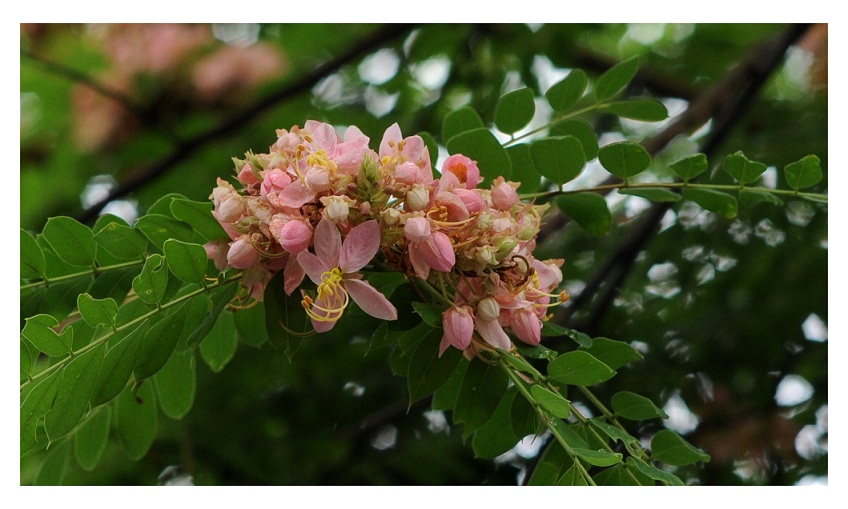
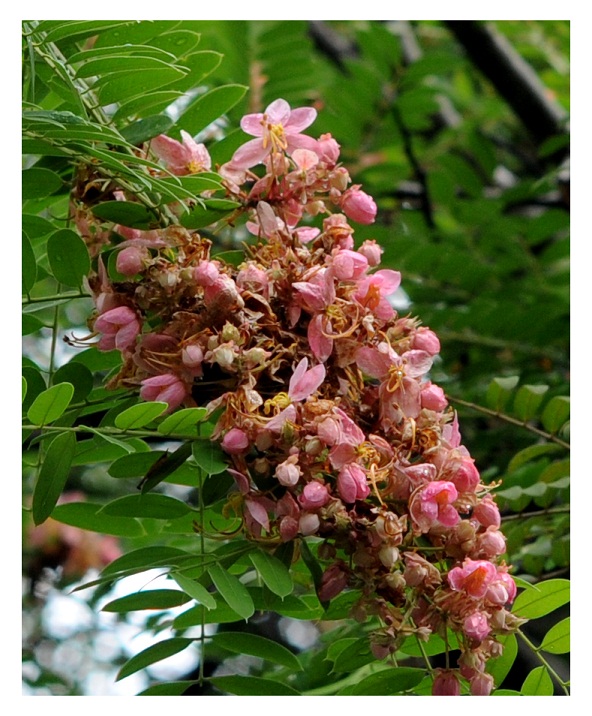
A Red Cassia in late flower

The late-blooming Red Cassia sets the avenue canopy aflame, flowering as it does when all colour is spent after the monsoon's departure

In early August I had posted an encounter with the lovely Red Cassia (Cassia roxburghii) and that was already late for the summer flowering season in the subcontinent. Not so for the Red Cassia, though.
Drenched and parted from the tree during the uncannily timed Diwali showers, a flower on the road hosts an ant
Now that the monsoon has receded from most of the country and only my hometown Pondicherry (and the lower coast of TN) had the singular fortune of torrential rainfall on Diwali, a C roxburghii is in full bloom. The tree does flower late but even most other Red Cassias are now done.

Cassias have the ability to hybridize and I have mentioned very different color variations earlier (assuming the brick-red to be the type specimen). This particular tree at the end of J N Street seems to be yet another variation. The flowers are not brick-red; they have a bit of yellow and unlike the first variation, have plenty of pink. The clusters and the flowers are similar to the red cassia -- three long stamens, curved inwards; unlike those of Java Cassia, they are not swollen in the middle. The rest of the stamens are smaller.
October 28, the Red Cassia in bloom. Not quite as rich as the Java Cassia's pink, but flowering is profuse

The same tree at the end of J N Street in Pondicherry, notice the predominant pink hue
The type specimen - notice the brick red shade of the clusters

Another Red Cassia variation in yellow and pink

A cluster of the specimen in question - a few yellow flowers but mainly pink

Rain-drenched leaves and a pink bunch

Another cluster from the same tree, the browns are creeping in -- dead flowers

Brilliant brick red (with a few yellows and pinks) of the type specimen.
This one finished flowering a month ago
Is this the last red Cassia in bloom? I am tempted to say yes but cannot be certain. If you plan to plant flowering trees in your home garden or along an avenue, do consider the Red Cassia. There is nothing like it to brighten up an overcast day and catch the sun as it breaks through the clouds.


Text and photos by Sahastrarashmi
Read more posts on Flowering Trees

An intimate encounter with the lovely Red Cassia

The brilliant brick reds, salmon-pink and yellow of Cassias light up avenues even as summer wears out its welcome. Sahastrarashmi presents an intimate encounter with the flowering tree as never experienced before
Studio portrait of Red Cassia - the yellow (possibly hybrid) variation


Studio portrait of Red Cassia - the brick-red flowers are interspersed with pink, but from a distance overshadow other shades
The seemingly endless tropical summer tends to linger a bit longer on the eastern coast down south where I live. It’s an extended goodbye, a season that begins to grudgingly allow the relief of a few cool days in an otherwise hot and sultry clasp that stretches on for six interminable months and threatens to last forever. Life runs along in slow motion and all movement requires the extra effort needed to cut through the thick blanket of heat, and is hence discouraged. Few are brave enough to put up a show and among those who do – Cassias win hands-down.
Red Cassia canopy at peak bloom - extreme top canopy
The Java Cassias (Cassia javanica) are the first to erupt in a rapturous frenzy of pink and white, followed by the pendulous clusters of bright-yellow laburnums (Cassia fistula) and as they begin to give in to the onslaught of the unsparing summer, the Red Cassias (Cassia roxburghii) explode. They see the summer out.
The terracotta-red bunch -- this colour defines the Red Cassia
You can be so struck by their resilience that you risk ignoring their astonishing beauty. The mid-sized, mimosa-leaved trees with long drooping branches and shiny green leaves betray hints of a few buds in mid-May. By mid-June the big brick-red clusters are conspicuous and by the end of the month most trees are in full bloom.
A pink cluster from a flowering Red Cassia
The overall aspect of the flower clusters is brick-red and, on closer view, you cannot but notice the fine green veins on the papery petals. The clusters are in reality quite variegated and one of the most stunning features of the flowers are the hues you can find in a single bunch. There is soft-pink, deep-pink, pink with a hint of yellow, brick-red with shades of yellow, terracotta-red, bright yellow and faded white. The clusters can vary in the mix and pink clusters can be seen along with terracotta-red ones. You soon realize that the terracotta red (described as the primary colour by both Pradip Krishen and earlier by Blatter and Millard) is mainly what the eye sees from a distance, a property of the red wavelength, while the profusion of shades is visible only up-close.

While the clusters appear terracotta red from a distance, the flowers sport a profusion of hues


Three clusters - Pink and Yellow, Brick Red, and Pink. The last two are from the same tree.

Flower clusters from a possible hybrid - the clusters are yellow and pink and not terracotta-red - late July
An intriguing property of Cassias is that they hybridize easily and this may be the reason for even more variation. Just next to the handsome specimen with terracotta-red clusters is a variant where yellow flowers predominate with some white and pink – there are barely hints of darker shades (sSee pic of the three bunches above). This can make identification difficult but keep in mind that the other common Cassia, the Java Cassias, are almost always in shades of pink (no yellow or brick red) and the flowers are not only in clusters (towards the end of the flowering season) but cover the branches along the length (see below). The less common Burmese Pink Cassia is also deep-pink in color and the Cassia marginata (common in Mysore) has red flowers but lacks the large bunches as in Cassia roxburghii.
Java Cassia flowers cover the branches along its length.


Cassia marginata flowers (from Lalbagh, Bangalore). Notice the three longer red stamens with maroon anthers. This Cassia is quite common in Mysore

A flowering branch - mid-June
The flower is five-petaled, diminutive with salmon-pink sepals. Each flower has ten light yellow stamens, each with bright red anthers. There are three long stamens, curved inwards but unlike those of Java Cassia are not swollen in the middle. The rest of the stamens are smaller.
Red Cassia stamens have no swelling. The calyx is salmon pink.

Cassia javanica flower. Notice the yellow stamens with the swelling on the three longer ones.
Blatter and Millard trace the tree as a native of Ceylon and mention that it was introduced in India in 1802 (Royal Botanic Gardens in Calcutta now called the Acharya Jagadish Chandra Bose Indian Botanic Garden). Pradip Krishen suggests that the tree may also be native to South India.
Flowers from a roadside tree
Red Cassia in Pondicherry - late July


A view at mid-height -- the flowers are interspersed in foliage. The upper canopy tends to have less foliage while at the peak of flowering.
As I write, the Laburnums are a mere shadow of their once exuberant blooms. Slow brown death is creeping into Java Cassias. The flaming red crowns of most Gulmohars have returned to a verdant green, and the yellow shower of Copper Pods is spent. But the Red Cassias are holding on at their peak. In their limitless palette of colours and fiery blooms, the intense tropical summer finally seems to have met its match.
The petals, up close
Smitten with flowering trees? Don't forget to read our richly illustrated posts on the Copper Pod, the Gulmohar and the explosive beauty of the Cannonball Tree.


Text and Photographs by Sahastrarashmi
Thanks to my friend Shanmugam R for his partnership in photo sessions and explorations in the world of Cassias, from Pondicherry all the way to Mysore via Bangalore.

Encounter: Cannon Ball Tree, an explosion of beauty

In flower the Cannon-Ball Tree is lovely but, by Toutatis, beware the skull-crushing quality of its menacing fruits
The first time I looked up at a Cannon Ball tree, my upward drifting gaze was arrested midway and forced downwards in shock. The reaction, in hindsight, was perfectly natural. Being a great fan of a particular Gaulish village I ascribe to the fear that anything that can fall on your head eventually will. In this case I was staring at huge rusty balls, by all appearance of skull-cracking hardness, hanging 40 feet up in the air and waiting to cause mortal damage to an unsuspecting victim.

Cannon Ball Tree (Couroupita guianensis) is a native of the southern Caribbean and northern parts of South America (Colombia, Guyana, Surinam, French Guiana, Amazonian Ecuador, Amazonian Peru, and parts of Amazonian Brazil). It belongs to the Brazil Nut family and is a botanical oddity. Its unique appearance has ensured its presence in botanical collections worldwide. This evergreen tree, first described in 1775, can grow up to 30 m tall. It seems to have been known in India for hundreds of years – a mystery, since we do not know how and when it came to our shores.


The “odd” feature of the tree is that the flowers and eventually the fruits grow out of woody extrusions from the trunk of the tree. These extrusions can be very small, from an upward-jutting stick adorned with a flower cluster, to a tangled mass of 6-feet long extrusions just below the foliage. When not weighed down by the fruits these extrusions resemble a thorny patch of vines twisted, entwined and jumbled up in maddening confusion, each carrying bulbous buds or fleshy six-petalled scarlet flowers.


Once the fruits develop some of these extrusions will straighten out into long thick rope-like strands with fruits dangling at the end. Wisely enough, the tree has never been used as an avenue tree though a trial plantation in Al Qaeda territory is in order. The fruits, which are up to 25 cm in diameter and take a year to mature, crash to the ground with an explosive sound and crack open to reveal a foul smelling pulp. 


In its native habitat peccaries (New World relatives of pigs) eat the fruits and help spread the seeds. I am not sure if Indian pigs have developed a taste for the fruit yet. The flowers are extremely attractive and aromatic. The petals are scarlet on the inside, with a white base, and yellow outside. There are two sets of stamens. The first, which is infertile, is on the curved hood and are a lovely pink with yellow heads. The hood itself is white and tinged with pink on the exterior. The fertile stamens form a ring at the center of the flower just below the curved hood. These are shorter and have yellow heads. The flower has no nectar and uses the pollen in the infertile exposed stamens to attract bees. In trying to get at the pollen, which the bees use as food, they have to work their way between the two sets of stamens, inadvertently brushing the fertile stamens in the ring.
The large petals, tapered at the apex with the prominent stigma at the center, have been imagined as a representation of multiple cobra hoods around a Shiv lingam. This has earned the tree several Shiva-associated appellations - Shiv Kamal, Kailaspati, Nagalingam, Nagalinga Pushpa, Mallikarjuna, etc. – and lots of survival aid in the form of propagation near Shiva temples. In the native Amazon (where it's called Castanha de macaco, monkey nut) it is a favorite of shamans and is believed to provide protection against the ill-disposed spirits of the netherworld.

The bark of a young tree at the Jardin Botanique in Pondicherry showed dull red granulations along the length and some knobby growth. However, in the mature tree at Bangalore's Cubbon Park the knobs were absent while the granulations, though present, were less conspicuous.
Handsome specimens of this tree can be found in most Botanical Gardens. I saw my first at the Jijamata Udyan in Mumbai (formerly Victoria Garden). There are nice Cannon Ball Trees in Cubbon Park (some pictures here are from this tree), Lalbagh and Jardin Botanique in Pondicherry where I shot this tree extensively. 


Do pay it a visit. I am sure you will love it. But remember the invincible Gauls and stay away from remaining under it. Text and pictures by Sahastrarashmi


If you love flowering trees, you should not miss these other 'encounters':


Darling Buds of May


The Copper Pod


Indian Laburnum - the Vishu Tree