We’ve moved! Here’s where you can find us

The Green Ogre is now at https://www.greenogreindia.org
Showing posts with label monsoon. Show all posts

When Sky Jasmine rained down

The Indian Cork Tree's expended blossoms infuse rare magic into the morning after a stormy monsoon night

I stay on the coast in Pondicherry. My sense of infinity is linked to the sea. It is not confined to poignant gazing at the horizon but often it attains a physical dimension -- like infinite solar energy, pumping up infinite moisture-soaked clouds and, eventually, the infinite deluge.

Often this happens during the Diwali holidays. 

Not surprisingly, the question on the returning monsoon is my favorite weapon to stump a studious class X smart-ass.

Luckily, the second flush of the Indian Cork Tree (Millingtonia hortensis) coincides with the monsoon here. Sometimes, the rains pause to take a breath. One such pause was on the morning after Diwali when I took these pictures.


Five days later...

Three hundred kilometres away in Bangalore, the city's tireless chronicler, Peter Colaco, wrote of the Cork Tree:
It was late in the year, most of the flowering trees had no blossoms. Clinging to the sides of the bowl were tall, stately trees with hanging sprays of white-scented flowers. The botanical name is Millingtonia hortensis and people call it the Cork Tree. But its Kannada name most accurately describes it: 'akasha mallige', sky jasmine.

Text and photographs: Sahastrarashmi

A Red Cassia in late flower

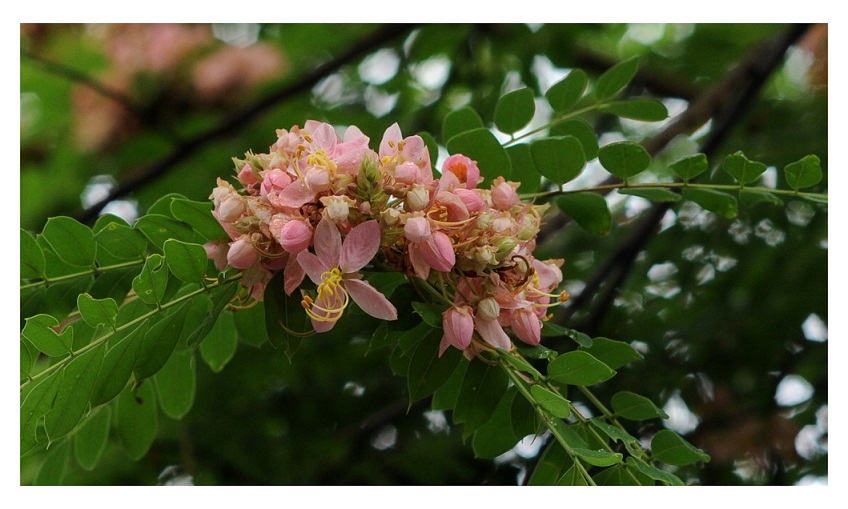
The late-blooming Red Cassia sets the avenue canopy aflame, flowering as it does when all colour is spent after the monsoon's departure

In early August I had posted an encounter with the lovely Red Cassia (Cassia roxburghii) and that was already late for the summer flowering season in the subcontinent. Not so for the Red Cassia, though.
Drenched and parted from the tree during the uncannily timed Diwali showers, a flower on the road hosts an ant
Now that the monsoon has receded from most of the country and only my hometown Pondicherry (and the lower coast of TN) had the singular fortune of torrential rainfall on Diwali, a C roxburghii is in full bloom. The tree does flower late but even most other Red Cassias are now done.

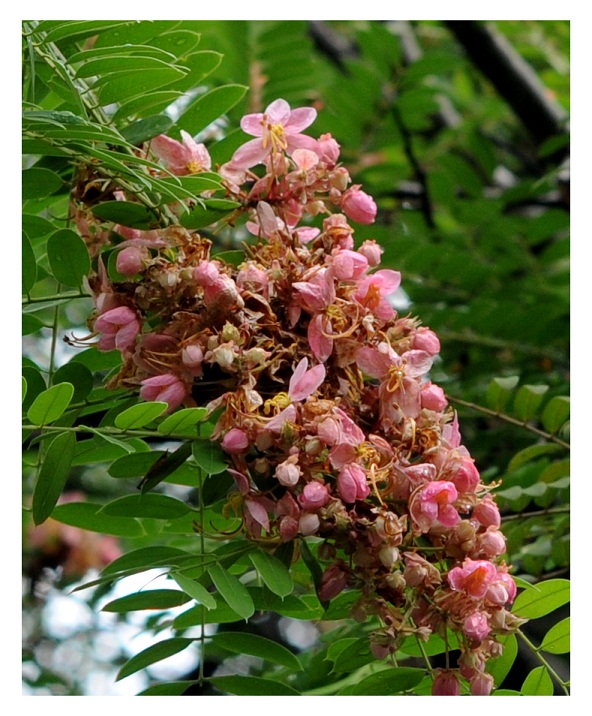
Cassias have the ability to hybridize and I have mentioned very different color variations earlier (assuming the brick-red to be the type specimen). This particular tree at the end of J N Street seems to be yet another variation. The flowers are not brick-red; they have a bit of yellow and unlike the first variation, have plenty of pink. The clusters and the flowers are similar to the red cassia -- three long stamens, curved inwards; unlike those of Java Cassia, they are not swollen in the middle. The rest of the stamens are smaller.
October 28, the Red Cassia in bloom. Not quite as rich as the Java Cassia's pink, but flowering is profuse

The same tree at the end of J N Street in Pondicherry, notice the predominant pink hue
The type specimen - notice the brick red shade of the clusters

Another Red Cassia variation in yellow and pink

A cluster of the specimen in question - a few yellow flowers but mainly pink

Rain-drenched leaves and a pink bunch

Another cluster from the same tree, the browns are creeping in -- dead flowers

Brilliant brick red (with a few yellows and pinks) of the type specimen.
This one finished flowering a month ago
Is this the last red Cassia in bloom? I am tempted to say yes but cannot be certain. If you plan to plant flowering trees in your home garden or along an avenue, do consider the Red Cassia. There is nothing like it to brighten up an overcast day and catch the sun as it breaks through the clouds.


Text and photos by Sahastrarashmi
Read more posts on Flowering Trees

Encounter: Golden Frog

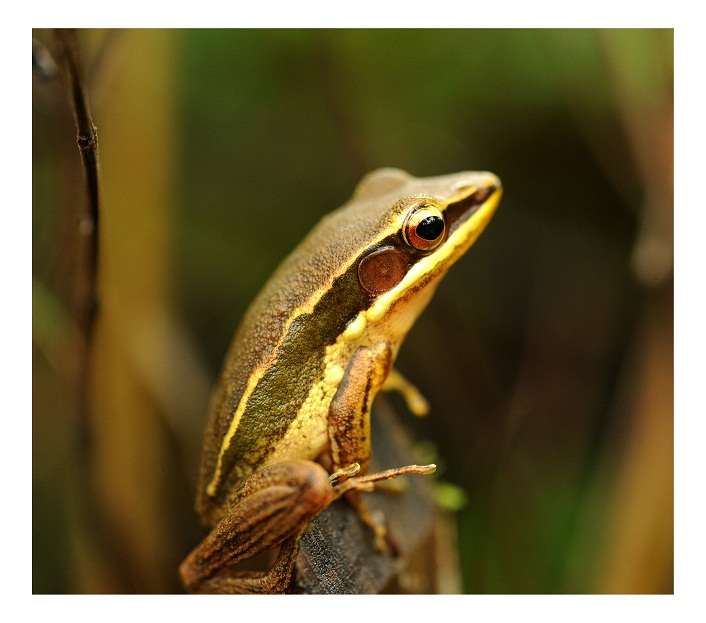
Our very own Golden Frog, a Western Ghats endemic, gave us the cherished privilege of a long and uninterrupted audience

At the outset let me state that the frog we encountered is not to be confused with the Panamanian Golden Frog (Atelopus zeteki), which was last seen and filmed in the wild in 2007. The entire known population in the wild is now assumed extinct and the frog survives only in captivity. Our Golden Frog (Hylarana aurantiaca) is luckier, but the Sword of Damocles of the amphibian world, the fungal infection chytridiomycosis, hangs over its head too.
Frogs have an extremely permeable skin, through which they can absorb oxygen into the bloodstream. Oxygen first dissolves in a thin water film on the surface of the skin and then from there into the blood. This feature, which evolved to aid their amphibious lifestyle, is now one of the reasons for the rapid decline of frog populations around the globe. The permeable skin makes them highly susceptible to toxins in the water. So evolved is this feature in frogs that a lungless frog has been discovered in 2007 in the rainforests of Borneo, Indonesia. The Bornean Flat-headed Frog (Barbourula kalimantanensis) has no lungs and this 7 cm long frog breathes entirely though its skin. The absence of lungs helps it attain a flatter body shape -- a key adaptation to survival in its habitat, fast-running mountain streams, since it aids streamlining and reduces drag. But it is already threatened due to rise in water toxicity due to mining.

We first encountered the Golden Frog during a late evening “frogging” session at ARRS. They were perched on leaves and calling (the vocal sac is internal) but in the feeble torchlight it was very difficult to make out the distinctive coloration, especially the yellow-orange back bordered by two golden streaks – the characteristics that gives them their regal name. The next day I saw a couple of them on the same bushes beside a small monsoonal wetland right outside our cottage and as the excited Ogres scanned the bushes we realized that there at least 20 of them right there. As we photographed them, the frogs maintained the calm and composure of meditating Zen monks. There was no alarm, no anxiety and no visible discomfiture. In fact, as the successive monsoon fronts arrived -- the sequence of mist, drizzle, heavy shower, sunshine, mist played out though the day -- they hardly seemed to move. I observed one of them seated in position for almost three hours. They also seemed to be quite gregarious, seated on leaves, twigs, stems and branches of the bush close to each other.

Hylarana aurantiaca is found in moist evergreen forests, swamps and coastal regions bordering the southern Western Ghats and is probably a Western Ghats endemic since the population found in Sri Lanka is suspected to belong to a separate, yet undescribed, species. It is described as a semi-arboreal and semi-aquatic frog. The frogs we came upon at the ARRS (which has a population of over 200-300 Golden Frogs) were typically perched on small bushes – on stems and twigs – and on large leaves close to the ground. There was a small disused water-logged paddyfield nearby so the bushes were technically at the edge of a shallow water body. Their IUCN status is Vulnerable.

The frog is small in size -- approximately 4 cm from the snout to the vent. The toes are dilated into discs and the middle digit of the toes is longer than the other two. It has three digits on each limb and the webbing is barely noticeable. The skin can be smooth but is often granulated especially on the back due to scattered conical tubercules. The nostril is close to the snout and the tympanum is quite distinct, almost the size of the eye, only slightly smaller.

Hylarana aurantiaca’s distinct feature is a chocolate-brown/olive-green band that runs from the tip of the snout along the flanks to the hindlegs. The eye, nostril and tympanum are all situated on this band. This band is bordered by a bright yellow, almost golden streak running all along the upper border and till the foreleg along the lower border. The back, which is essentially bordered by these two Midas-touched streaks is orange/orange-yellow or olive-brown. The back and the limbs have no barring but for some dark splotches. The eye is black and bulging, the eyelids bright orange. The underparts are creamy white and the skin is a translucent glowing orange when it is lit up by the sun.

Currently, around the world, most of the roughly 5,000 species of frogs are in decline, and we have a very real risk of losing species that are not yet discovered. In India, while 12 new species of tree-frogs were discovered by a team led by S D Biju of Delhi University, Systematics Lab, Delhi, another initiative to re-discover 50 lost amphibians of India (LOST! Amphibians of India Initiative) has yielded just five re-discoveries so far, the prized one being Chalazodes Bubble-nest Frog (Raorchestes chalazodes), unrecorded since 1874. Researchers estimate that we may have lost up to 13% of our amphibians already.

We Ogres cherish the time we spent with the Golden Frogs at ARRS. They were trusting, accessible and -- pardon me for anthropomorphising -- extremely friendly. It was a privilege to observe and photograph them from so close. The Golden Frog is a lovely representative of a species that has a special place in our hearts – be it as a Frog Prince or as a metaphor in Matsuo Basho’s famous Frog Haiku.

Text and Photographs by Sahastrarashmi
Enjoy more Agumbe Diaries

Encounter: Malabar Pit Viper

Little did we know that we were being watched by a silent and mysterious presence on a wooden beam behind us
The first time I went to Agumbe Rainforest Research Station, I remember walking for hours in the night, hoping to catch a glimpse of Malabar Pit Vipers. No luck. This time, on a trip with the other ogres, nearly two full days passed without incident.
The heat-sensing pits between the eye and nostril can be clearly seen
On the second night, Sandy and I were walking towards our tent in pouring rain, guided only by the small beam of my torch. I almost stepped on a twig that lay across my path -- a dry twig that appeared to be mottled with pale lichen growth in bluish green and brown. Except this twig was moving! 

"Stop!" I shrieked. Sandy bumped into me from behind. I guided the torch beam towards the head of the "twig". One good look at the snake's triangular head was enough to conclude that it was a viper. That, in addition to the colour pattern, pointed us in the right direction. This was a Malabar Pit Viper (Trimeresurus malabaricus)!

As I watched the fella slither past me slowly, I asked Sandy to go and fetch the others. As he ran back, I stood there in pouring rain and pitch darkness observing the snake cross the path and slowly enter a dense thicket. At times, when a twig or branch was too high, the snake lifted itself upwards like a straight stick and hooked its head on the twig. Then, it pulled itself up. This behaviour pointed to the snake's tree-dwelling lifestyle. 

By the time Sandy came back with Beej, the viper had almost dissolved into the shrub, aided by perfect camouflage. I was upset that the others had not had a good look at the snake.
The brown markings on green can be seen
Malabar Pit Vipers are nocturnal and are generally found in low bushes, trees and on rocks. During the day they are inactive and may be seen basking. They are endemic to the Western Ghats and are found between altitudes of 600 to 2134 metres. Adult snakes can grow to 55-79 centimeters. The longest ever measured was 105 centimeters. The triangular head is broader than the neck. They are typically green but appear in other morphs and a lot of variations have been recorded, including reddish-brown, yellow, etc. On its back the snake is olive or brown with black or brown spots, which may be joined to form a zigzag pattern. The sides have faint yellow spotting and the tail has yellow and black markings. The pupils have vertical slits. Malabar Pit Vipers are ovoiviviparous -- the eggs form, develop and hatch within the mother's body.

Pit vipers, which are classified under the subfamily Crotalinae in the family Viperidae, are distinguished from other vipers by the presence of a pair of heat-sensing pits located between the eye and nostril. These organs help the snake detect the body heat of warm-blooded prey even in absolute darkness.

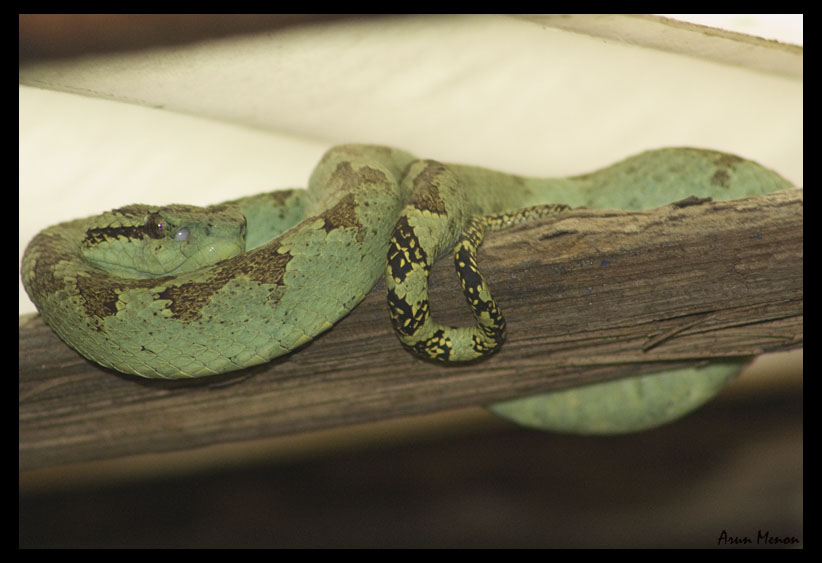
The other ogres were disappointed at missing the snake the night before but at 4 pm the next day, our luck turned. The ogres were busy treating a Vine Snake like a supermodel. After about 20 minutes all except me and Andy left the scene. After lingering for another ten minutes, we decided to go back to the room to pack and freshen up before our return journey. Just as we left Prashanth, the station manager, called out to us. He pointed to a wooden beam just under the roof of the dining area and said, "Look who's sitting here." There lay a Malabar Pit Viper, coiled, calm and relaxed.

Relaxed and lazing

Observing from high above
It dawned on us that all the while, as we were photographing the Vine Snake, this chap was watching the drama from its high throne!

The others arrived and we took good, long looks at the snake. Malabar Pit Vipers have prehensile tails (adapted to grasp or hold) and this perhaps helps them to anchor themselves on branches or twigs while they lunge at their prey. Here, the snake had used its tail as a kind of hinge to loop it against the beam in the absence of anything else to hold on to. 

We made sure to keep our distance as vipers, though slow, are known to be capable of extremely fast strikes. The venom is mildly haemotoxic -- the toxins destroy red blood cells, disrupt clotting of blood, and causes tissue damage. In humans it results in pain and swelling. 
The prehensile tail is used as a hinge in the absence of anything to hold onto
I'm sure the snake wouldn't have wanted to waste its venom on us, and instead save it for the geckos, tree-frogs, shrews, and birds which make up a large part of its diet. Pit vipers have erectile fangs which are kept folded against the roof of the mouth. They are brought into place only when striking.

After we observed and photographed the snake, I asked Prashanth if he would move the snake since it was close to the dining area. To my surprise, he said they would leave it there and let it decide its own way out at night. Though I was a little concerned about slithering vipers that might end up over our heads or under the dining table, I was also glad that ARRS offered a haven for snakes where they had right of way.
Text: Arun
Photographs: Sahastrarashmi and Arun
Read more Agumbe Diaries

The Green Ogre Weekend Update July 10

If you've missed anything this week, the weekend edition of The Green Ogre should sort you out...


I've been away on a family vacation most of last week, soaking up the monsoon in south Goa. Rain-washed Goa is refreshing. The Western Ghats slope down in a verdant riot that skids to a stop beside the ocean, buffered only by deserted beaches of soaked, clingy sand. Butterflies, dragonflies and birds were everywhere. Despite a domestic ban on birding, I sneaked sly glances at stork-billed kingfishers, prinias, spotted munias, black drongos and even a crimson sunbird that dropped by the hotel garden to say hello as I was dunking my daughter in the pool. Gorgeous, I say. And now, having returned sufficiently vindalooed, balchaoed, rechaedoed and bibincaed, I'm pleasantly surprised to see that my fellow-Ogres have been hacking away. 

This week, we continued our Agumbe Diaries and presented more finds from our sojourn in that neck of the deep, dark woods. On Monday, Sahastra introduced us to the Bicoloured Frog, one of the most attractive creatures to hop on the forest floor. In fact, if you're not watchful, you might mistake it for the forest floor itself.
MORE>
Sex is always a subject for steamy discussion. Despite Sandy's depraved jokes about the amatory pursuits of frogs, I gleaned some wisdom from watching all sorts of creatures in love. Dragonflies interlocked in subtle arcs as they mated on twigs. Grasshoppers and bush crickets carried on unabashed, hopping away together only when we almost crushed them underfoot. Lesser Whistling Ducks wheeled in the air, piping joyously, while Rufous Woodpeckers introduced new mates to the treasure trove of ants' nests in the treetops. Love was so in the air, and so inspired were we by monsoon mating mania that that we shot like zoopornographically obsessed paparazzi.
MORE>


Having said too much already, and having pushed this blog to the brink of NSFW-ness, we thought it best to clam up on Wednesday. But then, Arun's busy frame of mud-puddling lime butterflies raised so many curious eyebrows and engendered a spate of new questions.


Dung Beetles aren't the most charismatic of insects. They are dark, round, fat and inconspicuous except when they whir absent-mindedly past your ears or crash dizzily into lamps at night. Worse, their crappy lives revolve around what other animals leave behind. But then again, rain affords you the luxury of time. Time enough to stop and stare at a cow pat for five hours, and we were amazed at how a Dung Beetle made short work of it. Andy essayed this ode to the lowly dung-muncher.
MORE>
Last Day's Luck is a phenomenon that has mystified most nature-walkers. After three days at Agumbe we had heard so much about snakes that we expected them to stalk us from every bush and tree stump. No such luck. And then, a few hours before we were to depart, a Green Vine Snake showed up and allowed us the luxury of a long, relaxed photo-session.
MORE>


Among things that crawl, snakes scare the mojo out of most people. And a leaping frog has been known to turn dull altos into shrieking sopranos. But leeches?! Those eyeless, elastic strips of skin that crawl the mulchy rainforest floor? Sandy is so terrified of leeches that he gave us a hard time on the trip, repeatedly checking under our feet and rushing off unannounced into the bathroom to strip himself down for vainglorious de-leeching attempts. He refused to cross a stream and enter the dark rainforest for fear of his wetting his shoes -- later, when we returned from the walk soaked in rain and bristling with living leeches, he looked relieved that Fate hadn't picked him for that brief adventure. Leechophobia drove Sandy to such a paroxysm of panic that he wrote a fantasy-laced opus on these bloodsucking monsters.
MORE>


That's your weekend edition of The Green Ogre. Enjoy! 

Encounter: Whining for a Vine Snake

For three days we roamed Agumbe despairing that no snake had slithered across our path. And then we had a stroke of Last Day's Luck!


We saw them all at Agumbe - frogs, lizards, insects, birds... even a mammal. But other than a close encounter that Sandy and I one night, the three other Ogres whined for the slithering kind, especially Green Vine Snakes (Ahaetulla nasuta), which are generally quite common in the Agumbe Rainforest Research Station (ARRS) campus.

After three dry days (not at all in the literal sense) we had a stroke of so-called Last Day's Luck. The four of us, except Sahastra, were exploring a far corner of the campus when we heard him call out to us. He met us half-way and exclaimed, "Vine Snake!" I don't think I have run faster in my life. I stopped only when Sahastra motioned me to, as we were close to the dry shrub in which the snake was stretched out.
The contrast a Vine snake brings to its background is impressive
The next twenty minutes were spent photographing and admiring the snake. We made sure not to agitate the snake by keeping our distance, not because we feared it but because we wanted the snake to be as comfortable and relaxed as it was. 


Although an agitated vine snake looks impressive -- it inflates and flattens its neck and throat, revealing a black-and-white checkered pattern -- we made sure we did not do that. Such pictures of the vine snake (with chessboard markings and mouth open) are most common in photographic forums, indicating that the snakes were threatened or stressed by the photographers in search of an impressive picture. I implore readers, and photographers among them, to exercise restraint while photographing these snakes.

Green Vine Snakes are slender arboreal snakes that can grow up to 1.5 metres on average. The green colouration is due to the interaction of a yellow pigment on the snake's blue skin. The longest specimen ever measured was a female, which was 1.94 metres. The snake has a long, triangular, pointed snout. The eyes are slightly forward-facing with pupils that are horizontal slits.
The pointed snout and horizontal slits of the pupils are characteristic
These snakes are found in forested habitats, including gardens, up to an elevation of 1,800 m. A diurnal predator, it generally waits and ambushes its prey, which include frogs, birds, tadpoles, lizards, small mammals and other snakes. Green Vine Snakes are rear-fanged and mildly venomous. Human victims may suffer local swelling, numbness or itching.
Coils
The forward-facing eyes, which enable binocular vision, help the snake judge depth and distance, which are necessary to sustain its arboreal lifestyle. The snake's eyes and pointed snout have also led to myths that it plucks out the eyes of its adversaries. Curiously, J C Daniel has recorded that the Vine Snake has the "habit of striking the eye of its opponent, the only object in movement in a tree snake's view" and adds that the snake's common name in Tamil means "eye-pecking snake".

The forward-facing eyes help the snake judge depth and distance
The Green Vine Snake is generally quite aggressive and does not take well to being handled. But it's not difficult to figure if the snake is feeling threatened and wants to be left alone - all you need to look for are those chessboard markings. 

Vine Snakes snakes are ovoviviparous -- they produce eggs that develop within the mother's body. The female gives birth to live young, which have no placental connection with the mother. A vine snake may have between 3-23 young at a time.


After being treated like a model for around 20 minutes, the patient snake decided to move on, deciding to end its encounter with the ogres. But I'm sure that the snake and the ogres were happy that they treated each other with respect and none were left whining.

Text and photos by Arun Menon
Lead photo by Sahastrarashmi 
Read more Agumbe Diaries