We’ve moved! Here’s where you can find us

The Green Ogre is now at https://www.greenogreindia.org
Showing posts with label Mysore. Show all posts

Burning Bright - In praise of the Flame of the Forest


Devoid of flower through the year it is like any other tree pale of trunk and green of leaf. But come March, when the Flame of the Forest burns up the landscape for far furlongs, its incendiary sight you can neither ignore nor forget


I remember Beej telling me about his first visit to BR Hills on damp, foggy morning, and how the Flame of the Forest in full bloom had studded the landscape like the faces of smiling children in a sea of glum grownups. When I saw the spectacle for myself it was an epiphany in itself. 


It was in March last year, when mornings had ceased to be bone-chilling and moved on to what one might call mild and pleasant, that I was on a customary stroll along the bund of the now “ruined for renovation” Hebbal Lake in Mysore. Just next to a fig tree of which I have written some time ago), I noticed a breathtaking transformation. There had materialized a tree, with branches that looked like bare muddied bones covered with orange-red flowers like glowing upturned claws. The morning sun rendered the numerous flowers yellow with gleaming edges. It looked like the tree was smiling - nay, I should say beaming. The name of the tree dawned upon me automatically – from my memory of Beej describing it on one of our trips. Flame of the Forest. Butea monosperma.


A hundred glowing claws
I realized at that moment that I had passed the tree a thousand times without giving it a second glance. I have photographed parakeets and herons perched on its branches without a care for what it may have been. It was just another tree with brown branches and green leaves, innocuous to the extent of being invisible. All of a sudden this tree had transformed into a sight: Its branches conquered by bright orange flowers, as if the tree had gone up in flames. Does spontaneous combustion occur in trees, too?
Tongues of Flame
This year, after returning to Kerala, I had another chance to visit Mysore. My heart bled as I walked along the Hebbal Lake bund, which was razed of the lantana vegetation that grew on its banks (these bushes once resounded with the rapturous calls of White-browed Bulbuls every time we passed them). The only consolation was that the larger trees on the other side of the bund had been left alone. The Flame of the Forest beamed at me, as if glad to see me again.
A closer look at the flowers
Orange flowers like upturned claws, with tiny yellow stamens protruding like snake tongues. In some branches the flowers had given way to fruits – green pods that carry the seeds.  
Look closely and you can't miss the pods that encapsulate the seeds
Numerous Chestnut-headed Starlings, uttering shrill cries, hopped from branch to branch, looking for nectar and drinking themselves to a state of inebriation. Beej had likened the trees he had seen in BR Hills to happy-hour bars in the forest – with so many feathered patrons swilling their free drinks and paying scant regard to the ogling birdwatchers. Could they be blamed? Such a feast is on offer only once a year! 
The hardy tree, which thrives in a variety of climates and topographies, is a medicinally important plant as extracts from it are used in various drugs. Now I am on the lookout for a sapling for my tiny yard. I’d love to have a Flame of the Forest right next to the mango, guava and sapodilla saplings that I have planted.


Text and photos: Sandeep Somasekharan
Smitten with flowering trees? You have to check out The Green Ogre's archive of posts celebrating them!


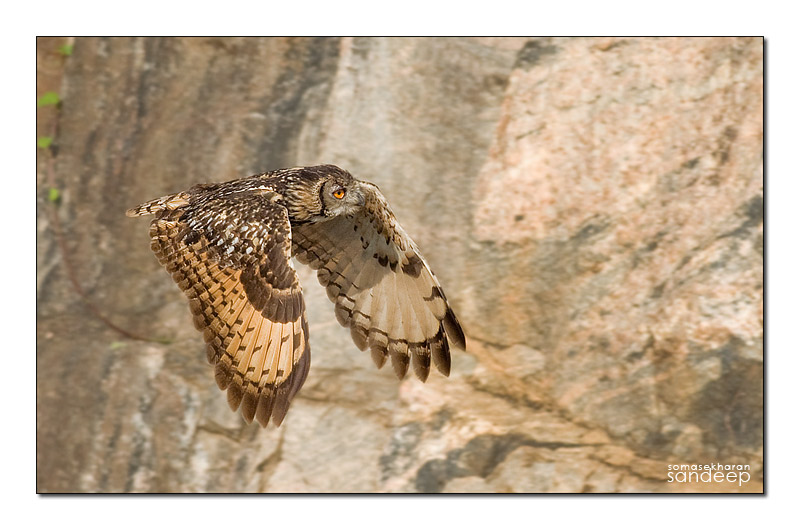
Two hoots in a deserted quarry

My love of owls has made me peer into abandoned quarries, tree hollows, rafters of old barns, and dilapidated houses. Last year, I watched three Indian Eagle Owl chicks grow from featherballs to subadults. We waited a whole year to publish this report, assured that they are now relatively safe


In India, where kids grow up with superstitions whispered into their ears, owls are much maligned. An owl hooting at night is said to bring death. Barn owls (Tyto alba) fetch lakhs in the black market as they are believed to have magical powers that aid in black magic. And some say if you starve and beat an Indian Eagle Owl (Bubo bubo bengalensis), it will start talking like a human and predict your future. For a nature-watcher, however, these hunters of the night are graceful and elegant. And the more you watch them, the more you fall in love.
the beauty with large eyes!
My love of owls has made me peer into abandoned quarries, tree hollows, rafters of old barns, and dilapidated houses. In one such quarry in the outskirts of Mysore I saw a fully grown female Indian Eagle Owl, which perched on the least noticeable ledges and watched us with her large, all-perceiving eyes. The spell she cast on us was unbreakable, so much that we continued to pay her frequent visits.


Generally she would be quite shy, taking off to distant inaccessible corners of the quarry if we got close. But on one visit in January last year, she didn't leave her perch, however close we approached. The ledge, though, was inaccessible - it was about 10 feet high and about 7 feet away from the edge of the deep rainwater pool at the bottom of the quarry. We imagined the reason for her perceived acquiescence was that she might be nesting. We left her alone.
Momma squints a warning
A few weeks later, in February, we returned. The mother was nowhere to be seen. Scanning the ledge carefully corroborated our guess: three tiny feather-balls. My heart thumped. The sun was coming up, and the chicks were pushing against the farthest corner of the quarry wall, seeking protection from the early morning sunlight that was now turning harsh. The nest was a humble setup -- a ledge with sand at the bottom and some grass growing at the edges. Mommy showed up presently, her stern stare radiating a warning: “Keep off!”

Huddled in the nest and vulnerable.

Momma plays sentinel

When we next visited the quarry a month later, in March, we couldn’t spot any chicks. Dismayed that they might have died of illness or fallen to predators, we prepared to leave when we spotted a chick behind the grass stalks that jutted out of a ledge. It appeared to be three times larger than we had last seen it. Another sat a few feet away on another ledge. There was no sign of the third (we never saw it again). Mommy occupied another ledge, watching us intently with the same stern schoolteacher expression. Since the chicks were on a different ledge from her, it was pretty obvious that they had started to fly.
Well concealed

And the second chick on another ledge
Our next trip to the quarry happened only in May as something or the other interfered with our plans. All we saw were two adults: The larger mother and the other was probably one of the chicks, which had by now grown large enough to be on its own. The second chick had probably left the quarry (or maybe it was dead -- we would never know), and I had a feeling that I would not see this one for long either.
The little one takes flight...

The last glimpse that I got of the young owl
As expected, on later visits we found only the mother owl. Since Eagle Owls are voracious eaters and require a large area to hunt in, it is likely that the grown chicks had left to set up their own fortresses elsewhere. I do think about them once in a while, wondering where they would be now, whether they managed to survive and found happy hunting grounds of their own beyond the reach of superstitions or predators. 


After all, when babies grow up before your eyes, you get attached to them!


Further reading:


  1. An excellent technical documentation of Eagle Owl chicks [PDF], by Eric Ramanujam and T Murugavel, is available at the Journal of Threatened Taxa website. 
  2. Sad, Wise Eyes, an article about owl trafficking by Shruti Ravindran, appeared in the March 2009 issue of Outlook magazine.


Text and photos by Sandeep Somasekharan


More on The Green Ogre:


Read more about Indian Eagle Owls and Barn Owls 
Read more about threats to Mysore's scrubland habitats
 

Encounter: Indian Silverbill

If coochicooable was a word, it would fit the Indian Silverbill


My first memories of fellow Ogre Sahastra are tied to a photograph he posted in the Infosys photography club. The first was of a group of tiny, brown birds with beautiful conical beaks shining like metal, perched on a plant reduced to sticks by harsh summer. And the bird's name sounded like a wind chime tinkling.


Indian Silverbill.
If 'coochicooable' was a word, it would fit the Indian Silverbill
Immediately, I was intrigued by the Indian Silverbill or White-throated Munia (Euodice malabarica) and recognized it the moment I saw it in Mysore. The birds, always in a flock, perched on tall grass stalks, flitting from one to another, stealing an occasional private moment to plant tiny kisses on each other.

The Indian Silverbill blends into its surroundings thanks to its dull plumage
Since then I have seen them everywhere in small groups, feeding on tiny seeds of grass in scrublands. Often, their small size renders them invisible -- they are even smaller than sparrows -- and when you step into the grass, you can see ten or twenty suddenly take flight, making soft cheeping noises.
The birds huddle close and whisper gossip
At times they huddle together on a single stalk perhaps to share body heat in a cold breeze, or face each other and peer at something far beyond, their tiny eyes tinkling.

Text and photos by Sandeep Somasekharan
Read more posts in our Encounter series

An intimate encounter with the lovely Red Cassia

The brilliant brick reds, salmon-pink and yellow of Cassias light up avenues even as summer wears out its welcome. Sahastrarashmi presents an intimate encounter with the flowering tree as never experienced before
Studio portrait of Red Cassia - the yellow (possibly hybrid) variation


Studio portrait of Red Cassia - the brick-red flowers are interspersed with pink, but from a distance overshadow other shades
The seemingly endless tropical summer tends to linger a bit longer on the eastern coast down south where I live. It’s an extended goodbye, a season that begins to grudgingly allow the relief of a few cool days in an otherwise hot and sultry clasp that stretches on for six interminable months and threatens to last forever. Life runs along in slow motion and all movement requires the extra effort needed to cut through the thick blanket of heat, and is hence discouraged. Few are brave enough to put up a show and among those who do – Cassias win hands-down.
Red Cassia canopy at peak bloom - extreme top canopy
The Java Cassias (Cassia javanica) are the first to erupt in a rapturous frenzy of pink and white, followed by the pendulous clusters of bright-yellow laburnums (Cassia fistula) and as they begin to give in to the onslaught of the unsparing summer, the Red Cassias (Cassia roxburghii) explode. They see the summer out.
The terracotta-red bunch -- this colour defines the Red Cassia
You can be so struck by their resilience that you risk ignoring their astonishing beauty. The mid-sized, mimosa-leaved trees with long drooping branches and shiny green leaves betray hints of a few buds in mid-May. By mid-June the big brick-red clusters are conspicuous and by the end of the month most trees are in full bloom.
A pink cluster from a flowering Red Cassia
The overall aspect of the flower clusters is brick-red and, on closer view, you cannot but notice the fine green veins on the papery petals. The clusters are in reality quite variegated and one of the most stunning features of the flowers are the hues you can find in a single bunch. There is soft-pink, deep-pink, pink with a hint of yellow, brick-red with shades of yellow, terracotta-red, bright yellow and faded white. The clusters can vary in the mix and pink clusters can be seen along with terracotta-red ones. You soon realize that the terracotta red (described as the primary colour by both Pradip Krishen and earlier by Blatter and Millard) is mainly what the eye sees from a distance, a property of the red wavelength, while the profusion of shades is visible only up-close.

While the clusters appear terracotta red from a distance, the flowers sport a profusion of hues


Three clusters - Pink and Yellow, Brick Red, and Pink. The last two are from the same tree.

Flower clusters from a possible hybrid - the clusters are yellow and pink and not terracotta-red - late July
An intriguing property of Cassias is that they hybridize easily and this may be the reason for even more variation. Just next to the handsome specimen with terracotta-red clusters is a variant where yellow flowers predominate with some white and pink – there are barely hints of darker shades (sSee pic of the three bunches above). This can make identification difficult but keep in mind that the other common Cassia, the Java Cassias, are almost always in shades of pink (no yellow or brick red) and the flowers are not only in clusters (towards the end of the flowering season) but cover the branches along the length (see below). The less common Burmese Pink Cassia is also deep-pink in color and the Cassia marginata (common in Mysore) has red flowers but lacks the large bunches as in Cassia roxburghii.
Java Cassia flowers cover the branches along its length.


Cassia marginata flowers (from Lalbagh, Bangalore). Notice the three longer red stamens with maroon anthers. This Cassia is quite common in Mysore

A flowering branch - mid-June
The flower is five-petaled, diminutive with salmon-pink sepals. Each flower has ten light yellow stamens, each with bright red anthers. There are three long stamens, curved inwards but unlike those of Java Cassia are not swollen in the middle. The rest of the stamens are smaller.
Red Cassia stamens have no swelling. The calyx is salmon pink.

Cassia javanica flower. Notice the yellow stamens with the swelling on the three longer ones.
Blatter and Millard trace the tree as a native of Ceylon and mention that it was introduced in India in 1802 (Royal Botanic Gardens in Calcutta now called the Acharya Jagadish Chandra Bose Indian Botanic Garden). Pradip Krishen suggests that the tree may also be native to South India.
Flowers from a roadside tree
Red Cassia in Pondicherry - late July


A view at mid-height -- the flowers are interspersed in foliage. The upper canopy tends to have less foliage while at the peak of flowering.
As I write, the Laburnums are a mere shadow of their once exuberant blooms. Slow brown death is creeping into Java Cassias. The flaming red crowns of most Gulmohars have returned to a verdant green, and the yellow shower of Copper Pods is spent. But the Red Cassias are holding on at their peak. In their limitless palette of colours and fiery blooms, the intense tropical summer finally seems to have met its match.
The petals, up close
Smitten with flowering trees? Don't forget to read our richly illustrated posts on the Copper Pod, the Gulmohar and the explosive beauty of the Cannonball Tree.


Text and Photographs by Sahastrarashmi
Thanks to my friend Shanmugam R for his partnership in photo sessions and explorations in the world of Cassias, from Pondicherry all the way to Mysore via Bangalore.

Encounter: The Coppersmith Barbet


More often heard than seen, the diminutive Coppersmith is a thousand times smaller than its enormous voice

Once a while we may be treated to the sight of a coppersmith perched this low
I was on my first ever trip to Ranganathittu Bird Sanctuary near Mysore, when I had a flat tire halfway through. As I pushed my two-wheeler along with my friend for kilometers looking for a pile of tires or a board screaming "puncher" (or variants of it) advertising a puncture mechanic in these parts of the world, I saw a strikingly colorful bird on an electric line. It was predominantly dark green, with striking red tufts above the beak and under the chin. It sat there, tilting its head left and right, and then took off. And I came home, thumbed through my Salim Ali (this was before I graduated to Grimmett and Inskipp) and found the name -- Coppersmith Barbet (Megalaima haemacephala).
 
A not-so-ripe fig makes a Coppersmith look elsewhere...
I had to wait a while before I came to realize the philosophy behind the intriguing name. I came to hear (and see) it calling high up from a treetop with its neck craned -- whatever little it could manage with that short neck - and letting out a full-throated but short ringing tuk... tuk.... Apparently, this call earned the bird its name as it sounded, to the imaginative listener, like a coppersmith flattening out a sheet of his metal with a mallet.
Once his mind is set on it, no fig is too large!
Sexes are alike and juveniles are cute variants of the adults sans the red above the beak and below the eyes.
A juvenile, lacking the red crest and throat patch
The coppersmith is mostly a frugivore and a voracious fig eater -- if you see a fig tree with a large number of ripe fruits, take a closer look: the coppersmith barbet is invariably in there.
Who said three's too many?
The Coppersmith Barbet has survived in semi-urban areas and cities that offer fruiting trees for food, and cavities on tree trunks for nesting. If you still find the bird uninteresting you also might change your opinion when I tell you that it is the official bird of the city of Mumbai. That is a fitting honor for a resilient bird that is clinging on despite rampant urbanization.

Text and photographs by Sandeep Somasekharan

Tree or no tree, who gives a fig?

A fig tree in fruit is a forest in itself: every creature in the vicinity is attracted to the sprawling canopy to eat the ripe red fruits, or the fruit-eaters. Sadly, these lovely fig trees are disappearing with our appetite for wider roads

Ripening fruit on a fig tree
Fig trees (Ficus sp) are valuable sources of food for many birds and animals. In an age when fruit trees have turned into cash crops restricted to orchards, with guards stationed to keep birds away, these trees, which provide tiny fruits that ripen to a rich red and house thousands of tiny seeds, become life-givers for birds and mammals. When they are not fruiting, the trees' thick canopies provide safe haven for several species. When the fruits ripen you can hear the clamour of a hundred birds feasting from a long way off.


I have seen a number of fig trees in and around Mysore, but the one that most inhabits my memory is the huge tree near my village in Karukutty, Ernakulam district, Kerala. That tree is believed to be 500 years old and hosts a sarppakkavu -- a shrine dedicated to serpent spirits. My grandfather told me that it was an atthi-maram -- Malayalam for fig tree, though I never saw it in fruit in the days I spent with my grandparents. 


It was nevertheless an amazing tree. Its branches and roots were barely distinguishable from each other. Long strands hung down from the boughs, slowly growing towards the ground. On touching the ground they turned into pillar-like struts supporting the superstructure of the tree. And in this way the tree would branch out and occupy a fair acreage of land.


The Ficus tree at Karukutty
Though I have never seen the fruits of the tree at Karukutty, the ones in Mysore have more than compensated for my loss. There is a huge tree near the smoking zone at Infosys and there are other trees I have seen at my regular birding haunts. I have seen them spread new leaves, sprout tiny ripe fruits, and some others meet their ends - either through natural causes, or at the hands of humans.
A Chestnut-tailed Starling eyes its next morsel
The first casualty I can remember is one near Mysore's Outer Ring Road. This tree had a deep hollow that was home to a Spotted Owlet. The canopy played host to Chestnut-tailed Starlings, Common Mynas, Rose-ringed Parakeets, Brahminy Kites and, at times, a pair of Oriental Honey Buzzards. 


One morning when we arrived, it simply wasn't there -- all that remained was a stump. For no reason that was apparent, the tree had been cut down and the plot where it stood remains empty even today. I have seen shoots emerge from the still-standing trunk but it will take years for it to regain its past glory -- perhaps more than my lifetime, and that is if it is allowed to stand for that long. 


Some trees, like the one on the shore of Lingambudhi Lake, has been spared the axe since it stands in the compound of a temple.


A Coppersmith Barbet attempts the seemingly impossible
Another one that I shall remember was a fig tree that used to stand near Hebbal Lake in Mysore. It was a majestic tree and bore smaller fruits than that of the Banyan (Ficus bengalensis) but, unfortunately, I never got round to identifying it. It was the roost of purple herons and I have even spotted a Booted Eagle hiding in the thick branches. Last June we found the tree fallen, its trunk brutally snapped by heavy winds that mark the advent of the monsoon.


A contented Golden Oriole in a fig tree laden with fruit

With the widening of the Ring Road in Mysore two fig trees beside the road have been felled. As the city grows, many more are likely to fall prey to development. And the birds that depend on these trees for food will be driven further and further away. And then, sadly, we shall refer to them all in past tense.


Text and photos by Sandeep Somasekharan

Mommy loves you!

The Green Ogre salutes mothers and mothers to be of every feather! Happy Mothers Day! We love you back!

A female baya weaver feeds a juvenile (right)


The next time you see a leopard in your town...

If you took the city of Tokyo and turned it upside down and shook it you would be amazed at the animals that fall out: badgers, wolves, boa constrictors, crocodiles, ostriches, baboons, capybaras, wild boars, leopards, manatees, ruminants, in untold numbers. There is no doubt in my mind that feral giraffes and feral hippos have been living in Tokyo for generations without seeing a soul." 
- Yann Martel, Life of Pi 


As the horrendous impact of the earthquake that hit Japan last month has shown, "shaking" a city is none too far-fetched an image. But when Martel wrote these lines, his metaphor was perhaps figurative. Either way, there are incidents time and again where you run into leopards, jackals and foxes in open yards, farmhouses and city outskirts. And this troubling reality is reinforced further by the leopard that ventured into the Mysore campus of Infosys in February. 


We are slowly being enlightened to the reality that the description of wild animal doesn't necessarily suit animals that are confined to forests. Leopards can survive in suburbs and cities by hiding in abandoned buildings and preying on stray dogs. This January, fellow-Ogre Bijoy and friend Rohit saw a leopard that had been run over by a speeding vehicle at dawn on the NICE road on the outskirts of Bangalore city. While the leopards of Mumbai have made headlines repeatedly, Mysore has seen several leopard-man conflicts in recent years. The worst was perhaps in 2008 when, in the presence of police and forest officials, an assembled mob surrounded a leopard that had strayed into the city and beat it to death. Media spread rumours that it was a man-eater, as it had desperately lunged at some of its tormentors with the fury typical of a cornered wild animal. 


The morning of March 8 saw forest officials, police and CISF at the Infosys campus in Mysore after a leopard had been spotted at night in one of the buildings under construction. This time the leopard was tranquilized and subsequently released 90 km away in Nagarahole National Park. Some amateur photographers got too close to the cornered leopard, completely disregarding security warnings. As these heroes attempted to photograph the leopard from close quarters, the cat charged them. On the basis of this incident, media reports announced shriekingly that the leopard had "mauled" the photographer. Mercifully, being amid a more "aware" group of humans, the leopard was not immediately branded a man-eater and bludgeoned to death. 


Leopards are all around, especially in a city like Mysore. Chamundi Hills, a well-known leopard habitat, is being encroached by the city from all directions. Naturally, running short of food, opportunistic leopards will take to the suburbs for easy pickings in stray dogs and livestock. Rarely do we get instances where they attack humans, and when they do, it is either when they are cornered or trying to protect their young. 


The Ministry of Environment and Forests has come up with very elaborate guidelines on how to deal with human-leopard conflict. When there has been no deliberate attack, and no straying into thickly populated area, the manual says it is best to leave the leopard alone, the reason being that the animals may make every effort to keep away from people. But if the leopard ends up in a populated area, there is a chance that human presence can agitate them into acts of desperation. In the rare event of it being a child-lifter or in case of deliberate attacks on humans, the officials are permitted to euthanise the animal in a humane way. 


Apart from this, several steps may be taken to minimize public fury due to such conflicts. The manual provides guidance to build leopard-proof cattle sheds, educate villagers who are compensated for any livestock taken by the animals, and to leave the livestock kill alone to prevent further attacks. Also, providing proper sanitation and waste disposal in villages near forests is important to check pig and stray dog activity as these animals attract leopards. In some villages in the Himalayas, we have noticed dogs with spiked metal collars to deter leopards (the cats are known to kill their prey with a fatal bite to the throat, severing the jugular vein).


A Bhotia dog in Chopta, Uttarakhand is fitted with a spiked metal collar to deter predation by leopards
Man-animal conflicts are a reality we have to live with given the increasing rate of habitat fragmentation. Sighting a leopard near human habitation does not warrant pressing the panic button -- it might be a passerby on the lookout for stray dogs. Alert the local wildlife warden rather than raise a public alarm. 


Download this informative manual [PDF/ ZIP] on human-leopard conflicts. You never know when you may need it.
-------------------------------------------


Text by Sandeep Somasekharan with additional inputs from Bijoy Venugopal
Photographs: Leopard image by Philip MacKenzie/ Stock.xchng; Other images by Bijoy Venugopal


Thanks to Kalyan Varma for the conversations that inspired this post and to Vidya Athreya whom we have never met but whose important work at Project Waghoba we have followed from a distance. The Green Ogre had earlier written about Kalyan's stirring photo-essay on the capture of a leopard in Valparai. 


Also read Arun Menon's account of a suspected leopard presence in Bilikal Rangaswamy Betta.

Wordless Wednesday - Ducking the sunset


All rights reserved