We’ve moved! Here’s where you can find us

The Green Ogre is now at https://www.greenogreindia.org
Showing posts with label hovering. Show all posts

On the Wing: Black-shouldered Kite

An attractive raptor even while perched, the Black-shouldered Kite is hard to forget once spotted hovering

For a long time after I learned to identify this bird, also called the Black-winged Kite to differentiate it from the Australian  Black-shouldered Kite (Elanus axillaris), I did not witness its flight. During the winter dusk near my village in Rae Bareli, I always saw it hover over potential prey that it had spotted on the ground. All you needed was to scan the horizon and, eight times out of 10, you could spot this bird hovering. The kite hovers over open scrub or grassland patches with its wings held high up and with slow wingbeats, beginning quite high up and gently gliding lower before it starts hovering again. This, presumably, is a tactic to get closer to its prey and fix its location on the ground. Sometimes the bird shifts sideways while still hovering. The action is repeated 2-5 times after which the raptor either swoops down or flies off to locate another quarry - usually lizards and rodents.
Its flight is similar to its hover -- gentle wing-beats punctuated by long glides. On this occasion, I first saw it perch on a tree stump as the wind gently caressed its soft white down feathers. It fixed me with its sparkling red eyes and after a beat took off gently, skimmed the tops of the thorny acacias and flapped out of view.
This elegant raptor, with its diagnostic grayish-black shoulder patch and red, owl-like iris, is found throughout India except for the country's extremities.

Text and photos by Sahastrarashmi
Read all posts in our On the Wing series 

Encounter - What's black and white, and hovers?

Ogres Sandy and Arun recollect their encounters with the common but lovable Pied Kingfisher

Black, white and eats fish


Sandy: The first time I saw the Pied Kingfisher (Ceryle rudis) was in Thekkady, Kerala, in my fledgeling days of bird-watching. As a kid I had read that kingfishers were of many kinds and this one was called "pulli meen kothi" - literally, the "spotted fish-pecker" (in Malayalam). The book carried an illustration of a bird with a large head and a larger bill -- it wasn't very far off the mark when I first noticed this bird perched on an embankment. Then it did something that amazed me. With a sharp call it rose from its perch, flew a few feet into the lake, and hovered. It didn't move left or right, forward or backward - it just hung stationary in the air, wings beating furiously. Then came the typical kingfisher dive, cutting into the water, and a moment later the bird emerged with a tiny fish struggling in its mean-looking beak.


Seconds before the dive, the pied kingfisher straightens its wings


Arun: I used to watch Pied Kingfishers in the fields near my house in Kerala. It was a pleasure to observe them early in the morning as they hovered in the mist, their black-and-white bodies flickering in and out of sight. They are generally hard to miss as they are always on the move and active unlike other kingfishers, which rely mostly on the patient 'wait and watch' strategy. The Pied King, as I nicknamed these true kings of the kingfisher world, are the only kingfishers I have seen that are capable of true, sustained hovering. The others can fly and dive and at most manage to hover for just a couple of seconds.  I last observed these birds at Madiwala Lake in Bangalore. A pair was continuously fishing along the entire length of the bank. I'm not sure why they preferred to fish in this way. Maybe the vegetation along the lake shore darkened the water with their reflections and shadows and helped eliminate the sky's reflection to aid better views beneath the water surface.


A Pied Kingfisher hunting in Madiwala Lake, Bangalore
A resident bird of the Indian subcontinent, the Pied Kingfisher lives on fish and crustaceans unlike its cousin the White-throated Kingfisher, which prefers easier prey like amphibians, reptiles and insects. It is always found near water bodies and nests in burrows on the embankments. The call is a shrill 'kri kri kri.' 

Male and female birds can be easily distinguished by their breast bands. The male has double unbroken bands across its chest while the female has a single broken band.

A male, easily identified by the double-banded "necklace" on its breast

In the female, the single breast band is broken
Unlike other kingfishers, which prefer the convenience of open perches near water bodies to dive down after prey, the Pied Kingfisher's modus operandi is somewhat similar to the Common Kestrel and the Black-shouldered Kite (whom we have met previously in our Raptor Friday series). It hovers in the air above water bodies, looking for prey, head down. Upon locating the prey, makes a vicious plunge and emerges with the kill. This fishing strategy could be one of the reasons why this kingfisher has a black-and-white coloration. As the bird hovers over a water body, its white underside blends in with the background of the sky, effectively camouflaging it as it is fishing and improving the chance of a successful hunt. Other kingfishers stalk by waiting and watching for signs of prey movement, so they have darker colouration which would blend in with the surrounding foliage.


A hovering male shows off its largely white underside
Hovering moments...


Sandy: My latest encounter with this bird was at Polachira, a wetland near Thiruvananthapuram, Kerala. Summer had set in, and the water body was turning shallow, leading to fish shoals being concentrated in the deeper patches. On a misty, breezy morning a pair of Pied kingfishers was flying about, hovering, diving and coming up with catches nearly each time. I spent almost an hour photographing them against a rising sun.


The dive...


Text: Arun Menon and Sandeep Somasekharan
Photographs: Sandeep Somasekharan. Additional photos by Arun Menon
All rights reserved

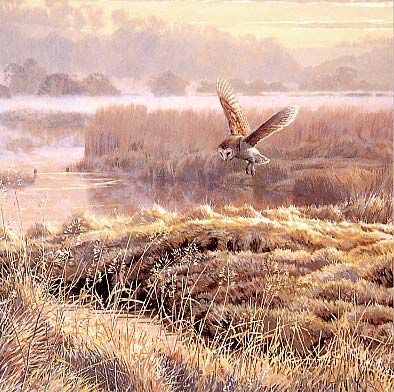
Barn Owl hovering, redux

Last week, I saw a barn owl just outside our apartment complex. It was past 7 and this guy swished by with a ghostly whisper of wings. I waited to see if it would hover, but it just flew up into a dead tree and perched there.
In August 2001, I saw barn owls hovering for the first time. Here's a note and the subsequent discussion (from bngbirds):
I moved to Mumbai last month from Bangalore. While I found the bird life -- like the people here -- to be hardy and adaptive, what I saw last Saturday really took the cake. I was taking a late night stroll on the esplanade at Carter Road, Bandra. Most people who are familiar with Mumbai know of the profusion of rats here, as well as their insouciance and nonchalance -- I've had rats ambling up to inspect my feet and when I tried to shoo them off, they would rear up on their hind legs and bare their teeth at me. Terrifying stuff, really. On this night, as usual, there were rodents aplenty scurrying on the esplanade. Suddenly a ghostly white shape materialised out of somewhere -- a barn owl, that graceful stalker of urban vermin. There were at least two or three of them policing the stretch, easily distinguishable from the night herons that were also stalking other prey on the shore. One of these owls appeared to be struggling against something in the air, about 10-15 feet from the ground. I hoped the poor bird wasn't caught against an electric wire. As I moved closer, I found no obstructions in its path. The bird was hovering! I've known only ospreys, kestrels and pied kingfishers to hover (at least, they are the only ones I have seen doing so, apart from hummingbirds in the US, and back home, harriers who manage a mean hover against the breeze, or maybe pipits and skylarks that do their own versions). This barn owl, however, was doing an amazing job of it, with all the flourish of a trapeze artist on an invisible trapeze. It would flap briefly against the wind (a strongish sea breeze), apparently catch hold of a current and hover -- quasi-static -- in one place, wings rapidly beating. Before anybody casts any aspersions, I must stress that I wasn't drunk, and I had three others with me who weren't, too (though they wouldn't know an owl from a bat if I hadn't told them) and we all saw this amazing spectacle. The barn owl held its pose for about 30-40 seconds, then caught another current and performed for us again. All the while, I noticed the head cock from side to side and those large, shiny, black eyes taking in the view. Unfortunately, I didn't catch sight of the bird preying on any of those execrable rats, but I sure hope it managed a great meal that night. Such talent is certainly deserving of great reward.
That post is archived at bngbirds. It was revealed that barn owls, like many other owls, do hover. And the interesting discussion that followed highlighted the observation that "woodland owls have no need to hover".