We’ve moved! Here’s where you can find us

The Green Ogre is now at https://www.greenogreindia.org
Showing posts with label bird photography. Show all posts

Download the December wallpaper

December is seven days old and we've been sluggish. Blame it on the cold! Here's our last wallpaper of the year. May the lemony yellowness of this Oriental White-eye light up your holidays. 


Seasons Greetings!


Photo: Sandeep Somasekharan


DOWNLOAD THIS PHOTO TO USE AS A WALLPAPER FOR YOUR DESKTOP OR LAPTOP


Disclaimer: This Green Ogre free download is hosted at File Factory, a third-party file storage service. For reasons best known to your ISP or your employer, depending on where you are accessing this page from, you may or may not be able to download the file. If you manage to download it at first go, thumbs up! If not, we encourage you to keep trying from various locations. You don't have to be a paid subscriber to download the file. Ignore all the promotional stuff at the top of the page, scroll down and choose the SLOW DOWNLOAD option. Paid subscribers are offered faster downloads while unsubscribed or free users will have to wait for a few seconds before downloading. Do not let this thwart your quest. Enjoy!

Wordless Wednesday: Do or Dive


Photograph: Sandeep Somasekharan
And if you prefer words, read: What's black and white and hovers?

Encounter - Chestnut-headed Bee-eater

In the deciduous forests fringing the Western Ghats, look out for the charming Chestnut-headed Bee-Eater


Bee eaters are probably a bird-lover's (and photographer's) favourite birds -- breathtakingly beautiful, amazingly acrobatic and acquiescent. Early into my birding days, I ran into the Chestnut-headed Bee Eater (Meropus leschenaulti) when I had imagined that the Green Bee-eater (Merops orientalis) was the end of the road to birding bliss.
A Chestnut-headed Bee-eater looks out from its vantage near Valparai, Tamil Nadu

The chestnut head and crown are definite pointers to identification. A chestnut-and-black line runs horizontally at the base of the neck, under the off-white/ cream-coloured cheeks and chin. The chestnut on the head tapers back, well beyond the shoulders to blend into the rich foliage-green of the wings and tail. The body, breast down to the vent, sports a lighter shade of green, and the inner tail-feathers are a dull olive.
Perched on a mud bank, maybe near a nest, near Valparai, Tamil Nadu

Quite a few people, in my experience, confuse the European Bee Eater (Merops apiaster) and the Green Bee-eater for the Chestnut-headed. The chestnut head in this species is darker in comparison to the golden-yellow of the Green Bee-eater in breeding plumage, and the cheeks are off-white, compared to the blue cheeks of the Green Bee-eater. The European Bee-eater, too, sports a chestnut crown, but it ends a little above the forehead, and then a dark band like a highwayman's hood runs over the eyes. In the Chestnut-headed Bee-eater the chestnut runs all the way to just above the beak and over the eyes, and ends in a dark line under the eye.
Showing off the bold brown collar
If you are straining against the bright sky, unable to discern the colors, the tail is an easy giveaway. The long spike, present in most bee eaters, is absent and the Chestnut-headed Bee-eater's tail ends in a shallow w. The call is a repetitive 'trill' -- gruffer than the Green Bee-eater's -- while perched and in flight.


Chestnut-headed Bee-eaters are agile on the wing, capable of swift flight and spectacular aerial sallies. They wait on open perches, tossing their heads from side to side, keeping a keen eye out for insect movement. A patient observer may be rewarded with the sight of them snapping up wasps, dragonflies or butterflies at arm's length. Then the birds return to the perch, repeatedly beating the prey, which is still clasped in the bill, against the perch to separate the stings.
This is typically how you might encounter the Chestnut-headed Bee-eater - on an open perch in a forest glade

The Chestnut-headed Bee-eater nests in holes on sand embankments. They are common in south India, and I have spotted them in several places in the Western Ghats including the Anamalais. I have heard stories about village children raiding the nests with playful curiosity, but thankfully those occasional incidents remain the only threats to these lovely birds, loss of habitat and natural predators notwithstanding.


Text and photos: Sandeep Somasekharan
See all posts in our Encounter series

Le Question: What colour is the eye of the Sarus?

Seeing eye to eye with the Sarus Crane evokes a host of questions and the answers aren't exactly simple

Shashwat and I were driving along a small arterial road in Rae Bareli, checking out the pairs of Sarus Crane (Grus antigone) among the paddy fields on either side. It was the end of a relatively warm November day, and dusk was imminent. We came across a beautiful female near a clump of reeds by the roadside -- though sexes are almost alike, I could tell since it was smaller than the male, which was foraging a few metres away.

Me: What colour is the Sarus?
Shashwat: Grey, White.
Me: What is the colour of its face?
Shashwat: Red
Me: And the color of its beak?
Shashwat: White, Grey
Me: And the eye?
Shashwat: The Sarus has no eye!
The Sarus hadn’t lost an eye but we were looking into the setting sun with the clump of reeds and the bird in the foreground. Its bright red eye was hidden in the glowing red skin of its head -- you actually could not see it. I knew the eye existed and that he was only telling me what he saw. We were both right, as a Zen master might say, but he was in the "moment"; the unconditioned observer.

Heard the laugh track of the Nilgiris?

While walking in the Nilgiris, listen closely for the guffaw of the Nilgiri Laughingthrush. And treasure it, for you'll hear it nowhere else on earth
When I had first laid my hands on a Sony prosumer camera I found I could photograph birds within reach, and the target of one of my first attempts was a Nilgiri Laughingthrush, otherwise called the Rufous-breasted Laughingthrush or the Black-chinned Laughingthrush (Trochalopteron cachinnans). I first saw the bird on a trip with my parents to Doddabetta, a peak near Ooty. Kannada for 'the large hill', Doddabetta is the second highest peak in south India and the highest point in the Nilgiris.
As we walked about like regular tourists, bracing against the strong chill wind, I saw a unique bird -- with bushy white eyebrows and captivating, red eyes -- hop about on the macadam not far from the tourists. Incredibly, it didn't seem perturbed by the crowd - something you can observe only in Doddabetta.

Wordless Wednesday: Babbler thumbs its nose

Photograph: Sahastrarashmi
Enjoy all Wordless Wednesdays

On The Wing: Indian Grey Hornbill

What goes flap-flap-glide, flap-flap-glide? A Grey Hornbill in flight!


Grey hornbills (Ocyceros birostris) fly like tiny missiles -- if not by speed, by profile.

Flap-flap-glide, flap-flap-glide... when you see one pass by you can always expect another one to be close behind – usually its soulmate. This one was headed straight for me when it realized I was right ahead, braked in the air spreading the wings and tail feathers, and within a second, it changed direction by ninety degrees and disappeared into the branches of a tree.

Text and photo by Sandeep Somasekharan
All rights reserved
See all posts in our On the Wing series

Wordless Wednesday - Sitting Duck

Photograph: Sandeep Somasekharan
All rights reserved
See all Wordless Wednesday posts

Wordless Wednesday: Drongos on a date

Wordless Wednesday - Who said three's a crowd?


Photograph: Sandeep Somasekharan
See more Wordless Wednesdays

Wordless Wednesday - Who goes there?


Photograph: Sandeep Somasekharan

Wordless Wednesday - An Edgar Allan (Hoo)Poe mystery


Mommy loves you!

The Green Ogre salutes mothers and mothers to be of every feather! Happy Mothers Day! We love you back!

A female baya weaver feeds a juvenile (right)


Raptor Friday - The Lesser Fish-Eagle

Formerly thought to be a resident of the Himalayan foothills, the Lesser Fish-Eagle has pleasantly surprised us by nesting along rivers in southern India

Formerly thought to occur only in the Himalayan foothills, the Lesser Fish-Eagle has now been confirmed as a resident breeder along the Cauvery River in Karnataka as well as river islets in Kerala, both in southern India
The Lesser Fish-Eagle (Ichthyophaga humilis) was believed to be a resident of the Himalayan foothills until recently when there has been a flurry of sightings along the Cauvery river in Karnataka. Other recent reports also confirm that the bird is a resident in southern Kerala (see notes below).


Let me tell you before I begin that 'lesser' is a relative term, to be taken literally only when comparing this raptor to the Grey-headed Fish-Eagle (Ichthyophaga ichthyaetus). In no way should this bird be mistaken for a diminutive creature as it is more than two feet tall when perched, with an impressive wingspan.
All of my three sightings have been in the Ranganathittu Bird Sanctuary near Mysore. The bird would perch on a branch overlooking the river, appearing pensive. On all three occasions, when our boat drew close the bird took off, never to be seen again that day. To watch it fish remains a dream unfulfilled.
The extent of white in the Lesser Fish-Eagle's plumage are a distinguishing mark to identify it against the closely related Grey-headed Fish-Eagle
As its name suggests the Lesser Fish-Eagle feeds on fish and is hence found mostly along riversides. The head is grey, the chest brown and the wings are a deep brown. The belly and thighs are white and the tail is dark. In the field, the primary distinguishing feature to tell it apart from the Grey-headed Fish-Eagle is to observe the area where the white parts of the bird end. In the Lesser Fish-Eagle, the white area ends abruptly at the beginning of the tail. In the Grey-headed Fish-Eagle, it extends all the way to the tip of the tail where it terminates in a thick, dark band. 


Both the Lesser Fish-Eagle and the Grey-headed Fish-Eagle are listed as vulnerable (VU) in the IUCN Red List.


Notes:
1. The latest issue of the journal Indian Birds (Vol. 7, No. 1), April 25, 2011 carries a comprehensive report on the breeding of the Lesser Fish-Eagle in Cauvery Wildlife Sanctuary, Karnataka, India. The report is authored by Dinesh Ramarao, Dipu Karuthedathu, Mohanram K, Prakash H L, Raju A K, Sreekumar H, Srikanth Kumar and Vinay Das


2. A separate report in the same issue of the journal, by C Sashikumar, C K Vishnudas, S Raju, P A Vinayan and S Kannan, informs us that the Lesser Fish-Eagle is a breeding resident in Kerala including reservoir islets in the Parambikulam and Periyar forest areas.


Text and photos by Sandeep Somasekharan
All rights reserved

Encounter - What's black and white, and hovers?

Ogres Sandy and Arun recollect their encounters with the common but lovable Pied Kingfisher

Black, white and eats fish


Sandy: The first time I saw the Pied Kingfisher (Ceryle rudis) was in Thekkady, Kerala, in my fledgeling days of bird-watching. As a kid I had read that kingfishers were of many kinds and this one was called "pulli meen kothi" - literally, the "spotted fish-pecker" (in Malayalam). The book carried an illustration of a bird with a large head and a larger bill -- it wasn't very far off the mark when I first noticed this bird perched on an embankment. Then it did something that amazed me. With a sharp call it rose from its perch, flew a few feet into the lake, and hovered. It didn't move left or right, forward or backward - it just hung stationary in the air, wings beating furiously. Then came the typical kingfisher dive, cutting into the water, and a moment later the bird emerged with a tiny fish struggling in its mean-looking beak.


Seconds before the dive, the pied kingfisher straightens its wings


Arun: I used to watch Pied Kingfishers in the fields near my house in Kerala. It was a pleasure to observe them early in the morning as they hovered in the mist, their black-and-white bodies flickering in and out of sight. They are generally hard to miss as they are always on the move and active unlike other kingfishers, which rely mostly on the patient 'wait and watch' strategy. The Pied King, as I nicknamed these true kings of the kingfisher world, are the only kingfishers I have seen that are capable of true, sustained hovering. The others can fly and dive and at most manage to hover for just a couple of seconds.  I last observed these birds at Madiwala Lake in Bangalore. A pair was continuously fishing along the entire length of the bank. I'm not sure why they preferred to fish in this way. Maybe the vegetation along the lake shore darkened the water with their reflections and shadows and helped eliminate the sky's reflection to aid better views beneath the water surface.


A Pied Kingfisher hunting in Madiwala Lake, Bangalore
A resident bird of the Indian subcontinent, the Pied Kingfisher lives on fish and crustaceans unlike its cousin the White-throated Kingfisher, which prefers easier prey like amphibians, reptiles and insects. It is always found near water bodies and nests in burrows on the embankments. The call is a shrill 'kri kri kri.' 

Male and female birds can be easily distinguished by their breast bands. The male has double unbroken bands across its chest while the female has a single broken band.

A male, easily identified by the double-banded "necklace" on its breast

In the female, the single breast band is broken
Unlike other kingfishers, which prefer the convenience of open perches near water bodies to dive down after prey, the Pied Kingfisher's modus operandi is somewhat similar to the Common Kestrel and the Black-shouldered Kite (whom we have met previously in our Raptor Friday series). It hovers in the air above water bodies, looking for prey, head down. Upon locating the prey, makes a vicious plunge and emerges with the kill. This fishing strategy could be one of the reasons why this kingfisher has a black-and-white coloration. As the bird hovers over a water body, its white underside blends in with the background of the sky, effectively camouflaging it as it is fishing and improving the chance of a successful hunt. Other kingfishers stalk by waiting and watching for signs of prey movement, so they have darker colouration which would blend in with the surrounding foliage.


A hovering male shows off its largely white underside
Hovering moments...


Sandy: My latest encounter with this bird was at Polachira, a wetland near Thiruvananthapuram, Kerala. Summer had set in, and the water body was turning shallow, leading to fish shoals being concentrated in the deeper patches. On a misty, breezy morning a pair of Pied kingfishers was flying about, hovering, diving and coming up with catches nearly each time. I spent almost an hour photographing them against a rising sun.


The dive...


Text: Arun Menon and Sandeep Somasekharan
Photographs: Sandeep Somasekharan. Additional photos by Arun Menon
All rights reserved

Wordless Wednesday - The gorilla's kiss

Encounter: Pied Crested Cuckoo or Jacobin Cuckoo

The arrival of the Pied Crested Cuckoo is believed to announce that the monsoon is here


The Pied Crested Cuckoo is a beautiful bird which visits India in the winter from Africa. I have been sighting these guys continuously for the past 3 years, and its timing has been impeccable -- right at the onset of the monsoon. This time the first sighting was a couple of days before the monsoon arrived.

I remember having seen him three years back on the outskirts of Mysore. I had barely begun birding at that time, and I was struck dumb by its stunning and unique appearance. The black-and-white body and the distinct crest were nothing short of stunning for me. It was really close to me and by the time I fumbled with my camera and got a couple of shots off, the bird had flown away. And both shots ended up blurred.


Last year we saw a pair again in the same vicinity and got one of them really close for photography. This year, I have sighted at least 20 of them, in various parts, though my luck with photography was considerably less. But I got an opportunity to see one feeding on a caterpillar and got a record shot yesterday!


Text and Photos: Sandeep Somasekharan

Encounter - White-browed Bulbul

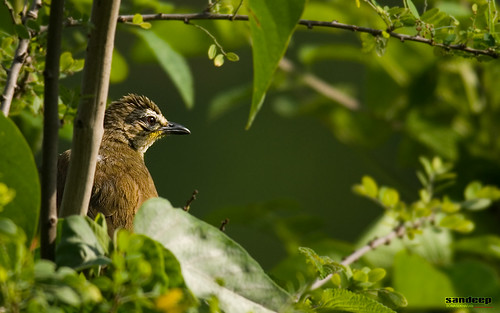
It makes itself scarce. Its call is so enmeshed in the thickets and brambles of forest undergrowth that it is part of the sound you take back with you from the jungle. But few first-time birders I have escorted on their maiden outing have come away after a good look at this fellow. The bird in the picture is the White-browed Bulbul (Pycnonotus luteolus). It has one of the longest and most exuberant of songs - bursting out in a rush of joyous chuckling notes. One of my early birding mentors described it to me, quite memorably, as a marble being shaken in a bottle. But look in that direction, and the stage-shy songster would have dived for cover. So, take a good look at this guy here and memorise the sight - the bright white supercilium is diagnostic. A crestless bulbul, unlike the Red-vented and Red-whiskered Bulbuls, this fellow's dietary habits have been observed to be similar to that of its cousins, which means it feeds largely on fruit, insects and flower nectar. When it's breeding time, the White-browed Bulbul makes a cup-shaped nest in a short tree, where it lays two to four eggs in a clutch. So, the next time you hear that bubbly song, you know whom to look out for. Photograph: © Sandeep Somasekharan

The best bird photographers are ethical

KolkataBirds has compiled a very interesting showcase of the best bird photographers in India. There is a disclaimer at the bottom of the page that brushes aside all criticism or opinions one may have of this list and the methods employed to compile it. It's a bewildering list - some are unknowns, some are known schmoozers, and others merely photographers because they own some fancy equipment. But among this motley crowd are some real stars - Sudhir Shivaram, Kalyan Varma, Joanna van Gruisen - photographers whose work reveals more than posed portraits of the bird's appearance. Through their pictures they offer a revelation of rarity, of poorly known and little studied birds, as well as insight into their behaviour, habit and habitat. Dhritiman Mukherjee offers glimpses of two rarely sighted birds - the Blood Pheasant and the Himalayan Snowcock. Joanna van Gruisen's remarkable picture of a male Pheasant-tailed Jacana (the best picture of the collection) with an egg - probably not its own - in its mouth is a revelation of extraordinary and probably undocumented parental/ territorial behaviour. Kalyan Varma's wonderful picture of Wreathed Hornbills in flight offers little by way of detail but plenty in terms of behavioural insight. These are pictures worth a thousand words or more. Many of the others are just showing off their lifers. Today, photographers have better access to great equipment and many have the money and means to travel. This means that more and more shutterbugs interested in getting a great photograph and earning peer respect are travelling to forests, deserts, grasslands and other habitats on photographic safaris. What is the impact of their frequent visits on these fragile and sensitive habitats? Are their means ethical? Some of the most reputed photographers of our time were known to be absolutely callous to the plight of their photographic subjects - disturbing nesting sites, exposing nests and chicks and resorting to trickery with recorded bird calls and suchlike. With the best equipment, even a fashion photographer can photograph birds in the wild. But wildlife photographers are not merely artists and wildlife photography isn't art for art's sake. They are pilgrims in nature's great shrine, their methods are acts of prayer, and every photographic opportunity is a blessing. POSTSCRIPT: Gopi points out that Kalyan Varma's picture of the Wreathed Hornbill offers rare insight into the flocking behaviour of this species and that flocks can be quite large for a bird of this size. He also ponders the question if the increasing interest in bird photography is actually leading to increased conservation of birds - or is it just leading to more disturbed habitats.

Remembering Sultanpur 2006