We’ve moved! Here’s where you can find us

The Green Ogre is now at https://www.greenogreindia.org
Showing posts with label madmaheshwar. Show all posts

Madhyamaheshwar - In the temple of the Drunken Lord

Life is so quiet and still in Madhyamaheshwar that it's easy to imagine why local people believe that the deity is drunk
A wayside shrine en route to Madhyamaheshwar
A moss-encrusted tree on the trail
“I found myself moved by the simplicity of this shrine. It was a place where nothing stood between me and the spiritual elements of nature… Nothing was hidden from view -- no lamps, no smoke and mirrors, no priests performing a sleight of hand. I noticed the lichen on the rocks, the irregular colors in the stone lingam, the bruised petals on the primulas. Garlands of mist trailed across the meadows.”

Stephen Alter – Sacred Waters


We emerged from the mossy, rain-soaked forest after almost ten hours of walking (the rain had continuously threatened us along the way but we just couldn't hurry, the trail was difficult and the forest dark, damp and bird-rich – all of those factors had successfully conspired to delay us). It took a while to spot the Madhyamaheshwar shine. It was unassuming, at the end of a small settlement consisting of a few chai shops (and inns), a few shepherds' shelters, a dharmashala. The name Madhyamaheshwar means the “middle-lord” a reference to the emergence of Shiva’s navel at the spot but the locals refer to it as Maddamaheshwar, literally the Drunken Lord.


A peaceful calm pervaded the settlement, interrupted by the occasional slow soft murmur of the cold rain. Dusk was well on its way, the light fading gradually with the occasional fog bank cloaking the settlement and giving the false impression of light in the brief white-out. The stream running down from the ridge from Buddha Madhyamaheshwar and flowing along the temple perimeter gave the only indication of motion where everything else seemed to be at a standstill. It wasn’t difficult to imagine why the Middle Lord might be a tad drunk.

The shrine is situated at 10,400 feet (3,289 meters) from sea level on the slope of a ridge 25 kilometers northeast of Guptkashi. The ridge (in this season full of flowers) runs along the west and north of the temple (the trek to Kanchani Tal is along this ridge). To the east is a valley that falls away quite steeply. A steeply ascending trail emerges at the temple from the south through a patch of forest. Pilgrim traffic is barely a trickle (there are no busloads of pilgrims here since the 2-day trail is only for the hardy) and except for locals the only other travelers are an occasional trekking party.

The temple is a simple structure in the middle of a small, squarish courtyard cut from the ridge. It sits in the middle of a depression. A stream descending from the grassy ridges is diverted to enter the temple from the west, running along the inner perimeter and exiting into the valley through the northeastern corner. Along the entire length of the inner perimeter are embedded moss-speckled lingams of various sizes, and near the stream are copper images of Shiva and Shakti. While the work on the copper plates lack the finesse of a master craftsman they represent a more immediate and accessible form, that of Shiva who resides in the ridges, the forest and the mountains. This is not an imported, transplanted deity. 

Copper images of Shiva and Shakti
Stone lingams line the perimeter of the inner path around the temple
The Brahma Kamal (Saussurea obvallata), which is used to adorn the lingams (and offered to the pilgrims as prasad), is collected from the meadows in the vicinity of Kanchani Tal by a barefoot priest – the flowers have large translucent white petals with a hint of green and a papery texture.
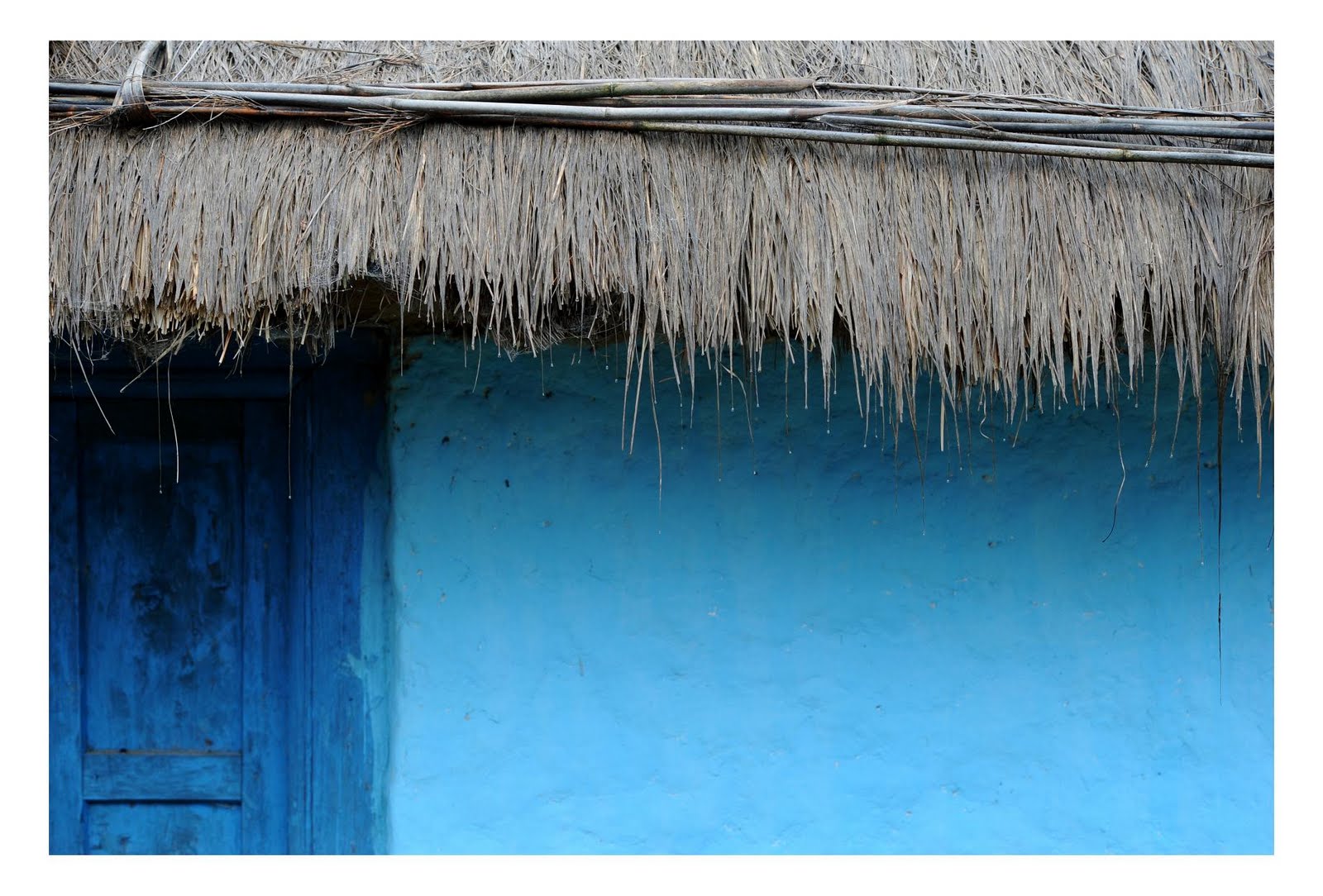
The rain ensures that there are not too many birds, but there are still a few. A flock of Pink-browed Rosefinches (Carpodacus rodochroa) feed in the shrubs beyond the temple’s perimeter and a pair of Red-headed Bullfinches (Pyrrhula erythrocephala) court along the blue walls of a nearby house. Oriental Turtle Doves feed in the temple courtyard and a Besra dismembers its prey on the canopy of a nearby oak. We briefly glimpse a Himalayan Monal (Lophophorus impejanus) dart out of dwarf rhododendron bushes from the ridge above and Mistle Thrushes go about their business in the soaked meadows, exceedingly difficult to spot in the mist...
The Chaukhamba range dazzles
A Chestnut-bellied Nuthatch is at home in the mossy bark
A Pink-browed Rosefinch reveals the rationale behind its name
A Chestnut-tailed Minla in the forest
An offering of freshly picked mountain wildflowers
A Kashmir Rock Agama enjoys a brief spell of sunshine
Buddha Madhyamaheshwar - the old temple
A walk on the ridge offers a view of the Madhyamaheshwar Ganga
Chaukhamba - an awe-inspiring massif in any season
One of the less conspicuous denizens of the Himalayas
The great old temple at Madhyamaheshwar
Something to brighten up rain-dampened spirits
At the temple the rituals are slow and lack commercial gloss. As we join the evening arti, our feet numb against the wind-chilled granite slabs, I realize that despite my discomfort I am not impatiently waiting for its end, and the shiver that runs down the spine is actually due to the nearness to Shiva who, here at Madhyamaheshwar, is just once removed from the raw elements that he is.
 
Text by Sahastrarashmi 
Photographs by Sandeep Somasekharan and Sahastrarashmi 
Photo of Buddha Madhyamaheshwar by Rohit Tewari

Upriver, a monsoon love affair with the Ganga

It's easy to see why Lord Shiva fell in love with the Ganga. Mere mortals can be hopelessly smitten


Bhageeratha watched with terror in his eyes as a miffed Ganga hurtled towards Earth from the heavens. His penance to bring Ganga down to earth to cleanse his ancestors' souls had succeeded; but in the process, did he bring forth the doom of all mankind? For Ganga, it was too much of an insult to be asked to descend from her abode among the gods and flow on earth among the mortals. She would show them her wrath; her immense force would flood the entire earth in the blink of a mortal eye.... But she was bridled, by none other than Mahadev Shiva, who stood in her path and let his matted locks intercept her flow. She entered his locks, and emerged in a placid and smooth flow, tamed. And her soothing touch on his temples even changed Mahadev's life. He fell in love... 


My much-awaited tryst with Ganga started at Haridwar, the gateway to the Himalayas, on our trip to Madmaheshwar. All along our flight from Chennai to Delhi, the skies were choppy, and it was no different in the Himalayas. Under a sky threatening to brim over, I saw her first, flowing with effortless ease, murky and swift under a bridge on the Haridwar-Rishikesh highway. Like a blue-blooded maiden, carrying herself with a dignity that evoked sighs of admiration, but from a respectful distance. The volume of water that flows along the river supports a big percentage of the world’s second largest population, and just a glance was enough to see how… We drove upriver for many kilometers. Past Rishikesh the Shivaliks rose up from the plains. The roads were built as ledges along the mountains, in whose gorges the Ganga flowed, keeping us company all the way. Signs screaming to beware of landslide/rockfall were everywhere along the road. But so captivated were my eyes that the fact that landslides could hold us up, delay us, or even doom our trip didn’t register in my brain. The mists seemed to rise upwards like an inverted curtain from the surface of the river. The skies were overcast and saturated, and a downpour seemed imminent. It seemed as if Mahadev had spread his locks a tad to allow more water to gush towards the Earth, perhaps to cleanse many more souls! The higher we went the river became more turbulent. At Devprayag, the Ganga splits into Bhagirathi and Alaknanda -- rather, the Alaknanda and Bhagirathi merge at Devprayag. From here, we followed the Alaknanda. Landslides littered our way, which was being cleared by bulldozers as we watched. The mud that the mountains shook up was pushed over the ledge, into the hungry river, which looked as if it could swallow entire roads, if not the mountains themselves. A few hours of driving upriver took us to Rudraprayag, where the Mandakini meets the Alaknanda. The waters were still turbid, but looked much more menacing. In the planes the flow was smoother but here the rivers dashed against rocks, around curves, churning and frothing. Here she resembled a young woman, hasty and headstrong, hissing and winding like an angry snake. Part of her vehement aspect, before she entered Mahadev's locks, seemed to have resurfaced.We followed Mandakini, which originates near Kedarnath, towards the Kedarnath/Ukhimath route. However next morning we parted company and met one of it’s most beautiful tributaries – the Madhyamaheshwar Ganga, which originates in the galciers of the massive Chakhamba. Past Ukhimath, Uniana and Ransi villages our drive ended, and we moved upriver of Madhyamaheshwar Ganga, a lovely jade green river, on foot, climbing the steep hills towards Madmaheshwar. Alaknanda never left our side, always flowing with a distinct rushing noise. On days that it didn’t rain, she sounded more like a girlfriend who doesn’t stop chattering, and on the days when it rained cats and dogs, she was a nagging wife. When we would return, the rains would let up in patches, and from the color of the water at the various confluences of streams, we saw where it had rained and where it hadn’t. The water in the streams flowing from areas of higher rainfall (and soil erosion) were a murky brown while others were a rich marble green! And soon we saw where all the water came from. There were numerous waterfalls streaking the landscape, and this in addition to the snowmelt from the extensive glaciers from the Chaukhamba massif. Like a few runaway streams caressing the temples of Mahadev, these streams slid down the ridges of the mountains... We drank from waterfalls far from habitation during our treks to Madmaheshwar and back, crossed rivulets flowing over the road (letting water and an occasional leech into our shoes), and lost count of the waterfalls which joined Madhyamaheshwar ganga. Some gushed, some giggled and some roared as we walked past them. Maybe due to the therapeutic powers of the waters, not once did any of us fall ill or face a bout of indigestion. The sun, when it chose to make an appearance, presented us with amazing spectacles -- causing rainbows in the spray that rose from the rocks, pounded by the the streams that would later join the Madhyamaheshwar ganga and then Mandakini, Alaknanda and finally the Ganga itself. And here, she looked like an innocent girl with rainbows and stars in her eyes. By the end of the trip, I could see why Lord Shiva supposedly made Ganga his wife. It was hard not to fall in love with her.

Encounter: Running into a golden raptor

A glimpse of the majestic Golden Eagle
When I set out on the Madmaheshwar trek in September 2010, I had not entertained hopes of seeing a Golden Eagle (Aquila chrysaetos daphanea) as the altitudes we would frequent would not be high enough to be the habitat of this majestic raptor. But even at the beginning of our trek, near Gaundhar, we had seen four or five long-winged eagles soaring over a bugyal (alpine meadow) overlooking the Gaundhar village. They were too far for identification but from the shapes of their wings we thought they might be Golden Eagles. But we had nothing to bet on.


The sighting of note occurred at the end of the trip. We were in pieces with creaking joints and strained muscles as we completed the 10 km descent from Madmaheshwar to Gaundhar village.


We walked over to the humble hotel of Mr Panwar, had tea and debated whether to go down to the river Mandakini for a bath or get one in the bathroom. Finally, my fellow-trekkers Sahastra and Rohit decided to go down to a pipe fed by a rivulet, and I decided on the bathroom.


Within five minutes I was fresh from my first bath in five days (in icy cold water, to boot). From the terrace of Kailash Hotel I looked out for birds as the sun dipped behind the mountains. I saw something glide high above us but let it pass, thinking it was a griffon. But when I saw the fanned tail, I realized it was an eagle and ran in to get my telephoto lens. I followed it in burst mode as it flew higher towards the top of the hill, at the foot of which the Gaundhar village lay.


The bird perched on a leafless tree and was hidden from view. I lingered, waiting for it to emerge, and eventually it did take off from that perch. The sun had set completely by then and the bird, making absolutely no fuss, slowly glided to the opposite hill -- much lower this time -- favouring some better shots. It descended to a tree high up on the hill across the Mandakini and the darkness closed in like curtains drawn on a splendid show.


Text and pictures by Sandeep Somasekharan

Encounter - Red-headed Bullfinch (in a wall-eating cameo!)

Maybe we had stumbled upon the beauty secrets of this gorgeous bird


Strolling around the temple premises of Madmaheswar I saw a small bird hopping playfully on the plinth beside the Pujariji’s (priest) quarters. Slightly larger than a swallow, it had a golden-yellow crown, thick black bill and large round eyes.

I crept up to it, only to see it fly away. I waited in the vicinity for what seemed to be forever, hoping it would return, and suddenly spied a rusty-red version of the same bird between the reeds. It struck me that the first one should be the female and this one would be the male. 

Again, my attempt to approach to photograph unsettled it and it flew away but this time to another building a little way off. And here, I noticed it pecking at the walls of the building. My first impression was that it was trying to eat insects off the wall. After a few minutes it flew away into the dense forest below. I dropped all hope of finding it again. Later, I'd identify them as a pair of Red-headed Bullfinches (Pyrrhula erythrocephala).

After our customary tea from the stall of Beerbal, the temple canteen proprietor, I was about to return to our accommodation when I noticed the female bird sitting at the plinth of the shack right ahead. This time I was lucky. My approach didn’t alarm them, and I could get a good look at both the male and female.

The male Red-headed Bullfinch...

...and his lady


As I watched, both the male and female took turns nibbling at the plastering of the shack wall. Yes, they were clearly taking bites out of the bright blue painted walls. Sahastra and I surmised that they were probably after the calcium from the lime, though we are not sure of the reason for this. 

...and the happy feeding moments

Can anybody throw some light on this unusual behaviour?

- Text and pictures by Sandeep Somasekharan