We’ve moved! Here’s where you can find us

The Green Ogre is now at https://www.greenogreindia.org
Showing posts with label himalayas. Show all posts

On hobbled knee across the Nandakini


In the final episode of her Bedni Bugyal travelogue, Jennifer Nandi crosses a bridge and a river into another consciousness, one that holds the tranquility of the Himalaya and perturbation over its future in delicate balance
The snow-clad flanks of the hills reflected in Bedni Kund was a vision that sustained us on that trying and redeeming journey
The day breaks warm with birdsong. Always and every time, new and irresistible distractions wake us early. It is a good thing we are birders since the rooms are saturated with dust and stale odours. So, we escape the fusty accommodation to strain our ears at the muted lisps of birds fussing in the underbrush near the sun-baked mud hut of our host. With permission we approach, and watch her deft use of primitive tools to prepare our meal for the day.


The locals gather around and we learn their hazardous ways. They complain of diminishing reserves of fuel wood for cooking and heating homes, depleted soils, and overgrazed pastures. This surely suggests worsening conditions for life in the mountains. It brings notice to the linkage between alpine deforestation and lowland floods. The degraded forests hold less soil, catch less runoff and stabilize fewer slopes. Rapid weathering renders the soil fragile. Nature at odds with its environment can’t thrive; and when the depredation is ruthless, no seed can survive in such uncongenial ground.


Amid the balmy verdant forests are vast monocultures of blue pine
Water is a fragile commodity – the scarcity of drinking water in the villages is growing. In 2007 there was a high rate of run-off because of the variability of precipitation. The monsoon-like downpours we experienced in early May that year caused higher sediment loads in the rivers which must have surged in floods onto the Ganges plain – washing our future into the sea. The fragility of the biota is compounded by bedrock shifts. The Himalaya are dramatic testimony to the relentless power of drifting continents. In this context, is the Himalaya described as a high-energy environment. 


Yet, the basic life-support systems – soil, water, and biota, the limiting factors in the mountain ecosystems – have failed to restrict this village community of Kanol in their dreams. Half a dozen of its young men have joined the armed forces. However, scarcity and degradation forces them to live frugally. We wander out alongside the terraced hillsides. A little path leads toward the forest. Spring flowers that feed the spirit clutch at the hillsides – wild gerberas, forget-me-nots, geraniums, and daisies like the different colours of the sunlight. Nature surely blunts even the worst excesses of man. It seems our path is strewn with flowers. But our hearts are heavy with the burden of knowledge that we inevitably soil our most precious resource. These sanctuaries of forest and reason on which civilization depends are ultimately made inefficient through degradation.
Water, clear and clean, appears abundant in the Himalaya but we saw enough to learn that its future is uncertain
It is approaching late afternoon. Devidutt is nowhere to be seen. He has consumed a powerful soporific to keep him insensate for the next three hours. We eat without him. His casual camp procedures have overwhelmed us. We neither look in horror as he wipes the skillet with a dirty rag before cooking; nor at his complete disregard for clean plates and cutlery. 
Without our capricious guide Devidutt, seen here making tea in the hollow of an oak to keep the winds from snuffing the fire, our journey would have been wanting for character or anecdote
In failing light we gather for quiet reflection, meditation and thanksgiving. It is our last night together as a trekking team. We rejoiced in the simple thought that we'd had both a challenging and an enjoyable time. We were also safe.


The next day arrives too soon. There is much traffic on the way down. The history of human settlement in the Himalaya is marked by regular mobility for purposes of trade, resources, work, pilgrimage, or social exchanges. Travel has been an ongoing feature of these mountains. The intricate network of walking trails, resting places, and the cultural traditions of inn-keeping and porters, testify to that. 
Wild geraniums poke out of the understorey
Early in 1991 when I had climbed to Kuari Pass, the public bus dropped us by the roadside at Nandaprayag. We then walked to Ghat and upwards to Kuari. Now the newly built roads have opened what had been inaccessible terrain to vehicular traffic and to new economic markets all over the range. Such efforts both materially and symbolically convey to the remote villages the opportunities and risks of the wider world.


The stony, steep descent to the River Nandakini has all but crippled us. Sunita and I lag behind the men. At last, with the river in sight, I walk to sit on the bridge. Sunita finds her way closer to the river. Clearly, she is in no mood to talk. I give her space. 


Soon, we are joined by three German trekkers with their guide. The guide comes up to importune me with questions. After I had explained that we were birders, he asks what ‘equipment’ would one need to engage in bird-watching. 


“Just your eyes,” I say lightly. 
“No, no, one must have binoculars too.” 
“Ok,” I say, “And a field guide.” 
“What else,” he asks. 
“A basic creative principle,” I say facetiously. 
“Where can I buy that?” 
Such simple-mindedness. 
“One has to learn to observe – that’s the key. Birders must notice everything in its full, detailed richness.” 
“Where can I find such people?” he asks. 
“On a hillside, just watching,” I reply. 


He dismisses me with a disbelieving look on his face. What a fortunate breed we are with an endless succession of surprises in life, by just engaging in the challenge of identifying.
It is now my turn to probe with questions. I walk up to this alpine leprechaun to ask why his legs were green. In the torrential rain of yesterday, the colour of his pants ran! 


I turn toward Sunita to share the joke. She has finished smoking and is now inspecting her nails. She needs more time. The joke will have to wait. Now I wait for some signal of her readiness. She upturns her water bottle to her parched lips. That’s my cue, some physical sign of preparedness.


The Nandakini, one of the Ganga's little-known tributaries, is one of the most beautiful of Himalayan rivers though our passage across it, over a quivery single-log bridge, was fraught with apprehension
Devidutt has been haranguing me to hurry up. He beams when we follow him. He is very encouraging. Our trek is nearly at its end. Sitel is in sight. Though it has begun to rain once more, we shelter in a shed while the men negotiate for a taxi. The women pile in with the driver and a couple of his friends. We have no clue what’s going on in the back. Fifteen men with all our luggage and theirs, sacks of village wealth, all pack into the back of the ‘tempo’. We didn’t hear a word of complaint from our fellow-trekkers, not even from the eternal comedian, Bijoy. We shall all miss this superb mimic. And I will always remember Sahastra, whose appreciation of visual delights was not just an indulgence, but rather an ennobling of ordinary need.


Leaving the Himalaya brings on the pangs. What traveler can forget the dark, silent shape of a Plumbeous Water Redstart as it flirts its fiery tail against the stone-grey foam of a rushing river?
While we wait to board the train at Hardwar, pilgrims laden with Ganga-jal jostle for a place to sit. I recollect reading somewhere that we must be “steady in what we do, not blown like feathers at the wind’s discretion, nor think that every water cleanses you.” I shall remember opening my pores to bathe in Nature. I shall remember the flirting tail of a Plumbeous Water Redstart, the Ultramarine Flycatchers confabulating on the quantity of gossamer needed for the nest, the shrill green of the parakeets – their colour as loud as their calls. Design in nature is a concatenation of accidents – chance genetic changes but so culled by natural selection that the result is not just effective but beautiful as well as to seem a miracle of purpose. 


Thoreau once wrote, “In wildness is the preservation of the world.” A century later, Wendell Berry proposed this necessary corollary: “In human culture is the preservation of wildness.”

By Jennifer Nandi


Photographs: Sahastrarashmi and Bijoy


Odyssey to Bedni Bugyal, a travelogue in ten parts, is now concluded. Follow these links to read previous episodes:
Part 1 | Part 2 | Part 3 | Part 4 | Part 5 Part 6 Part 7 Part 8 | Part 9

Grey-headed Canary Flycatcher: An Afternoon Haiku

What could be common to a tiny forest bird and a temple statuette that embodies grace, beauty and wild power? 
Having looked at a small group of 4-5 highly energetic and extremely acrobatic birds with small grey heads, small straight sharp beaks, large black eyes and yellow bodies, I looked expectantly at Sunita. Beguiled by the beauty and thrilled at finding a new bird, I wanted a name – to end the delightful morning walk on a satiated note.

“OK, so this bird that you see is ... take a good look. Notice the greenish-yellow upper body, the whitish-grey throat. The yellow on the belly all the way to the vent – it glows in the light.”

A shaft of white light penetrated the top-canopy and lit up a space surrounded by a cluster of branches in the mid-canopy of a copse of tropical deciduous trees. Drawn to the light a buzz of winged insects circled in random flight paths and were being hawked by the birds in our viewfinder.

All of this was fine but I wanted a name.
I looked again. The birds seemed to set their sights on a winged insect and with remarkable dexterity follow its flight path, and change direction quickly to snap up the prey. Flying trapeze artists on steroids. The change of direction was random; the birds picked up their targets in mid-air and within the blink of an eye perches were exchanged. 

“Notice the typical flycatcher behavior – exposed mid-canopy perch, the swift and short targeted sortie. And the large eyes.”

Still no name.

It was a satisfying end to a nice morning walk that had yielded Chestnut-bellied Nuthatches, Black-hooded Orioles, Hoopoes of the European race, Asian Barred Owlets, Black Redstarts, Grey Hornbills, and White-bellied Drongos among others. The small grey-yellow birds were right in the garden attached to our home and, like a true landowner, I felt a flush of pride at this newly discovered treasure. But for it to be truly mine, in my village, my garden and my backyard, I needed to know what it was called.

“OK... so this is a -- Sahastra, have you had a good look?”

Absolutely. I had, down to the soft tit-tit that emerged from the trees in a low-frequency murmur of avian satisfaction. My neck hurt, my eyes were blinded and the suspense was unbearable. All of this had just one cure – a name.

“The grey-headed Canary flycatcher. I did not know it was found here."
I didn’t care. The bird was mine for all time to come.

November noon
                             ticks vanish
                                                           canary flycatchers

In subsequent Novembers investigations established that the Grey-headed Canary Flycatcher (Culicicapa ceylonensis) had made the small patch adjacent to my home a regular haunt.

The next meeting with the bird was in the Himalayas, in May, as we descended the Loharjung-Wan road towards Didana. We heard the chee-weeeee-wee call with a soft whistle before the long weeeee and they were almost always in mixed hunting flocks. Jennifer informed us that they often make up the extremities of these flocks, a bit like the advance guard.

My first encounter with the birds in southern India was at Muthodi and again they were quite vocal. The habitat was different here -- not the montane oak forests of the Himalaya, or the dry-deciduous groves of Rae Bareli in the Gangetic flood-plains -- but the birds behaved just the same. The call, the perch, dexterity and the delight.

The next day while driving back to Bangalore, we stopped at the Belur temple. Its scale is not what one expects – small and star-shaped as opposed to the huge imposing masses that a lot of temples are. In his book “Diving the Deccan”, Bill Aitken found it an uninspiring anti-climax. On our way back, birding talk was interspersed with notes of the archaeological, and I managed a summary: 

The Belur Temple is like a (canary) flycatcher, small but exquisitely crafted.

Beej remarked, “You must be the only birder ever to imagine such an example. Or for that matter, any archaeologist.

The Huntress at Belur, lit by a shaft of evening light
Bill Aitken can try some birding, I guess, and start with the flycatchers. It will ensure that he is better appointed when he is in the presence of the Belur Huntress the next time round.

Text and photo of the Belur Huntress by Sahastrarashmi
Photographs by Sandeep Somasekharan

Encounter: In Shangri-La with Bar-headed Geese

Meeting the Bar-headed Goose, arguably the world's highest flier, in its breeding grounds at 15,000 feet is a rare and humbling privilege
Korzok (4,595 m, 15,075 ft), the small settlement on the border of the incredibly blue Tso Moriri was the highest I had even been. So when had my first sighting of the Bar-headed Goose (Anser indicus), one of the highest flying birds in the world, on those very waters at a shouting distance from the 300-year old monastery, you can perhaps excuse me for believing that it was probably pre-ordained.


The lake, along with several other high altitude lakes and marshes of Ladakh (including the now popular Pongong Tso), is a breeding ground for this enigmatic goose whose simple diagnostic features are the black bars along the face. The first bar starts just behind its black eye giving it a very peculiar “eyeless” appearance when seen from a distance. The body is grey and it honks like rest of the goose family. The beak is yellow and the legs and feet are orange. The geese eat grasses along the lakes and are ground-nesters, laying a clutch of 3 to 7 eggs in a shallow, down-padded depression.


The Bar-headed Goose is probably the world's highest flying bird. The birds have been observed flying over the peaks of the Great Himalayas (this is the Siberian population, not the one in Ladakh) and one estimate put the height of their migration flyway at over 10,000 m (33,000 ft). This would mean that they might even be taking advantage of jet streams for their migratory flights – probably the only bird known to do so. They have a flapping flight – not a soaring/gliding one – and adaptations like a large wing surface and haemoglobin capable of using the rarefied oxygen more efficiently. Following the jet stream cuts the needs for energy and enables one of the fastest migrations into India.


At Tso Moriri, I encountered them along the shore while walking along the lake. They saw me before I saw them and had started to walk down towards the water, chicks in tow, when I spotted them. There was no panic but they kept a watchful eye on me till they reached the lake. Then they gently swam away – a very gentle, effortless paddle, hardly appearing to move yet growing more and more distant while bobbing up and down along the wind-ruffled blue waters tinted with the silver of dawn.


Once winter grips the plateau in early October, the Bar-headed Geese will fly inland to Assam, northern India and right down to Tamil Nadu in peninsular India. Along the way, as they disperse, large congregations can sometimes be seen, and one of the birds' favoured sites is the Pong Dam in Kangra (Himachal Pradesh) where upto 30,000 geese flock. They stay on till late April before heading back to their breeding grounds.
Bar-headed Geese at home in Tso Moriri
The downy chicks take after their parents
A few fledged juveniles join the adults - note the darker napes of the juveniles
Text and Photographs by Sahastrarashmi 
Close up of the Bar-headed Goose from Wikipedia Commons

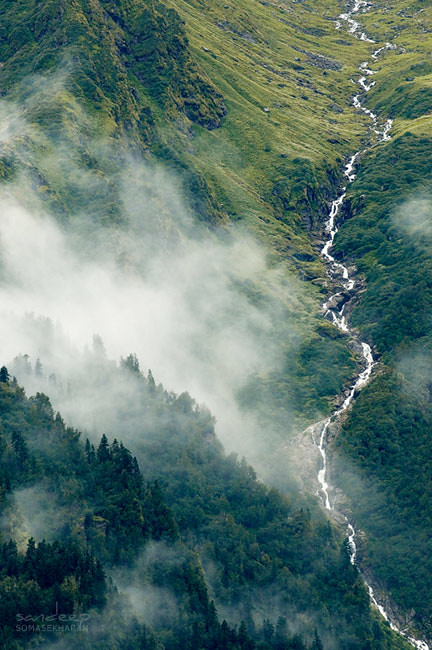
Wordless Wednesday: A Himalayan Riverscape


Photograph: Sandeep Somasekharan
All rights reserved

Encounter: Kashmir Rock Agama

At 6,000 feet oxygen isn't as easy to aspire as I'd like. My lungs labour to adapt subcontinental lethargy to the punishing demands of altitude, and for a while I am oblivious to the spectacular Himalayan scenery drifting by in a sweat-soaked blur only furlongs away from my fumbling feet. As I acclimate, I feel the gentle breeze cool the sweat upon my skin, which tans slowly in the ultraviolet ray-laden sunlight.
Male (front) and female Kashmir Agamas soak up the sun


As the miasma clears, I am alerted to rustles in the grass that only reptiles can make. I hope for herpetologist's luck to chance upon Himalayan Pit Vipers, but none come my way. Sahastra and I begin our slow ascent towards Deoriya Tal from the roadhead at Sari (a village mostly uncharted except by distributors of gutkha, bottled water and kurkure) in Rudraprayag district of Uttarakhand. Minutes into our climb, we notice great fat lizards basking on the rough walls of gneiss. 


It is past nine on a warm day by Himalayan standards. But perhaps no other creature enjoys the sunshine more flamboyantly than the Kashmir Rock Agama (Laudakia tuberculata). As the rocks warm up and heat waves distort the horizon, they arrive like tourists to a beach, falling over each other as they squabble for the best spot to soak up the sun. Like all reptiles, they are "cold-blooded", in that they have limited physiological resources to maintain a constant body temperature essential for metabolism. Therefore, they depend on external sources for warmth, and the sun (now available abundantly after a protracted and wayward monsoon) is the best source of it.  


A large male at the end of the breeding season shows only the bright blue limbs
Despite not being morning persons as such, their sluggishness evaporates as they bask. Drunk on sun, they grow perky and dart energetically among the stones. Their slate-grey bodies, which offer a fitting camouflage among the blue-green chips of rock, liven up with activated pigments. When young both sexes are stippled with bright blue spots, which are replaced with patches of pigmented skin as they age. The males' forelimbs and hind-limbs darken from pale blue-gray to brilliant azure and breeding males can acquire vibrant shades of purple, yellow and orange on the flanks and throat patches. The markings on the smaller females also become accentuated during the breeding season, which lasts typically from May to August. 


Juvenile Kashmir Rock Agamas have spotted skin 
The Kashmir Rock Agama occurs commonly at lower elevations in the Western Himalayas, which includes mountainous regions in northern Punjab, Himachal Pradesh, Uttarakhand and Kashmir. Outside of India, they occur in Pakistan and Afghanistan. 


We were lucky to catch the lizards as they trooped out in large numbers from their hiding places in rock crevices to welcome the day. Some of them breakfasted on ants and small winged insects. Now and then an agama would choose a young bud or flower of the introduced Morning Glory, and make a quick meal of it. Some degree of vegetarianism has been widely documented in many agamid lizards, which are known to be omnivorous throughout the year. Breeding occurs in summer, when protein-rich insect food is widely available.


An adult makes a meal of a flower bud
As we ascended to the cool oak forest that skirts the beautiful lake of Deoriya Tal, we no longer saw the lizards. For the next two weeks our trek would take us to higher altitudes that were inhospitable for reptiles in late autumn. On our way through the foothills after our sojourn in the mountains, the Kashmir Rock Agamas were there to welcome us back. 


Text and photos by Beej

Wordless Wednesday: The Last Musk Deer


In 2002, while in Chopta (part of Kedarnath Musk Deer Sanctuary), we had tried to visit the Musk Deer Breeding Centre but were denied access. They behaved as if it were a nuclear installation, a friend who was with me then had observed.
Later in August 2006 I was in Chopta with Gopi Sundar and Swati. We happened to visit the breeding centre and it turned out that all the deer (>12) had died out due to a disease outbreak, except one lone survivor (in the picture).
Photos: Sahastrarashmi / K S Gopi Sundar

Encounter: A monsoon brush with Cobra Lilies

A not-so-pale view of hills
I woke up to the sound of rain pounding the tin roof of the rented shack and the remnants of a nightmare lingering on. I dreamed that the mountain looming above us has suddenly sprung a gigantic waterfall, which is nonchalantly carrying my shack to the valley below. Though I am still cozy inside the sleeping bag, it is impossible to get rid of the feeling that the cold mist is out to get me. The bed beside the sleeping bag is damp and cold and the moment the shack’s door is opened the fog starts creeping in looking out for dry pockets, if any remain.
We are in Chopta and this is August. The Himalayan monsoon has made the place its own and we are part of the package. We have come here to bird and over the next few days we will be intimately acquainted with cold rain, rolling mists, tenacious leeches and precarious roads, often all four at the same time. It drizzles from dawn to dusk and pours at night time. The only birding afforded is a few brave moments in the drizzle and a short gift of sunshine usually in the evenings.
But in the special way that that Himalayas give back to a battered traveler there are rewards for those who endure (which we do).
A meadow teems with monsoon gifts
The trees are ghostly shapes overgrown with ferns and moss

There is the swoosh of an unseen Lammergeier approaching through the mist, restless tits and yuhinas flitting about the oak tops, yellow-breasted greenfinches taking off in a whirr from a snow patch in the meadow, Himalayan woodpeckers with their perfect Y markings, and the gorgeous rufous-bellied niltava in a feeding frenzy that a brief sunshine affords. There are plump but remarkably agile rufous-gorgetted flycatchers chasing winged quarries in dark glades, flower-draped meadows where we literally had to wade through scent, verditer flycatchers reminding us of the colour of the skies we could not see, a group of Himalayan Tahr on an impossible ledge, trees draped in dark-green wet moss which the white-tailed nuthatches rip apart hunting for grubs, the iridescent blue green-tailed sunbird with its purple sash glowing in the setting sun, slick black lichen-spattered crags, mist-soaked dripping ferns bursting out from crevices, and the mesmeric cobra lilies.
Cobra Lilies are in plenty and we are captivated. They grow below dripping rocky crags, besides brooks, at meadow edges and by the roadside. On first appearance they seem like some strange hybrid form of plant and snake and, as we get used to them, the feeling gets stronger. They are a mephistophelean prank of nature, a fitting substitute for the cobra in an environment too cold for it. Over the next few days we locate two species, both of which are hypnotically charming and no matter how many times we come across them, they have the power to stop us in our tracks and take closer awe-inspired looks.

Arisaema propinquum

Arisaema propinquum
Arisaema propinquum flowering

Arisaema tortuosum or Wallich's Cobra Lily has a remarkable resemblance to the cobra's hood. It grows to a height of about 30 cm and has a dark purple hood (spathe) striped with whitish green and a beautiful nettled pattern. The spathe ends in a short pointed tail much like a cobra with its tongue in check. The fruit is like a cob of corn, green at first and maturing to a bright orange red in fall much like a smoked-out painter's psychedelic rendering of corn.

Arisaema propinquum flower
The species is named after Nathaniel Wallich. Wallich was born in Copenhagen in 1786 and landed in the Dutch outpost of Frederiksnagore (Serampore) in Bengal in November 1808 where he was appointed as a surgeon. After the British ran over the Dutch colonies in India, Wallich after a brief stint in prison was appointed as assistant to William Roxburgh, the East India Company's botanist in Calcutta. This afforded him the opportunity to visit and study the flora and fauna of the subcontinent especially of Nepal and Burma (almost 20 species of flora and fauna are named after him including the Cheer Pheasant (Catreus wallichii). Later, following a stint with the Asiatic Society he was permanently associated with the East India Company's Botanical Garden at Calcutta, where he served from 1817 to 1846. During these years he published books, undertook expeditions, assisted plant hunters who stopped by at Calcutta and undertook a trip to Assam to evaluate the prospects of growing tea. He is remembered at the Kew gardens where his collections are held and a herbarium is named after him.
Arisaema jacquemontii
Jacquemont's Cobra Lily is more slender and serpentine. What it lacks by way of true likeness to the cobra's hood it makes up with its extremely delicate shape and elongated, lightly winding acute apex of the spathe, and its gregarious nature. A cluster of Jacquemont's Cobra Lilies has the surreal feel of slender green cobras dancing in the breeze with their long unforked tongues out to catch the raindrops.
A cluster of Arisaema jacquemontii
Arisaema jacquemontii or Jacquemont's Cobra Lily is named after Victor Jacquemont, a French botanist and geologist who travelled to india in 1828 on behalf of Muséum d'Histoire Naturelle and died in Bombay four years later aged 31. He was in the court of the charismatic Sikh emperor Ranjit Singh (the famed owner of the Koh-i-Noor diamond employed at least four Italian and French mercenary generals who had served in the Napoleanic wars in Europe) and records indicate that he travelled to Ladakh and Himalayas among other places. Several plants are named for him, including Acacia jacquemontii, the Himalayan White Birch (Betula jacquemontii), the Indian Tree Hazel (Corylus jacquemontii) and Afghan Cherry (Prunus jacquemontii).
The Cobra Lilies (normally used for the Asiatic species) are also sometimes referred to as Jack in the Pulpit. They belong to the genus Arisaema which (as per the website rareplants.de) “is made up of more than 250 herbaceous species, which are distributed throughout temperate to tropical areas on all continents with the exception of Australia, Europe and South America. Their main distributional range is located from the western Himalayas, southeast to China and Japan, whereas in North America only two to three species and in Central America some two species are known at present. The majority of Arisaema species grow in humus-rich, well-aerated soils in mountain meadows and slopes as well as open spots in lowland to high altitude woods, few species grow in pure loamy soils in sunny rock crevices. In general immature species are male, with maturity they change their sex to female. Several Cobra Lilies switch sex almost every other year in order to store enough energy for fruiting the following year after their male phase.”
Sex change is the peculiar characteristic that this genus possesses. According to the Wikipedia entry on the genus "Arisaema plants are typically male when small, and female or hermaphraditic when large, with a single plant capable of changing sex based on nutrition and genetics, and perhaps changing sex several times during its long life (20 years or more).”
The species is hardy and survives in temperatures as low as -18°C using the two pronged strategy of planting the adult tubers and corms deep down to prevent freezing and adaptation for using the winter snow for insulation. Chopta, which is situated at 2900 meters (9514 feet) and gets snowed out in the winters, is probably among the best places for these (another being the Valley of Flowers near Badrinath). The sub-continent is home to almost a dozen Arisaema species with one -- Arisaema tortuosum or Whipcord Cobra Lily -- distributed in the peninsula and Western Ghats.
I have avoided mid-monsoon visits to the Himalayas in the last few years and have not come across the cobra lilies since but autumn treks have consistently rewarded me with the sight of the bright orange cobs harbouring the black seeds. Its function accomplished, the hood would have withered off, but it is not too difficult to imagine it. An uncannily accurate feeling of the first encounter almost always follows.

Text by Sahastrarashmi (thanks to K S Gopi Sundar for identification help)

Photographs of Cobra Lilies by K S Gopi Sundar /Sahastrarashmi Other photographs by Sahastrarashmi

Encounter - Royle's Pika

The Royle's Pika has to be the cutest inhabitant of the Himalayas
In May 2007, I had my first brush with the ills of altitude. Being the youngest (and I imagined vainly, the fittest) of our group of six, I took my physical prowess too seriously as I climbed enthusiastically (and too fast) from Loharjung Pass to the village of Didana. This was the first leg of our trek, which would eventually see us to the alpine meadow of Bedni Bugyal at about 12,000 feet above mean sea level. From Bedni, the source of the Bedni Ganga, most climbers proceed to Roopkund, the famous "skeleton lake" that Bill Aitken described in The Nanda Devi Affair. We, however, would trek downhill to Wan.


Before we reached Bedni, a hailstorm fell upon us. Drained by a fever I had caught the night before and addled by painkillers for my creaky knees, I was in no condition to welcome this terrifying act of god. For all its fierceness the storm was enchanting. Pearls of ice scattered around us and lay shimmering in the grass like gelid balls of dew. The temperature dropped and perhaps, so did the atmospheric oxygen levels as we climbed from the magical Ali Bugyal towards the valley that separated it from Bedni Bugyal. I started to hallucinate and frequently wandered to the edge of the trail. My friends had many stories to tell me about myself when I finally came to.


The stone hut at Bedni where I first encountered the Royle's Pika
A stone hut with a disintegrating roof accorded us shelter from the storm. Here, our guide Devidutt had stoked a fire. As I sat beside it thawing out my feet, my senses returned. The meadow was glazed with ice and a shaft of cold white light entered the doorway. It was then that I heard a squeak and saw a shape scuttle out of the hut. I pulled myself up to my aching knees and stepped outside to see what it was.


At first I saw nothing. But presently, a curious face emerged from under the slate slabs. Whiskers a-quiver, it was a tiny creature that was mouse-like and rabbit-like at once. It regarded me with beady eyes and then nonchalantly proceeded to chomp on a husk. I stirred only slightly to shift my weight to the other leg, and the little guy was gone in a flash.


I had just encountered the Royle's Pika (Ochotona roylei), a tiny lagomorph (the order Lagomorpha includes hares and rabbits) that inhabits the meadows of Himalayas. Over the next two days, I would see more of it and grow to love it. Pikas scurry about the hillsides like tiny stuffed toys. Two or more individuals sometimes chase each other in low-key skirmishes but most of the time they are content to sit down and do some energetic chewing. Blades of grass, flowers and seeds are consumed rapidly and with total concentration.


Battered by the elements at Bedni and dying to go home, I was consoled only by this little furball of hope. Animated, cheery and full of life as it scurried about the ruins of the shrine to Nanda Devi at Bedni, the pika brought me back to high spirits just as stuffed toys cheer up convalescing patients.


The Royle's Pika is one of 30 extant species found in the world (27 of these are found in Asia including seven in the Indian Himalayas). The name 'pika' is onomatopoeic and can be traced to the language of the Evenks, the indigenous people of Siberia, who mimicked the animals' soft piping call. Because pikas live in landscapes where food is scarce, they are known to consume their own faeces at night to extract maximum nourishment. This revolting aspect of the animal's character is compensated for by its very adorable looks.


Royle's Pikas can be seen basking on the rocks
and chewing meditatively on grass and seeds
I found the Royle's Pika to be quite abundant in Bedni Bugyal, which is a good 600 to 1,000 feet above the tree line. Surprisingly, our group also encountered a lone individual once in an oak-and-deodar forest a good 4,000 vertical feet below Bedni. I pointed to the animal and asked Devidutt what they called it in their language. He considered it sleepily for a minute and then informed me with a tone of authority that it was a chooha (the Hindi word for rat).


In 2009, I found pikas aplenty in the boulder-strewn meadows around Chopta and also all the way up to the temple precincts at Tungnath. We also found some individuals in the oak forest skirting the road to Gopeshwar, which circumvents the Kedarnath Wildlife Sanctuary in Chamoli district of Uttarakhand. Pikas usually scoot when you approach them, though they emerge after a while to study you through the corners of their eyes, a behaviour I found very amusing. On one occasion, we saw two Yellow-throated Martens trying to flush the pikas out of their hiding places (unfortunately, they vanished before I could pull out the camera).


The individual in the main picture appeared near my left shoe as Sahastra and I leaned against a rock outcrop for shelter from a sudden thunder-shower. It was so close to me that I shot it at 3x zoom. I've never been so close to a pika before -- or since.

Chaukhamba, the four-pronged mountain of Garhwal

I was drawn to the massif gleaming in the horizon as it towered over the lesser ranges in the foreground
Chaukhamba (right) from Bedni Bugyal. The peak next to it is Shivling (near Gangotri).
Photo: Sahastrarashmi (2002)
In September 2009, Sahastra and I took a train from Delhi to Haridwar and ventured on our second trip together to the Himalayas. On the first leg we aimed to explore the trail to Tungnath, one of the five sacred shrines dedicated to Shiva (known as the Panch Kedar). We began by taking the trail to Deoria Tal from Ukhimath, a hillside town overlooking the Mandakini. As we discovered the next morning, the mountain river, one of the tributaries of the Ganga, was a glinting turquoise ribbon thousands of feet in the valley below. Yet its muffled roar sought us out like a persistent stage whisper. 


We had spent an exhausting day riding a cramped made-for-the-mountains bus from Haridwar to Ukhimath via Rudraprayag, the confluence of the Mandakini and the Alaknanda rivers. At 4 pm the town, made respectively famous and notorious by by Jim Corbett and a man-eating leopard in the 1920s, was hot, muggy and swarming with flies. It didn't feel like we were in the Himalayas at all. 


At Ukhimath we found some respite though it wasn't cold as we had expected (or hoped -- because the Himalayan cold is at once welcome and frightening). The peak of Kedarnath, lit by the embers of a long-gone sun, presided over a great part of the evening as we sat on the lawns of the GMVN guesthouse running over our plans for the next day. 


Chaukhamba from Deoria Tal
A jeep driver dropped us off at Sari, the roadhead to Deoria Tal. Glad to be on foot again after many months, we began a laboured ascent to the lake as our city-slicker lungs acclimated to the altitude. Oak and rhododendron paved the fern-fringed path. Warblers abounded in the low canopy. As the sun came out, griffons began to circle overhead. On the sun-warmed rocks, Kashmir Rock Agamas sat motionless, their slaty blue limbs blending into the smooth stone beneath them.  Some of them appeared to be making a meal of small flowers growing among the grass.
Kashmir Agamas basking in the sun
After climbing 4 km and about 3000 vertical feet, we arrived at a glade. Sahastra, who was walking ahead of me, exclaimed, "You must see this!" A gentle meadow began where the forest ended. The edges of a limpid lake reflected the charcoal sky. And ahead of it, presiding over the horizon, was a massif. It had to be Chaukhamba.


Chaukhamba -- the name literally means four pillars -- is one of the highest peaks in the Garhwal region of Uttarakhand.  The spires range in elevation from 23,419 feet (Chaukhamba 1) to 22,487 feet (Chaukhamba 4). The highest peak was first summited in 1952 by Lucien George and Victor Russenberger, two Swiss members of a French expedition (source: Wikipedia).


A Himalayan Woodpecker tries its luck on a slender tree
We admired the peak in awe for a long time and then explored the lake. A variety of warblers and flycatchers were in abundance. White wagtails chased insects in the grass while a Himalayan woodpecker knocked on wood for luck. Black-headed jays were almost tame, coming up to the kitchen shack for morsels.


Chaukhamba remained a persistent presence on our journey from Chopta to Tungnath and all the way up to Chandrashila, at 13,123 feet the highest peak on this trail.


Chaukhamba from the trail to Tungnath
Two years earlier, on a trek to Bedni Bugyal via Loharjung pass, I had encountered Chaukhamba for the first time. Climbing through an oak forest from the hamlet of Didana toward Ali Bugyal, I was drawn to a mountain gleaming in the horizon as it towered over the lesser ranges that had eclipsed it while we were at lower altitudes. I distinctly remembered its massive hulking form and the four spires. As we watched, clouds veiled the view and we did not see it again. 


Chaukhamba has since dominated my memory of the Himalayas. Up until I glimpsed the serene and stately form of Nanda Devi from Auli. But that is another story.


Text and photos by Beej
Main photo by Sahastrarashmi