We’ve moved! Here’s where you can find us

The Green Ogre is now at https://www.greenogreindia.org
Showing posts with label orissa diary. Show all posts

Odisha Diary – Birds and rewards in Jeypore

Birds and spirited village women invite Jennifer Nandi's careless attention as she enjoys Odisha's pastoral countryside

A Paddyfield Pipit, among the commoner countryside birds, still begs a second look
We have a tight calendar and with an air of sweet conspiracy we connive to make it even tighter. Our intrigue pays off. Instead of permitting the morning to blur into the afternoon's dazzle, we rise at an unwelcoming hour to drive before the day breaks warm with birdsong to that very place we had made a pact to re-visit. 

Our timing is perfect; for as we approach those coffee bean plantations alongside the forests, we are assailed by loud calls. Stepping out of the car quickly, we pursue the owners of those intriguing calls. After an hour’s search, having scrambled through scrub, negotiated through barbed wire our attention not wavering for more than is strictly necessary, we sense that suddenly the air has surrendered all motion. But not those bushes! 
Instead of permitting the morning to blur into the afternoon's dazzle, we rise at an unwelcoming hour to drive before the day breaks warm with birdsong
The Indian Scimitar Babbler, that very elusive bird, shows itself as it pauses from inspecting the moss-covered branch of a tree. It flies off to join others members who are rummaging in the undergrowth for insects. They communicate in mellow bubbling sounds. The male's musical flute-like calls are immediately answered by the subdued reply of the female. We are rewarded with good views. 
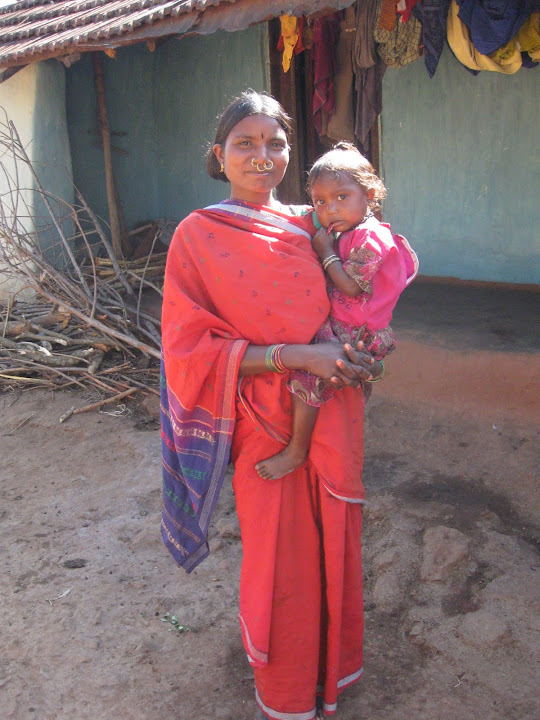
Pleasant-faced villagers in Jeypore
We turn around to drive in the direction of agricultural villages and stop at open fields at the edge of the forest. Twittering sounds are coming from the semi-arid scrub that borders the uneven baked mud. But these countryside species receive our careless attention – the Crested Larks in well-defined dress, the energetic engagements of Ashy-crowned Sparrow-lark pairs, the Plain Prinia pouring out its rapid wheezy trill of a song, and the weak flutter of the Paddyfield Pipit showing off its pure white outer tail feathers! 

Across the flat expanse we see our guide Tapan waving in the hope that we might stick to his carefully drafted schedule! We are happy having concocted much magic out of our simple morning and demonstrate our enthusiasm to visit the villages he is eager to show us. We stop at the village shop to buy sweets and books to distribute among the children. The agricultural village looks comparatively prosperous with different gourds growing around its outskirts. The elders welcome us and show off their homes. A very dramatic old lady with a bright orange-red cloth wound around her holds a long conversation with Tapan and nods in our direction. She is pleased to see us. 

This elderly lady attired in flaming orange is full of the fire of life
Later, when we visit a potters’ village, we are advised to buy heaps of pens besides the cookies for there are a great number of children in the village. They pose with us and obediently sit on a circular platform probably built by a local MLA to be used as an electioneering platform rather than of some real use for the villagers.

Serried ranks of pots flank a single potter working the wheel. He is a young man who must practise the art that his diligent father taught him. Looking at the way he moulds the clay delicately with such proficiency we reckon he probably imbibed the art from his mother’s milk. So adept is he – neither pausing nor faltering – that he smiles at us while holding a conversation with Tapan.
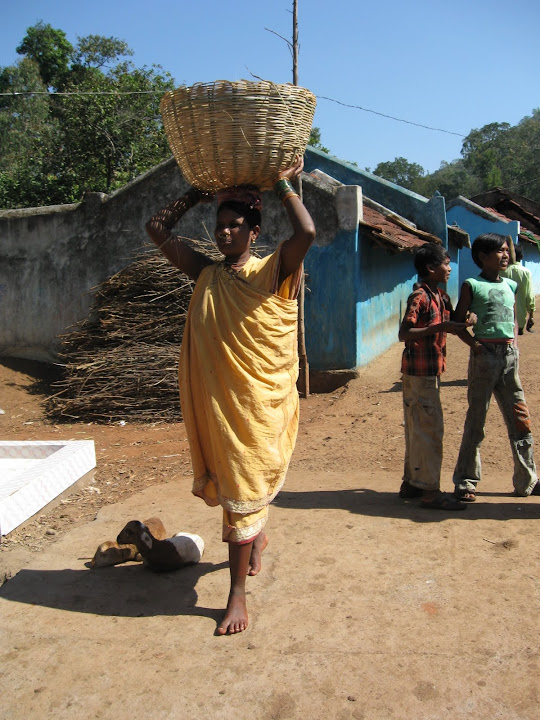
Perhaps the discipline imposed by poverty heightens the villagers' appreciation of life. Indifference to the natural world is for those who spend their waking lives planning their travel to the next
As I walk through the rest of the village with some of the young men leading the way, I remark at their friendliness. The day’s arduous toil hasn’t diminished their good humour. Maybe the discipline of poverty heightens their appreciation of life and its inhabitants. Maybe, when one is less concerned about personal extinction, one focuses on the world around. Indifference to the natural world is surely for those who have little regard for this world and spend all their waking life planning and scheming about their travel to the next! 

Back in the car, a pensive, reflective mood absorbs us both. Tapan gently suggests that we have some refreshments. We had forgotten all about lunch - so engrossed were we in the goodwill and kindliness that we experience in village after village. This feeling would accompany us throughout our Odisha experience. It is possible to see infinity in the ordinary, in the common.

Photographs:
Paddyfield Pipit by J M Garg/ Wikimedia Commons
Other photos by Jennifer Nandi

Read more Odisha Diaries 
Also by Jennifer Nandi:
Odisha Diary – Meeting our Kondha and Paraja countrymen

En route to Chhattisgarh's tribal heartland, Jennifer Nandi is overwhelmed by the dignified social intelligence of Odisha's Kondha and Paraja tribes

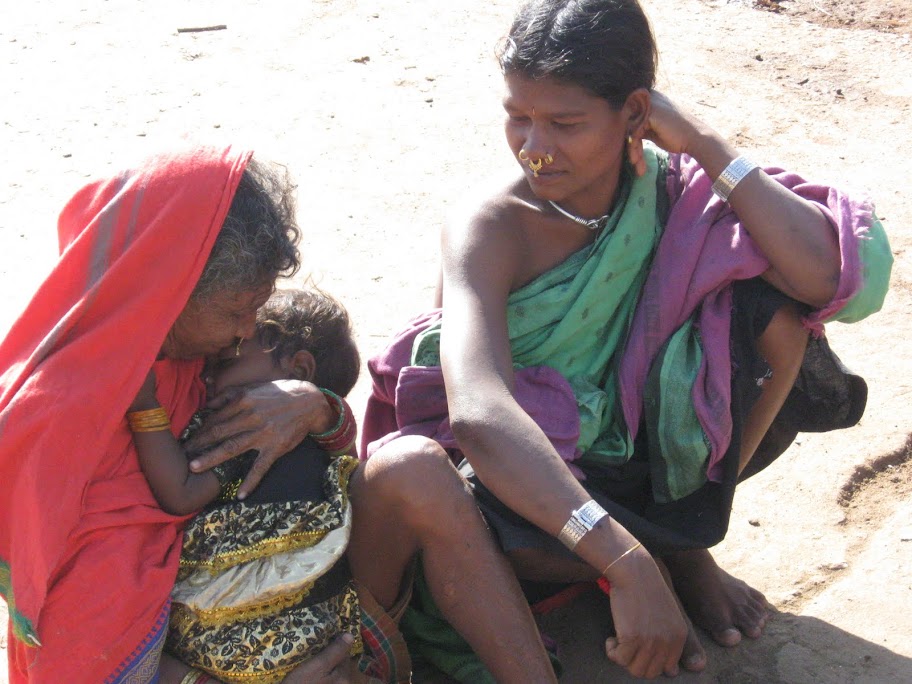
We are on the road by 8 am travelling to Jeypore. Spectacular scenery on both sides of a run-down highway leaves us mesmerised. Lush and green, Odisha looks so rich. Sadly the state is battling grinding poverty. We stop at a village of Niyamgiri where we interact with the Kondha tribes who were once infamous for human sacrifice. Their native language called “Kui” has no written script. Some anthropologists refer to these tribals as being part of a Proto-Australoid group. Certainly the older women do indeed bear a passing physical resemblance to Australian aborigines. The younger women are lithe and beautiful with tattoo markings and jewellery and a piece of cloth wound around the waist and then carelessly thrown over the shoulders. I am amazed at such natural beauty worn so easily. They sit in the warm sunlight, looking at us take pictures, talking to their babies, bathing their little ones, pounding rice, just carrying on despite our nosiness, our inelegant clothes and ungainliness with our shiny cameras. The group embodies an intelligence that seems to be fundamentally social. 

Kondha tribal women
With a culture intricately interwoven with the forest environment, the natural wisdom of these land-dwellers is under threat. Surrounding their village is thick forest that hides the bauxite that the Indian Government wants to mine. The villagers have refused to move. For how long can they keep their ground? Media writing will diminish their stories, undermine their character and trivialize their concerns. Slowly though, their assimilation into mainstream India will take place. For now, they receive quantities of food because they are considered below the poverty line; toilets are built for them and some arrangement for schooling of the young is made. We drive away with mixed feelings for a people who belong to a different time. 

What's he smoking?
Further down the winding road we halt to greet a man smoking a huge cigar. He hails from another village but is from the same Kondha tribe. We ask permission to photograph him and he gladly poses for the camera. I’m very interested in the leaves of the cigar so, with much nodding and gesturing and a big smile to ameliorate my language shortcoming, I learn that they come from the Tendu tree – the same tree with whose leaves beedis are made. 

Verdant vistas unveil as we hurtle forward on yet another hairpin bend of the Eastern Ghats. But all is not well. The green equilibrium is punctuated by a strong military and Central Reserve Police Force presence.

In fact, until the hills drop away and the land levels into the plains of Jeypore, we are continually reminded that we are pushing the envelope of unknowns here. Sadly, the forests of Orissa that spill over into the state of Chattisgarh provide a haven for Naxalites. Yet the Naxalites are firmly on the side of the tribals. Who fought for Australia’s aborigines when mining magnates sold their entire country’s mineral wealth to the Chinese? 

Anyway the welter of questions without answers doesn’t stop us from birding! Where sections of the forest yield to coffee plantations, we stop to have a quick look round.There are Ultramarine Flycatchers, White-browed Bulbuls and Black-winged Cuckoo-shrikes – the last of these I think are at the very edge of their distribution. There are other calls and I’m torn between spending more time here and heading off to our destination. To explore with undying curiosity is so empowering - I often wish more parents would spend time just nurturing this one quality in their children. My decision is made for me – our guide Tapan gently stands close to us and smiles. It’s time to go! But we negotiate to come back to this place tomorrow before we journey on to visit other tribal villages. 

Women of the Paraja tribe
The Hotel Hellow in Jeypore is unattractive but the food is very good – after a hurried lunch we dash off to more villages. The Paraja tribes of Nandpur village are agriculturalists, Tapan tells us, shifting their nomadic settlements in the face of natural calamities. Yet their homes seem more substantial than those of the Kondha. 

Grain is laid out to dry in a Paraja village in Nandpur
Grain is spread out in the sun to dry. It appears to be of the millet family – so named for those thousands of grains harvested from a single seed grown. I’m guessing it’s finger millet – Orissa being one of the important finger millet growing states. Although the grain’s ‘centre of diversity’ is probably in the Ethiopian highlands, it was introduced into India more than 3,000 years ago. But, as is the fate of all our grains, Ragi, as it is known in this part of the subcontinent, has many hybrid varieties developed by crossing Indian and African cultivars. I’m not so sure these hybrids compare well with the traditional varieties. For one thing, the stem of the hybrids has very low fodder value and for another, they would have to be grown in pure stands. The mixed cropped fields of the Deccan area is no place for hybrids. But in the hybrid stands I wouldn’t be surprised that the wild species Eleusine indica and E. aegyptiaca grow as weeds. I have learned that the wild grains are smaller and well enclosed in the ‘glumes’ which is a word from Latin meaning ‘hull’ or ‘husk’. Anyway, for taste, I’d choose the traditional. It comes at a higher price, so we learned at the local village market.

Text and photos by Jennifer Nandi

Read more of Jennifer Nandi's Odisha DiaryPreviously in this series:

Odisha Diary: The Chilika non-starter

Chilika, India's largest lagoon and the second-largest of its kind in the world, offers a tepid reception to Jennifer Nandi, who retreats from it experiencing a strange emotion between disappointment and happiness


India’s largest Lake, Chilika, famed for its birdlife, is our next destination. We pore over the map that shows a short and direct road from Puri to the Lake but both driver and guide advise us that we’d be better off taking the longer but better road via the capital, Bhubaneshwar. The drive takes longer than expected. Impatience gets the better of us as we ask ourselves what would we expect to see in the mid-morning glare. 


The sight that meets us is not good. Like all lakes in India it is a tourist attraction. There are no birds anywhere just throngs of people enjoying the sunshine, the water, feeding themselves at a clutter of stalls - a loud chaos so inimical to what we were looking forward to! Hurriedly we engage what appears to be a ‘speedboat’. 


We are 45 minutes on the water with not a bird in sight when the boat breaks down. The boatman offers to get us another to take us back. I refuse to listen to any deviation from our plan of watching birds. I resolutely hold my ground and coerce our Guide to call his contact on shore to send us another boat for which we would happily pay. This done, we wait on the water for roughly 20 minutes till our second boat arrives. We zoom off much faster and for once feel that we’re getting somewhere! But a thrilling anguish awaits us…..


As we approach flotillas of duck, seagulls and both Greater and Lesser Flamingos in the distance, we are cautioned by a ‘forest’ guard boat not to venture any closer than we had already done! It is a protected area and off-limits to us. I feel within me a secret tension between disappointment and happiness that the birds are under such secure guard. We head back for a quick lunch and a long drive to Raygada, the heart of Orissa’s tribal belt.


The late afternoon sunshine shining through Orissa’s jungle fast approaches us. It is interesting to note that the word ‘jungle’ comes from India. In its Hindi form of jangal, it denotes any area of uncultivated land. Indian jungles are not necessarily forested, and today less so than ever. But well away from centres of population there do still survive a few extensive and well-wooded jungle tracts, especially in eastern and central India. This is despite the fact that the government has acquired forest land with a voracious indifference to forest dwellers both human and animal.


Just before dusk we halt a circumspect distance away from a small, very relaxed village of the Sauras. Noticeable signs of cultural assimilation into mainstream India are very evident. The people are calm and smile shyly. But time is catching up with us and we leave in a hurry. Hours later we hit a roadblock just an eyelash away from our hotel. It’s back to urbanisation with its attendant problems. A van has hit a cyclist provoking the villagers to burn a tyre and blockade traffic. It costs us an hour. We check in to our hotel at Raygada at 10 pm.


Previously in Jennifer Nandi's Odisha Diary:


Text and photos: Jennifer Nandi
All rights reserved

Odisha Diary: Guideless and guileless in Bhitarkanika

When the local bird guide of two decades vintage turns out to be a shimmering dud, Jennifer Nandi takes control of the rest of her birding trip at Bhitarkanika
Early morning at Bhitarkanika - eagles in the trees harry the waterfowl
Birding guides are, at the best of times, difficult to come by. Our unequivocal request directed at the ground operators at Odisha for an able birding guide with a real sense of the park and its bird life was received with understanding. When time is at a premium, it’s essential to have an efficient bird watching strategy. This is greatly aided by the local guide whose ample knowledge of his park takes you exactly where we might see interesting birds. 

Shivering with cold and excitement, we wait and wonder whether the promised expert would actually turn up. Our foreheads furrow as we fight off a rising chorus of doubts; our eyes squint in the inky blackness that is only just beginning to fade. And we struggle with the impotence of restlessness. But all seems well – we see Tapan, our guide, accompanied by a large plum of a man. His hands hold a stick or lathi; binoculars are strung around his neck. This is for real - our designated local birding guide with 20 years experience behind him, strides out of the morning darkness to meet us. We are thrilled. On our wish list are such precious items as the Mangrove Whistler but we do not want to get ahead of ourselves. 
A Monitor Lizard on a mid-morning walk
This spectacle certainly throws a warm halo over matters at once as we head off in dead earnest to board the boat, walking rapidly to mitigate some of the excitement. We cruise for a short while until majestically our birding guide signals with his lathi for the boat to stop. He strides off the one-foot wide gangplank and imperiously summons us. Obediently we follow him into the lightening gloom. 
Up and down the canals by boat
Sadly, this is his brief spasm of importance. That he is useless to the point of embarrassment is evident from his first identification. He points excitedly to an Orange-headed Ground Thrush, misidentifying it as a Mangrove Whistler. I am stupefied that anyone could make such a grievous error. For the uninitiated, an Orange-headed Thrush matches its description – it really does have an orange head. The peninsular race has vertical black head stripes. Striking, wouldn’t you say? And the Mangrove Whistler – it is a drab grey-brown bird! 

Eyes puckered in bewilderment, I turn to the Orange-headed Thrush page of Inskipp’s field guide to birds and simply point; and then to the Mangrove Whistler page, and point again. I am stunned into silence and robbed of my vowels! His ponderous self-image permits no embarrassment -- he nods, smiles and says yes, it’s the same bird, only younger! Soon he is misidentifying the eagles flying overhead, the ducks, the waterfowl... 

Twenty years! To be out in the field for twenty years and not know your own backyard birds is unforgivable especially since you tout yourself as an experienced professional birder! To remonstrate with such deafening dumbness would be a waste of very valuable time and energy. So we just give him a very wide berth. 
A marsh crocodile, one of many that are bred at Bhitarkanika, basks in sumptuous sun
Filled with a kind of melancholy gaiety, we focus on the fecund riot of plant and animal life that must await us. Once we get over the shock of having to find the feathered gems on our own, we have quite a good time. We seem to have the park to ourselves – there isn’t another human being in sight. So we walk unobstructed into the early morning mist, surprising the preening water birds. Short-toed Serpent Eagles fly low overhead. Lesser Spotted Eagles harry the waterfowl and rest in the tops of nearby trees. This is breathtakingly beautiful country. Behind me teal take off sending a bright shiver down my spine which in an odd way reveals to me a secret concerning myself. Watching excites me. 

Ken signals for coffee and we cup our palms around steaming hot cups of Lavazza made in our very own percolator! A boar rooting aggressively in the leaf mould catches our eye. He moves out of sight and we set off along a drier path walking alongside each other. I am closer to the bushes on the right. While our vision is focused intently on birds that might hop onto the path ahead to glean for food, we hear an excited shout from behind. We turn to see our guide pointing at a 10-foot King Cobra that permitted us to walk within two feet of its magnificent presence. It raises its head to give us a once over and then serenely, without fuss, slithers away. It occurs to me that I had chosen the very bushes along that path for what I took to be a very private answering of nature’s call. How wrong I was! 
This 10-feet King Cobra made the answering of nature's calls a little less private
This morning has been most wonderful and we steer ourselves in the direction of returning to the lodge for a much needed breakfast. A scrumptious fare awaits us and we do immense justice – but we are in a hurry to get back to the water. We wander up and down all the channels by country boat. Mugger crocodiles – some measuring over 20 feet – are on most banks. Bhitarkanika breeds freshwater marsh crocodiles and then releases them into the channels. The ride relaxes us – the mid-morning sun warms us to a point where we make up our minds to do an early morning walk the following day before our departure to Konarak. We fix a time with the boatman who is only too happy to navigate his beloved boat while we watch with meditative alertness. 

Text and photos by Jennifer Nandi
All rights reserved

Previously in this series:

Other travelogues by Jennifer Nandi

Odisha Diary: Onward to Bhitarkanika

Jennifer Nandi's sojourn in Odisha begins with a ride through the Buddhist ruins at Udayagiri and Ratnagiri 


Some serious packing after dinner leaves the night in tatters – yet, we are ready to leave the hotel at 5.30 in the morning to catch our flight to Bhubaneshwar. Sushanto, the epitome of courtesy, is our guide for the Orissa (officially renamed Odisha in November 2010) segment of our journey. He meets us at the airport, with welcoming gestures and smiles, brimming with keen anticipation and excitement at the next 10 days that we must all spend together. We settle in for the long drive to Bhitarkanika Marine Sanctuary, our final destination.


Our route winds around the Buddhist ruins of Udayagiri and Ratnagiri in the district of Jajpur. In fact, the Chinese traveller Huien T’sang noted that the three hills – Ratnagiri, Lalitgiri and Udayagiri -- which housed a Buddhist complex, was the seat of a flourishing Buddhist University called Pushpagiri. In the northern part of Langudi Hill of the Udayagiri village there is an archaeological site with several Jain and Buddhist rock-cut caves. One of these is a double-storied cave with ranges of cells cut into three sides of an open courtyard. Inscriptions from the caves date from the 2nd century BCE to the 10th century CE. Ratnagiri was established during the reign of the Gupta king Narasimha Baladitya in the first half of the 6th century CE, and flourished until the 12th century.


The archaeological site at Udayagiri is not to be confused with that found in the twin hills of Khandagiri and Udayagiri, 8 km to the west of Bhubaneshwar, which had become strong centres of the Jain faith under the Chedi king, Kharavela.

We wander at will around some magnificent sculptural ruins – few people notice us. Foreigners are an extreme rarity in these parts but Ken is left well alone, apart from some surreptitious sidelong glances.


A cloud of Rose-ringed Parakeets swarms over the fields of grain
The drive onwards to the sanctuary takes us through sleepy villages. Each village has its own scrupulously clean temple courtyard. In the nearby fields where peanuts have just been harvested, troops of langurs complete the day’s pickings. Hundreds of Rose-ringed Parakeets swarm over grain fields. No villager makes any attempt at chasing them away.


In the fields, Hanuman Langurs complete the day's picking of peanuts
As we near the estuary of the Brahmani river, the land gets wetter. In the ditches by the side of the roads are children, both boys and girls, sometimes accompanied by men -- they are all knee-deep in slush, looking for clams and suchlike. Beyond, in the quiet of a village hut, women work at the charkha, the spinning wheel of Mahatma Gandhi’s time. Others paint their outside walls with white rice powder; still others prepare the day’s cowdung using a broad-bladed hoe to combine the dung with the mud and their feet to flatten any hardnesses that might have escaped their careful attention. Finally, hands are used to precision-shape the perfect cow dung cakes that are left to dry adorning every village courtyard, wall and dry open space. Unused dried cakes are stored under hay. Any threshing to be done is duly taken to the highway. Cars drive over the grain, thus obviating the need for expensive threshing machines. In fact, the villages use the nearest road as their very own drying shed – all comestibles that require drying end up along the edges of the road.


Preparing dung cakes for fuel is cheerful work
Our car drives through a maze of embankments until just before dusk. We throw luggage into our rooms and hurriedly set out to maximise the last rays of the dying sun. We walk along the canal right next to our very basic lodge. Our last-ditch effort at birding pays off -- we see three different species of woodpecker. What a wonderful end to a long day!


Text and photos by Jennifer Nandi
All rights reserved


Previously by Jennifer Nandi:
The Andamans Diary
The Sundarbans Diary