We’ve moved! Here’s where you can find us

The Green Ogre is now at https://www.greenogreindia.org
Showing posts with label travel. Show all posts

A ramble through Alaska - Portage Glacier, Anchorage

Concluding Anand Yegnaswami's sojourn in Alaska, this episode sees him face to face with a Grizzly and learning something new about the gender of Santa's red-nosed reindeer


Refreshed from a rather uneventful third day of our trip we emerged from our slumber gung-ho about what was to be our first experience of a fjord. We had read in school textbooks about Norwegian fjords and here was our ticket to experience one from a cruise boat.
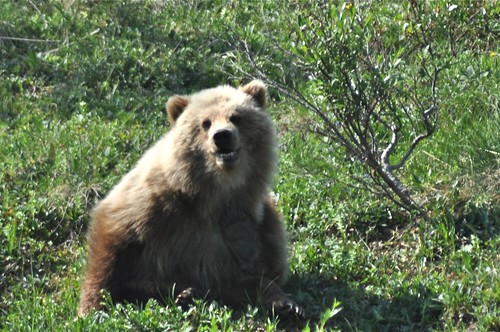
A brown bear
The cruise we had booked promised fascinating views of glaciers and wildlife that included sea-lions, puffins and whales. The Czech acquaintances Rajarshi made the previous day had shown us captivating images from the cruise taken a day earlier. Had someone heard us praying, they might have assumed us to be sexist expecting parents but we prayed hard for the sun.


As we emerged from the hotel still praying, the ice-cold drizzle left us bedraggled and washed away our hopes of the fjord experience. It wasn’t a surprise when the cruise operator told us it was impossible to provide cruise services on such a wet and windy day.  We were done with Seward and as we headed out I learned from chatting with the lady at the gas station that the day before had been the 14th sunny day of the year. I left grumbling about the weather. Zeus was off my worship list.
Portage Glacier with the Blue Ice visible
We opened the glove compartment to look at the guide and found Plan B smiling at us – we settled on Portage Glacier and the Alaska Wildlife Conservation Center. The weather seemed to have come out of its fickle bout and we enjoyed our drive until we reached the glacier. Having caught wind of my recent affront, Zeus sent a freezing downpour accompanied by a breeze so strong that the tandem strike could have frozen the marrow in our bones. We braved the weather and moved on to the Alaska Wildlife Conservation Center.
Bisons at the Alaska Wildlife Conservation Center
At the Conservation Center we saw significant acreage allocated for the rehabilitation of wild animals. Moose, elk, brown bear, Bald Eagles, bison, coyote, musk ox and lynx formed the group of animals that have found refuge here. We heard about the injured Bald Eagle that was too hurt to be safely released back into the wild. I was pained at the plight of a bird of prey so majestic that was now hopping along a solitary branch of a tree stump and would never again spread its mighty wings. Having seen the commendable conservation efforts at the wildlife center we headed for Anchorage.


The Seward Highway 1 that flanks Cook Inlet is known to offer Beluga whale sightings and we kept our eyes wide open and shouted “Beluga” for everything that moved only to quickly realize our folly and melt into sheepish grins. By the time we reached Anchorage our throats were parched from the screaming while our eyes were dreary from having seen none.
Anchorage, Alaska
Anchorage is one of the coziest cities I have visited during the beginning of fall, not temperature-wise but temperament-wise. The city, built by army engineers, is organized well into streets and avenues with buildings bristling with character. The three previous days of recluse living with inadequate social interaction made the visit to Anchorage a treat. I have never enjoyed crowds so much. 


We lapped up the cultural gallimaufry with gusto as we saw different races, nationalities and ethnicity converge on the city while we went looking for souvenirs. We saw totem pole replicas with carvings of raven, bear, and whales. We saw artwork on ivory from whales and even baleen, which raised our eyebrows on the legality of the sale of these items. The trip to Alaska illustrated the power of nature to sustain communities in the severest of weather conditions. 


There is, however, a thin line between sustenance and exploitation. Will the pressure of population take its toll on this paradise? From our interaction during the trip we learnt that most of the population in Alaska is transient, they travel to Alaska for work during the summer and leave before winter. Probably the inhospitable winter is in a way a boon for conservation. We left for the airport.

Sculpture in Anchorage asserting the significance of nature in Alaska
At the airport we chatted up a gentleman from Colorado who was returning from a visit to his girlfriend’s family near Anchorage. He brought in a very interesting piece of information from the Caribou farm he had stayed in. He mentioned emphatically that “male Caribous lose their antlers by December 15." Which means Rudolph is a female!

I took back more than just souvenirs, pictures and memories from Alaska.


Text and photos by Anand Yegnaswami
Read all posts in the Alaska series

On hobbled knee across the Nandakini


In the final episode of her Bedni Bugyal travelogue, Jennifer Nandi crosses a bridge and a river into another consciousness, one that holds the tranquility of the Himalaya and perturbation over its future in delicate balance
The snow-clad flanks of the hills reflected in Bedni Kund was a vision that sustained us on that trying and redeeming journey
The day breaks warm with birdsong. Always and every time, new and irresistible distractions wake us early. It is a good thing we are birders since the rooms are saturated with dust and stale odours. So, we escape the fusty accommodation to strain our ears at the muted lisps of birds fussing in the underbrush near the sun-baked mud hut of our host. With permission we approach, and watch her deft use of primitive tools to prepare our meal for the day.


The locals gather around and we learn their hazardous ways. They complain of diminishing reserves of fuel wood for cooking and heating homes, depleted soils, and overgrazed pastures. This surely suggests worsening conditions for life in the mountains. It brings notice to the linkage between alpine deforestation and lowland floods. The degraded forests hold less soil, catch less runoff and stabilize fewer slopes. Rapid weathering renders the soil fragile. Nature at odds with its environment can’t thrive; and when the depredation is ruthless, no seed can survive in such uncongenial ground.


Amid the balmy verdant forests are vast monocultures of blue pine
Water is a fragile commodity – the scarcity of drinking water in the villages is growing. In 2007 there was a high rate of run-off because of the variability of precipitation. The monsoon-like downpours we experienced in early May that year caused higher sediment loads in the rivers which must have surged in floods onto the Ganges plain – washing our future into the sea. The fragility of the biota is compounded by bedrock shifts. The Himalaya are dramatic testimony to the relentless power of drifting continents. In this context, is the Himalaya described as a high-energy environment. 


Yet, the basic life-support systems – soil, water, and biota, the limiting factors in the mountain ecosystems – have failed to restrict this village community of Kanol in their dreams. Half a dozen of its young men have joined the armed forces. However, scarcity and degradation forces them to live frugally. We wander out alongside the terraced hillsides. A little path leads toward the forest. Spring flowers that feed the spirit clutch at the hillsides – wild gerberas, forget-me-nots, geraniums, and daisies like the different colours of the sunlight. Nature surely blunts even the worst excesses of man. It seems our path is strewn with flowers. But our hearts are heavy with the burden of knowledge that we inevitably soil our most precious resource. These sanctuaries of forest and reason on which civilization depends are ultimately made inefficient through degradation.
Water, clear and clean, appears abundant in the Himalaya but we saw enough to learn that its future is uncertain
It is approaching late afternoon. Devidutt is nowhere to be seen. He has consumed a powerful soporific to keep him insensate for the next three hours. We eat without him. His casual camp procedures have overwhelmed us. We neither look in horror as he wipes the skillet with a dirty rag before cooking; nor at his complete disregard for clean plates and cutlery. 
Without our capricious guide Devidutt, seen here making tea in the hollow of an oak to keep the winds from snuffing the fire, our journey would have been wanting for character or anecdote
In failing light we gather for quiet reflection, meditation and thanksgiving. It is our last night together as a trekking team. We rejoiced in the simple thought that we'd had both a challenging and an enjoyable time. We were also safe.


The next day arrives too soon. There is much traffic on the way down. The history of human settlement in the Himalaya is marked by regular mobility for purposes of trade, resources, work, pilgrimage, or social exchanges. Travel has been an ongoing feature of these mountains. The intricate network of walking trails, resting places, and the cultural traditions of inn-keeping and porters, testify to that. 
Wild geraniums poke out of the understorey
Early in 1991 when I had climbed to Kuari Pass, the public bus dropped us by the roadside at Nandaprayag. We then walked to Ghat and upwards to Kuari. Now the newly built roads have opened what had been inaccessible terrain to vehicular traffic and to new economic markets all over the range. Such efforts both materially and symbolically convey to the remote villages the opportunities and risks of the wider world.


The stony, steep descent to the River Nandakini has all but crippled us. Sunita and I lag behind the men. At last, with the river in sight, I walk to sit on the bridge. Sunita finds her way closer to the river. Clearly, she is in no mood to talk. I give her space. 


Soon, we are joined by three German trekkers with their guide. The guide comes up to importune me with questions. After I had explained that we were birders, he asks what ‘equipment’ would one need to engage in bird-watching. 


“Just your eyes,” I say lightly. 
“No, no, one must have binoculars too.” 
“Ok,” I say, “And a field guide.” 
“What else,” he asks. 
“A basic creative principle,” I say facetiously. 
“Where can I buy that?” 
Such simple-mindedness. 
“One has to learn to observe – that’s the key. Birders must notice everything in its full, detailed richness.” 
“Where can I find such people?” he asks. 
“On a hillside, just watching,” I reply. 


He dismisses me with a disbelieving look on his face. What a fortunate breed we are with an endless succession of surprises in life, by just engaging in the challenge of identifying.
It is now my turn to probe with questions. I walk up to this alpine leprechaun to ask why his legs were green. In the torrential rain of yesterday, the colour of his pants ran! 


I turn toward Sunita to share the joke. She has finished smoking and is now inspecting her nails. She needs more time. The joke will have to wait. Now I wait for some signal of her readiness. She upturns her water bottle to her parched lips. That’s my cue, some physical sign of preparedness.


The Nandakini, one of the Ganga's little-known tributaries, is one of the most beautiful of Himalayan rivers though our passage across it, over a quivery single-log bridge, was fraught with apprehension
Devidutt has been haranguing me to hurry up. He beams when we follow him. He is very encouraging. Our trek is nearly at its end. Sitel is in sight. Though it has begun to rain once more, we shelter in a shed while the men negotiate for a taxi. The women pile in with the driver and a couple of his friends. We have no clue what’s going on in the back. Fifteen men with all our luggage and theirs, sacks of village wealth, all pack into the back of the ‘tempo’. We didn’t hear a word of complaint from our fellow-trekkers, not even from the eternal comedian, Bijoy. We shall all miss this superb mimic. And I will always remember Sahastra, whose appreciation of visual delights was not just an indulgence, but rather an ennobling of ordinary need.


Leaving the Himalaya brings on the pangs. What traveler can forget the dark, silent shape of a Plumbeous Water Redstart as it flirts its fiery tail against the stone-grey foam of a rushing river?
While we wait to board the train at Hardwar, pilgrims laden with Ganga-jal jostle for a place to sit. I recollect reading somewhere that we must be “steady in what we do, not blown like feathers at the wind’s discretion, nor think that every water cleanses you.” I shall remember opening my pores to bathe in Nature. I shall remember the flirting tail of a Plumbeous Water Redstart, the Ultramarine Flycatchers confabulating on the quantity of gossamer needed for the nest, the shrill green of the parakeets – their colour as loud as their calls. Design in nature is a concatenation of accidents – chance genetic changes but so culled by natural selection that the result is not just effective but beautiful as well as to seem a miracle of purpose. 


Thoreau once wrote, “In wildness is the preservation of the world.” A century later, Wendell Berry proposed this necessary corollary: “In human culture is the preservation of wildness.”

By Jennifer Nandi


Photographs: Sahastrarashmi and Bijoy


Odyssey to Bedni Bugyal, a travelogue in ten parts, is now concluded. Follow these links to read previous episodes:
Part 1 | Part 2 | Part 3 | Part 4 | Part 5 | Part 6 | Part 7 | Part 8 | Part 9

Ramble through Alaska - Exit Glacier

At Exit Glacier, not far from the top of the world as the puffin flies, we stayed at a historic hotel and stayed clear of bears


We were drained from the previous day’s drive to the Arctic that ended only at 3 AM on Day 3 of our trip at Seward, Alaska. Seward is a tiny town in the southern part of Alaska in the Kenai Peninsula, named after William H Seward who negotiated the purchase of Alaska. The town offers access to the Kenai Fjords National Park and the Exit Glacier, which were in our itinerary for the next two days. We had stayed at the Hotel Van Gilder -- a historic hotel in Seward.

Exit Glacier
Built in the early 20th century, Hotel Van Gilder has seen the metamorphosis from an office building, hotel, women’s dormitory to its final use as a historic hotel. We were impressed with its interiors and furnishings, which gave us the feeling that we were indeed staying at a place of historic significance. The interiors, with their Italian feel, reminded me of another place where I had stayed at Miami Beach.
Hotel Van Gilder, Seward, Alaska
We had a three-hour nap as we had to get to the Harding Ice Field Trail to begin our hike. The weather was not benign and there was a continuous drizzle. A rather gloomy day compared to the heaps of sunlight we had received the day before. When we got to the visitor’s center for the Exit Glacier we could hear a lot of talk about bears in the area, and we made the necessary enquiries on how to evade bears, which included making a lot of noise and trying to look larger than the bear by spreading out the limbs high, or using a pepper spray (which we didn’t have). We then proceeded with caution. We passed a few hikers on the way back and some warned us about bears in the area. After about 30 minutes into the hike Raghavan and I decided we didn’t want to be hugged by any bears. I was reminded of a lesson my high school English text book about a hiker who was attacked by a bear that took out his scalp with one blow. Rajarshi was nonchalant about the bear threat and decided to continue all alone. 

A cruise ship at Resurrection Bay
We hung around for short hikes at the base of the glacier and were pained to read about how it had receded over the past years. Back at Seward Raghavan and I ate and headed out to explore the town's streets, a journey that took us to Resurrection Bay. Back at the hotel we were joined by Rajarshi who related his hike experience, the friends he had made, and a black bear he had spotted along the glacier.
Colorful mural on the wall of a restaurant
We ended the day with a visit to a local watering hole where we caught up with the friends Rajarshi had made during the trek -- two from the Czech Republic and one from Japan -- and we exchanged notes on our travels and headed back hoping we could catch glimpses of puffins, sea lions and whales during our cruise at the Kenai Fjords National Park.

Text and photos: Anand Yegnaswami
Lead Photo: Public Domain


Read previous posts in the Alaska series

Ramble through Alaska - the Arctic Circle

Leaving Mt Denali behind we left with optimism for the Arctic Circle, into the ragged latitude of the midnight sun


Disappointed with the weather at Denali National Park that denied us a view of Mt Denali on the first day of our trip to Alaska, we looked for an suitable alternative and found it in the Arctic Circle.

We headed out of Denali National Park early morning towards Fairbanks en route to the Arctic Circle. Aware that we could not hope for lavish feasts on the way we stocked up on food. It was a hastily planned jaunt with many unknowns, all of which added to the sense of adventure. 

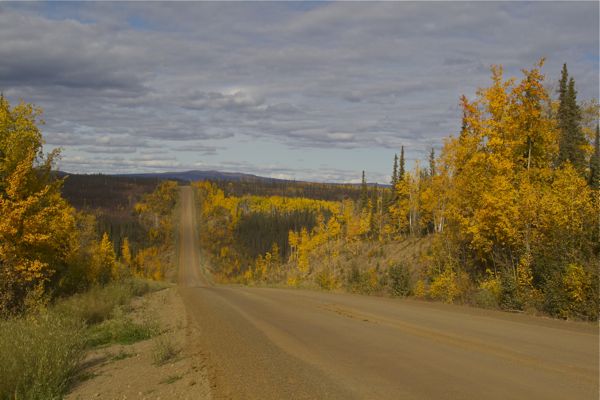
The unpaved road dotted with aspens
First, we had approximated distances as we had used paper maps for planning. Moreover, we had little knowledge of the pockets of civilization and amenities we might find on the way. Additionally, we did not have a complete picture of the road conditions. Yet, the temptation to seek exploratory salvation grabbed caution from our senses and threw it into the air. We were on our way to seek a place in the plaque for the ones who crossed over to the frontier of the midnight sun.
The tundra close to Denali National Park
The Arctic Circle is an imaginary circle of latitude that runs around the earth at 66 ½ degrees north of the equator. Due to the axial tilt of the earth the regions north of this circle experience at least one 24-hour day (in summers) and one 24-hour night (in winters) during the year. The Arctic Circle is not a single geo-spatial coordinate; it is a number of geo-spatial coordinates strung together, and we were hoping to cross over into the Arctic on the Dalton highway that connects Fairbanks with the offshore drilling region near Prudhoe Bay. All we could learn from our limited research was that there would be a signpost by the highway indicating the Arctic Circle.

We crossed Fairbanks and further north got onto an unpaved road that significantly slowed us down. Soon we were driving along the Trans-Alaskan Pipeline, which connects the offshore platforms in Prudhoe Bay in the Northern extremity of Alaska with the Southern Alaskan port of Valdez (rather infamously known for the 1989 oil spill involving the tanker vessel Exxon Valdez at Prince William Sound). Raghavan added a trivia that the Mother Ship of the smokers in the movie Waterworld was named Exxon Valdez. The day was clear and sunny and our thoughts went back to Mt Denali, for on a day like this the peak would have been clearly visible, yet the landscape around our route specked with aspens made the drive to the Arctic a visual treat. 

The Trans-Alaskan Pipeline
We crossed the mighty Yukon River and entered the tundra, which was dotted with fascinating land formations including a cluster of rocks shaped like fingers called Finger Mountain.
Rock formations on the way to the Arctic Circle

Finger Mountain
Just after noon we reached the rather nondescript Arctic Circle. We could not appreciate the faunal value of the region, though we were spellbound at the artistic landscape that told of nature's craft of creating visual masterpieces. The vegetation in the tundra supports Caribou and with them follow Brown and Grizzly bears; yet the highway we took was a trifle compared to the expanse of the tundra and therefore diminished our chances of spotting wildlife.
Board indicating the Arctic Circle on the Dalton Highway
On the way back the sun painted the scenery with vivid hues and just before it went down we got a glimpse of the Northern peak of Denali from George Parks highway. Inundated with zeal infused by a lively day we looked forward with hope for the next day’s foray – the Exit Glacier in the Kenai Peninsula.

A glimpse of Mt Denali from George Parks Highway
Text and photos: Anand Yegnaswami


Previously in this series: Part 1 - Ramble through Alaska

A ramble through Alaska

Moose, elk, grizzlies and caribou are on Anand Yegnaswami's mind as he recalls a trip to Alaska's Denali National Park

Alaska was a part of Russia until 1867 when US Secretary of State William H Seward played a key role in purchasing it for $7.2 million. It is believed that the Russians were keen on the sale as having the Americans in their backyard would be a deterrent against the English. Most Americans felt that it was foolish to buy this barren patch of land and mockingly referred to the deal as “Seward’s Folly”. Mr Seward it appears was a man of profound foresight for despite the criticism he had mentioned that his greatest achievement was “the purchase of Alaska – though it will take people a generation to find it out.” Five generations later, I had an opportunity to seek out the truth myself.
The Thursday before Labor Day 2008, shortly before 11:30 pm (Alaska Time), Raghavan and Rajrishi from SFO, and I from Seattle landed at Anchorage’s Ted Stevens International Airport, picked up our rations at a nearby grocery store, and headed to Denali National Park.

Denali, which means “the tall/high one” in the Athabaskan language, is the highest peak in North America. The region around Denali, designated as the Denali National Park, is abundant in fauna. However, we were also hoping for a clear day to catch a glimpse of the peak itself, which is covered by clouds for most of the year.

Back at Anchorage, we were out on the Glenn Highway headed for Wasilla. Shortly after midnight of August 2008 (Alaska Time), John McCain announced Alaska governor Sarah Palin as his running mate for the 2008 Presidential Elections. I would like to think it was a mere coincidence that we passed by the town that day, for the quest we were actually on was Denali.
The road to Denali was desolate and serpentine with frequent changes in elevation. Quite often we would see light on the horizon and mistake it for the Northern Lights (Aurora Borealis). Whether this was the effect of fatigue from the long travel or a case of highway hypnotism we do not know. However, we made the same mistake knowing well that we could not expect to see the auroral phenomenon at that time of year. We saw some moose beside the highway in the early hours of the day and just about daybreak we reached the Park Visitor Center.

The Denali National Park is the only US National Park that does not allow personal vehicles inside the park. However, the authorities have ensured that ample shuttle buses are available to travel within the park. Shuttle buses are available for Toklat River (6.5 hours round trip), Eielson Visitor Center (8 hours round trip), Wonder Lake (11 hours round trip), Kantishna  (13 hours road trip). Our plan for Day 1 was the Eielson Visitor Center option as the duration seemed reasonable and we had planned to upgrade it to a Wonder Lake trip if Mt Denali was visible. Though we made enquiries about the Discovery Hiking Tour for day 2,  they were sold out. It was a cloudy day and it seemed unlikely that Mt Denali would be visible, yet we crossed our fingers and got into the bus.
Moose in Alaska (Douglas Brown/ Flickr)
On the trip to the Eielson Visitor Center, we passed a few solitary moose. The bus driver forewarned us to keep a safe distance from them while we were in the park, since it was the rutting season and solitary males were known to be very aggressive. After crossing the Savage River we came across a herd of caribou (Rangifer tarandus). Also known as Reindeer in Europe, these deer are both migrant and resident. The migrant herds are known to travel up to 5,000 kilometers in a year. The reindeer are food species for a variety of carnivores including wolverine, wolves, brown bear and Grizzly and we were about to meet one such foe. 
Further ahead of the Savage River we came across a mother Grizzly Bear (Ursus arctos horribilis) and her cub. Grizzlies are found in copious numbers in this region, though the irony is that they do not reproduce often. Females mate only from the age of five and they do not mate until a few years after the cubs leave, or are killed. The Grizzly Bear has very high nutritional needs as it needs to keep itself nourished through long periods of hibernation. Its diet includes berries, fish and large mammals such as moose, elk, bison, caribou and sheep. We were getting a good idea of the food chain of the region. Next we saw Dall sheep (Ovis dalli) as small white specks climbing high up on the mountain face.
Grizzly Bear in Alaska (dgrice/ Flickr)
Moving on we saw several shrubs that seemed to be ravaged by some form of pestilence. Our driver explained that the shrubs were denuded due to the feeding frenzy of the Snowshoe Hare (Lepus americanus), which are predominant in the region. The landscape at Denali National Park is eerie on a cloudy day towards the end of summer. The mountains are stripped bare of snow, with dark patches exposed by the erosion caused by melting ice. Yet the tundra can surprise you with an occasional patch of bright red or yellow in these otherwise dreary surroundings.

Ahead we encountered Arctic Fox (Vulpus lagopus) by the side of the bus. At the Eielson Visitor Center we had to decide whether to proceed to Wonder Lake or head back to the Denali Visitor Center as the day had been rather cloudy. We chose to catch a shuttle back. We had just emerged from the visitor center when we froze. The mist was thick but we could see that the dark figure that hopped a few feet away from us was not really the cuddly kinds. We stood still as the Grizzly cub hopped towards a trail below us and were concerned that the mother might appear any moment. However, these concerns were belied as we got into the shuttle towards the Toklat River.
At the Toklat river a Grizzly foraged near the river bed. We tried to get close for a photo when a moose came calling. Not wishing to be the moose’s bunny for the day we got back to the shuttle, only to realize that the clouds were clearing. 

Were we destined to catch a glimpse of Mt Denali today? We changed our minds and caught a shuttle back to the Eielson Visitor Center.

However, by the time we reached Eielson Visitor Center the weather had worsened. Disappointed, we sat before a table with the map of Alaska. Giving up hope to see Mt Denali, we decided to spend Day 2 making a foray to the Arctic Circle.

Text and photographs by Anand Yegnaswami
Other images sourced from Flickr (as credited)

Odisha Diary – Birds and rewards in Jeypore

Birds and spirited village women invite Jennifer Nandi's careless attention as she enjoys Odisha's pastoral countryside

A Paddyfield Pipit, among the commoner countryside birds, still begs a second look
We have a tight calendar and with an air of sweet conspiracy we connive to make it even tighter. Our intrigue pays off. Instead of permitting the morning to blur into the afternoon's dazzle, we rise at an unwelcoming hour to drive before the day breaks warm with birdsong to that very place we had made a pact to re-visit. 

Our timing is perfect; for as we approach those coffee bean plantations alongside the forests, we are assailed by loud calls. Stepping out of the car quickly, we pursue the owners of those intriguing calls. After an hour’s search, having scrambled through scrub, negotiated through barbed wire our attention not wavering for more than is strictly necessary, we sense that suddenly the air has surrendered all motion. But not those bushes! 
Instead of permitting the morning to blur into the afternoon's dazzle, we rise at an unwelcoming hour to drive before the day breaks warm with birdsong
The Indian Scimitar Babbler, that very elusive bird, shows itself as it pauses from inspecting the moss-covered branch of a tree. It flies off to join others members who are rummaging in the undergrowth for insects. They communicate in mellow bubbling sounds. The male's musical flute-like calls are immediately answered by the subdued reply of the female. We are rewarded with good views. 
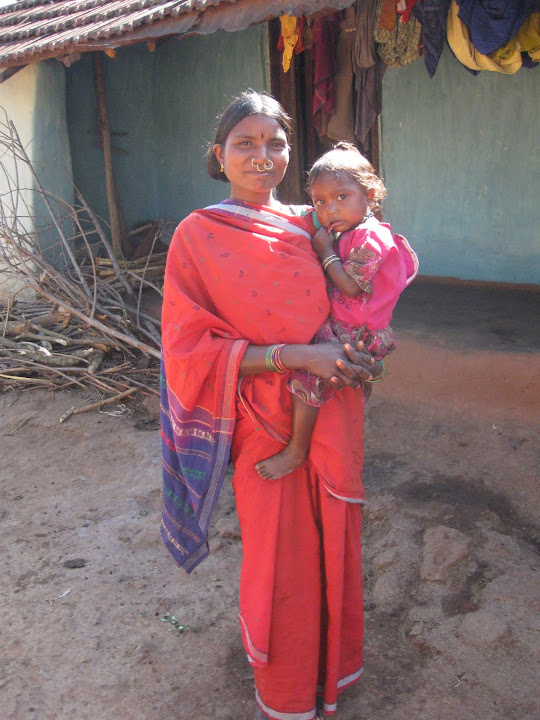
Pleasant-faced villagers in Jeypore
We turn around to drive in the direction of agricultural villages and stop at open fields at the edge of the forest. Twittering sounds are coming from the semi-arid scrub that borders the uneven baked mud. But these countryside species receive our careless attention – the Crested Larks in well-defined dress, the energetic engagements of Ashy-crowned Sparrow-lark pairs, the Plain Prinia pouring out its rapid wheezy trill of a song, and the weak flutter of the Paddyfield Pipit showing off its pure white outer tail feathers! 

Across the flat expanse we see our guide Tapan waving in the hope that we might stick to his carefully drafted schedule! We are happy having concocted much magic out of our simple morning and demonstrate our enthusiasm to visit the villages he is eager to show us. We stop at the village shop to buy sweets and books to distribute among the children. The agricultural village looks comparatively prosperous with different gourds growing around its outskirts. The elders welcome us and show off their homes. A very dramatic old lady with a bright orange-red cloth wound around her holds a long conversation with Tapan and nods in our direction. She is pleased to see us. 

This elderly lady attired in flaming orange is full of the fire of life
Later, when we visit a potters’ village, we are advised to buy heaps of pens besides the cookies for there are a great number of children in the village. They pose with us and obediently sit on a circular platform probably built by a local MLA to be used as an electioneering platform rather than of some real use for the villagers.

Serried ranks of pots flank a single potter working the wheel. He is a young man who must practise the art that his diligent father taught him. Looking at the way he moulds the clay delicately with such proficiency we reckon he probably imbibed the art from his mother’s milk. So adept is he – neither pausing nor faltering – that he smiles at us while holding a conversation with Tapan.

Perhaps the discipline imposed by poverty heightens the villagers' appreciation of life. Indifference to the natural world is for those who spend their waking lives planning their travel to the next
As I walk through the rest of the village with some of the young men leading the way, I remark at their friendliness. The day’s arduous toil hasn’t diminished their good humour. Maybe the discipline of poverty heightens their appreciation of life and its inhabitants. Maybe, when one is less concerned about personal extinction, one focuses on the world around. Indifference to the natural world is surely for those who have little regard for this world and spend all their waking life planning and scheming about their travel to the next! 

Back in the car, a pensive, reflective mood absorbs us both. Tapan gently suggests that we have some refreshments. We had forgotten all about lunch - so engrossed were we in the goodwill and kindliness that we experience in village after village. This feeling would accompany us throughout our Odisha experience. It is possible to see infinity in the ordinary, in the common.

Photographs:
Paddyfield Pipit by J M Garg/ Wikimedia Commons
Other photos by Jennifer Nandi

Read more Odisha Diaries 
Also by Jennifer Nandi:

From Madurai to Mount Kailas, a pilgrim's puzzling progress

A chance find in a Pondicherry flea market points to an unknown Tamil Nadu pilgrim party's mysterious journey to the base of Mount Kailas in 1948, only two years after Heinrich Harrer arrived in Lhasa


Last Sunday, as I am prone to do on weekends, I paid a visit to the flea shops on the East Coast Road in Pondicherry. These shops, which usually offer a motley collection of old stuff – terracotta figurines, calendars and posters, furniture, French porcelain, old black-and-white photographs, books and the usual bric-à-brac, sometimes throw up a surprise.

Rummaging through an old tin trunk full of dusty faded black-and-white photos I came across an old, slightly faded picture with a mountain in the background. That was surprising enough – 90 percent of the pictures are usually studio portraits of respectable South Indian families, newlyweds, demure housewives and pious Brahmins – but what hooked me was the familiar outline of the peak. From its aspect, it could have been only one mountain -- a huge mass of rock and snow, magnificent in its setting, awe-inspiring and bequeathed with majestic grandeur. It was Mount Kailas (6714 m).

My heart pounded as I dusted the picture and read the text printed on the mount: “Photo taken on 10-7-48 during the pilgrim visit by Sri K. L. N. Janakiram to Holy Mount Kailas.” Four men stood in front of the mountain, three looking away from the camera with the canvas tent visible behind the fourth person. The four pilgrims appear in good shape, proud but with no visible swagger at this achievement, which even in these times when Toyota Land Cruisers race down to within shouting distance of the holy mountain, is a matter of undue vanity and arrogance for quite a few.

To put this in context, the region was still being explored in the late 1930s. A paper written in 1942 by the eminent geologist Darashaw Nosherwan Wadia (after whom the Institute of Himalayan Geology was renamed in 1976), mentions explorations carried on between 1928 and '38 in the Kailas-Manasarovar region as having "raised some doubts regarding Sven Hedin’s conclusions [the Swedish geographer, explorer and writer was the first European to enter the Kailash-Manasarovar region]. Though not a professional geographer, the Swami [Swami Pranavananda, whose book Exploration in Tibet attempted to surmise the sources of the Himalayan rivers] has made a record of most interesting, accurate and painstaking observations of natural features and phenomena which provide valid data on the intricate question of fixing the sources of these rivers”. 

The rivers spoken of are the Indus, Sutlej, Ganges and Brahmaputra. Heinrich Harrer’s fabled escape to Tibet via the Tsang Chok-la Pass (5,896 m) near Badrinath was made only in 1944 (he reached Lhasa on January 15, 1946).

Partly due to its remoteness, but mainly since Tibet was closed to foreigners through much of its history, the chronology of first explorations of this mysterious Himalayan kingdom is as intriguing as the land itself.

While trade between India and Tibet, conducted during the summer months once the high passes were free of snow, has a long history, the first Europeans on record to visit Tibet were probably the Jesuit monks António de Andrade and Manuel Marques from Portugal who arrived in Tibet via the Mana Pass near Badrinath. This was in 1624 during the reign of the Mughal Emperor Jehangir. They set up a short-lived mission in Tibet and their travel accounts were quite popular in Europe where they were translated into all major regional languages.

Between 1893 and 1908, Hedin led three expeditions into Central Asia and Tibet. During his second expedition (1899-1902) he was unable to reach Lhasa, being turned back by the Tibetan army, he exited via Ladakh continuing to to Calcutta via Delhi, Agra and Benaras. During his third expedition (1905-1908), he became the first European to reach and explore the sacred Kailas and Manasarovar region of Tibet. He was also credited with locating the sources of the two greatest rivers of Asia – the Indus and the Brahmaputra (a discovery that was later questioned – he may have found one of the sources).

The British, who were not allowed entry into Tibet, worried that other European powers would beat them to it (the Russians were persevering hard to enter Tibet). They trained and sent several Indians from Johar Valley in Uttarakhand to carry out surveys in Tibet. Between 1865 and 1882, Nain Singh, Mani Singh, Kishen Singh and later Kinthup (from Sikkim), disguised as Ladakhi merchants, undertook several undercover survey missions to Tibet, explored the land (they were trained to cover a fixed 33-inch pace and click a bead after every 100 paces), measured the altitude (by measuring the boiling temperature of water, mercury was hidden in a cowrie shell and the walking stick a makeshift thermometer) and coordinates of Lhasa , surveyed the Manasarovar region, and successfully determined the course of the Sutlej river and the upper course of the Tsangpo.

One gets an idea of how little was known about Tibet despite all these attempts by the fact that until 1912 it was not known if Tsangpo in Tibet was the same river as the Brahmaputra in India. In 1878, Kinthup was specifically sent to Tibet for this reason but despite his valiant efforts this mission met with a tragic end. He was to float 50 specially marked logs a day for 10 days down the Tsangpo. Surveyors were to lie in wait for these logs on the Indian side in Arunachal Pradesh. However, first he was duped and sold as a slave by his fellow-traveller. Then, 18 months later, when he managed to flee his captors on the pretext of a pilgrimage, his letter to his handlers never reached India. He floated the logs and when he finally returned, his hunch that the Tsangpo was indeed the Brahmaputra (he correctly described the river as it rounded the huge peak of Namche Barwa, 7745 m, entering a deep gorge within a short distance of the Indian hills) was met with scepticism. The gorge described by Kinthup is now known as the Yarlung Zangbo Grand Canyon – the world’s deepest canyon where the Brahmaputra cuts through the Eastern Himalayas to enter India.
The north face of Mount Kailas, also spelled Kailash (Photo: Ondřej Žváček/ Wikimedia Commons)
I could learn very little about the routes taken to Kailas during the days of British rule. Several options existed via the Mana pass (5608 m, near Badrinath), Lipulekh (5334 m, the current route), via Leh over the Changtang plateau, from Sikkim via Nathu La (4010 m) and via Bhutan, or from Nepal. I can only guess the route that this party from Tamil Nadu could have taken. But regardless of that, they would have faced lawless bandits, inclement weather and the perils of uncharted routes. It’s a testimony to both their endurance and faith that this journey to the abode of Shiva was a success.

While I feel sorry that the photograph of these four pioneer pilgrims ended up in a flea shop, as someone who is completely taken in by the mystique of the Himalayas, it is a perfect gift. The photograph has finally come home.

Text by Sahastrarashmi 

Main Photo: Unknown
References: Trekking in the Indian Himalaya (Lonely Planet). For pictures of turn-of-the-century Tibet, visit The Tibet Museum

Odisha Diary: Onward to Bhitarkanika

Jennifer Nandi's sojourn in Odisha begins with a ride through the Buddhist ruins at Udayagiri and Ratnagiri 


Some serious packing after dinner leaves the night in tatters – yet, we are ready to leave the hotel at 5.30 in the morning to catch our flight to Bhubaneshwar. Sushanto, the epitome of courtesy, is our guide for the Orissa (officially renamed Odisha in November 2010) segment of our journey. He meets us at the airport, with welcoming gestures and smiles, brimming with keen anticipation and excitement at the next 10 days that we must all spend together. We settle in for the long drive to Bhitarkanika Marine Sanctuary, our final destination.


Our route winds around the Buddhist ruins of Udayagiri and Ratnagiri in the district of Jajpur. In fact, the Chinese traveller Huien T’sang noted that the three hills – Ratnagiri, Lalitgiri and Udayagiri -- which housed a Buddhist complex, was the seat of a flourishing Buddhist University called Pushpagiri. In the northern part of Langudi Hill of the Udayagiri village there is an archaeological site with several Jain and Buddhist rock-cut caves. One of these is a double-storied cave with ranges of cells cut into three sides of an open courtyard. Inscriptions from the caves date from the 2nd century BCE to the 10th century CE. Ratnagiri was established during the reign of the Gupta king Narasimha Baladitya in the first half of the 6th century CE, and flourished until the 12th century.


The archaeological site at Udayagiri is not to be confused with that found in the twin hills of Khandagiri and Udayagiri, 8 km to the west of Bhubaneshwar, which had become strong centres of the Jain faith under the Chedi king, Kharavela.

We wander at will around some magnificent sculptural ruins – few people notice us. Foreigners are an extreme rarity in these parts but Ken is left well alone, apart from some surreptitious sidelong glances.


A cloud of Rose-ringed Parakeets swarms over the fields of grain
The drive onwards to the sanctuary takes us through sleepy villages. Each village has its own scrupulously clean temple courtyard. In the nearby fields where peanuts have just been harvested, troops of langurs complete the day’s pickings. Hundreds of Rose-ringed Parakeets swarm over grain fields. No villager makes any attempt at chasing them away.


In the fields, Hanuman Langurs complete the day's picking of peanuts
As we near the estuary of the Brahmani river, the land gets wetter. In the ditches by the side of the roads are children, both boys and girls, sometimes accompanied by men -- they are all knee-deep in slush, looking for clams and suchlike. Beyond, in the quiet of a village hut, women work at the charkha, the spinning wheel of Mahatma Gandhi’s time. Others paint their outside walls with white rice powder; still others prepare the day’s cowdung using a broad-bladed hoe to combine the dung with the mud and their feet to flatten any hardnesses that might have escaped their careful attention. Finally, hands are used to precision-shape the perfect cow dung cakes that are left to dry adorning every village courtyard, wall and dry open space. Unused dried cakes are stored under hay. Any threshing to be done is duly taken to the highway. Cars drive over the grain, thus obviating the need for expensive threshing machines. In fact, the villages use the nearest road as their very own drying shed – all comestibles that require drying end up along the edges of the road.


Preparing dung cakes for fuel is cheerful work
Our car drives through a maze of embankments until just before dusk. We throw luggage into our rooms and hurriedly set out to maximise the last rays of the dying sun. We walk along the canal right next to our very basic lodge. Our last-ditch effort at birding pays off -- we see three different species of woodpecker. What a wonderful end to a long day!


Text and photos by Jennifer Nandi
All rights reserved


Previously by Jennifer Nandi:
The Andamans Diary
The Sundarbans Diary