We’ve moved! Here’s where you can find us

The Green Ogre is now at https://www.greenogreindia.org
Showing posts with label birdwatching. Show all posts

Birding in Nagaland - a trip to Fakkim Wildlife Sanctuary

Atul Jain and friends track down the Spot-breasted Parrotbill, the Mountain Bamboo Partridge and other incredible birds at Fakkim Wildlife Sanctuary
Mountain Bamboo Partridge
The plan to visit Pungro and Fakkim WLS, Nagaland was hatched on “Emerald Blue”, the sailing boat which had taken us to Narcondam Island. The usual suspects Harkirat Sangha, Manoj Sharma and I got together to organize a trip to this wonderful birding hotspot. The credit to unravel this scantily birded spot goes to Ramki and Shashank. Ramki’s cracking pictures of Yellow-throated Laughingthrush appeared as an apparition in my dreams and made me restless over the last one year. Angulie, the only birding guide in Nagaland, was our trip organizer and took great care of all our logistics.
Rusty-rumped warbler
We landed at Kolkata a day before heading to Dimapur. Kolkata was explored to the fullest, more for its culinary delights than birding. However, Dr Khoonish was kind enough to take us to the famous Kalikapur reed beds next morning and we were rewarded with good views of sulking Rusty-rumped Warblers.


Harkirat has more than a passing interest in war history and was very keen to explore the Kohima War Cemetery. And precisely for this reason, we made a dash to this memorial upon our arrival at Dimapur airport  rather than lingering over a cup of tea. This is one of the best-kept war memorials in India and has a rich historic background of the Second World War, where the British and Indian forces thwarted invasion by Japanese soldiers. The epitaphs on the graves gave good insight into the soldiers' bravery and the sentiments of their loved ones.


Male Slaty-blue Flycatcher

We started early the next day with packed lunches. The distance from Kohima to Pungro is approximately 290 km and can be covered in 9 hours. However, it is different for birders and much different for die-hard birders like Manoj. He had taken a vow not to miss a single bird on the road and thus every myna and sparrow was scrutinized and identified down to the race. This also helped us pile up a few interesting lifers: Rufescent Prinia, Slaty-backed Flycatcher and Emerald Cuckoo. It was 8 pm when we arrived at the rest-house in Pungro. The rest-house was new, clean and comfortable. It had all the modern amenities like double beds, electricity and running water. The kitchen was non-functional and thus Angulie had to carry provisions and LPG gas from Kohima. He got down to work immediately and a simple but tasty meal was put on the table in no time.
Female Slaty-blue Flycatcher
The morning was misty and that made us start a bit late at 5.30 am. The moment we got out of Pungro village (on the way to Fakkim), we encountered a flock of Amur Falcons (c25) on a Eucalyptus tree. Harkirat and Manoj were of the view that these falcons were on return passage. The spring/summer passage of these birds is still a mystery and there are few records during this period from South Asia.  Taking this as a good omen, we ventured further and followed the leads given by Shashank. The forest is degraded and has sparse undergrowth. This does not deter the rarities from calling it home and soon we were gloating over sightings of Spot-breasted Parrotbills, Slender-billed Oriole, Rufous-capped Babbler, Green-backed Tit, Flavescent Bulbul, Long-tailed Minivet, Large Hawk-Cuckoo and Yellow-breasted Greenfinch. A few raptors like Oriental Honey Buzzards and Amur Falcons made regular appearances and created much excitement within the group. However, the bird that stole the show was Yellow-throated Laughingthrush, which was sighted by Angulie among the trees next to the yellow-colored milestone. The flock was silent and appeared quite bold. The cameras went into a tizzy and the only sound I could hear was Wrrrr! All four of us hugged and we could not believe that we got this bird so easily. This sighting galvanized us and soon we were gaping at another rarity: White-browed Laughingthrush. The birds were carrying nesting material and it was concluded that it is nesting time for this species. Later on we found out that this is a common bird and easily visible in this area. The Moustached Laughingthrush was also not so shy and was sighted on a few occasions. We spent the whole day in this stretch of 200 metres and it gave us most of the birds we were looking for from this trip.
Spot-breasted Parrotbill
We headed towards Fakkim the next day. Fakkim is a sleepy town at the foot of the Saramati mountain range. It is approximately 3 hours' drive from Pungaro. It started drizzling in the morning when we left and we reached Penkim around 6 am. The left turn towards this village passes through a good patch of forest and we spent a few hours bird-watching over  breakfast. The Indian Blue Robin was common and so were Striped Laughingthrush, Streaked Spiderhunter, Slaty Blue Flycatcher, Jungle Crow and a lone sighting of Dark-breasted thrush. The real ordeal was in store for us a bit later when our vehicle got stuck in a slushy unpaved road just a few kilometres short of Fakkim. We tried all the tricks in our bag and managed to get the vehicle out with great difficulty. This incident unnerved our driver to the extent that he refused to take the risk of crossing a wooden bridge on a stream short of Fakkim village. We left the vehicle on the road and covered the last mile on foot. A word of caution to future travelers to this area: Hire a 4X4 Mahindra Scorpio. The village was almost empty as most of the folks had gone out for work in the fields. A quaint little church stood solid at the highest point of the village. We clicked a few pictures to announce to the world that we had been there and done that and then made our way to Fakkim WLS. Time was short but we managed to bird for an hour in the sanctuary. We saw a Ferruginous Flycatcher on the nest and a few warblers like Rufus Faced, Rufus Crowned and Grey headed canary flitting around in shrubs. The highlight of the trip was not a bird sighting but a pack of 6 wild dogs which gave us excellent views while trying to cross the road in front of us. The pack appeared to be scared as it was being chased by a local villager trying to hunt it down with a stone. All of us were gleeful that he was unsuccessful in his attempt.
White-browed Laughingthrush

We birded in Pungro for a few hours in the morning before heading back to Khonoma. A Pale-footed Bush Warbler and flocks of Asian House Martin were the highlights on the return journey. I came back to Delhi the next day and Harkirat and Manoj carried on with the remaining part of the trip to Khonoma. Here is the first-person account from Khonoma:
                                                                                     
A cyclonic storm on the evening of May 3 had left four people dead and a few injured in the state. We were informed by Angulie that our homestay in Khonoma had received nature’s wrath and was not in any shape to receive us. The Nagaland Post of May 4 had reported that 66 houses in Khonoma were damaged in the previous night’s storm. Had we been in Khonoma a day before, we would have experienced our roof being blown away from above our heads. Uncertain about our lodging arrangements, we arrived at Khonoma to discover that the birding was good and happening. We decided to spend the remaining nights at Kohima and manage a daily up-and-down to Khonoma.


One of the first birds we came across was a Chestnut-vented Nuthatch. We had the company of three individuals and it was a pleasant surprise to watch one of the birds sitting in a tree fork and going to sleep while we were peeping through our binoculars. A rare ‘lifer’ gone to sleep before our popped-out eyes shall always remain fresh in our memories. The next to come was a bold Naga Wren Babbler that posed and offered photographic opportunities. This was followed by a not-so-obliging Rusty-capped Fulvetta.


For the next three days, we went up and down the steep hillsides and nullahs of Khonoma  and explored its beautiful valleys. Common Hill Partridge was heard calling every day. Angulie showed us scratched-up areas on the ground where the bird had been feeding a few moments before our arrival. The search for Cachar Wedge-billed Babbler took us up and down the steep and slippery ravines but to no avail. We were rewarded with stunning views of Dark-rumped Swift, Honeyguide and Slaty-blue Flycatcher (ssp. with rufous underparts). On one of the evenings, we were rewarded with great views of two male Kalij Pheasants. We saw some pigeons in the distance that could have been Speckled Wood Pigeons. Striped and Assam Laughingthruses were responding to the call but never showed up and Grey-sided Laughingthrushes gave poor views. Crested Serpent Eagle and Mountain Hawk Eagle were the only raptors that staged single performances. A pair of Long-billed Thrushes was a pleasant surprise. Blue Whistling Thrush showed briefly twice at the same spot, and possibly it was the same bird.
Yellow-throated Laughingthrush
Other  bird sightings were Mountain Bamboo Partridge, Great, Yellow-throated (heard only) and Blue-throated Barbets, Large Hawk, Eurasian, Oriental, Lesser and Plaintive Cuckoos, House and Fork-tailed Swifts, Oriental Turtle Dove, Long-tailed Shrike (ssp tricolor), Maroon Oriole, Long-tailed Minivet, Ashy Drongo, Black-throated Thrush, Lesser Shortwing, Dark-sided Flycatcher, Little Pied Flycatcher, Rufous-bellied and Large (heard only) Niltavas, Indian Blue Robin, Green-backed Tit, Black-throated Tit (ssp. manipurensis), Nepal House Martin, Crested Finchbill, Red-whiskered, Red-vented and Black Bulbuls, Hill Prinia, Grey-belied Tesia (dirt common), Blyth’s Leaf & Chestnut-crowned Warbler, Red-faced Liocichla, Spot-breasted Scimitar Babbler, Rufous-capped and Golden Babblers, Silver-eared Mesia, Blue-winged Minla, Whiskered and Stripe-throated Yuhinas, Grey Sibia, Mrs. Gould’s Sunbird, Eurasian Tree Sparrow and Common Rosefinch.


Text: Harkirat Sangha, Manoj Sharma, Atul Jain 
Images: Manoj Sharma

Odisha Diary: The Chilika non-starter

Chilika, India's largest lagoon and the second-largest of its kind in the world, offers a tepid reception to Jennifer Nandi, who retreats from it experiencing a strange emotion between disappointment and happiness


India’s largest Lake, Chilika, famed for its birdlife, is our next destination. We pore over the map that shows a short and direct road from Puri to the Lake but both driver and guide advise us that we’d be better off taking the longer but better road via the capital, Bhubaneshwar. The drive takes longer than expected. Impatience gets the better of us as we ask ourselves what would we expect to see in the mid-morning glare. 


The sight that meets us is not good. Like all lakes in India it is a tourist attraction. There are no birds anywhere just throngs of people enjoying the sunshine, the water, feeding themselves at a clutter of stalls - a loud chaos so inimical to what we were looking forward to! Hurriedly we engage what appears to be a ‘speedboat’. 


We are 45 minutes on the water with not a bird in sight when the boat breaks down. The boatman offers to get us another to take us back. I refuse to listen to any deviation from our plan of watching birds. I resolutely hold my ground and coerce our Guide to call his contact on shore to send us another boat for which we would happily pay. This done, we wait on the water for roughly 20 minutes till our second boat arrives. We zoom off much faster and for once feel that we’re getting somewhere! But a thrilling anguish awaits us…..


As we approach flotillas of duck, seagulls and both Greater and Lesser Flamingos in the distance, we are cautioned by a ‘forest’ guard boat not to venture any closer than we had already done! It is a protected area and off-limits to us. I feel within me a secret tension between disappointment and happiness that the birds are under such secure guard. We head back for a quick lunch and a long drive to Raygada, the heart of Orissa’s tribal belt.


The late afternoon sunshine shining through Orissa’s jungle fast approaches us. It is interesting to note that the word ‘jungle’ comes from India. In its Hindi form of jangal, it denotes any area of uncultivated land. Indian jungles are not necessarily forested, and today less so than ever. But well away from centres of population there do still survive a few extensive and well-wooded jungle tracts, especially in eastern and central India. This is despite the fact that the government has acquired forest land with a voracious indifference to forest dwellers both human and animal.


Just before dusk we halt a circumspect distance away from a small, very relaxed village of the Sauras. Noticeable signs of cultural assimilation into mainstream India are very evident. The people are calm and smile shyly. But time is catching up with us and we leave in a hurry. Hours later we hit a roadblock just an eyelash away from our hotel. It’s back to urbanisation with its attendant problems. A van has hit a cyclist provoking the villagers to burn a tyre and blockade traffic. It costs us an hour. We check in to our hotel at Raygada at 10 pm.


Previously in Jennifer Nandi's Odisha Diary:


Text and photos: Jennifer Nandi
All rights reserved

Wordless Wednesday - An Edgar Allan (Hoo)Poe mystery


Mommy loves you!

The Green Ogre salutes mothers and mothers to be of every feather! Happy Mothers Day! We love you back!

A female baya weaver feeds a juvenile (right)


Odisha Diary: In the court of the Sun God

After chasing down the Mangrove Whistler in Bhitarkanika, Jennifer Nandi journeys to the temple towns of Konarak and Puri, where a technicality stops her from washing away her sins


A pair of Yali, fearsome mythical beasts, guard the temple gates
True to his word, the boatman is already at the jetty - we choose to go to the same area where we had seen the snake. There is an embankment between two large bodies of water that we had reached too late the previous morning. Now we have arrived just in time to see close-ups of the Spotted Eagles – those birds that often live lives of piracy, bullying birds such as Black Kites to jettison their prey.

There is much on the menu here – frogs, lizards, young birds. With predatory intent, an eagle leaves its perch, its head pointed downwards. I love the fact that I’m inexhaustibly intrigued by natural history. Once again I watch with intense attention - in full knowledge that the bird flies out of the collective unconscious of dinosaurs. That feathered reptile archaeopteryx, which lived 150 million years ago in the late Jurassic period, lives on in the birds! 

As the sun touches the leaves of the tallest trees, its warmth coaxes a family of otters to run and swim and frolic. The air is punctuated with the whine of a few mosquitoes but it does little to alter the beauty of the morning. I am reminded time and time again that the touch of nature is such exquisite pleasure. 
Throughout my journey I will often be reminded how the world is gilded just for my delight! 

A long day ahead compels us to make haste - we walk through the dry scrub forest that skirts the water bodies and whose outer bushes had harboured the King Cobra. We see no snake. However, we get a good look at a real Mangrove Whistler! We didn’t really expect to see the bird, but we are early and there is absolutely no one about. We just get lucky.

Two hours later we are ready for the road. We collect flasks of freshly brewed coffee and some omelette sandwiches that the kitchen had kindly consented to pack for us. Further into our journey with delectable anticipation we open up our packet of sandwiches and laugh out loud - for some reason the cook had chosen to insert a slice of bread between two omelettes! But it’ll have to do. 
The Sun Temple at Konarak symbolically represents the Sun God's Chariot, complete with enormous carved wheels
Konarak is five hours’ journey away. In the 13th century, on the shore of the Bay of Bengal, the Ganga kings of Odisha built one of the most elaborate and ambitious temples ever conceived. It is dedicated to the Sun God Surya, who is depicted as being drawn by a chariot. Built in red sandstone (Khandolite) and black granite, colossal stone wheels, intricately carved, are positioned along its flanks. Rearing seawards are massive draught horses. The scale of this temple is overwhelming. As is the case at Khajuraho, there is a rich variety of sculptural ornamentation which includes many mithuna (intertwined couples). Truly beautiful.

The sprawling temple complex at Konarak
On our way to the Jagannath temple at Puri we stop at the beach where 60,000 pilgrims would gather the following day to perform the ritual bath. Built in the first half of the 12th century by Chodagangadev, the greatest among the Ganga dynasty’s fifteen kings, the Jagannath temple at Puri is surrounded by two walls. Its 60 metre-high shikara is topped by the flag and wheel of Vishnu. It houses the jet-black deity of Jagannath, Lord of the Universe and incarnation of Vishnu. This image is very popular across Odisha. In the assembly hall, Jagannath, his brother Balbhadra and sister Subhadra are continually dressed and garlanded by priests for different ceremonies – several thousand men perform the elaborate rituals. The temple’s kitchen employs several hundred cooks to feed those dependent on Jagannath for their livelihood. 

In the streets of Puri
Only Hindus are permitted to enter the Temple at Puri so we just walk the streets till darkness falls. Tourists can still have an overview of the temple complex from the roof of the Raghunandan Library! I muse about festivals in days gone by when the king would parade around his city, escorted by courtiers, troops and musicians. So also would the god be paraded in a splendid procession. The main deity, Jagannath, an avatar of Vishnu, would ride on a massive inexorable moving shrine pulled by large bands of devotees. This spectacle gave rise to the word Juggernaut -- for an inexorable force that crushes whatever is in its path.

Text and photos by Jennifer Nandi
All rights reserved

Read more entries from Jennifer's Odisha Diary

Also by Jennifer Nandi:

Sundarbans Diary - In celebration of alert laziness

On the last leg of her sojourn in the Indian Sundarbans in West Bengal, Jennifer Nandi enjoys an off-day that turns out quite rewarding


Jan 11, 2010 


Our definition of a pleasant morning – few tourists! We enjoy a slow walk on one of the islands to a watchtower - the walkways leading up to it are securely fenced off to provide protection against sudden tiger intrusion.


A thirsty bird of prey lands on a protruding root of a tree at the water’s edge. Searching for distinctive features, we quarrel over its identification and conclude that it’s a Besra (Accipiter virgatus). It’s a wonderful luxury knowing the names of these birds - but it isn’t really necessary to identify them. Even if you don’t know the names of birds, you can always just watch. Watching becomes an interesting habit. It’s what one can always do while waiting, especially while waiting. And birds provide such thrilling moments. But the key to one’s enjoyment is the knowledge that accompanies the thrill. It is with understanding of the phenomenon called life, that one’s joy is enhanced. I’m eternally gratified to have the explanation while witnessing any of life’s dramas unfold. So here I am, delighted anew, because delight is more often than not, sudden and utterly unexpected.


Back on the boat, blurred images of non-bird-like movement fill our binocular-aided vision. Jumping from the prop-roots of the mangroves onto the broad mudflats up ahead are mudskippers so named for their ability to hop across the mud using their tails for propulsion. Their stumpy pectoral fins enable them to "walk" across the exposed mud. Some cling to vertical proproots or tree trunks using their pelvic fins that have fused together to form suckers. To breathe out of water, they carry a mixture of air and water in their gill chambers. If however, they open their mouths to feed, this fluid comes gushing out! Then of course the mudskipper must dash back to the water’s edge to gulp another mouthful. They have a peculiar appearance with eyes on the tops of their heads. We see some resting in shallow water with their bodies fully submerged but for the eyes. It’s an interesting way to keep an eye on what is happening in the world! 


A scuttling, lopsided Fiddler Crab distracts us – it’s a male. He has one claw that is out of all proportion to its body – all to attract a mate! We spin our heads abruptly to the sound of raucous communication by Kingfishers, signalling the sun’s progression toward the horizon. They resume activity at this part of the day with vocalisations to intimidate rivals fighting for favoured fishing rights. If a Pied Kingfisher sights a fish near the surface it will aim and plunge, with wings folded, from a height of anything up to 10 metres. Watching this bird hang poised in the air with rapidly vibrating wings and with beak and tail pointed sharply downwards, while taking aim one appreciates the realization that these birds must’ve had to develop the muscular skills this technique required without having to develop any radical skeletal modifications such as those evolved by the hummingbird. We watch it hover, witness its disappointment, then see it briskly pass on to hover elsewhere. Apparently the kingfisher’s superbly controlled accurate dive seems to have been developed originally to pluck prey from the ground. It’s always a joy to watch them effortlessly pick up fish swimming just below the surface of the water. It is an act of extraordinary skill performed within a matter of a few seconds, without falter or fumble. The birds that pioneered diving for fish had to learn how to offset their aim to allow for the way that light bends as it enters or leaves water.


An egret ventures perilously close to a slumbering Estuarine Crocodile
There are Collared and Black-capped Kingfishers too. They batter their prey before swallowing them whole. One, having been dispatched from his perch by a rival, swipes his dagger-shaped bill on his new perch to wipe off the frustration or indignity of having been ousted. Flying low over the coast, a sea eagle comes in to perch on the bare branch of a tall tree, within 10 ft of us. Sea eagles too have huge, powerful beaks. They have impressive wingspans and their big sturdy legs and feet are always bare, with extremely powerful sharp, curved talons. Like most animals, the sea eagle feeds on what it obtains most easily. It may fish for food, steal a meal from another bird, or eat dead fish and other animal remains. 


A dark Changeable Hawk Eagle journeys in with prey in its talons. It is a striking bird and it is my first viewing of the bird in its black morph. It perches on a strong branch to devour his supper. The din of roosting birds peaks as the sun slips below the horizon and suddenly, all is quiet. 


Back at the lodge a theatrical drama awaits us. Put up by the local villagers, it is an energetic, colourful performance. They throw themselves into the act with unreservedness. Their costumes are bold and bright, their make-up carefully done and we enjoy the show thoroughly. The theme is a prayer to the goddess Bonbibi to keep them safe from the tiger. The goddess is much worshipped by locals - especially those whose livelihood depends on wood-collection for fuel from the mangrove forests. Her protection is sought against tiger attacks – several of the villagers had suffered the loss of loved ones or had themselves managed to escape with injuries. The performance is a valiant effort to bring their plight of a marginal existence to the forefront, compelling visitors who come to this small town at the water’s edge to at least participate in their precarious reality by any small measure. There are few inducements for most tourists to come here, so they must do what it takes to optimise the limited traffic.

Entering the Indian Sundarbans

With the Sundarbans of Bangladesh behind her, Jennifer Nandi explores the Sundarbans of West Bengal, India. Political boundaries, she finds, are not the only dividing line between the two nations. Beginning her journey at Kolkata, she despairs at the atmosphere of abject neglect and callousness...


It is hard to believe that Calcutta (now Kolkata) was once part of the Sundarbans – that mangrove-jigsaw spanning across two countries; land which had conquered the accidents of geography, the frailty of human beings, and distressingly, left only the cyclonic weather beyond control. 

A three-hour drive from the Oberoi Grand to the jetty at Gadkhali takes us through countryside more peopled than what we witnessed in Bangladesh. A mayhem of cows jostles with pedestrian life while village life spills onto the main road. Crowded around the street frontage of tented tea stalls and shops selling Bengali sweetmeats, are gangs of unemployed youth. The younger boys play cricket on a patch of wasteland and tyre-repair shops do brisk business. 

Eyes in the field - The Audubon Guide to birding binoculars

The Audubon Magazine makes for fine reading. And recently, I came across this excellent guide to buying a pair of birding binoculars. Since I know that many readers of The Green Ogre are newbie birders, I thought this was worth sharing.

This excerpt is sure to hook you:
Many beginners assume that the job of binoculars is to enlarge an image, so it must be better to buy the most powerful binoculars they can find. This is a mistake, because brightness and field of view are far more important than magnification. In fact, too much magnification makes binoculars useless. Keep in mind that binoculars that magnify an image eight times also magnify the small movements of your hand eight times. Ten-power binoculars magnify those movements ten times. The more the image moves, the less useful information you get from it.

Read the entire guide at this link and download this very useful cut-and-keep PDF.

Encounter: The Brain Fever bird

As a child, this was one of my three mystery birds (the others were the Red-wattled Lapwing and the Indian Cuckoo). Near Palakkad, in northeastern Kerala, where I spent most of my summer vacations, moonlit nights and rainy afternoons would reverberate with the unending call of this bird. My grandparents told me the bird was crying out: 'Kezhekku edha? Kezhekku edha?' ('Where's the east, where's the east?'). But the bird behind the call remained a mystery. Sometimes, I would run out in the middle of a meal when I heard its call from the mango trees behind my grandfather's house. Usually, I saw nothing but a shadowy shape flitting away, with the call trailing behind it. I was about 14 when I had my first chance encounter with the Brainfever Bird. It had just rained in the afternoon. I was strolling through the newly sown paddy fields looking for Sparrow Larks when I saw a greyish bird flapping weakly above my head. The paddy fields were like a clearing between two groves. The bird took its time covering the distance and entered the grove ahead of me. It was an acacia grove and the only purpose it really served was to provide solitude to clandestine lovers and liquor bootleggers. Of course, the kids were told that it was full of wild boar and therefore dangerous. Alone, with a pair of binoculars, I entered the grove. I didn't come across any clandestine lovers, bootleggers or wild boar. There were no other birds in that grove except some jungle crows and yellow-billed babblers. The calls grew louder and they came from everywhere. There was more than one bird. I followed the calls for about 15 minutes and wandered right to the end of the grove. Then I saw it, clinging to a casuarina tree and calling. This was it - the mystery brainfever bird. And a few hundred feet ahead of it, on another tree, was another individual. And then a third broke into song above my head. The acacia grove was teeming with them. Since, I have seen Common Hawk-Cuckoos (Cuculus varius) very often. They kept me up all night at Auroville, and then again up at Didana in the Garhwal Himalaya. This picture came out of a trip to BR Hills, when Sandy shot the guy as he pretended not to notice. Mimicking a shikra or some such hawk, it had sailed off the canopy and perched on an outlying bough. I could imagine what was on the mind of the sahib who christened this bird as he lay in bed, tormented by malaria and humidity, listening the Common Hawk-cuckoo scream 'Brain fever, brain fever' in febrile crescendo. Its call, performed ad nauseam, can drive the most patient birdwatcher mad. Look at me! Photograph: © Sandeep Somasekharan. Used with permission.

Birdyard, mourned

All the trees have been marked to be cut. Every single one. Not just the gangly teak (Tectonia grandis), but even the ones that have no 'value' - the red-leaved Indian almond (Terminalia catappa), the green-barked, symmetrical silk cottons (Bombax), the fallow but foliaceous mango (Mangifera indica) and the stout jackfruit (Artocarpus heterophyllus). Maybe even the cashew trees will go. And with them, some others that had turned the backyard of that not-so-old grandparental home into my childhood birding paradise. From the bamboo thicket on the verge of the dry deciduous forest patch to the edge of the paddy fields, I spent my boyhood here watching so many birds I now know so intimately that just their calls, trickling through to my ears from afar in any wooded patch, can assure me of their presence. Golden and black-hooded orioles, white-browed and red-vented bulbuls, Indian pitta, orange-headed ground thrush, racquet-tailed drongos, white-cheeked barbets, coppersmiths. Up in the canopy were Indian scops owls, jungle owlets, crested serpent eagles, shikras, leafbirds, ioras. I watched the gaudy Indian pitta rummage about among the dry leaf litter by day, and listened for its wheet-ew call at dusk. Red spurfowl came into the cowshed to pick at maggots in the dung. Jungle bush quail whirred into the air even as my heart pounded at the sudden announcement of their presence. Grey francolins called from the gateposts. Peafowl courted in the yard. For three days, I watched a black-naped monarch fly sorties almost at eye-level. In those camera-less times, I have seen black, bronzed and racquet-tailed drongos share perch on a tree branch. And, as if to compete with that, a tree full of vernal hanging parrots, rose-ringed and plum-headed parakeets. And then, there were other magic moments: when a 16-foot king cobra was found spitting and hissing in a pit meant to catch wild pig. And in the pit next to it, two jackal cubs (one blind) and two terrapins. One night, a small Indian civet slunk out of the forest to clean up the banana leaves from a feast. I chased skinks without luck. I collected glow-worms and trapped their pale light in bottles. Under stones, I looked for scorpions. And scanned treetops for green agamid lizards. Once, in a dry field, I saved a lapwing's egg from two circling pallid harriers, innocently unconscious of the fact that even harriers needed to eat. I go there less frequently now. The people who once lived there - my grandparents - live with my parents in Bangalore. At night, the only sounds in the house are of rats racing on its rafters, bats squabbling on its beams and the crunch of termites eating away its innards. Half of the birds I saw in my youth don't visit any more. The jackals have stopped calling. The wild pigs still come sometimes. I have seen neither the pitta nor the monarch on recent visits. That house was a place I had saved in my heart for my daughter's growing up years. But now, with the trees numbered for the axe, I have nothing to go there for. If I want to remember that house and its patch of forest, I must plant the seeds of memory before I forget.

Bird list - BR Hills, Oct 9-12, 2008

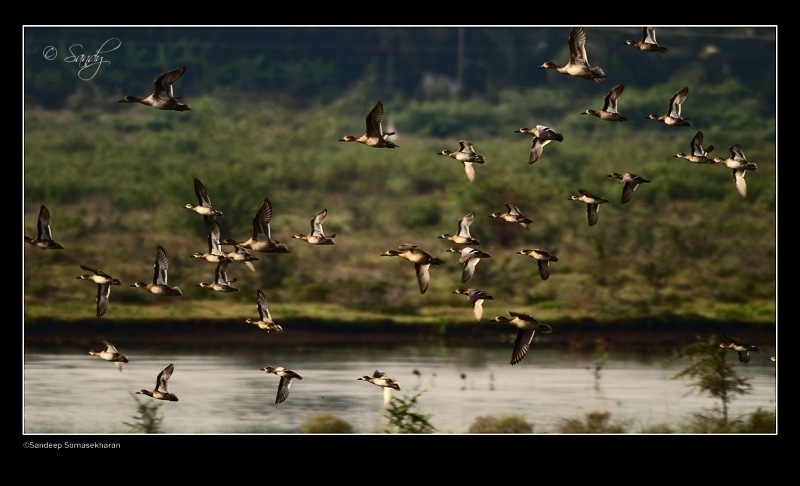
BR Hills Oct 9 – 12, 2008 Birders: Dr Prashanth, Sahastrarashmi, Sandeep, Bijoy Oct 9 - Nagavalli Tank, Chamarajnagar en route to BR Hills via K Gudi 1. Spotbill Duck 2. Gadwall 3. Black Ibis 4. Eurasian Spoonbill 5. Lesser Whistling Duck 6. Barn Swallow 7. Green Sandpiper 8. Red-wattled Lapwing 9. Yellow-wattled Lapwing 10. Long-tailed Shrike 11. Cattle Egret 12. Little Egret 13. Whiskered Tern 14. Pond Heron 15. Grey Heron 16. Common Snipe 17. Black-winged Stilt 18. Little Cormorant 19. Brahminy Kite 20. Green Bee-eater 21. White-throated Kingfisher 22. Common Coot 23. Intermediate Egret 24. Scaly-breasted Munia 25. Laughing Dove 26. Spotted Dove 27. Ashy Prinia 28. Common Tailorbird 29. Red-vented Bulbul 30. Black Kite 31. Pheasant-tailed Jacana 32. Little Grebe 33. White-browed Wagtail 34. Grey Wagtail 35. Greater Coucal 36. Indian Silverbill 37. Rose-ringed Parakeet 38. Common Myna 39. White-breasted Waterhen (H) 40. Grey Francolin (H) 41. Oriental Honey Buzzard 42. Indian Robin Forest gate to K Gudi 43. Grey Junglefowl 44. Small Minivet 45. White-bellied Drongo 46. Common Kingfisher 47. Green Imperial Pigeon 48. Common Flameback 49. Large-billed Crow 50. Rufous Treepie 51. Blue-faced Malkoha 52. White-browed Fantail 53. Great Tit 54. Bar-winged Flycatcher-shrike 55. Common Hawk-Cuckoo 56. Jungle Babbler 57. Black-hooded Oriole 58. Grey Cuckooshrike 59. Bronzed Drongo 60. Brown-capped Pygmy Woodpecker 61. Grey Hornbill 62. White-cheeked Barbet 63. Yellow-crowned Woodpecker 64. Gold-fronted Leafbird 65. Purple-rumped Sunbird 66. Pale-billed Flowerpecker 67. Velvet-fronted Nuthatch 68. Chestnut-bellied Nuthatch 69. Greenish Warbler 70. Red-whiskered Bulbul 71. Hill Myna 72. Vernal Hanging Parrot 73. Red-rumped Swallow 74. Blue-bearded Bee-eater 75. Malabar Parakeet 76. Scarlet Minivet 77. Common Iora 78. Asian Koel 79. Tickell’s Blue Flycatcher (H) 80. White-browed Bulbul (H) VGKK grounds 4:30 pm – 7 pm 81. Brown Shrike 82. Emerald Dove 83. Brown Fish Owl (?) 84. Grey Nightjar (H) October 10, 6:15 AM 85. Orange-headed Ground Thrush 86. Spangled Drongo 87. Racket-tailed Drongo 88. Puff-throated Babbler 89. Lesser Yellownape 90. Oriental White-eye 91. Golden Oriole 92. Thick-billed Flowerpecker 93. Greater Flameback 94. Crested Serpent Eagle 95. Yellow-browed Bulbul 96. Plum-headed Parakeet 97. Crested Treeswift 98. Grey-headed Canary Flycatcher 99. Malabar Whistling Thrush 100. Asian Paradise Flycatcher Oct 11 - K Gudi – Chamarajnagar 101. Changeable Hawk-Eagle 102. Red Spurfowl 103. Black-headed Munia 104. Asian Fairy Bluebird Oct 11 - Punjur-Bedaguli 105. Black Eagle 106. Asian Brown Flycatcher 107. Brown-headed Barbet Image: Gadwalls (Anas strepera) in flight at Nagavalli Tank, Chamarajnagar. Photo: © Sandeep Somasekharan. Used with permission

The best bird photographers are ethical

KolkataBirds has compiled a very interesting showcase of the best bird photographers in India. There is a disclaimer at the bottom of the page that brushes aside all criticism or opinions one may have of this list and the methods employed to compile it. It's a bewildering list - some are unknowns, some are known schmoozers, and others merely photographers because they own some fancy equipment. But among this motley crowd are some real stars - Sudhir Shivaram, Kalyan Varma, Joanna van Gruisen - photographers whose work reveals more than posed portraits of the bird's appearance. Through their pictures they offer a revelation of rarity, of poorly known and little studied birds, as well as insight into their behaviour, habit and habitat. Dhritiman Mukherjee offers glimpses of two rarely sighted birds - the Blood Pheasant and the Himalayan Snowcock. Joanna van Gruisen's remarkable picture of a male Pheasant-tailed Jacana (the best picture of the collection) with an egg - probably not its own - in its mouth is a revelation of extraordinary and probably undocumented parental/ territorial behaviour. Kalyan Varma's wonderful picture of Wreathed Hornbills in flight offers little by way of detail but plenty in terms of behavioural insight. These are pictures worth a thousand words or more. Many of the others are just showing off their lifers. Today, photographers have better access to great equipment and many have the money and means to travel. This means that more and more shutterbugs interested in getting a great photograph and earning peer respect are travelling to forests, deserts, grasslands and other habitats on photographic safaris. What is the impact of their frequent visits on these fragile and sensitive habitats? Are their means ethical? Some of the most reputed photographers of our time were known to be absolutely callous to the plight of their photographic subjects - disturbing nesting sites, exposing nests and chicks and resorting to trickery with recorded bird calls and suchlike. With the best equipment, even a fashion photographer can photograph birds in the wild. But wildlife photographers are not merely artists and wildlife photography isn't art for art's sake. They are pilgrims in nature's great shrine, their methods are acts of prayer, and every photographic opportunity is a blessing. POSTSCRIPT: Gopi points out that Kalyan Varma's picture of the Wreathed Hornbill offers rare insight into the flocking behaviour of this species and that flocks can be quite large for a bird of this size. He also ponders the question if the increasing interest in bird photography is actually leading to increased conservation of birds - or is it just leading to more disturbed habitats.

Garhwal, April - May 2007

Six birders - some green, some brown, others a primed yellow - made a trek to the Garhwal Himalaya in April 2007. I, who used to consider myself one of the primed yellow category, found myself so clueless at times that I became a birder of many colours. An account of that trek - as a travel piece, not a birding trip - has been published on Rediff.com (first in India Abroad's travel special). Here is the link

Remembering Sultanpur 2006

Himalaya on my mind


If my piece on the Bedni Bugyal trek was a one-week breeze, here comes the hurricane.

My good friend Jennifer Nandi, whose reading has ingrained in her the poesy of Thoreau and the acidity of Dame Dorothy Parker, has written what I believe to be a heartfelt and insightful account of the trek of which we were both a part.

It was perhaps relevant that I met Jennifer for the first time on this journey, and that I met her in an age of data - where we wage impatient battles with an arsenal of information but little understanding. I found in her approach to understanding nature a sense of what I'd like my children to inherit from me - an insatiable curiosity about the machinations of the natural world life, the zeal to communicate it to those who probably do not care, and a never-say-dieness about getting it done.

Read her account.

Muthodi Bird List

Sept. 30 - Oct. 2, 2008
  1. Alpine Swift (Tachymarptis melba)
  2. Ashy Woodswallow (Artamus fuscus)
  3. Bar-winged Flycatcher Shrike (Hemipus picatus)
  4. Black Eagle (Ictinaetus malayensis)
  5. Black-crested Bulbul (Ruby Throated) – (Pycnonotus melanicterus gularis)
  6. Black-headed Cuckooshrike (Coracina melanoptera)
  7. Black-lored Tit (Parus xanthogenys)
  8. Blue-bearded Bee Eater (Nyctyornis athertoni)
  9. Bronzed Drongo (Dicrurus aeneus)
  10. Chestnut-headed Bee Eater (Merops leschenaulti)
  11. Common Flameback (Dinopium javanense)
  12. Common Iora (Aegithina tiphia)
  13. Common Myna (Acridotheres tristis)
  14. Common Tailorbird (Orthotomus sutorius)
  15. Crested Serpent Eagle (Spilornis cheela)
  16. Crested Treeswift (Hemiprocne coronata)
  17. Crimson-backed Sunbird (Nectarinia minima)
  18. Crimson-fronted Barbet (Megalaima rubricapilla)
  19. Dark-fronted Babbler (Rhopocichla atriceps)
  20. Golden-fronted Leafbird (Chloropsis aurifrons)
  21. Greater Coucal (Centropus sinensis)
  22. Greater Flameback (Chrysocolaptes lucidus)
  23. Greater Racket-tailed Drongo (Dicrurus paradiseus)
  24. Grey Wagtail (Motacilla cinerea)
  25. Grey-headed Canary Flycatcher (Culicicapa ceylonensis)
  26. House Swift (Apus affinis)
  27. Indian Pond Heron (Ardeola grayii)
  28. Jungle Babbler (Turdoides striata)
  29. Jungle Myna (Acridotheres fuscus)
  30. Jungle Prinia (Prinia sylvatica)
  31. Large Cuckooshrike (Coracina macei)
  32. Laughing Dove (Streptopelia senegalensis)
  33. Little Egret (Egretta garzetta)
  34. Malabar Grey Hornbill (Ocyceros griseus)
  35. Malabar Parakeet (Psittacula columboides)
  36. Malabar Trogon (Harpactes fasciatus malabaricus)
  37. Mountain Imperial Pigeon (Ducula badia)
  38. Oriental Honey Buzzard (Pernis ptilorhyncus)
  39. Oriental Magpie Robin (Copsychus saularis)
  40. Oriental White Eye (Zosterops palpebrosus)
  41. Pale-billed/ Tickell's Flowerpecker (Dicaeum erythrorynchos)
  42. Plum-headed Parakeet (Psittacula cyanocephala)
  43. Purple-rumped Sunbird (Nectarinia zeylonica)
  44. Red-vented Bulbul (Pycnonotus cafer)
  45. Red-whiskered Bulbul (Pycnonotus jocosus)
  46. Rufous Babbler (Turdoides subrufa)
  47. Rufous Treepie (Dendrocitta vagabunda)
  48. Scarlet Minivet (Pericrocotus flammeus)
  49. Shikra (Accipiter badius)
  50. Small Minivet (Pericrocotus cinnamomeus)
  51. Southern Hill Myna (Gracula religiosa)
  52. Spotted Dove (Streptopelia chinensis)
  53. Tickell's Blue Flycatcher (Cyornis tickelliae)
  54. Velvet-fronted Nuthatch (Sitta frontalis)
  55. Vernal Hanging Parrot (Loriculus vernalis)
  56. White-bellied Woodpecker (Dryocopus javensis hodgsonii)
  57. White-cheeked Barbet (Megalaima viridis)
  58. White-rumped Munia (Lonchura striata)
  59. White-throated Kingfisher (Halcyon smyrnensis)
  60. Wire-tailed Swallow (Hirundo smithii)
  61. Yellow-browed Bulbul (Iole indica)

Presence felt:

Rufous Woodpecker (Celeus brachyurus) Malabar Whistling Thrush (Myophonus horsfieldii) White-rumped Shama (Copsychus malabaricus) Grey Junglefowl (Gallus sonneratii) Indian Peafowl (Pavo cristatus) Booted Warbler (Hippolais caligata) White-bellied Blue Flycatcher (Cyornis pallipes)