We’ve moved! Here’s where you can find us

The Green Ogre is now at https://www.greenogreindia.org
Showing posts with label superstition. Show all posts

Indian Licorice - Black-eyed beads of death

The red-and-black seeds frequently used in the indoor games of my childhood, I learned recently, are deadly poisonous. Introducing the pretty and dangerous Rosary Pea or Indian Licorice. Now chew on that!


Back when I was a kid visiting my grandparents, dinner would generally be over by 7 pm. The lack of a television at their place meant that we had to spend time together, playing indoor games seated on the cold, red-oxide coated cement floor. Usually, it was a game called "ottayo-irattayo" (roughly translated, it means "Odd or even").


Granddad had a box full of  lovely red-and-black seeds (known in Malayalam as kunnikkuru), which he would distribute equally among the players. The game was to grab random handfuls and make the opponent guess if the count was even or odd. A correct guess corroborated after counting the seeds, would be rewarded with the entire handful being "won" and added to the guesser's pile, and a wrong guess would mean surrendering the same number of seeds to the opponent. The game goes on till one player is out of seeds and becomes a pauper. 


Granddad warned me the first day he taught me the game that at no cost should I eat the seeds or even put them in my mouth. I would vomit blood and die if it was ingested, he warned. Even though I didn't believe it completely (my grandparents carried on about a lot of superstitious beliefs) I was never tempted to chew on one after hearing that.


Even or odd? 
Another memory of this seed is tied to the famous Guruvayur temple in Thrissur, Kerala. Inside the temple premises is a wide-brimmed vessel filled with these seeds. They are there for an interesting ritual: Kids are to grab a handful and drop it back in - this was believed to make them more mischievous. I was really disappointed that they made me drop the colorful seeds back into the vessel; I would have loved to carry some home!


A pod that has already burst open
About 25 years later, I came upon a creeper at Polachira wetlands (near Thiruvananthapuram) that carried a pod that was just splitting open. From within peered five or six of those red peas. I came home immediately and tried to read up on the seed. I realized it was the seed of a creeper called Abrus precatorius, otherwise called the Rosary Pea or Indian Licorice. And my Granddad's warning of toxicity was spot on. The seeds contain a toxin called abrin, which is very harmful to humans even in very small quantities -- it can stop protein synthesis at a cellular level and cause death within 3-5 days. Incredibly, despite its toxicity, it was very popular among children of my generation who played games like ottayo-irattayo. The current XBOX generation would probably never get to even see one.


A small vine, already carrying numerous seeds
Compared to my grandparents' superstitions (among them -- whistling at night invites snakes, and owls hooting at night are harbingers of death), this one turned out to be a piece of local wisdom. I wonder how many more would be proven true with reading and experience. 


Text and photos: Sandeep Somasekharan

Two hoots in a deserted quarry

My love of owls has made me peer into abandoned quarries, tree hollows, rafters of old barns, and dilapidated houses. Last year, I watched three Indian Eagle Owl chicks grow from featherballs to subadults. We waited a whole year to publish this report, assured that they are now relatively safe


In India, where kids grow up with superstitions whispered into their ears, owls are much maligned. An owl hooting at night is said to bring death. Barn owls (Tyto alba) fetch lakhs in the black market as they are believed to have magical powers that aid in black magic. And some say if you starve and beat an Indian Eagle Owl (Bubo bubo bengalensis), it will start talking like a human and predict your future. For a nature-watcher, however, these hunters of the night are graceful and elegant. And the more you watch them, the more you fall in love.
the beauty with large eyes!
My love of owls has made me peer into abandoned quarries, tree hollows, rafters of old barns, and dilapidated houses. In one such quarry in the outskirts of Mysore I saw a fully grown female Indian Eagle Owl, which perched on the least noticeable ledges and watched us with her large, all-perceiving eyes. The spell she cast on us was unbreakable, so much that we continued to pay her frequent visits.


Generally she would be quite shy, taking off to distant inaccessible corners of the quarry if we got close. But on one visit in January last year, she didn't leave her perch, however close we approached. The ledge, though, was inaccessible - it was about 10 feet high and about 7 feet away from the edge of the deep rainwater pool at the bottom of the quarry. We imagined the reason for her perceived acquiescence was that she might be nesting. We left her alone.
Momma squints a warning
A few weeks later, in February, we returned. The mother was nowhere to be seen. Scanning the ledge carefully corroborated our guess: three tiny feather-balls. My heart thumped. The sun was coming up, and the chicks were pushing against the farthest corner of the quarry wall, seeking protection from the early morning sunlight that was now turning harsh. The nest was a humble setup -- a ledge with sand at the bottom and some grass growing at the edges. Mommy showed up presently, her stern stare radiating a warning: “Keep off!”

Huddled in the nest and vulnerable.

Momma plays sentinel

When we next visited the quarry a month later, in March, we couldn’t spot any chicks. Dismayed that they might have died of illness or fallen to predators, we prepared to leave when we spotted a chick behind the grass stalks that jutted out of a ledge. It appeared to be three times larger than we had last seen it. Another sat a few feet away on another ledge. There was no sign of the third (we never saw it again). Mommy occupied another ledge, watching us intently with the same stern schoolteacher expression. Since the chicks were on a different ledge from her, it was pretty obvious that they had started to fly.
Well concealed

And the second chick on another ledge
Our next trip to the quarry happened only in May as something or the other interfered with our plans. All we saw were two adults: The larger mother and the other was probably one of the chicks, which had by now grown large enough to be on its own. The second chick had probably left the quarry (or maybe it was dead -- we would never know), and I had a feeling that I would not see this one for long either.
The little one takes flight...

The last glimpse that I got of the young owl
As expected, on later visits we found only the mother owl. Since Eagle Owls are voracious eaters and require a large area to hunt in, it is likely that the grown chicks had left to set up their own fortresses elsewhere. I do think about them once in a while, wondering where they would be now, whether they managed to survive and found happy hunting grounds of their own beyond the reach of superstitions or predators. 


After all, when babies grow up before your eyes, you get attached to them!


Further reading:


  1. An excellent technical documentation of Eagle Owl chicks [PDF], by Eric Ramanujam and T Murugavel, is available at the Journal of Threatened Taxa website. 
  2. Sad, Wise Eyes, an article about owl trafficking by Shruti Ravindran, appeared in the March 2009 issue of Outlook magazine.


Text and photos by Sandeep Somasekharan


More on The Green Ogre:


Read more about Indian Eagle Owls and Barn Owls 
Read more about threats to Mysore's scrubland habitats
 

Encounter - The Indian Eagle owl

The Indian Eagle Owl (Bubo bubo bengalensis) is a sub-species of the Eurasian Eagle Owl, formerly known as the Indian Rock Eagle owl. My first run-in with this enigmatic bird was near Mysore's well-known landmark - Chamundi Hills. My friend saw him sitting on a tree near a quarry, and we had a long tryst trying to photograph him from outside the wire fencing around the hill. The large, orange-yellow eyes, the prominent horns and his large size (not to speak of an impressive wingspan), makes the bird really some viewing.


Can you meet that stare?


After that, there have been multiple incidents when we have had a run-in with this huge bird, mostly in and around abandoned quarries. But it is tough to spot them when they sit on some shadowy ledge in such quarries, as their colors make for a perfect camouflage. They emerge from their hiding places past dusk, when they hunt for rodents, bats and birds at night and return to their cavernous abodes late at night. The bird is known to tear apart its prey with its sharp claws and beak before devouring them. They are known to feed on large-sized birds as well, including some birds of prey.

Showing off that impressive wingspan

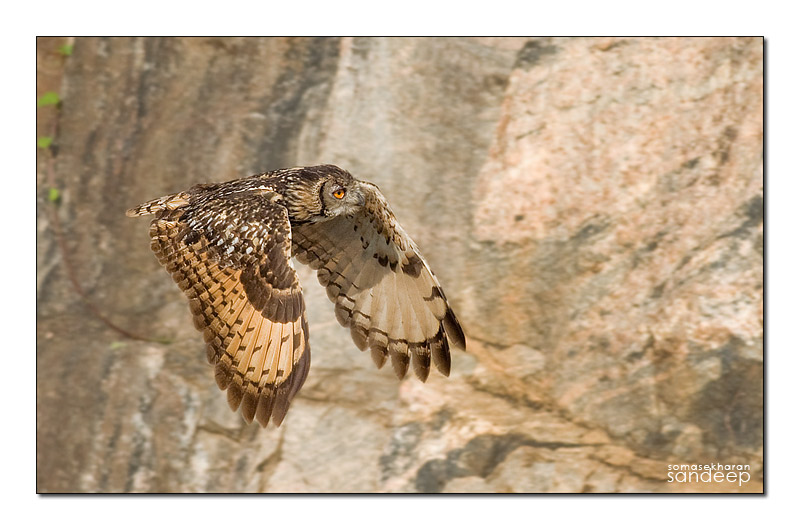
There have been instances when we have stopped at quarries to spot these birds and seen them take off from ledges right underneath us, or from nearby trees as we scouted the location to spot one. In most cases, the only way to spot them is to see them take off from their resting places.


In flight

Like the barn owl (Tyto alba), this bird is a victim of poaching and hunting due to superstitions. The hoots of this bird are supposed to bring bad luck and death in many places, and that is one reason why people are known to hunt them. Not to mention increasing fragmentation of their habitats due to urbanization and the resulting lack of food… 

Please spare our lives
Text and photographs: Sandeep Somasekharan