We’ve moved! Here’s where you can find us

The Green Ogre is now at https://www.greenogreindia.org

Invasive Species: When green journalism turns yellow

By crying wolf over green issues, ill-informed journalists are indulging in yellow journalism. The recent scare-mongering by the national media over the "death" of the wetland bird sanctuary of Sultanpur is a case in point. 

Keoladeo Ghana park director Anoop KR holding an invasive Mangur catfish and the partially consumed leg of a bird retrieved from its digestive tract


Over the last two weeks the national media -- particularly Delhi-based newspapers and television channels -- have been beating their breasts and wailing about the imminent death of wetland ecosystems such as Bharatpur and Sultanpur (the former in Rajasthan, the latter in Haryana). Both these bird sanctuaries are canal-fed wetland ecosystems whose health and survival depend on riverine water inflow: Bharatpur is fed by a canal from the Bhima river, while Sultanpur depends on water channeled from the Gurgaon canal that diverts water from the Yamuna.


On June 16, The Hindustan Times reported that Sultanpur lake had dried up and that the future of the wetland sanctuary was imperiled. Excerpt:
As a grim reminder of the future, the bodies of two African Black fish, with their rotten yellow scales and broken bones, lie beside each other on the parched, cracked earth. Barely six feet away, the grey carrion of a Blue Bull (Neelgai), with its torso missing but tiny horn and moldy skin intact, engages the attention of a solitary crow.
At first read, this comes across as serious reportage of an environmental disaster. In truth, it is just theatre of the verbose. HT quoted Minister for Environment and Forests Jairam Ramesh, well known for his love of expressing opinion that he has not had time to adequately consider, as writing in an open letter to Haryana Chief Minister Bhupinder Singh Hooda: “You are well aware of the history of the park and the role that Indira Gandhi played in having it declared as a sanctuary way back in 1972. It is doubly unfortunate that a sanctuary with Gandhi’s name is so closely associated should find itself in such a pathetic state.” 


Spoken like a true Congress loyalist. Except that since the sanctuary was notified, nobody in the great party has spared a thought for it. Except perhaps another Gandhi that the Congress doesn't quite favour. Maneka Gandhi, the outlawed daughter-in-law of the first family, was briefly associated in the media with Sultanpur but not in a way that any birder or environmentalist would appreciate. With her blinkered animal rights philosophy she resisted, for long, every measure by concerned environmentalists to evict feral dogs, which posed great threat to nesting birds and nestlings (see my video about dogs in Sultanpur). Eventually, the dogs were evicted but only after a lot of damage was already done.


The me-too media kowtowed, with journalists barely stopping to hold their breaths to investigate the facts. The television channel CNN-IBN, well-known for its shrieky alarmist stand on issues (modeled on the personality of its chief), pronounced that all was not well with Sultanpur. The ticker screamed: "Dead fish raise a stink".


The Times of India, not always saluted for its objectivity, surprised us pleasantly by showing reason in the face of blind speculation. Its story, carried on the same day as the HT story, pointed us to the source of the problem. The paper quoted Keshni Anand Arora, commissioner and principal secretary of forests in Haryana, as blaming the introduced African catfish or Mangur for predating on indigenous fish species and birds. 


Therein lay the tale. The African Mangur or Sharptooth Catfish (Clarias gariepinus), sometimes known as the Walking Catfish, occurs naturally from South Africa to northern Africa all the way up to southern Europe. It is a hardy and adaptive fish with extremely well-developed lungs that allow it to survive outside an aqueous environment for prolonged periods, including extended spells of drought (as witnessed this past summer in northern India). In fact, when pressed, the mangur actually walks on land using its fins to move from one water body to another. 


The Mangur was illegally introduced into India from Bangladesh and its cultivation is banned in some parts of the country. In May 2009, The Hindu reported: The breeding of African catfish is banned in India in the wake of an order by the Kerala High Court back in 2000. The case, on the basis of a petition from Kerala’s fish breeders, was referred by the Court to the National Committee on Exotic Species, which in turn recommended its ban. The African mangur, which grows into huge sizes, is not preferred even by traditional fish-eating communities who consider it “not very tasty”.


It was Mint, however, that brought out the best-reported and comprehensive coverage of the issue on Monday, highlighting the need for controlling the propagation of invasive species citing the case of the Magur as a flashpoint. The Mint story, by Padmaparna Ghosh, included a slideshow about invasive species and a video interview with my friend Gopi Sundar, research associate of the International Crane Foundation and an expert on wetland ecology. The story also quoted Anoop KR, director of the Keoladeo Ghana National Park in Bharatpur, who has been working at exterminating the invasive fish in his park. The bloated bellies of the mangur, which can grow up to 30 ft long, aroused suspicions which his dissections subsequently confirmed. The mangur in Bharatpur had been eating birds in additional to indigenous fish species.


It's pretty much the same story in Sultanpur, albeit under-reported. This summer, water has not been plentiful and the swamps have dried. The sanctuary has been sealed off and that explains why the nilgai -- considered a crop pest in these parts -- are dying off. The authorities are concertedly ridding the wetland of mangur and hoping that the extirpation of the species from the sanctuary will allow more native species of fish to breed and encourage birds to come back to the lake.


The shock of drought, Gopi explains, is actually beneficial to certain kinds of wetlands. The real issue -- that of invasive species -- must be addressed across the country. Lantana, a weed introduced accidentally from South America as an ornamental, now chokes the undergrowth in forests across the country. Its impact can be seen in the mixed deciduous forests of the Western Ghats. Parthenium, introduced along with wheat imports from America, is also widespread in Indian forests. Some native species have adapted well to the introduced varieties. Lantana, for instance, is favoured by some species of butterflies as well as bulbuls, sunbirds and flowerpeckers. Various NGOs including Atree and NCF are at work on projects to control the spread of invasive species. For concerned mediapersons, that should provide the context for the story.


A cabbage white butterfly on a lantana blossom. Lantana camara, native to South America, was introduced by gardeners. Pollination by local butterflies and berries spread by bulbuls, flowerpeckers and other local species make its control very difficult. 


I was disappointed by the reaction of some "concerned birders" and "activists" (who otherwise run profitable birding tours for Indians and expats) to the situation at hand. By fomenting the interest of ill-informed journalists in non-crises such as the annual cycle of flooding and drought in the wetlands of the subcontinent, these "friends of the environment" are stabbing it in the back. These are trying times, when every media vehicle worth its TRP (or self-funded readership survey) wants to appropriate the issue of "green journalism". It pays to be patient, talk to the real experts, and refrain from alarmist coverage altogether. 


Message to journos: hankering for scoops belongs in the realm of journalism of a different colour -- yellow, not green.


PHOTOS: (C) GOPI SUNDAR AND SWATI KITTUR

Random lunacy, pictured

Say cheese!


Brightly!


The moon was a ghostly galleon...


...tossed upon cloudy seas

When the elephant played peekaboo

I feared the elephant's shrewd little eyes were fixed on the diminutive human shuffling against my thigh. I don't think we got the joke then, but when we viewed the pictures up close on our return to Bangalore, the punchline that tickled my daughter was ours to behold.


On a trip to BR Hills a couple of weekends ago, we came upon a herd of elephants beside a waterhole. It was dusk and the light was fast fading. The herd comprised seven individuals including a young tusker. They were waiting to have their fill of grass before going down to the waterhole to drink. 


We had not seen any "big game" that evening and the tourists (us included) who had paid well in excess of Rs 2000 a head for a night's stay at Jungle Lodges were hungry for entertainment or photographic souvenirs. And the staff was equally concerned about not disappointing them. So we stopped, interrupting the jumbo party, and spent an awfully long time watching the elephants. My daughter, growing bored of the increasingly dim view of hulking grey shapes in the tall grass, began to make conversation with herself. It was against the rules of the jungle, I suppose, and I had some trouble convincing her to quiet down.

The elephants grew impatient as they waited to drink. I was struck at how polite they were in objecting to the interruption of their evening's business: they shuffled impatiently but unhurriedly out of the undergrowth into our view. It was all very subtle and very civilized when they could have charged in unison and scared the living dung out of us. Sitting there in that open jeep with the air growing cooler around me, I felt a little ridiculous to be part of this paying party of safari-goers who were testing the patience of these sapient beasts.

There was a clear sense of leadership in the herd. The matriarch moved first, stepping out into the clearing. Another elephant, which looked a little younger than her (probably her second-in-command), seemed to be expressing her impatience to the matriarch with eye contact and head shaking. She seemed the more impetuous of the two and I am sure with time she would learn her management lessons. I was struck at how none of the other elephants stepped out of line to take the lead in charging us. 

The matriarch never took her eyes off us for a moment. When she had enough of waiting and dropping glaring hints, she shook her head, huffed and ventured towards the water. On two occasions when she trumpeted my daughter tried her best to respond. Heads turned in alarm and looked accusingly at my precious little underage tourist. At one point, I feared the pachyderm's shrewd brown eyes were fixed on the diminutive human shuffling against my thigh as I leaned out for a picture.


All along my daughter chuckled to herself, saying (in Malayalam) that this whole affair was a nalla tamasha -- a good joke. I don't think we got the joke then, but when we viewed the pictures up close on our return to Bangalore, the punchline that tickled her was ours to behold. The matriarch had been playing peekaboo with the little girl in the jeep.


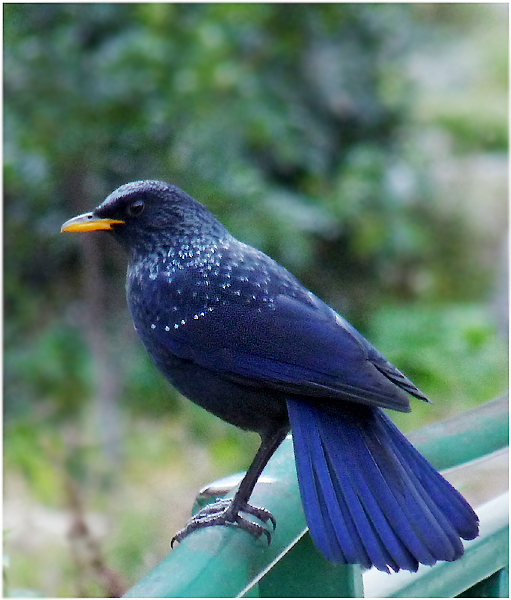
Encounter: Blue Whistling Thrush

Relatively dowdy, screechy and less musical than its cousin, the Malabar Whistling Thrush of the Western Ghats, the Blue Whistling Thrush is nonetheless a character. 


To reach any destination in the Himalaya -- from anywhere that you may venture to do so -- you must first impatiently transect the purgatory of dust and grit posed by successive urban habitations. Those are the trials of the pilgrimage that you must endure to be deserving of a holiday in the hills. Climbing up towards Himachal from the plains of the Punjab or journeying to the snowy heights of Uttarakhand via Kathgodam or Haridwar, you know instantly that the hills are near when you catch the first glimpse of that ubiquitous Himalayan inhabitant -- the Blue Whistling Thrush (Myophonus caeruleus). 


Relatively dowdy, screechy and less musical than its cousin, the Malabar Whistling Thrush of the Western Ghats, the Blue Whistling Thrush is nonetheless a character. Walking a trail, you may feel eyes burning into your back. Turn around and you may see a shadowy crow-like bird rearranging itself nonchalantly on a tree or skulking away into the shelter of the shrubbery. Around mountain streams, you are sure to find two or more males settling territorial differences acrimoniously. 

It's perhaps one of the most wide-ranging of our hill birds -- my friends and I have seen Blue Whistling Thrushes from 5000 feet to 11,000 feet up in the Himalayas. Apart from inhabiting our northern hills, these thrushes, the largest of their family, are known to occur widely from Central Asia eastwards to China and south to the Sundas (courtesy: Wikipedia). 

This guy was photographed a few hundred metres from the entrance of the Valley of Flowers National Park in Uttarakhand, India. I had just photographed a rainbow glistening in the spray of a waterfall when I turned to my right and saw that I wasn't enjoying the spectacle alone. So I snapped up my fellow-aesthete, too.


Moth Smoke II - id help please!

The early monsoon has brought on a spate of moth-finding. Here are three beauties that I shot around the house. Id help will be greatly appreciated.


1 - Medium. Shot on exterior wall


2 - Small, shot on shelf beading


3 - Small, found resting against a car window


All of these moths were found alive in Bangalore, India. 

Snake in the grass and the hiss of life

In childhood, I have watched snakes clubbed to death by people I loved. Possessed by ignorance and fear, perhaps they killed without thinking, because harmless snakes had been at the receiving end of their wrath. I had no say then but I knew it was awfully wrong. Today, by saving a baby cobra from imminent doom, I attempted to right some wrongs.


It had to happen on the most hectic of Wednesdays. After being saddled with work all morning, I sat down to a late lunch at 2 pm when my daughter's nanny alerted me to a commotion downstairs. 


I heard one word, "Snake." 


I sprang up in alarm -- at the harm I feared for the serpent. In my childhood, I have watched snakes being clubbed to death by people I loved and respected but who were doubtless possessed by a mixture of ignorance and fear. Perhaps they killed without thinking, because harmless Vine Snakes and Cat Snakes had been at the receiving end of their wrath. I had no say in the goings on then, but I knew it was awfully wrong and couldn't endorse their bravado. Often, the valour of some people was measured by how many snakes they had killed, and some of them were big heroes in that sense, having killed King Cobras and Russell's Vipers.


Staring down from the balcony, I saw the housekeeping ladies, the gardener, the electrician, a security guard and sundry others trying to cajole what looked like a slender brown rope into a plastic bag. Rushing downstairs with the camera, I pleaded with the to-be-saviours of our community not to kill the snake.


On bended knee, I saw eye to eye with the feisty little serpent. It was a young common cobra (sex, to my untrained eye, indeterminate). Hood spread out, it was a little less than a foot long. It hissed and struck at the ground with a great show of malevolence. Clearly, the snake was alarmed at the attention but it stood its ground. I was impressed already and my heart warmed to the little creature. I must say I've never seen a better display of yogic breathing. The hiss came right from the pit of the animal's stomach as it reared up three-quarters of its length in the air. The black tongue, slick and forked, took in the particles of my unwashed avatar. 


It must be hard to be a snake, much harder than it is to be a rat. Rats get away with untold destruction but they hardly ever get slaughtered with the same missionary vehemence that accompanies a snake killing. Serpent-killers are felicitated as valiant heroes for pitting their defenceless human wits against these slithery peddlers of deadly poison. But rat-killers, you see, are merely getting rid of vermin. That was what I lectured my spectators as I tried to buy time for the snake. But it was becoming a case of too many cooks and the security guard's machismo nearly got him bitten. When the snake lunged at his hand the crowd shrank back, echoing an inversion of its hiss. One bite was going to cost me the chance of saving the snake's life.


Around me, people watched, perhaps wondering which way I'd choose to save them. Some muttered that releasing the snake would only bring it back. And what would I do then, one of the concerned residents asked? I thought of calling for a professional snake rescue (yes, Anees, I thought of you) but we were pressed for time, my lunch was going cold, and the tempers of the bystanders were fraying. I didn't want to compound matters by exhibiting the ineptitude of a reluctant saviour.


When the dramatis personae began to spew theories on the peril that the little fellow posed to the denizens of our apartment, I knew I was running out of time. Finally, the electrician and I tricked the little snake into entering the bag and it was despatched to be released in the swamp behind the apartment.


That's one little fellow saved. But the clearing of vacant lots for construction activity this monsoon will surely throw up plenty of snake casualties. How can one gift them the hiss of life?

A BR Hills weekend in pictures

Driving in the beautiful Biligirirangans can be equally exhausting and enchanting!


Drove with the family for the first time to my favourite forest in Karnataka last weekend. Wandered desperately for 40 km between Yelandur and Chamarajnagar looking for a fuel station because we forgot to top up at Mysore. We had a flat tyre outside the park gate on the way in, which delayed our lunch and made us all crabby. Blew up a freelancer's fortune on the acco at Jungle Lodges, went on two safaris (uneventful but for a lung-aerating drive), paid our respects to the presiding deities at K Gudi and Biligiri Rangaswamy Temple, and returned to the city morose via the very picturesque Kanakapura Road. 


A view of the Valley on the climb towards K Gudi

A copse of lianas and vines on the road from K Gudi to BR Hills -- one of my favourite stops in these forests


This young tusker was part of a small herd that we encountered on Saturday evening's safari


There were large herds of spotted deer with impressive stags


The monsoon was about to set in and the Blue Tiger butterflies were either mud-puddling or swarming around certain plants in the forest


Text and photographs by Beej
All rights reserved

Tehelka's Summer Special - my travelogue on Meghamalai

It rains nine months of the year in Meghamalai


The May 29, 2010 issue of Tehelka was an unusual one. The magazine took a break -- a holiday, if you will -- from its hard-nosed coverage of grimmer happenings. 


The enjoyable Summer Special compiled travel articles by well known writers (such as Amitava Kumar, Amit Chaudhuri, Mridula Koshy, etc.) along with relative unknowns (such as moi). My piece was on Meghamalai, that almost unheard-of hill station in the High Wavy Hills near Theni in south-eastern Tamil Nadu. 


Excerpt:


Tamil for ‘cloud mountain’, Meghamalai is an isolated hill station in the southern Western Ghats. In the 1930s, the British planted tea here. The only way to get to the ‘High Wavys’ — as James Henry nelson described these hills in The Madura Country — is by a tortuous private road. There are no restaurants or fuel stops along the 39-km stretch from Chinnamanur. The two decent but expensive accommodations are owned by Wood Briar Estates. Only the most desperate tourists visit Meghamalai, as a side-trip from Thekkady in Kerala.


Link: Holiday at the High Wavys