All Rights Reserved
We’ve moved! Here’s where you can find us
The Green Ogre is now at https://www.greenogreindia.org
Showing posts with label wildlife photography. Show all posts
When the elephant played peekaboo
I feared the elephant's shrewd little eyes were fixed on the diminutive human shuffling against my thigh. I don't think we got the joke then, but when we viewed the pictures up close on our return to Bangalore, the punchline that tickled my daughter was ours to behold.
On a trip to BR Hills a couple of weekends ago, we came upon a herd of elephants beside a waterhole. It was dusk and the light was fast fading. The herd comprised seven individuals including a young tusker. They were waiting to have their fill of grass before going down to the waterhole to drink.
We had not seen any "big game" that evening and the tourists (us included) who had paid well in excess of Rs 2000 a head for a night's stay at Jungle Lodges were hungry for entertainment or photographic souvenirs. And the staff was equally concerned about not disappointing them. So we stopped, interrupting the jumbo party, and spent an awfully long time watching the elephants. My daughter, growing bored of the increasingly dim view of hulking grey shapes in the tall grass, began to make conversation with herself. It was against the rules of the jungle, I suppose, and I had some trouble convincing her to quiet down.
The elephants grew impatient as they waited to drink. I was struck at how polite they were in objecting to the interruption of their evening's business: they shuffled impatiently but unhurriedly out of the undergrowth into our view. It was all very subtle and very civilized when they could have charged in unison and scared the living dung out of us. Sitting there in that open jeep with the air growing cooler around me, I felt a little ridiculous to be part of this paying party of safari-goers who were testing the patience of these sapient beasts.
There was a clear sense of leadership in the herd. The matriarch moved first, stepping out into the clearing. Another elephant, which looked a little younger than her (probably her second-in-command), seemed to be expressing her impatience to the matriarch with eye contact and head shaking. She seemed the more impetuous of the two and I am sure with time she would learn her management lessons. I was struck at how none of the other elephants stepped out of line to take the lead in charging us.
The matriarch never took her eyes off us for a moment. When she had enough of waiting and dropping glaring hints, she shook her head, huffed and ventured towards the water. On two occasions when she trumpeted my daughter tried her best to respond. Heads turned in alarm and looked accusingly at my precious little underage tourist. At one point, I feared the pachyderm's shrewd brown eyes were fixed on the diminutive human shuffling against my thigh as I leaned out for a picture.
All along my daughter chuckled to herself, saying (in Malayalam) that this whole affair was a nalla tamasha -- a good joke. I don't think we got the joke then, but when we viewed the pictures up close on our return to Bangalore, the punchline that tickled her was ours to behold. The matriarch had been playing peekaboo with the little girl in the jeep.
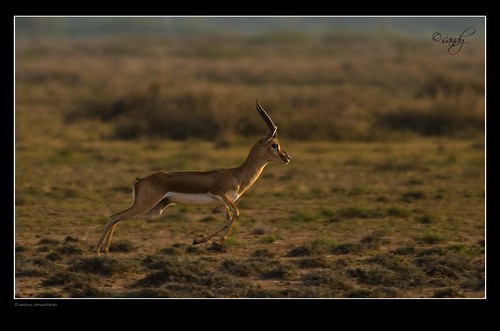
Encounter: Chinkara or Indian Gazelle
Labels:
chinkara,
encounter,
gujarat,
indian gazelle,
kutch,
Naliya grassland,
Sandy,
ungulate,
wildlife photography
Knights of the Western Ghats - Kalyan Varma's photoessay
Kalyan Varma has relaunched his website, and with it, some very absorbing new features. His photo-essay on the Lion-tailed Macaques (Macaca silenus) of the Western Ghats is beautifully captured and enchantingly told.
Ok, ok, I know I'm going wild with the superlatives, but great photography often does that to me. And by great photography, I don't refer only to images that dazzle with their excellent composition and perfect lighting. You know, the kind that has a congregation of fellow-shutterbugs go 'ooh' and 'aah' and launch into impromptu discourses on F-stops, and finally sign off with the intriguing three-letter acronym (TLA) 'TFS' (fans of India Nature Watch will know what that means).
Kalyan inspires more than that. As I have said in these pages before, I admire his prowess for telling stories with his photographs, to capture interesting and insightful aspects of animal behaviour, and more than ever, to underscore the imperative for conservation.
And finally, because the Lion-Tailed Macaque (or LTM, if you prefer TLAs) is itself a species very dear to me. And because on my visit to Valparai, Divya Mudappa of the NCF told me the heart-rending story of a roadkill involving a pregnant female. And because Kalyan's camera was there, without blinking, to grieve that grisly death, this story must be told.
And no one but Kalyan can tell it like it is.
Kalyan Varma's photoessay>>
A leopard, a village and a photographer's conscience
From a respectful distance, I have always admired Kalyan Varma for his gift - the talent to tell stories and unravel mysteries through his wildlife photographs. But his coverage, in March this year, of a leopard trapped in the village of Valparai is sheer testament to the fact that this young man is no mere shutterbug collecting photographic souvenirs in our forests and trading them for awards. He is what wildlife conservation needs with utmost urgency -- a wildlife photojournalist with a conscience.
Not many people I know want to run into a leopard in the wild. So when one comes visiting a village, it is far from welcome. The leopard in this story was not above blame - it was responsible for the death of a young girl. It doesn't take much to anger a village and this killing provided ample tinder to fan a blazing hatred for the cat. A trap was set and the leopard was caught. The dramatis personae - villagers, forest officers, policemen and local press photographers - all played their part. The fallen hero, of course, was the leopard. What struck me about Kalyan's account was the irony of the 'shoot'. A veterinarian tries - first in vain - to bring the cat down, while all the while Kalyan clicks away feverishly, capturing through his trained eye the predicament of a wild animal that is down, but far from out.
In his journal, Kalyan writes: 'A tear rolled down its eye and the leopard slowly went down. I cocooned myself from the whole crowd as the cops were taking care of them and I could not see anything but the face of the leopard through the camera. I just broke down at this point and walked away.'
Read all about it here
Salut, Kalyan Varma. For boldly doing what no wildlife photographer has dared do before - for bringing out in detail the inexorable sadness of human-animal conflict.
Not many people I know want to run into a leopard in the wild. So when one comes visiting a village, it is far from welcome. The leopard in this story was not above blame - it was responsible for the death of a young girl. It doesn't take much to anger a village and this killing provided ample tinder to fan a blazing hatred for the cat. A trap was set and the leopard was caught. The dramatis personae - villagers, forest officers, policemen and local press photographers - all played their part. The fallen hero, of course, was the leopard. What struck me about Kalyan's account was the irony of the 'shoot'. A veterinarian tries - first in vain - to bring the cat down, while all the while Kalyan clicks away feverishly, capturing through his trained eye the predicament of a wild animal that is down, but far from out.
In his journal, Kalyan writes: 'A tear rolled down its eye and the leopard slowly went down. I cocooned myself from the whole crowd as the cops were taking care of them and I could not see anything but the face of the leopard through the camera. I just broke down at this point and walked away.'
Read all about it here
Salut, Kalyan Varma. For boldly doing what no wildlife photographer has dared do before - for bringing out in detail the inexorable sadness of human-animal conflict.
Subscribe to:
Posts (Atom)


