We’ve moved! Here’s where you can find us

The Green Ogre is now at https://www.greenogreindia.org
Showing posts with label Nilgiri Biosphere Reserve. Show all posts

Heard the laugh track of the Nilgiris?

While walking in the Nilgiris, listen closely for the guffaw of the Nilgiri Laughingthrush. And treasure it, for you'll hear it nowhere else on earth
When I had first laid my hands on a Sony prosumer camera I found I could photograph birds within reach, and the target of one of my first attempts was a Nilgiri Laughingthrush, otherwise called the Rufous-breasted Laughingthrush or the Black-chinned Laughingthrush (Trochalopteron cachinnans). I first saw the bird on a trip with my parents to Doddabetta, a peak near Ooty. Kannada for 'the large hill', Doddabetta is the second highest peak in south India and the highest point in the Nilgiris.
As we walked about like regular tourists, bracing against the strong chill wind, I saw a unique bird -- with bushy white eyebrows and captivating, red eyes -- hop about on the macadam not far from the tourists. Incredibly, it didn't seem perturbed by the crowd - something you can observe only in Doddabetta.

No porking please, we're boared

Thoughtlessly constructed and idiotically placed dustbins in a tiger reserve can turn a well-intended sanitation initiative into a howling travesty. How do you keep wild boar from scattering the trash you've conscientiously thrown away?


It was a beautiful afternoon in Bandipur. The sun was tucked into the skirt-folds of dark, purple-rimmed clouds and so many busloads of busy tourists had made sure to fill up the dustbins (and places within 500 metres of them) with all kinds of interesting garbage. There were fruit peels, corn cobs, half-eaten takeaways, packets of crisps with neglectfully wasted leftovers, et cetera. To perform a complete inventory, you needed to stick your head into the dump and rummage hard. Only a creature with a snout deserving of this luxury could get to the bottom of this mysterious treasure trove. 


Along came a pig. Not any ordinary pig. This, a large female wild boar (Sus scrofa cristatus) fattened habitually on human excess, sauntered by, snorted and regarded the dustbin with greedy curiosity, snivelling all over it. Its object of interest was a large, deep bucket of concrete, larger and heavier than itself, and made even more so, encumbered as it was with aromatic treasures.


As Arun and I watched, the pig sniffed around, tried to knock over the bin, and then gave up. Then the sow walked a short distance away and charged at the dustbin -- her belly-girdle of teats a-swinging -- and knocked it over. Satisfied with her effort, she tucked into the buffet that was now spread at her feet. Talk of pearls before swine!


A younger male sashayed over, eager to gate-crash her party. He tucked his snout into the lopsided bin, but the sow would have none of it. She grunted sharply and nudged him -- a little too hard for comfort. The aspiring usurper, whose relationship with her we could not quite fathom, crouched submissively and let her continue feeding. 


She munched away, undisturbed, while the other pig remained in position until the dustbin's original claimant had eaten her fill. Then, without ado, the sow walked away, leaving the bin to the younger pig.


And that's when we looked up and saw the sign.


Okay, we get the message.


So, how does one get wild boar to stop the annoying habit of scattering the litter that we have so conscientiously disposed of in dustbins? Simple: make the bins taller, of course, as the thoughtful officials at Parambikulam have done. 


Don't let their pitiable deprived expressions melt your heart -- or your resolve to dispose of garbage responsibly. Dustbins in a forest are for humans, not for wild boar.


Text and photos: Beej

An afternoon in a Nilgiri shola

The Nilgiri Biosphere Reserve, which includes the Nilgiris district of Tamil Nadu apart from regions in Karnataka and Kerala, has some of the highest ranges in southern India including Dodda Betta, the second highest peak in the Western Ghats. These high ranges are notable for a peculiar kind of forest habitat unique to the southern Western Ghats - the Sholas. The name is derived from the Tamil for grove or forest.


Moist broadleaved forests of stunted evergreen trees, the Sholas occupy the higher altitudes of the southern Western Ghats in the states of Karnataka, Tamil Nadu and Kerala. Tracts of dense, verdant forest, usually clumped around and overgrowing a stream, are separated by gentle undulating meadows of short, mellow-green grasses known to be resistant to fire and frost. Together, meadow and forest comprise the shola-grassland complex. Usually, shola forests are found above 2,000 m (over 6,500 feet) -- an exception being the sholas that occur in BR Hills at 1,600 m (over 5,200 feet) -- and bear a marked semblance to evergreen forests in northeastern India and southeast Asia. The sholas harbour unique biodiversity including endemic species separated from their nearest relatives in southeast Asia.


The Sholas, which function as effective moisture and carbon sinks, remain temperate year-round. Everywhere, this fragile and important ecosystem is threatened by increased fragmentation and encroachment by plantations and commercial afforestation. In the Nilgiris, the major invasive species are Tasmanian Blue Gum (Eucalyptus globulus) and Black Wattle (Acacia mearnsii), as well as monocultures of pine, cypress and silver oak. Shrubs like Scotch Broom (Cytisus scoparius), known locally as Kothagiri Malar, have also invaded the grasslands.


Black-shouldered Kite perched on an invasive Blue Gum

Great Tit in a dense clump of Black Wattle

Scotch Broom or Kothagiri Malar

To appreciate the magnificence of the shola ecosystem, you must enter it and experience it for yourself. Many sholas in the higher reaches of the Nilgiris are quite accessible to naturalists and nature enthusiasts -- as well as poachers, encroachers, wood-cutters, grazers and forest-produce gatherers. The one that I visited was tucked away behind a pine plantation. To enter it I had to step across a stream bordered by a lichen-encrusted tree hirsute with moss. 


At this enchanting portal, I was greeted by a soft, wheezy single-note call, which stopped abruptly at my arrival. Expecting a bird, I waited noiselessly for the source to show itself. Presently, the owner of the voice scurried down the tree, pausing just long enough for me to take a good look at it. It was a beady-eyed rodent, small and smoky grey with ears pressed flat against its head. In my mind, I ruled out the immediate possibilities -- the shape of the tail dictated that it was not a Malabar Spiny Dormouse (Platacanthomys lasiurus). The shape of the muzzle ruled out the Madras Tree Shrew (Anathana ellioti). 


It was a squirrel and markedly different in appearance from the Jungle Striped Squirrel (Funambulus tristriatus), which I have seen in Meghamalai (High Wavys) and Valparai (Anamalais) - that species has a rufous wash to the pelage. I was staring at a creature that was classified as Vulnerable in the IUCN Red List. This was the Dusky Striped Squirrel or the Dusky Forest Squirrel (Funambulus sublineatus), and it was too nimble for me to photograph (ARKive.org helpfully offers a picture we can use). 


ARKive photo - Dusky-striped squirrel
Dusky Forest Squirrel (Funambulus sublineatus) (ARKive.org)

The shola-grassland complex is made up of dense evergreen forests alternating with meadows of grasses resistant to frost and fire


The shola canopy is so dense that sunlight rarely strikes the ground

The occasional rays do penetrate the foliage to nurture new life on the mulchy forest floor

Ferns flourish in the corridors of sunlight

A flower picked from the forest floor

The moist conditions are hospitable to bryophytes such as mosses

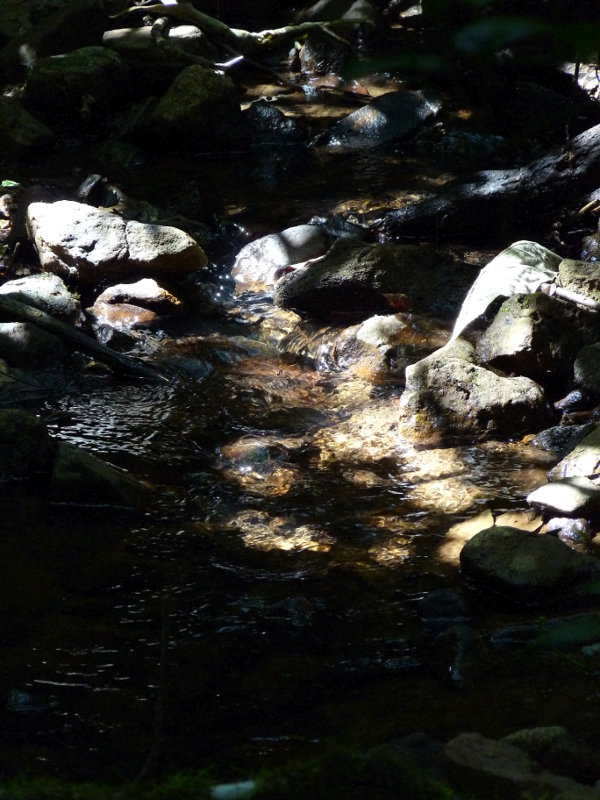
It is a world engrossed in the soft babble of water - and here you can relate with poets who believed that brooks chuckle to themselves

Morning frost has glazed the wildflowers with silvery ice, but the birds don't seem to mind

Beside the brook, a dragonfly soaks in the mellow sunshine

Some sholas accommodate a hard woody tree of the high-altitude Western Ghats - the Rhododendron (Rhododendron arboreum nilagiricum) 

January in the Nilgiris sees this tree in bountiful flower and it goes by the moniker Pongal Poo (or New Year Flower)

The canopies are patrolled by troops of Nilgiri Langurs, classified as 'Vulnerable' due to overhunting for their flesh, which is prized by indigenous medicine men

The Nilgiri Laughingthrush (Trochalopteron cachinnans) is classified as 'Endangered' as its natural habitat is fast shrinking

The Black-and-Orange Flycatcher (Ficedula nigrorufa) may be common in this part of the world but its range has declined severely in the last few decades due to the loss of its evergreen forest habitat

The Nilgiri Flycatcher (Eumyias albicaudata) is a common resident of the Sholas but is classified as Near-Threatened due to the decline of the shola habitat

A female Nilgiri Flycatcher
Black Bulbul on the verge of the shola thicket