We’ve moved! Here’s where you can find us

The Green Ogre is now at https://www.greenogreindia.org
Showing posts with label Sholas. Show all posts

A jaunt across Mudumalai - Trip Report

Our quick, packed trip to Masinagudi and Ooty yielded few lifers, but it gave us plenty of top-quality sightings

We stood at the junction of two worlds in Bangalore City Railway station. The arched stone buildings on Platform 6 were relics of a distant past and across the tracks were the eye-catching coaches of a new-look Shatabdi Express. Arun, Beej and I were headed to Mysore where Sandy was waiting to join us for our trip to Mudumalai, also his last birding trip from his base in Mysore, which he was to leave in two weeks. Sahastra, away in Uttar Pradesh, joined us occasionally in thoughts and conversation.
The long sighting of the Changeable Hawk Eagle was a highlight of our safari
We arrived at Mysore at 3:45 AM and were whisked away in Sandy’s car towards Bandipur. We entered just after the gates opened at 6 AM and were pained to see the noise generated by the trucks plying through the park. Needless to say, the disturbed environment ensured a drive devoid of any sightings save a few chitals inside Bandipur. 


A misty morning at Masinagudi


At Theppekadu, Mudumalai, we embarked on our first safari close to 7:30 AM. As we entered the safari we found a Sambhar lazing in the morning sun; it bolted at the sight of multiple telephoto lenses focused on it. Meandering through the serpentine safari tracks we chanced upon Chitals gilded by the morning sun. Arun and Beej directed our attention to Chitals in the velvet phase of their antlers. Chitals continued to hog the frame for most of the safari that ended with a cameo by a Indian Peacock sunning itself on the trunk of a dead tree.
Indian Peafowl

A baby langur learning to leap
Wanting more we headed out on our second safari, which took us through repulsive patches of lantana shrubs to begin with – not surprisingly, we saw nothing but a Hoopoe (Upupa epops). We started seeing more life as we left the lantana behind; first we came across a troop of frolicking Tufted Gray Langurs (Semnopithecus priam), a pair in the troop was indulging in games of passion. We watched like voyeurs as the langurs went about their pleasures unperturbed.
Hoopoe

Excuse us for intruding into their private life
Our next sighting on the safari was a dress circle view to a performance by the Changeable Hawk Eagle (Nisaetus cirrhatus). We found the eagle on a ground-level perch right in the middle of our safari path. It sat there sipping from a water puddle aloof of the low rumbling sounds from the engine of a gigantic body of metal headed its way. We proceeded gingerly towards the eagle, stopping frequently to observe. The bird held its ground until we were about 15 feet from it. Then it took flight and perched on a branch close to our safari van. An occasional flaunt of the crest, an occasional draw of the nictitating membrane were included in the performance. We moved on towards more chitals and eventually to our dwelling at Masinagudi. 

Changeable Hawk Eagle

Chital Stag with full antlers
At our place of stay we found company in an Intermediate Egret (Mesophoyx intermedia) and a Red Wattled Lapwing (Vanellus indicus), which had taken refuge in a pond nearby. We also found a pair of Small Minivets (Pericrocotus cinnamomeus), which we watched until our lunch was ready. With a satiated appetite and eyes hungry for more we left for the evening leg of our safari. 
Red Wattled Lapwing in flight
We started the evening safari from the Peacock Dormitory side and found a Forest Wagtail (Dendronanthus indicus), a Brown Fish Owl (Bubo zeylonensis), and a cow elephant with a male calf (whose tusks had just begun to appear). The calf made several mock charges – running around in circles, throwing up blades of grass and an occasional grunt. We left leaving the mammoth forest inhabitants to enjoy their peace. As we headed into the last safari of the day, we chanced upon Mr Dayanidhi Maran, the former union telecom minister, in the driver’s seat of an Innova parked by the Mudumalai-Bandipur road. We glanced and moved on; this sighting did not merit a checklist entry.
An agitated male calf

A Brown Fish Owl in its safe haven

After tea at the forest canteen we headed back to Masinagudi. The next morning we left early for Ooty via the Kalatty Ghat, hoping to spot Black-and-Orange Flycatchers and White-bellied Shortwings at the Botanical Gardens. On the way up, we spotted Rufous Treepies (Dendrocitta vagabunda), Brahminy Starlings (Sturnia pagodarum), Indian Peafowl (Pavo cristatus), Redvented Bulbuls (Pycnonotus cafer), Chestnut-headed Bee-Eaters (Merops leschenaulti), Grey Junglefowl (Gallus sonneratii) and Bonnet Macaques (Macaca radiata).
"Click me if you can," teased the Black and Orange Flycatcher

A very hungry caterpillar
After reaching the Botanical Gardens in Ooty we spotted the Black-and-Orange Flycatcher (Ficedula nigrorufa), which dared us to photograph it by frequently hopping around in a hedge. On the way out we spotted a Crested Goshawk (Accipiter trivirgatus) nibbling away at a kill. Oriental White Eyes (Zosterops palpebrosus), Pied Bushchats (Saxicola caprata), and a Pond Heron (Ardeola grayii) all flew in to have their names checked on our list. 

Eyes are white, lovely sight -- An Oriental White-eye
We finished with the Botanical Gardens and headed back to Masinagudi via Pykara. After a quick lunch we sped back to Mysore, making it just in time to catch our bus to Bangalore. With not even enough time to accord Sandy a sentimental farewell on his last birding trip ex-Mysore. But then again, we Ogres have tough layers. Sniff!

Trip List:

  1. Grey Junglefowl (Gallus sonneratii) 
  2. Indian Robin (Saxicoloides fulicatus) 
  3. Laughing Dove (Stigmatopelia senegalensis)
  4. Blue Rock Pigeon (Columba livia)
  5. Malabar Parakeet (Psittacula columboides)
  6. Rose-ringed Parakeet (Psittacula krameri)
  7. Vernal Hanging Parrot (Loriculus vernalis)
  8. Common Myna (Acridotheres tristis)
  9. Jungle Myna (Acridotheres fuscus)
  10. Brahminy Kite (Haliastur indus)
  11. White-browed Bulbul (Pycnonotus luteolus)
  12. Purple Sunbird (Nectarinia asiatica)
  13. Purple-rumped Sunbird (Nectarinia zeylanica)
  14. Oriental Magpie Robin (Merops leschenaulti) 
  15. Intermediate Egret (Mesophoyx intermedia) 
  16. Small Minivet (Merops leschenaulti) 
  17. Red Wattled Lapwing (Vanellus indicus) 
  18. Black and Orange Flycatcher (Ficedula nigrorufa) 
  19. Rufous Treepie (Dendrocitta vagabunda) 
  20. Ashy Drongo (Dicrurus leucophaeus) 
  21. White Bellied Drongo (Dicrurus caerulenscens) 
  22. Pond Heron (Ardeola grayii) 
  23. Ashy Woodswallow (Artamus fuscus) 
  24. Black Headed Ibis (Threskiornis melanocephalus) 
  25. Changeable Hawk Eagle (Nisaetus cirrhatus) 
  26. Crested Goshawk (Accipiter trivirgatus) 
  27. Brown Fish Owl (Bubo zeylonensis) 
  28. Blue Faced Malkoha (Phaenicophaeus viridirostris) 
  29. Plum Headed Parakeet (Merops leschenaulti) 
  30. White Throated Kingfisher (Halcyon smyrnensis) 
  31. Chestnut Headed Bee-Eater (Merops leschenaulti) 
  32. Hoopoe (Upupa epops) 
  33. Indian Peafowl (Pavo cristatus)
  34. Jungle Babbler (Turdoides striata) 
  35. Forest Wagtail (Dendronanthus indicus) 
  36. White Browed Wagtail (Motacilla maderaspatensis) 
  37. Grey Wagtail (Motacilla cinerea) 
  38. Brahminy Starling (Sturnia pagodarum) 
  39. Red Whiskered Bulbul (Merops leschenaulti) 
  40. Red Vented Bulbul (Pycnonotus cafer) 
  41. Oriental White Eye (Zosterops palpebrosus) 
  42. Pied Bushchat (Saxicola caprata) 
  43. Spotted Dove (Streptopelia chinensis) 
  44. Velvet Fronted Nuthatch (Sitta frontalis) 
  45. Pale-billed Flowerpecker (Dicaeum erythrorhynchos)
  46. Chestnut-bellied Nuthatch (Sitta cinnamoventris)
  47. Hair-crested Drongo (Dicrurus hottentottus)
  48. White-breasted Waterhen (Amaurornis phoenicurus)
  49. Common Flameback (Dinopium javanense)
  50. Brown-capped Pygmy Woodpecker (Dendrocopos nanus)
  51. Common Kingfisher (Alcedo atthis)


Text: Anand Yegnaswami
Photos: Arun Menon and Anand Yegnaswami

Encounter: The Bronzed Frog


In April 2006, we trekked from the Iruppu waterfalls in Kodagu (Coorg) to the Brahmagiri peak on the Karnataka-Kerala border. After crossing the lower bamboo-dominated patches we crossed a transition zone and reached a nice shola patch at the edge of the high-altitude grassland.


That's where we saw the frog. We found this individual near a small clear-water stream where we had stopped for lunch. In the dappled sunlight of the shola floor, a few individuals were perched on rocks close to the water. It was wet and quite well camouflaged among the rust, brown and maroon leaves sticking to wet stream rocks. The Bronzed Frog was not shy and stayed with us while we lunched, graciously allowing us to photograph it and allowing a close approach.

The common name of the frog is derived from the striking bronze strips that begin from near the snout, continue down the lower jaw, and run along the sides of the body to the lower limbs. The back is brown with bronze spotting and the hind limbs have broken bronze stripes. These strips appear just after the metamorphosis is complete. The Bronzed Frog is an important prey species for the Malabar Pit Viper (Trimeresurus malabaricus), another endemic species that loves the same moist, wet and green canopy-covered shola habitat. Hylarana temporalis was first described in 1864 and is endemic to the Indian subcontinent. It is found in the evergreen forests of the Western Ghats and the Sri Lankan highlands.
Hylarana temporalis or Bronzed Frog is similar to Hylarana aurantiaca, another endemic. H. temporalis is also found in slightly disturbed areas, but H. aurantiaca prefers only fairly pristine canopy-covered streams.
While an alarming die-out of amphibians, especially frogs, has been recorded in recent years, new species continue to be discovered across the world, including the Western Ghats. In early 2009, amphibian researchers S.D. Biju of Delhi University's Systematics Lab and Franky Bossuyt of the Amphibian Evolution Lab of the Vrije Universiteit Brussel announced the discovery of 12 new species of tree frogs from the Western Ghats. Dr Biju also rediscovered the Travancore Bushfrog (Philautus travancoricus), which had not been sighted in 100 years and was hence believed to be extinct. Approximately 126 amphibian species have been described from the Western Ghats.

Another species, Raorchestes resplendens, was recently described from the Eravikulam National Park and is believed to be restricted to a 3 sq km range on the summit of Anaimudi (the highest peak in the Western Ghats), further reinforcing the status of the Western Ghats as an important bio-diversity hotspot.
Text and photographs by Sahastrarashmi
Thanks to K S Gopi Sundar for ID help.

An afternoon in a Nilgiri shola

The Nilgiri Biosphere Reserve, which includes the Nilgiris district of Tamil Nadu apart from regions in Karnataka and Kerala, has some of the highest ranges in southern India including Dodda Betta, the second highest peak in the Western Ghats. These high ranges are notable for a peculiar kind of forest habitat unique to the southern Western Ghats - the Sholas. The name is derived from the Tamil for grove or forest.


Moist broadleaved forests of stunted evergreen trees, the Sholas occupy the higher altitudes of the southern Western Ghats in the states of Karnataka, Tamil Nadu and Kerala. Tracts of dense, verdant forest, usually clumped around and overgrowing a stream, are separated by gentle undulating meadows of short, mellow-green grasses known to be resistant to fire and frost. Together, meadow and forest comprise the shola-grassland complex. Usually, shola forests are found above 2,000 m (over 6,500 feet) -- an exception being the sholas that occur in BR Hills at 1,600 m (over 5,200 feet) -- and bear a marked semblance to evergreen forests in northeastern India and southeast Asia. The sholas harbour unique biodiversity including endemic species separated from their nearest relatives in southeast Asia.


The Sholas, which function as effective moisture and carbon sinks, remain temperate year-round. Everywhere, this fragile and important ecosystem is threatened by increased fragmentation and encroachment by plantations and commercial afforestation. In the Nilgiris, the major invasive species are Tasmanian Blue Gum (Eucalyptus globulus) and Black Wattle (Acacia mearnsii), as well as monocultures of pine, cypress and silver oak. Shrubs like Scotch Broom (Cytisus scoparius), known locally as Kothagiri Malar, have also invaded the grasslands.


Black-shouldered Kite perched on an invasive Blue Gum

Great Tit in a dense clump of Black Wattle

Scotch Broom or Kothagiri Malar

To appreciate the magnificence of the shola ecosystem, you must enter it and experience it for yourself. Many sholas in the higher reaches of the Nilgiris are quite accessible to naturalists and nature enthusiasts -- as well as poachers, encroachers, wood-cutters, grazers and forest-produce gatherers. The one that I visited was tucked away behind a pine plantation. To enter it I had to step across a stream bordered by a lichen-encrusted tree hirsute with moss. 


At this enchanting portal, I was greeted by a soft, wheezy single-note call, which stopped abruptly at my arrival. Expecting a bird, I waited noiselessly for the source to show itself. Presently, the owner of the voice scurried down the tree, pausing just long enough for me to take a good look at it. It was a beady-eyed rodent, small and smoky grey with ears pressed flat against its head. In my mind, I ruled out the immediate possibilities -- the shape of the tail dictated that it was not a Malabar Spiny Dormouse (Platacanthomys lasiurus). The shape of the muzzle ruled out the Madras Tree Shrew (Anathana ellioti). 


It was a squirrel and markedly different in appearance from the Jungle Striped Squirrel (Funambulus tristriatus), which I have seen in Meghamalai (High Wavys) and Valparai (Anamalais) - that species has a rufous wash to the pelage. I was staring at a creature that was classified as Vulnerable in the IUCN Red List. This was the Dusky Striped Squirrel or the Dusky Forest Squirrel (Funambulus sublineatus), and it was too nimble for me to photograph (ARKive.org helpfully offers a picture we can use). 


ARKive photo - Dusky-striped squirrel
Dusky Forest Squirrel (Funambulus sublineatus) (ARKive.org)

The shola-grassland complex is made up of dense evergreen forests alternating with meadows of grasses resistant to frost and fire


The shola canopy is so dense that sunlight rarely strikes the ground

The occasional rays do penetrate the foliage to nurture new life on the mulchy forest floor

Ferns flourish in the corridors of sunlight

A flower picked from the forest floor

The moist conditions are hospitable to bryophytes such as mosses

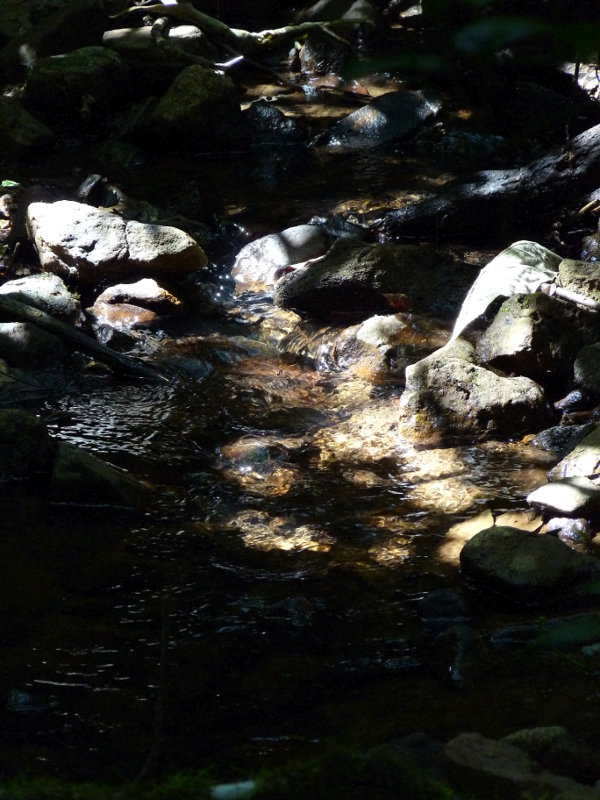
It is a world engrossed in the soft babble of water - and here you can relate with poets who believed that brooks chuckle to themselves

Morning frost has glazed the wildflowers with silvery ice, but the birds don't seem to mind

Beside the brook, a dragonfly soaks in the mellow sunshine

Some sholas accommodate a hard woody tree of the high-altitude Western Ghats - the Rhododendron (Rhododendron arboreum nilagiricum) 

January in the Nilgiris sees this tree in bountiful flower and it goes by the moniker Pongal Poo (or New Year Flower)

The canopies are patrolled by troops of Nilgiri Langurs, classified as 'Vulnerable' due to overhunting for their flesh, which is prized by indigenous medicine men

The Nilgiri Laughingthrush (Trochalopteron cachinnans) is classified as 'Endangered' as its natural habitat is fast shrinking

The Black-and-Orange Flycatcher (Ficedula nigrorufa) may be common in this part of the world but its range has declined severely in the last few decades due to the loss of its evergreen forest habitat

The Nilgiri Flycatcher (Eumyias albicaudata) is a common resident of the Sholas but is classified as Near-Threatened due to the decline of the shola habitat

A female Nilgiri Flycatcher
Black Bulbul on the verge of the shola thicket