We’ve moved! Here’s where you can find us

The Green Ogre is now at https://www.greenogreindia.org
Showing posts with label Nilgiri Flycatcher. Show all posts

The Green Ogre Weekend Update July 24

Last week the birds returned to The Green Ogre, though we have been feasting on frogs and snakes after our Agumbe conclave and continued to lick our fingers into the week that was
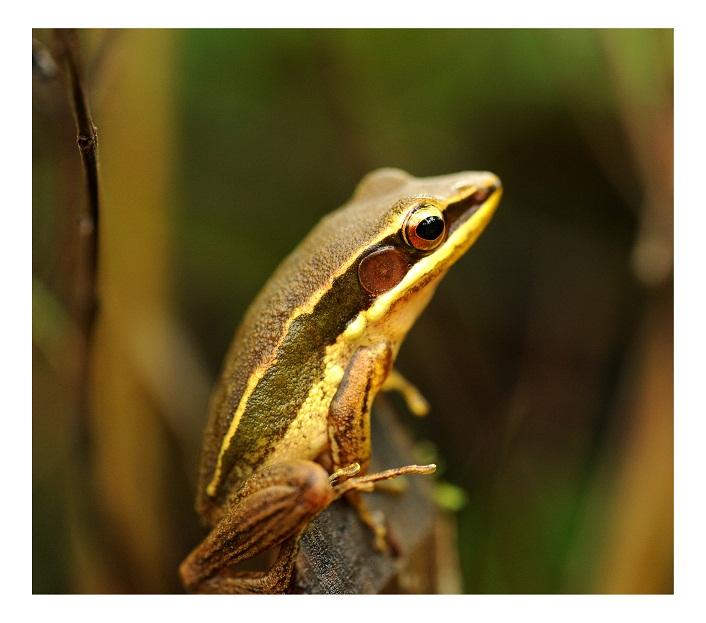
The Golden Frog
The Golden Frog (right) poses for an ardent admirer
Frogs have inspired fable, poetry and myth. And Sahastra, too. Back at Agumbe, he spent long meditative moments in the august (wasn't it June?) presence of the Golden Frog. And he came back with a lovely photo-essay on the species. Inspired by Matsuo Bashuo's immortal frog haiku, he wrote: "They were trusting, accessible and -- pardon me for anthropomorphising -- extremely friendly."
MORE >
Matsuo Basho's frog haiku (via Geishablog)
Imagine an amphibian that is frequently mistaken for a snake. In Kerala (where it is called iruthalamoori -- literally, two-headed ox) and parts of coastal Karnataka, caecilians are feared as fearsome two-headed snakes. The "heads" are in fact a pair of tentacles near the mouth, which aid the poor-sighted creature to feel its way around its dark, mulchy habitat.

Caecilian, you're breaking my heart!

At Agumbe we had the fortune of meeting the Bombay Caecilian, a purplish-black serpentine amphibian with moist, mucous-coated skin, thanks to the ARRS station manager Prashant. It was the experience of a lifetime.
MORE >


On Wednesday, the birds returned wordlessly to The Green Ogre, with Sandy showing us his picture of Racket-tailed Drongos on a monsoon date. Reminded me of that faux Japanese proverb from You Only Live Twice, quoted by Sean Connery playing 007: "Bird never make nest in bare tree."
The beautiful Nilgiri Flycatcher
In the dark, mysterious shola forests of the Nilgiris, you may chance upon a diminutive blue bird, bluer than the hills that take their name from the violet-blue blooms of Kurinji that bloom every 12 years. The Nilgiri Flycatcher is so beautiful it can make you catch your breath. As gnats and midges dance like dust motes in the cool shade of stream-watered sholas, the flycatcher hawks them with darts and sallies. Sandy regaled us with some lovely pictures. Also watch this video.
MORE >


The common Sand Boa that was saved from becoming a roadkill
Snakes are among the most common and least lamented of roadkills. And some, especially slow movers and those of nocturnal habit, are most susceptible to being run over by vehicles speeding carelessly on forest highways. Returning from a weekend trip Arun and a friend chanced upon a Common Sand Boa that was in grave risk of becoming a statistical addition to the list. "The sound that is produced as a vehicle runs over a snake is a sickening snap. I am glad I didn't have to hear it this time," he mused after they released the snake into the forest.
MORE >


Look out for more interesting posts next week. Enjoy your weekend (or what's left of it)!

Encounter: The Nilgiri Flycatcher

In the dark, mysteriously beautiful shola forests of the Nilgiris, look out for a little blue bird that will drive your blues away  


There's something common to the Nilgiris and this diminutive flycatcher -- the color blue. The Nilgiris -- literally Blue Hills -- get their name from the purple-blue flowers of the Kurinji (Strobilanthes kunthiana) that carpet their slopes once in 12 years. As for the male Nilgiri Flycatcher, it develops a dark metallic blue color as it reaches adulthood.


All my run-ins with the Nilgiri Flycatcher (Eumyias albicaudatus) have been in various parts of Ooty, which is part of the limited habitat that this bird occupies, and one reason why it has been classified as a near-threatened species in the IUCN Red list.

I saw it first on a trip to Mukurthi National Park, inside a small pocket of shola forest, as the bird hopped from one low branch to another looking for small winged insects. It was just one member of a mixed hunting flock. It soon disappeared into the dense undergrowth where it was too dark to discern anything.


I saw them in plenty in August 2009 on a couple of drives to Ooty. This time the sightings were elaborate, and it was exciting to watch them sally around catching insects on the wing, and letting out shrill warbles interspersed with sharp cheeps. A juvenile obliged me, letting me take a few snaps as it perched on a branch a few metres away from the road.
But the best sighting was this year in March when a two-day trip resulted in an hour-long encounter with a rotund male specimen, who hopped around quite close to us. First, it perched on some kind of hibiscus bush and later on a wall, often giving us curious glances, and letting us photograph him to our heart's content. 


The Little Blue Bird of the Blue Hills from Green Ogre on Vimeo.

Text and photographs by Sandeep Somasekharan
Video by Beej

An afternoon in a Nilgiri shola

The Nilgiri Biosphere Reserve, which includes the Nilgiris district of Tamil Nadu apart from regions in Karnataka and Kerala, has some of the highest ranges in southern India including Dodda Betta, the second highest peak in the Western Ghats. These high ranges are notable for a peculiar kind of forest habitat unique to the southern Western Ghats - the Sholas. The name is derived from the Tamil for grove or forest.


Moist broadleaved forests of stunted evergreen trees, the Sholas occupy the higher altitudes of the southern Western Ghats in the states of Karnataka, Tamil Nadu and Kerala. Tracts of dense, verdant forest, usually clumped around and overgrowing a stream, are separated by gentle undulating meadows of short, mellow-green grasses known to be resistant to fire and frost. Together, meadow and forest comprise the shola-grassland complex. Usually, shola forests are found above 2,000 m (over 6,500 feet) -- an exception being the sholas that occur in BR Hills at 1,600 m (over 5,200 feet) -- and bear a marked semblance to evergreen forests in northeastern India and southeast Asia. The sholas harbour unique biodiversity including endemic species separated from their nearest relatives in southeast Asia.


The Sholas, which function as effective moisture and carbon sinks, remain temperate year-round. Everywhere, this fragile and important ecosystem is threatened by increased fragmentation and encroachment by plantations and commercial afforestation. In the Nilgiris, the major invasive species are Tasmanian Blue Gum (Eucalyptus globulus) and Black Wattle (Acacia mearnsii), as well as monocultures of pine, cypress and silver oak. Shrubs like Scotch Broom (Cytisus scoparius), known locally as Kothagiri Malar, have also invaded the grasslands.


Black-shouldered Kite perched on an invasive Blue Gum

Great Tit in a dense clump of Black Wattle

Scotch Broom or Kothagiri Malar

To appreciate the magnificence of the shola ecosystem, you must enter it and experience it for yourself. Many sholas in the higher reaches of the Nilgiris are quite accessible to naturalists and nature enthusiasts -- as well as poachers, encroachers, wood-cutters, grazers and forest-produce gatherers. The one that I visited was tucked away behind a pine plantation. To enter it I had to step across a stream bordered by a lichen-encrusted tree hirsute with moss. 


At this enchanting portal, I was greeted by a soft, wheezy single-note call, which stopped abruptly at my arrival. Expecting a bird, I waited noiselessly for the source to show itself. Presently, the owner of the voice scurried down the tree, pausing just long enough for me to take a good look at it. It was a beady-eyed rodent, small and smoky grey with ears pressed flat against its head. In my mind, I ruled out the immediate possibilities -- the shape of the tail dictated that it was not a Malabar Spiny Dormouse (Platacanthomys lasiurus). The shape of the muzzle ruled out the Madras Tree Shrew (Anathana ellioti). 


It was a squirrel and markedly different in appearance from the Jungle Striped Squirrel (Funambulus tristriatus), which I have seen in Meghamalai (High Wavys) and Valparai (Anamalais) - that species has a rufous wash to the pelage. I was staring at a creature that was classified as Vulnerable in the IUCN Red List. This was the Dusky Striped Squirrel or the Dusky Forest Squirrel (Funambulus sublineatus), and it was too nimble for me to photograph (ARKive.org helpfully offers a picture we can use). 


ARKive photo - Dusky-striped squirrel
Dusky Forest Squirrel (Funambulus sublineatus) (ARKive.org)

The shola-grassland complex is made up of dense evergreen forests alternating with meadows of grasses resistant to frost and fire


The shola canopy is so dense that sunlight rarely strikes the ground

The occasional rays do penetrate the foliage to nurture new life on the mulchy forest floor

Ferns flourish in the corridors of sunlight

A flower picked from the forest floor

The moist conditions are hospitable to bryophytes such as mosses

It is a world engrossed in the soft babble of water - and here you can relate with poets who believed that brooks chuckle to themselves

Morning frost has glazed the wildflowers with silvery ice, but the birds don't seem to mind

Beside the brook, a dragonfly soaks in the mellow sunshine

Some sholas accommodate a hard woody tree of the high-altitude Western Ghats - the Rhododendron (Rhododendron arboreum nilagiricum) 

January in the Nilgiris sees this tree in bountiful flower and it goes by the moniker Pongal Poo (or New Year Flower)

The canopies are patrolled by troops of Nilgiri Langurs, classified as 'Vulnerable' due to overhunting for their flesh, which is prized by indigenous medicine men

The Nilgiri Laughingthrush (Trochalopteron cachinnans) is classified as 'Endangered' as its natural habitat is fast shrinking

The Black-and-Orange Flycatcher (Ficedula nigrorufa) may be common in this part of the world but its range has declined severely in the last few decades due to the loss of its evergreen forest habitat

The Nilgiri Flycatcher (Eumyias albicaudata) is a common resident of the Sholas but is classified as Near-Threatened due to the decline of the shola habitat

A female Nilgiri Flycatcher
Black Bulbul on the verge of the shola thicket