We’ve moved! Here’s where you can find us

The Green Ogre is now at https://www.greenogreindia.org
Showing posts with label Viper. Show all posts

Close Encounters of the Slithering Kind


These are not just encounters, but close encounters. In these situations I have either touched or been too close for comfort with certain members of the suborder Serpentes

I'd never imagined that such a day would dawn. In 2008, I visited the Agumbe Rainforest Research Station (ARRS) with friends PD, Zak and Subbu. I must mention here that I was so scared of snakes that I was almost on the verge of being ophidiophobic.

We were roaming the campus when station manager Prashant’s 4-year-old daughter found a baby Common Vine Snake (Ahaetulla nasuta) and caught it to show us. All four of us were stunned at the girl's courage. PD took it from the girl's hands and handled it easily as he was used to working with snakes during his stint as a volunteer with the Gujarat Society for Prevention of Cruelty to Animals (GSPCA). Then Subbu mustered the courage to hold it. Next was Zak.

All this while, I was chewing my fingernails. I too wanted to handle it but my inner voice hissed, "Don't get any bright ideas dude, that's a bloody snake!" At the same time I could hear PD saying, "Dude, it’s just a baby snake." Finally PD's voice won over my inner voice and I did it! The mortal fear dissolved away as I watched the little green fella slithering around my arm, once in a while flicking his tongue to 'taste' the air. This was a big milestone for me. I had held a live snake!
The first touch
The Indian Rock Python (Python molurus) is one of two kinds found in India. The International Union for Conservation of Nature (IUCN) lists it as NT (Near Threatened). Threatened or not, these snakes can be found every once in a while at the National Institute of Technology Karnataka (NITK) campus in Surathkal. I had seen them there twice in a span of 18 months.

I first saw a python when some security guys were showing it off to bystanders by catching hold of its tail and throwing it from one side of the road to the other. My requests to them to handle the snake properly fell on deaf ears. Luckily, a student helped the guards bag it and take it away to be released some 7 km away. This python was young and measured approximately 3.5 to 4 feet.

A year later, I encountered a python again and this time I had an experienced ally, PD, to guide me. Late one night, PD popped into my room and said, “Arun! Python, Ist block!” and ran back to his room to pick up his snake hook.

It took me a second to decipher what he had just said. We ran to the spot followed by Zak and Subbu wondering whether it could be a Russell’s Viper (Daboia russelii) since that short, thick venomous snake might appear to be a python to those who cannot tell them apart. There was no doubt about the snake's identity when we reached the spot. There, among the weeds, lay an enormous snake. Even in the darkness lit by a dim street-light, there was no mistaking its size and markings. This was an Indian Rock Python.

We wanted to move the snake from there as it was close to the hostel. If workers saw it, they might kill it. PD asked me to help for its sheer size and weight. I was so out of my wits that I looked around for help, only to see that Zak and Subbu had moved away. PD had already jumped on the snake and held its head. He was shouting at me to hold its lower body and tail as otherwise it would start wrapping around him. After a millisecond’s hesitation I too dived into the weeds and caught the snake.

The snake was extremely strong and there was ample confusion in the dim light. Finally, we subdued it and got a grip. That first touch of the python I shall never forget. The dorsal part was hard but with smooth scales. The ventral scales were rough. The body was hard and muscular. I could feel the muscles moving inside its body. It felt as if a leather sheath was filled with moving cricket balls. This was one snake that you didn’t have to worry about squeezing too much when handling. It was strong and hard to resist all of that! (Just kidding, you do need to handle it with extreme care.)
Once the snake was in our hands, everybody wanted to touch it while we both were already worrying about where to release it.
The fear that had enveloped me until now evaporated now that we caught the snake. After ensuring that the python was safe in our arms, everybody came forward to touch it and take snaps. We later measured, bagged and released it inside a forested corner of the campus, away from the hostel blocks. The python was 7 feet in length (adults grow to around 13 feet).

With this incident I actually overcame my fear of snakes. But this doesn’t mean I’ll go pick up a snake at the first instance I find one!


The third close encounter, now that I think of it, was one of the most hair-raising ones. Except that neither the snake nor I panicked. This species -- the Russell's Viper -- is responsible for the majority of human snakebite deaths in India

Russell's Viper (Photo of a captive snake taken at Guindy Snake Park, Chennai)
One morning, after camping in a forest in the Hosur Forest Division the previous night, I picked up my binocs and began birding alone. I was so engrossed and happy without the extra weight of my camera that I did not pay attention to the forest floor. As I observed a Crested Serpent Eagle calling and circling directly above me, I heard a faint rustle of leaves right next to where I was standing. I turned around to see a thick snake with brown or chestnut coloration, with prominent dark brown oval shaped markings. “Russell’s Viper?” I thought to myself calmly as I observed it uncoiling and beginning to move away, just a foot or so away from my feet. It took me a couple of seconds to realize how lucky I was not to have stepped on the snake or frightened it into biting. I still wonder how I stayed calm that day without jumping at the sight of a snake so close to me.

As the snake moved away into the dry bushes and settled down, I circumvented the bushes and came up in front of it. From there I watched the snake for a good 15 minutes before moving away. Unfortunately, I did not carry my camera that day. But the sight of the viper uncoiling will always be etched in my memory.


Had the “dangerous/deadly” snake, as most people claim vipers to be, chosen to strike instead of moving away, I would mostly not have been here to narrate this encounter as medical help was very far away from the spot. The viper moved away and let me live even when I intruded its personal space. Had it intruded our personal spaces, what would we have done?
Scale pattern of a Russell's Viper 


Text: Arun
Photographs of the Vine snake and Rock python: Pankil Desai
Photographs of Russell's Viper: Arun

Creeped out? Time to get over it! Read other snake posts on The Green Ogre

Encounter: Malabar Pit Viper

Little did we know that we were being watched by a silent and mysterious presence on a wooden beam behind us
The first time I went to Agumbe Rainforest Research Station, I remember walking for hours in the night, hoping to catch a glimpse of Malabar Pit Vipers. No luck. This time, on a trip with the other ogres, nearly two full days passed without incident.
The heat-sensing pits between the eye and nostril can be clearly seen
On the second night, Sandy and I were walking towards our tent in pouring rain, guided only by the small beam of my torch. I almost stepped on a twig that lay across my path -- a dry twig that appeared to be mottled with pale lichen growth in bluish green and brown. Except this twig was moving! 

"Stop!" I shrieked. Sandy bumped into me from behind. I guided the torch beam towards the head of the "twig". One good look at the snake's triangular head was enough to conclude that it was a viper. That, in addition to the colour pattern, pointed us in the right direction. This was a Malabar Pit Viper (Trimeresurus malabaricus)!

As I watched the fella slither past me slowly, I asked Sandy to go and fetch the others. As he ran back, I stood there in pouring rain and pitch darkness observing the snake cross the path and slowly enter a dense thicket. At times, when a twig or branch was too high, the snake lifted itself upwards like a straight stick and hooked its head on the twig. Then, it pulled itself up. This behaviour pointed to the snake's tree-dwelling lifestyle. 

By the time Sandy came back with Beej, the viper had almost dissolved into the shrub, aided by perfect camouflage. I was upset that the others had not had a good look at the snake.
The brown markings on green can be seen
Malabar Pit Vipers are nocturnal and are generally found in low bushes, trees and on rocks. During the day they are inactive and may be seen basking. They are endemic to the Western Ghats and are found between altitudes of 600 to 2134 metres. Adult snakes can grow to 55-79 centimeters. The longest ever measured was 105 centimeters. The triangular head is broader than the neck. They are typically green but appear in other morphs and a lot of variations have been recorded, including reddish-brown, yellow, etc. On its back the snake is olive or brown with black or brown spots, which may be joined to form a zigzag pattern. The sides have faint yellow spotting and the tail has yellow and black markings. The pupils have vertical slits. Malabar Pit Vipers are ovoiviviparous -- the eggs form, develop and hatch within the mother's body.

Pit vipers, which are classified under the subfamily Crotalinae in the family Viperidae, are distinguished from other vipers by the presence of a pair of heat-sensing pits located between the eye and nostril. These organs help the snake detect the body heat of warm-blooded prey even in absolute darkness.

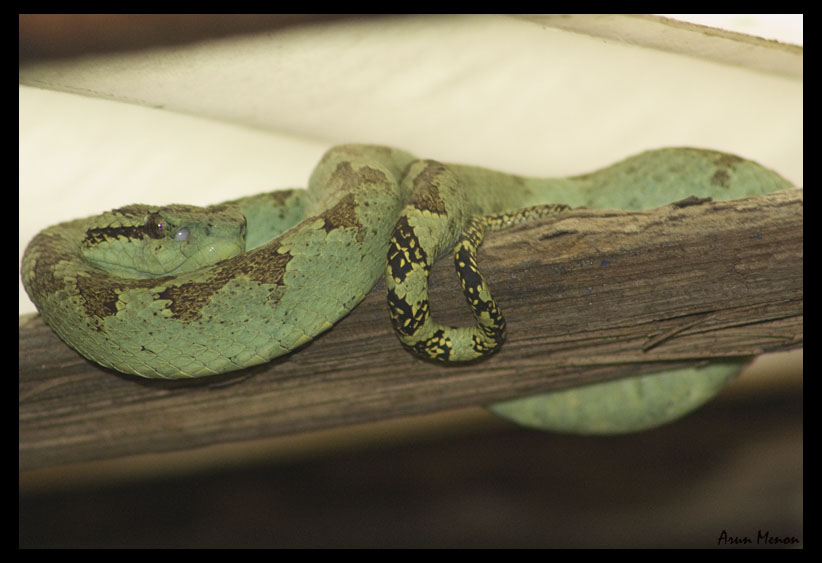
The other ogres were disappointed at missing the snake the night before but at 4 pm the next day, our luck turned. The ogres were busy treating a Vine Snake like a supermodel. After about 20 minutes all except me and Andy left the scene. After lingering for another ten minutes, we decided to go back to the room to pack and freshen up before our return journey. Just as we left Prashanth, the station manager, called out to us. He pointed to a wooden beam just under the roof of the dining area and said, "Look who's sitting here." There lay a Malabar Pit Viper, coiled, calm and relaxed.

Relaxed and lazing

Observing from high above
It dawned on us that all the while, as we were photographing the Vine Snake, this chap was watching the drama from its high throne!

The others arrived and we took good, long looks at the snake. Malabar Pit Vipers have prehensile tails (adapted to grasp or hold) and this perhaps helps them to anchor themselves on branches or twigs while they lunge at their prey. Here, the snake had used its tail as a kind of hinge to loop it against the beam in the absence of anything else to hold on to. 

We made sure to keep our distance as vipers, though slow, are known to be capable of extremely fast strikes. The venom is mildly haemotoxic -- the toxins destroy red blood cells, disrupt clotting of blood, and causes tissue damage. In humans it results in pain and swelling. 
The prehensile tail is used as a hinge in the absence of anything to hold onto
I'm sure the snake wouldn't have wanted to waste its venom on us, and instead save it for the geckos, tree-frogs, shrews, and birds which make up a large part of its diet. Pit vipers have erectile fangs which are kept folded against the roof of the mouth. They are brought into place only when striking.

After we observed and photographed the snake, I asked Prashanth if he would move the snake since it was close to the dining area. To my surprise, he said they would leave it there and let it decide its own way out at night. Though I was a little concerned about slithering vipers that might end up over our heads or under the dining table, I was also glad that ARRS offered a haven for snakes where they had right of way.
Text: Arun
Photographs: Sahastrarashmi and Arun
Read more Agumbe Diaries