We’ve moved! Here’s where you can find us

The Green Ogre is now at https://www.greenogreindia.org
Showing posts with label agumbe rainforest research station. Show all posts

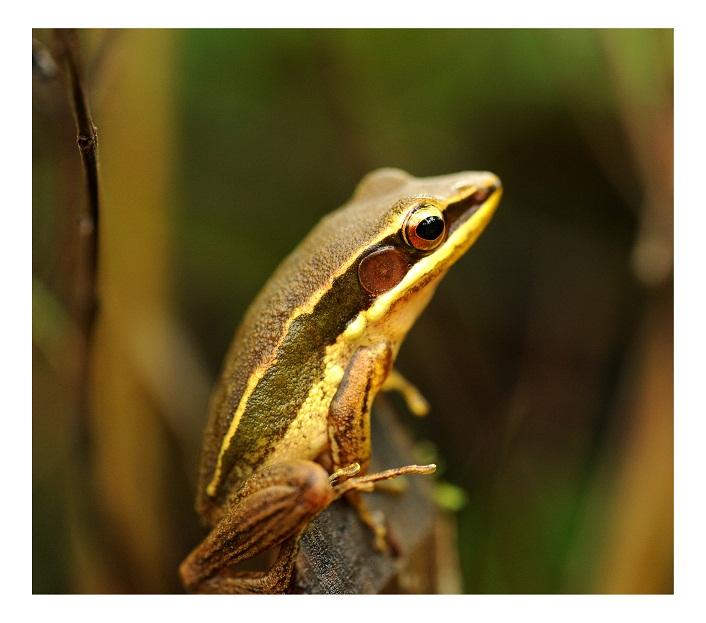
The Bicoloured Frog's Wedding Suit

The polka dots had thinned into the skin. The blacks had greyed into sallower shades. But the red-rimmed eyes still gleamed like rubies. Here was the Bicoloured Frog again, dressed for its wedding party
Bi-coloured Frog (Clinotarsus curtipes).
In early June this year, just as Agumbe awaited the deluge of the southwest monsoon, we visited the Agumbe Rainforest Research Station there. You might remember that we had posted an encounter with the polka-dotted Bicoloured Frog (Clinotarsus curtipes).

In his Book of Indian Reptiles and Amphibians, J C Daniel mentions that the species begins to breed with the onset of the southwest monsoon and tadpoles can be sighted in plenty in April, May and June. However, in Agumbe, none of the frogs we encountered displayed any hint of breeding colours.

The Kulgi Nature Camp abutting the Dandeli-Anshi Tiger Reserve (15°16'01"N 74°37'01"E), with its broad-leafed north Western Ghats moist deciduous forests, is drier than Agumbe (13°30'30"N 75°5'45"E) and the monsoon had receded by early October, though thundershowers staged a mock-charge in the evenings.
Agumbe, June: Bi-coloured Frog in non-breeding colours

The forest floor was not just a lot drier, the leaf litter was much less than at Agumbe
It was mid-morning and we were out birding along the Birder's Trail near Kulgi Nature Camp, having just enjoyed watching a mixed hunting party -- Velvet-fronted Nuthatch, Paradise Flycatcher, Scarlet Minivets, Brown-capped Pygmy Woodpecker, Greater Flameback and Common Iora -- and a much-relieved Sandy commented on the uncharacteristic lethargy of the leeches (there was to be no nightmare-induced macabre storytelling tonight). And then a casual glance at the forest floor revealed this treasure.
Creamy yellow upper body with prominent black dots

The upper body is bright golden-yellow and the dots have almost faded off
The transformation was remarkable. The dots on the upper body had almost faded off and the yellow was much brighter -- almost golden. The sharp division between the coloration of the upper and lower parts of the body remained but the glistening black limbs were now brown.


The black limbs have turned brown
The white patch that ran from the snout towards the eye was now yellow and a small black band separated it from the greenish-yellow (almost olive) skin of the sides, which now displayed a dual coloration -- a change from the uniform black of the non-breeding form. The most remarkable change, however, was the white-blotched grey of the frog's underside and the lower half of the belly between the fore and hind-limbs. It gave the frog's underbelly and sides a rather lichen-patched texture (less on the underbelly than the sides of the lower belly), perhaps a useful camouflage from slithering predators on the forest floor.

The large red-rimmed eye still glowed like a ruby.


Notice the lichen-patched texture of the underbelly that was uniform black before breeding commenced
Behaviourally the frog did not seem to have changed much. It was solitary, did not call, and was not jumpy or nervous. While we photographed, it stayed put, only taking a single jump if we stepped too close. 

It did seem a bit late in the season, but the forest had several wet patches and we hoped that somewhere, not too far away, was another individual of the species. Of the opposite sex.


Text and photographs by Sahastrarashmi

Close Encounters of the Slithering Kind


These are not just encounters, but close encounters. In these situations I have either touched or been too close for comfort with certain members of the suborder Serpentes

I'd never imagined that such a day would dawn. In 2008, I visited the Agumbe Rainforest Research Station (ARRS) with friends PD, Zak and Subbu. I must mention here that I was so scared of snakes that I was almost on the verge of being ophidiophobic.

We were roaming the campus when station manager Prashant’s 4-year-old daughter found a baby Common Vine Snake (Ahaetulla nasuta) and caught it to show us. All four of us were stunned at the girl's courage. PD took it from the girl's hands and handled it easily as he was used to working with snakes during his stint as a volunteer with the Gujarat Society for Prevention of Cruelty to Animals (GSPCA). Then Subbu mustered the courage to hold it. Next was Zak.

All this while, I was chewing my fingernails. I too wanted to handle it but my inner voice hissed, "Don't get any bright ideas dude, that's a bloody snake!" At the same time I could hear PD saying, "Dude, it’s just a baby snake." Finally PD's voice won over my inner voice and I did it! The mortal fear dissolved away as I watched the little green fella slithering around my arm, once in a while flicking his tongue to 'taste' the air. This was a big milestone for me. I had held a live snake!
The first touch
The Indian Rock Python (Python molurus) is one of two kinds found in India. The International Union for Conservation of Nature (IUCN) lists it as NT (Near Threatened). Threatened or not, these snakes can be found every once in a while at the National Institute of Technology Karnataka (NITK) campus in Surathkal. I had seen them there twice in a span of 18 months.

I first saw a python when some security guys were showing it off to bystanders by catching hold of its tail and throwing it from one side of the road to the other. My requests to them to handle the snake properly fell on deaf ears. Luckily, a student helped the guards bag it and take it away to be released some 7 km away. This python was young and measured approximately 3.5 to 4 feet.

A year later, I encountered a python again and this time I had an experienced ally, PD, to guide me. Late one night, PD popped into my room and said, “Arun! Python, Ist block!” and ran back to his room to pick up his snake hook.

It took me a second to decipher what he had just said. We ran to the spot followed by Zak and Subbu wondering whether it could be a Russell’s Viper (Daboia russelii) since that short, thick venomous snake might appear to be a python to those who cannot tell them apart. There was no doubt about the snake's identity when we reached the spot. There, among the weeds, lay an enormous snake. Even in the darkness lit by a dim street-light, there was no mistaking its size and markings. This was an Indian Rock Python.

We wanted to move the snake from there as it was close to the hostel. If workers saw it, they might kill it. PD asked me to help for its sheer size and weight. I was so out of my wits that I looked around for help, only to see that Zak and Subbu had moved away. PD had already jumped on the snake and held its head. He was shouting at me to hold its lower body and tail as otherwise it would start wrapping around him. After a millisecond’s hesitation I too dived into the weeds and caught the snake.

The snake was extremely strong and there was ample confusion in the dim light. Finally, we subdued it and got a grip. That first touch of the python I shall never forget. The dorsal part was hard but with smooth scales. The ventral scales were rough. The body was hard and muscular. I could feel the muscles moving inside its body. It felt as if a leather sheath was filled with moving cricket balls. This was one snake that you didn’t have to worry about squeezing too much when handling. It was strong and hard to resist all of that! (Just kidding, you do need to handle it with extreme care.)
Once the snake was in our hands, everybody wanted to touch it while we both were already worrying about where to release it.
The fear that had enveloped me until now evaporated now that we caught the snake. After ensuring that the python was safe in our arms, everybody came forward to touch it and take snaps. We later measured, bagged and released it inside a forested corner of the campus, away from the hostel blocks. The python was 7 feet in length (adults grow to around 13 feet).

With this incident I actually overcame my fear of snakes. But this doesn’t mean I’ll go pick up a snake at the first instance I find one!


The third close encounter, now that I think of it, was one of the most hair-raising ones. Except that neither the snake nor I panicked. This species -- the Russell's Viper -- is responsible for the majority of human snakebite deaths in India

Russell's Viper (Photo of a captive snake taken at Guindy Snake Park, Chennai)
One morning, after camping in a forest in the Hosur Forest Division the previous night, I picked up my binocs and began birding alone. I was so engrossed and happy without the extra weight of my camera that I did not pay attention to the forest floor. As I observed a Crested Serpent Eagle calling and circling directly above me, I heard a faint rustle of leaves right next to where I was standing. I turned around to see a thick snake with brown or chestnut coloration, with prominent dark brown oval shaped markings. “Russell’s Viper?” I thought to myself calmly as I observed it uncoiling and beginning to move away, just a foot or so away from my feet. It took me a couple of seconds to realize how lucky I was not to have stepped on the snake or frightened it into biting. I still wonder how I stayed calm that day without jumping at the sight of a snake so close to me.

As the snake moved away into the dry bushes and settled down, I circumvented the bushes and came up in front of it. From there I watched the snake for a good 15 minutes before moving away. Unfortunately, I did not carry my camera that day. But the sight of the viper uncoiling will always be etched in my memory.


Had the “dangerous/deadly” snake, as most people claim vipers to be, chosen to strike instead of moving away, I would mostly not have been here to narrate this encounter as medical help was very far away from the spot. The viper moved away and let me live even when I intruded its personal space. Had it intruded our personal spaces, what would we have done?
Scale pattern of a Russell's Viper 


Text: Arun
Photographs of the Vine snake and Rock python: Pankil Desai
Photographs of Russell's Viper: Arun

Creeped out? Time to get over it! Read other snake posts on The Green Ogre

Encounter: Golden Frog

Our very own Golden Frog, a Western Ghats endemic, gave us the cherished privilege of a long and uninterrupted audience

At the outset let me state that the frog we encountered is not to be confused with the Panamanian Golden Frog (Atelopus zeteki), which was last seen and filmed in the wild in 2007. The entire known population in the wild is now assumed extinct and the frog survives only in captivity. Our Golden Frog (Hylarana aurantiaca) is luckier, but the Sword of Damocles of the amphibian world, the fungal infection chytridiomycosis, hangs over its head too.
Frogs have an extremely permeable skin, through which they can absorb oxygen into the bloodstream. Oxygen first dissolves in a thin water film on the surface of the skin and then from there into the blood. This feature, which evolved to aid their amphibious lifestyle, is now one of the reasons for the rapid decline of frog populations around the globe. The permeable skin makes them highly susceptible to toxins in the water. So evolved is this feature in frogs that a lungless frog has been discovered in 2007 in the rainforests of Borneo, Indonesia. The Bornean Flat-headed Frog (Barbourula kalimantanensis) has no lungs and this 7 cm long frog breathes entirely though its skin. The absence of lungs helps it attain a flatter body shape -- a key adaptation to survival in its habitat, fast-running mountain streams, since it aids streamlining and reduces drag. But it is already threatened due to rise in water toxicity due to mining.

We first encountered the Golden Frog during a late evening “frogging” session at ARRS. They were perched on leaves and calling (the vocal sac is internal) but in the feeble torchlight it was very difficult to make out the distinctive coloration, especially the yellow-orange back bordered by two golden streaks – the characteristics that gives them their regal name. The next day I saw a couple of them on the same bushes beside a small monsoonal wetland right outside our cottage and as the excited Ogres scanned the bushes we realized that there at least 20 of them right there. As we photographed them, the frogs maintained the calm and composure of meditating Zen monks. There was no alarm, no anxiety and no visible discomfiture. In fact, as the successive monsoon fronts arrived -- the sequence of mist, drizzle, heavy shower, sunshine, mist played out though the day -- they hardly seemed to move. I observed one of them seated in position for almost three hours. They also seemed to be quite gregarious, seated on leaves, twigs, stems and branches of the bush close to each other.

Hylarana aurantiaca is found in moist evergreen forests, swamps and coastal regions bordering the southern Western Ghats and is probably a Western Ghats endemic since the population found in Sri Lanka is suspected to belong to a separate, yet undescribed, species. It is described as a semi-arboreal and semi-aquatic frog. The frogs we came upon at the ARRS (which has a population of over 200-300 Golden Frogs) were typically perched on small bushes – on stems and twigs – and on large leaves close to the ground. There was a small disused water-logged paddyfield nearby so the bushes were technically at the edge of a shallow water body. Their IUCN status is Vulnerable.

The frog is small in size -- approximately 4 cm from the snout to the vent. The toes are dilated into discs and the middle digit of the toes is longer than the other two. It has three digits on each limb and the webbing is barely noticeable. The skin can be smooth but is often granulated especially on the back due to scattered conical tubercules. The nostril is close to the snout and the tympanum is quite distinct, almost the size of the eye, only slightly smaller.

Hylarana aurantiaca’s distinct feature is a chocolate-brown/olive-green band that runs from the tip of the snout along the flanks to the hindlegs. The eye, nostril and tympanum are all situated on this band. This band is bordered by a bright yellow, almost golden streak running all along the upper border and till the foreleg along the lower border. The back, which is essentially bordered by these two Midas-touched streaks is orange/orange-yellow or olive-brown. The back and the limbs have no barring but for some dark splotches. The eye is black and bulging, the eyelids bright orange. The underparts are creamy white and the skin is a translucent glowing orange when it is lit up by the sun.

Currently, around the world, most of the roughly 5,000 species of frogs are in decline, and we have a very real risk of losing species that are not yet discovered. In India, while 12 new species of tree-frogs were discovered by a team led by S D Biju of Delhi University, Systematics Lab, Delhi, another initiative to re-discover 50 lost amphibians of India (LOST! Amphibians of India Initiative) has yielded just five re-discoveries so far, the prized one being Chalazodes Bubble-nest Frog (Raorchestes chalazodes), unrecorded since 1874. Researchers estimate that we may have lost up to 13% of our amphibians already.

We Ogres cherish the time we spent with the Golden Frogs at ARRS. They were trusting, accessible and -- pardon me for anthropomorphising -- extremely friendly. It was a privilege to observe and photograph them from so close. The Golden Frog is a lovely representative of a species that has a special place in our hearts – be it as a Frog Prince or as a metaphor in Matsuo Basho’s famous Frog Haiku.

Text and Photographs by Sahastrarashmi
Enjoy more Agumbe Diaries

Meeting Dr Jekyll and Mr Hyde in the rainforest

The two faces of a forest stream are so unlike each other


Encounter 1: Flamboyance
The cab driver drops us at the end of a muddy road and says he'll wait till we return. The rains have let up a bit and a few drops that cling to leaves is the only precipitation. The path winds uphill first and then starts to descend. Can't stop, leeches are climbing up our legs from every direction. Can't run - you need to be sure of where you are treading. 


Soon the sound gives it away -- a stream rushing through the rainforest. A fallen tree on the way forces us to take another path, winding down, careful not to step on leaf litter. No one knows what lies beneath the dried and decomposing leaves.


Glimpses of white shine through the leaves. The sound is loud now -- a low, continuous roar. We find a a rock jutting above the stream and step on it, then exclaim in unison: "Wow!" 
Winding through the canopy the stream flows right before us. It dives under the rock on which we stand and swivels over to stabler terrain to the right of us. It is not just the rushing roar we can hear now. There is whistling, hissing, gushing, rustling... along with a dozen other sounds that I can't put to words. Also the rushing water works up a wind. Leeches still clamber up my shins, and I drag, roll and flick them into the water as I set up the tripod.


Not sure what but something (other than the leeches) makes you feel vulnerable standing next to such a forest stream. There is this urge to finish stuff fast and move on. Am I worried about a flash flood? Scenes run in my head in fast forward - Arwen on horseback, mumbling mystic words that unleash water on the wraiths trying to cross the placid river: water that races down on them in the shape of a dozen horses and wash them away. 


When Bijoy says "Let's go" I find myself eager to comply. Climbing uphill, though the route was steep, doesn't feel tough at all - what more inspiration is needed than seeing leeches inching their way up your legs when you keep them still for a moment?

Encounter 2: Tranquility 
We walk past the cottage reserved for Romulus Whittaker and, at the edge of the forest, there is an electric fence (which was not electrified). We climb it and take a few steps downwards into the foliage. And we realize that we have just been transported into another dimension. Pandora, maybe?
The diffused sunlight that enveloped the open grassland in front of the cottages is absent here, cut off by the canopy that makes us feel we are inside a tunnel. An occasional croak is heard, succeeded by soft mumbling whispers as the running water gossips with the rocks. 


Everything sports some shade of green. The water, the leaves and the canopy... 


The interns at ARRS said the place throngs with life at night, but unfortunately they never went on a night-walk that side during our stay, so we couldn't accompany them...


These were two natural streams, both flowing right through the same rainforest. Perhaps both would merge somewhere, or one may get consumed by the other. But when we met them, they sported entirely contradicting personae - as different as Dr Jekyll and Mr Hyde.


Text and photos by Sandeep Somasekharan
Read more Agumbe Diaries


Encounter: Malabar Pit Viper

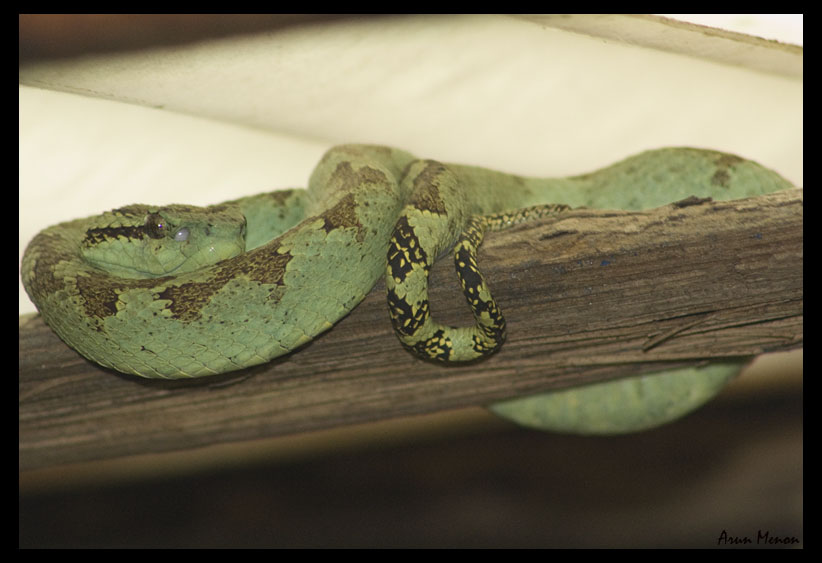
Little did we know that we were being watched by a silent and mysterious presence on a wooden beam behind us
The first time I went to Agumbe Rainforest Research Station, I remember walking for hours in the night, hoping to catch a glimpse of Malabar Pit Vipers. No luck. This time, on a trip with the other ogres, nearly two full days passed without incident.
The heat-sensing pits between the eye and nostril can be clearly seen
On the second night, Sandy and I were walking towards our tent in pouring rain, guided only by the small beam of my torch. I almost stepped on a twig that lay across my path -- a dry twig that appeared to be mottled with pale lichen growth in bluish green and brown. Except this twig was moving! 

"Stop!" I shrieked. Sandy bumped into me from behind. I guided the torch beam towards the head of the "twig". One good look at the snake's triangular head was enough to conclude that it was a viper. That, in addition to the colour pattern, pointed us in the right direction. This was a Malabar Pit Viper (Trimeresurus malabaricus)!

As I watched the fella slither past me slowly, I asked Sandy to go and fetch the others. As he ran back, I stood there in pouring rain and pitch darkness observing the snake cross the path and slowly enter a dense thicket. At times, when a twig or branch was too high, the snake lifted itself upwards like a straight stick and hooked its head on the twig. Then, it pulled itself up. This behaviour pointed to the snake's tree-dwelling lifestyle. 

By the time Sandy came back with Beej, the viper had almost dissolved into the shrub, aided by perfect camouflage. I was upset that the others had not had a good look at the snake.
The brown markings on green can be seen
Malabar Pit Vipers are nocturnal and are generally found in low bushes, trees and on rocks. During the day they are inactive and may be seen basking. They are endemic to the Western Ghats and are found between altitudes of 600 to 2134 metres. Adult snakes can grow to 55-79 centimeters. The longest ever measured was 105 centimeters. The triangular head is broader than the neck. They are typically green but appear in other morphs and a lot of variations have been recorded, including reddish-brown, yellow, etc. On its back the snake is olive or brown with black or brown spots, which may be joined to form a zigzag pattern. The sides have faint yellow spotting and the tail has yellow and black markings. The pupils have vertical slits. Malabar Pit Vipers are ovoiviviparous -- the eggs form, develop and hatch within the mother's body.

Pit vipers, which are classified under the subfamily Crotalinae in the family Viperidae, are distinguished from other vipers by the presence of a pair of heat-sensing pits located between the eye and nostril. These organs help the snake detect the body heat of warm-blooded prey even in absolute darkness.

The other ogres were disappointed at missing the snake the night before but at 4 pm the next day, our luck turned. The ogres were busy treating a Vine Snake like a supermodel. After about 20 minutes all except me and Andy left the scene. After lingering for another ten minutes, we decided to go back to the room to pack and freshen up before our return journey. Just as we left Prashanth, the station manager, called out to us. He pointed to a wooden beam just under the roof of the dining area and said, "Look who's sitting here." There lay a Malabar Pit Viper, coiled, calm and relaxed.

Relaxed and lazing

Observing from high above
It dawned on us that all the while, as we were photographing the Vine Snake, this chap was watching the drama from its high throne!

The others arrived and we took good, long looks at the snake. Malabar Pit Vipers have prehensile tails (adapted to grasp or hold) and this perhaps helps them to anchor themselves on branches or twigs while they lunge at their prey. Here, the snake had used its tail as a kind of hinge to loop it against the beam in the absence of anything else to hold on to. 

We made sure to keep our distance as vipers, though slow, are known to be capable of extremely fast strikes. The venom is mildly haemotoxic -- the toxins destroy red blood cells, disrupt clotting of blood, and causes tissue damage. In humans it results in pain and swelling. 
The prehensile tail is used as a hinge in the absence of anything to hold onto
I'm sure the snake wouldn't have wanted to waste its venom on us, and instead save it for the geckos, tree-frogs, shrews, and birds which make up a large part of its diet. Pit vipers have erectile fangs which are kept folded against the roof of the mouth. They are brought into place only when striking.

After we observed and photographed the snake, I asked Prashanth if he would move the snake since it was close to the dining area. To my surprise, he said they would leave it there and let it decide its own way out at night. Though I was a little concerned about slithering vipers that might end up over our heads or under the dining table, I was also glad that ARRS offered a haven for snakes where they had right of way.
Text: Arun
Photographs: Sahastrarashmi and Arun
Read more Agumbe Diaries

Encounter: Monster Leeches

Pardon me for exaggerating the danger posed by leeches, for experience has not been kind to me


The farmer looked at his buffalo lying in the leaf litter. She looked as if she had been sucked dry, with circular bite-marks the diameter of tennis balls. He gasped. Having spent all sixty three years of his life here, he knew the forest and the grasslands adjoining it like the back of his hand. There was absolutely no creature here that could inflict such a death. He had previously lost a few cattle to snake-bite, and a calf to a leopard. But, this was certainly odd. 


A slight movement among the fallen leaves caught his eye. A bullfrog? But something made him look at it again. It didn't have a head, just a stump in place. It tilted the stump-head left and right like a blind man trying to tell the direction of a sound. And it leaped right at him - the same way frogs do, albeit in the opposite direction.


As he battled with the thing, trying to pull out the stump that worked now like a suction-head attached firmly to his throat, he saw from the corners of his eyes, more of these creatures springing towards him from all directions. He screamed, though he knew well that there was no one around who could hear him...


A few miles away, in a secret army biological research station, the army chief read the report from his scientists. The last three decrypted reports had brought a smile to his face...


"Experiment to infuse tiger leech DNA into bullfrog spawn- Success
Self sustainability in the wild - Success
Reproducing capability - Success"


But the blood drained from his face as he read the last report....


CODE RED! Recapturing/ eliminating the specimen released to wild - Failure. Transmitters attached to six of the twenty not working.


If the Japanese could invent Godzilla out of their resentment for nuclear experiments and atom bombs, can't I invent a monster-leech?!
A drunk leech with a punctured stomach paints a gory picture (Photo: Sahastra)
Since childhood, I have been mortally afraid of leeches, though I had not yet encountered them. My dad was an avid trekker and came back from his trips with tales of how leeches attached themselves to the limbs of trekkers and grew fat sucking blood. He said that dropping salt or lemon juice over them made them drop off. The stories implanted a permanent apprehension in my head about leeches. Add to that other stories I heard of leeches getting under the eyelid of someone who washed his face in a stream only to be discovered two days later when the eye swelled up, of HIV viruses being found inside leeches in Africa, and of a guy who went to change his undies in the bushes after a long dip in a forest stream finding a fat, bloated leech mirroring his leech-like member... 


How much more does one need for mere fear to give way to paranoia?

The modus operandi of this bloodsucker is the proven lie-in-wait-and-ambush method. The moment you put your feet anywhere near one of them, they will detect motion and heat and latch onto you. They clamber up through gaps in your shoe, all the way up to where your socks end, and latch onto the skin. Its saliva contains an anaesthetic, which numbs pain and other sensation, and an anti-coagulant, which unclots the blood to make it flow smoothly. When it has had enough, it drops off.
The fat, dark specimen looks for a tender spot on Beej's index finger...

On our Agumbe trip we saw two kinds of leeches: a thin, long one with stripes around it and two along its length, and a darker, shorter one with two cream-coloured stripes on either side along its length. With the first one, the standard technique that Arun taught us worked well: Roll, pick and flick. Put a finger on top of it, and roll it over the leech. It would curl up into a ball, then just pick it up and flick it far with a finger. With the latter, this was tough as the guy just wouldn't roll. Here, pressing your nail near the bite to loosen its hold and then doing a carrom-strike with the middle finger was easier.
Two slender leeches attempt to find the point where the socks originate...
We also tried some experiments with the guy. Beej lifted one up, pulled it with both hands like a rubber band, twisted it and squeezed it in an attempt to "give him a tough time" - but the guy was literally indestructible that way. Chemical warfare was easier. Some salt on a leech would make it shrivel up and die, and same happened when we squeezed a drop of lemon juice on it. I had worn socks dipped in Dettol and brine and dried, but they didn't deter the leeches much. Wearing ankle-length shoes and jeans that extended all the way to the base of the shoe, made the leeches climb up the jeans - they were easier to spot and remove.

Locals often tell us to drop salt or hold a flame to a biting leech. But it is said that this may cause the leech to regurgitate blood along with bacteria in its stomach right on the bite wound, leading to the risk of infection.
One had latched on to my leg too (photo: Beej)
After the Agumbe trip, I made my peace with the leeches. Of course, peace is a relative term, though I even stood still with a leech having started to suck my blood long enough to let Beej photograph it. But there were moments when they troubled me -- like when one attached itself to Arun's arm at 1 AM when we were asleep inside the tent. And yes, the itch from only three bites (a blessing, considering the number that I plucked off my legs and one from right under my chin) hasn't worn off yet.

Photos by Sahastrarashmi, Beej and Sandeep
Read more Agumbe Diaries

Encounter: Whining for a Vine Snake

For three days we roamed Agumbe despairing that no snake had slithered across our path. And then we had a stroke of Last Day's Luck!


We saw them all at Agumbe - frogs, lizards, insects, birds... even a mammal. But other than a close encounter that Sandy and I one night, the three other Ogres whined for the slithering kind, especially Green Vine Snakes (Ahaetulla nasuta), which are generally quite common in the Agumbe Rainforest Research Station (ARRS) campus.

After three dry days (not at all in the literal sense) we had a stroke of so-called Last Day's Luck. The four of us, except Sahastra, were exploring a far corner of the campus when we heard him call out to us. He met us half-way and exclaimed, "Vine Snake!" I don't think I have run faster in my life. I stopped only when Sahastra motioned me to, as we were close to the dry shrub in which the snake was stretched out.
The contrast a Vine snake brings to its background is impressive
The next twenty minutes were spent photographing and admiring the snake. We made sure not to agitate the snake by keeping our distance, not because we feared it but because we wanted the snake to be as comfortable and relaxed as it was. 


Although an agitated vine snake looks impressive -- it inflates and flattens its neck and throat, revealing a black-and-white checkered pattern -- we made sure we did not do that. Such pictures of the vine snake (with chessboard markings and mouth open) are most common in photographic forums, indicating that the snakes were threatened or stressed by the photographers in search of an impressive picture. I implore readers, and photographers among them, to exercise restraint while photographing these snakes.

Green Vine Snakes are slender arboreal snakes that can grow up to 1.5 metres on average. The green colouration is due to the interaction of a yellow pigment on the snake's blue skin. The longest specimen ever measured was a female, which was 1.94 metres. The snake has a long, triangular, pointed snout. The eyes are slightly forward-facing with pupils that are horizontal slits.
The pointed snout and horizontal slits of the pupils are characteristic
These snakes are found in forested habitats, including gardens, up to an elevation of 1,800 m. A diurnal predator, it generally waits and ambushes its prey, which include frogs, birds, tadpoles, lizards, small mammals and other snakes. Green Vine Snakes are rear-fanged and mildly venomous. Human victims may suffer local swelling, numbness or itching.
Coils
The forward-facing eyes, which enable binocular vision, help the snake judge depth and distance, which are necessary to sustain its arboreal lifestyle. The snake's eyes and pointed snout have also led to myths that it plucks out the eyes of its adversaries. Curiously, J C Daniel has recorded that the Vine Snake has the "habit of striking the eye of its opponent, the only object in movement in a tree snake's view" and adds that the snake's common name in Tamil means "eye-pecking snake".

The forward-facing eyes help the snake judge depth and distance
The Green Vine Snake is generally quite aggressive and does not take well to being handled. But it's not difficult to figure if the snake is feeling threatened and wants to be left alone - all you need to look for are those chessboard markings. 

Vine Snakes snakes are ovoviviparous -- they produce eggs that develop within the mother's body. The female gives birth to live young, which have no placental connection with the mother. A vine snake may have between 3-23 young at a time.


After being treated like a model for around 20 minutes, the patient snake decided to move on, deciding to end its encounter with the ogres. But I'm sure that the snake and the ogres were happy that they treated each other with respect and none were left whining.

Text and photos by Arun Menon
Lead photo by Sahastrarashmi 
Read more Agumbe Diaries