We’ve moved! Here’s where you can find us

The Green Ogre is now at https://www.greenogreindia.org
Showing posts with label agumbe. Show all posts

The Bicoloured Frog's Wedding Suit

The polka dots had thinned into the skin. The blacks had greyed into sallower shades. But the red-rimmed eyes still gleamed like rubies. Here was the Bicoloured Frog again, dressed for its wedding party
Bi-coloured Frog (Clinotarsus curtipes).
In early June this year, just as Agumbe awaited the deluge of the southwest monsoon, we visited the Agumbe Rainforest Research Station there. You might remember that we had posted an encounter with the polka-dotted Bicoloured Frog (Clinotarsus curtipes).

In his Book of Indian Reptiles and Amphibians, J C Daniel mentions that the species begins to breed with the onset of the southwest monsoon and tadpoles can be sighted in plenty in April, May and June. However, in Agumbe, none of the frogs we encountered displayed any hint of breeding colours.

The Kulgi Nature Camp abutting the Dandeli-Anshi Tiger Reserve (15°16'01"N 74°37'01"E), with its broad-leafed north Western Ghats moist deciduous forests, is drier than Agumbe (13°30'30"N 75°5'45"E) and the monsoon had receded by early October, though thundershowers staged a mock-charge in the evenings.
Agumbe, June: Bi-coloured Frog in non-breeding colours

The forest floor was not just a lot drier, the leaf litter was much less than at Agumbe
It was mid-morning and we were out birding along the Birder's Trail near Kulgi Nature Camp, having just enjoyed watching a mixed hunting party -- Velvet-fronted Nuthatch, Paradise Flycatcher, Scarlet Minivets, Brown-capped Pygmy Woodpecker, Greater Flameback and Common Iora -- and a much-relieved Sandy commented on the uncharacteristic lethargy of the leeches (there was to be no nightmare-induced macabre storytelling tonight). And then a casual glance at the forest floor revealed this treasure.
Creamy yellow upper body with prominent black dots

The upper body is bright golden-yellow and the dots have almost faded off
The transformation was remarkable. The dots on the upper body had almost faded off and the yellow was much brighter -- almost golden. The sharp division between the coloration of the upper and lower parts of the body remained but the glistening black limbs were now brown.


The black limbs have turned brown
The white patch that ran from the snout towards the eye was now yellow and a small black band separated it from the greenish-yellow (almost olive) skin of the sides, which now displayed a dual coloration -- a change from the uniform black of the non-breeding form. The most remarkable change, however, was the white-blotched grey of the frog's underside and the lower half of the belly between the fore and hind-limbs. It gave the frog's underbelly and sides a rather lichen-patched texture (less on the underbelly than the sides of the lower belly), perhaps a useful camouflage from slithering predators on the forest floor.

The large red-rimmed eye still glowed like a ruby.


Notice the lichen-patched texture of the underbelly that was uniform black before breeding commenced
Behaviourally the frog did not seem to have changed much. It was solitary, did not call, and was not jumpy or nervous. While we photographed, it stayed put, only taking a single jump if we stepped too close. 

It did seem a bit late in the season, but the forest had several wet patches and we hoped that somewhere, not too far away, was another individual of the species. Of the opposite sex.


Text and photographs by Sahastrarashmi

Wordless Wednesday: Drongos on a date

Encounter: Bombay Caecilian, an amphibian epiphany

Its serpentine structure and moist, clammy skin gives the caecilian the appearance of a frog masquerading as a snake. Chances are you've seen this intriguing amphibian before but never taken a second look at it!
The head of the Bombay Caecilian, showing the tiny tentacles, mouth and the eyes. Note the ring-like folds on the skin and the whitish secretion of mucus
During our three days at the Agumbe Rainforest Research Station, breakfast conversations with station manager Prashant always yielded something interesting. On the morning of the day we were leaving I asked him casually about his work, and he mentioned in his characteristic unassuming manner that he had been part of the discovery and documentation of some species of Caecilians.

Caecilians! My ears perked up at the word. I hadn't heard it in a long time and something told me we were very close to an epiphany of sorts.

“Aren't they legless amphibians?” I asked.

“Yes,” he said laconically.

“And do you get them around here?”

“Yes.”

“Wish we could see them...” I murmured hopefully.

“I could show you one,” he said helpfully. “I have a pet.”

For the rest of the day we were at our best behaviour, grinning and glancing at Prashant hopefully every time we passed him. After lunch he asked us to wait outside a hut that probably served as a storage room for specimens. In its dim murkiness we saw him digging around in a bucket.


The caecilian's sinuous movements are very like a snake's
He came out of the hut holding a slender, purplish-black creature that resembled a snake at first glance. But unlike a snake's skin, which is dry and scaly, this animal's shiny body surface appeared to secrete mucus that rubbed off in white gobs on Prashant's hands. He invited me to touch it, and the skin felt soft, cool, slippery and moist under my fingertips. It was like touching a frog masquerading as a snake. This mucus is believed to be mildly toxic to predators, though that doesn't prevent pigs, snakes and chickens from eating some of the smaller caecilians.


Mucus, secreted by the caecilian's skin, keeps it moist while its mild toxicity is thought to deter predators
Though their snakelike appearance can be deceptive, caecilians are legless amphibians related to frogs, toads and salamanders. Their serpentine body structure is an adaptation for a burrowing lifestyle. They live among leaf litter and loose soil and can be found under fallen trees and rocks. There are 26 recorded species of caecilians in India, of which 25 are endemic and about 20 of these are found in the Western Ghats. Other caecilians have also been discovered from forests in Manipur and Nagaland in northeast India. 

The species we were admiring was the Bombay Caecilian (Ichthyophis bombayensis), which occurs in the Western Ghats. It was nearly a metre long – I had expected caecilians to be much smaller -- and the body is annulated (the skin is ringed with folds) as in worms. The two tiny eyes, barely more than dark spots sheathed by skin, are surrounded by pale white rings. This caecilian's eyesight is perhaps limited to distinguishing between darkness and light. The mouth has rows of small teeth that are adapted for holding and cutting prey, which primarily consists of earthworms, termites and small invertebrates that live in the soil. There are two tentacles close to the mouth and this has perhaps given rise to the myth that these are venomous two-headed snakes -- in Kerala they are known as iruthalamoori (literally, two-headed bullock) and killed because they are commonly mistaken for snakes (some resemble the similarly coloured shieldtail snakes).


Snake in the grass? Sadly, many caecilians are easily mistaken for snakes and therefore killed
Caecilians are oviparous, which means they lay eggs. It's hard to tell males and females apart externally, but males have a concealed copulatory organ, the phallodaeum, which can be inserted like a pseudo-penis into the aperture of the female during copulation. Fertilization takes place inside the female's body. As with most amphibians, caecilian eggs are strung together in gelatinous threads, like beads in a necklace. The female caecilian protects her clutch of eggs by coiling her body around them. The larvae are aquatic and free-swimming -- like tadpoles. 


If you happen to visit a plantation of areca, banana or coffee with moist, humus-rich soil and compost pits, look out for caecilians. Just remember that like all amphibians they are highly sensitive to depletion of soil quality and are therefore important environmental indicators.


Prashant treats us to a ampbibian epiphany

As we watched the caecilian with fascination, Prashant put it down on the ground. It moved swiftly through the grass and began looking for a place to hide away from the sunlight. He then put it back in its bucket and announced, "Show is over!"


Thanks, Prashant. We're all really grateful to you for introducing us to this intriguing amphibian. We have one more reason to keep our eyes glued to the ground in a rainforest. The birds can wait!


References:
A Field Guide to the Caecilians of the Western Ghats, India by Gopalakrishna Bhatta, Department of Zoology, Sri JCBM College, Sringeri, India


Text and additional photos: Beej
Lead photos: Sahastrarashmi
Read more Encounters and more posts from our Agumbe Diaries

Meeting Dr Jekyll and Mr Hyde in the rainforest

The two faces of a forest stream are so unlike each other


Encounter 1: Flamboyance
The cab driver drops us at the end of a muddy road and says he'll wait till we return. The rains have let up a bit and a few drops that cling to leaves is the only precipitation. The path winds uphill first and then starts to descend. Can't stop, leeches are climbing up our legs from every direction. Can't run - you need to be sure of where you are treading. 


Soon the sound gives it away -- a stream rushing through the rainforest. A fallen tree on the way forces us to take another path, winding down, careful not to step on leaf litter. No one knows what lies beneath the dried and decomposing leaves.


Glimpses of white shine through the leaves. The sound is loud now -- a low, continuous roar. We find a a rock jutting above the stream and step on it, then exclaim in unison: "Wow!" 
Winding through the canopy the stream flows right before us. It dives under the rock on which we stand and swivels over to stabler terrain to the right of us. It is not just the rushing roar we can hear now. There is whistling, hissing, gushing, rustling... along with a dozen other sounds that I can't put to words. Also the rushing water works up a wind. Leeches still clamber up my shins, and I drag, roll and flick them into the water as I set up the tripod.


Not sure what but something (other than the leeches) makes you feel vulnerable standing next to such a forest stream. There is this urge to finish stuff fast and move on. Am I worried about a flash flood? Scenes run in my head in fast forward - Arwen on horseback, mumbling mystic words that unleash water on the wraiths trying to cross the placid river: water that races down on them in the shape of a dozen horses and wash them away. 


When Bijoy says "Let's go" I find myself eager to comply. Climbing uphill, though the route was steep, doesn't feel tough at all - what more inspiration is needed than seeing leeches inching their way up your legs when you keep them still for a moment?

Encounter 2: Tranquility 
We walk past the cottage reserved for Romulus Whittaker and, at the edge of the forest, there is an electric fence (which was not electrified). We climb it and take a few steps downwards into the foliage. And we realize that we have just been transported into another dimension. Pandora, maybe?
The diffused sunlight that enveloped the open grassland in front of the cottages is absent here, cut off by the canopy that makes us feel we are inside a tunnel. An occasional croak is heard, succeeded by soft mumbling whispers as the running water gossips with the rocks. 


Everything sports some shade of green. The water, the leaves and the canopy... 


The interns at ARRS said the place throngs with life at night, but unfortunately they never went on a night-walk that side during our stay, so we couldn't accompany them...


These were two natural streams, both flowing right through the same rainforest. Perhaps both would merge somewhere, or one may get consumed by the other. But when we met them, they sported entirely contradicting personae - as different as Dr Jekyll and Mr Hyde.


Text and photos by Sandeep Somasekharan
Read more Agumbe Diaries


Encounter: Malabar Pit Viper

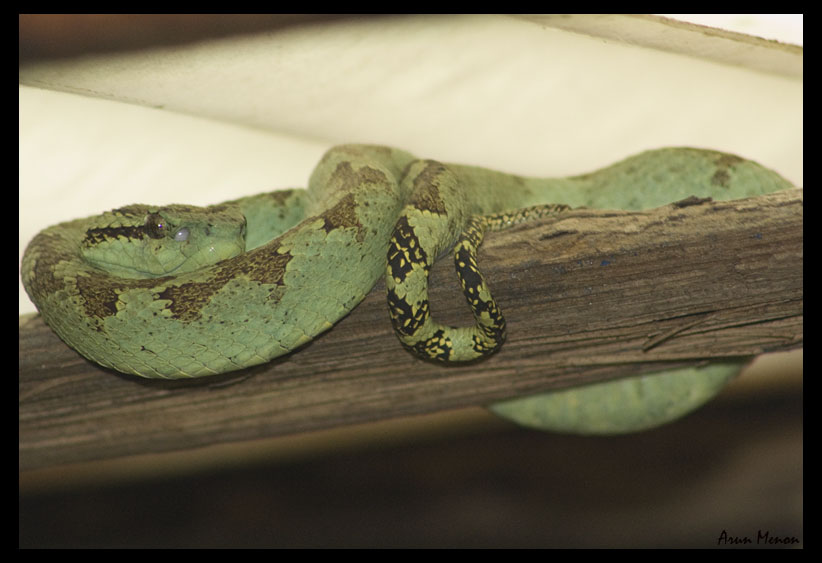
Little did we know that we were being watched by a silent and mysterious presence on a wooden beam behind us
The first time I went to Agumbe Rainforest Research Station, I remember walking for hours in the night, hoping to catch a glimpse of Malabar Pit Vipers. No luck. This time, on a trip with the other ogres, nearly two full days passed without incident.
The heat-sensing pits between the eye and nostril can be clearly seen
On the second night, Sandy and I were walking towards our tent in pouring rain, guided only by the small beam of my torch. I almost stepped on a twig that lay across my path -- a dry twig that appeared to be mottled with pale lichen growth in bluish green and brown. Except this twig was moving! 

"Stop!" I shrieked. Sandy bumped into me from behind. I guided the torch beam towards the head of the "twig". One good look at the snake's triangular head was enough to conclude that it was a viper. That, in addition to the colour pattern, pointed us in the right direction. This was a Malabar Pit Viper (Trimeresurus malabaricus)!

As I watched the fella slither past me slowly, I asked Sandy to go and fetch the others. As he ran back, I stood there in pouring rain and pitch darkness observing the snake cross the path and slowly enter a dense thicket. At times, when a twig or branch was too high, the snake lifted itself upwards like a straight stick and hooked its head on the twig. Then, it pulled itself up. This behaviour pointed to the snake's tree-dwelling lifestyle. 

By the time Sandy came back with Beej, the viper had almost dissolved into the shrub, aided by perfect camouflage. I was upset that the others had not had a good look at the snake.
The brown markings on green can be seen
Malabar Pit Vipers are nocturnal and are generally found in low bushes, trees and on rocks. During the day they are inactive and may be seen basking. They are endemic to the Western Ghats and are found between altitudes of 600 to 2134 metres. Adult snakes can grow to 55-79 centimeters. The longest ever measured was 105 centimeters. The triangular head is broader than the neck. They are typically green but appear in other morphs and a lot of variations have been recorded, including reddish-brown, yellow, etc. On its back the snake is olive or brown with black or brown spots, which may be joined to form a zigzag pattern. The sides have faint yellow spotting and the tail has yellow and black markings. The pupils have vertical slits. Malabar Pit Vipers are ovoiviviparous -- the eggs form, develop and hatch within the mother's body.

Pit vipers, which are classified under the subfamily Crotalinae in the family Viperidae, are distinguished from other vipers by the presence of a pair of heat-sensing pits located between the eye and nostril. These organs help the snake detect the body heat of warm-blooded prey even in absolute darkness.

The other ogres were disappointed at missing the snake the night before but at 4 pm the next day, our luck turned. The ogres were busy treating a Vine Snake like a supermodel. After about 20 minutes all except me and Andy left the scene. After lingering for another ten minutes, we decided to go back to the room to pack and freshen up before our return journey. Just as we left Prashanth, the station manager, called out to us. He pointed to a wooden beam just under the roof of the dining area and said, "Look who's sitting here." There lay a Malabar Pit Viper, coiled, calm and relaxed.

Relaxed and lazing

Observing from high above
It dawned on us that all the while, as we were photographing the Vine Snake, this chap was watching the drama from its high throne!

The others arrived and we took good, long looks at the snake. Malabar Pit Vipers have prehensile tails (adapted to grasp or hold) and this perhaps helps them to anchor themselves on branches or twigs while they lunge at their prey. Here, the snake had used its tail as a kind of hinge to loop it against the beam in the absence of anything else to hold on to. 

We made sure to keep our distance as vipers, though slow, are known to be capable of extremely fast strikes. The venom is mildly haemotoxic -- the toxins destroy red blood cells, disrupt clotting of blood, and causes tissue damage. In humans it results in pain and swelling. 
The prehensile tail is used as a hinge in the absence of anything to hold onto
I'm sure the snake wouldn't have wanted to waste its venom on us, and instead save it for the geckos, tree-frogs, shrews, and birds which make up a large part of its diet. Pit vipers have erectile fangs which are kept folded against the roof of the mouth. They are brought into place only when striking.

After we observed and photographed the snake, I asked Prashanth if he would move the snake since it was close to the dining area. To my surprise, he said they would leave it there and let it decide its own way out at night. Though I was a little concerned about slithering vipers that might end up over our heads or under the dining table, I was also glad that ARRS offered a haven for snakes where they had right of way.
Text: Arun
Photographs: Sahastrarashmi and Arun
Read more Agumbe Diaries

The Green Ogre Weekend Update July 10

If you've missed anything this week, the weekend edition of The Green Ogre should sort you out...


I've been away on a family vacation most of last week, soaking up the monsoon in south Goa. Rain-washed Goa is refreshing. The Western Ghats slope down in a verdant riot that skids to a stop beside the ocean, buffered only by deserted beaches of soaked, clingy sand. Butterflies, dragonflies and birds were everywhere. Despite a domestic ban on birding, I sneaked sly glances at stork-billed kingfishers, prinias, spotted munias, black drongos and even a crimson sunbird that dropped by the hotel garden to say hello as I was dunking my daughter in the pool. Gorgeous, I say. And now, having returned sufficiently vindalooed, balchaoed, rechaedoed and bibincaed, I'm pleasantly surprised to see that my fellow-Ogres have been hacking away. 

This week, we continued our Agumbe Diaries and presented more finds from our sojourn in that neck of the deep, dark woods. On Monday, Sahastra introduced us to the Bicoloured Frog, one of the most attractive creatures to hop on the forest floor. In fact, if you're not watchful, you might mistake it for the forest floor itself.
MORE>
Sex is always a subject for steamy discussion. Despite Sandy's depraved jokes about the amatory pursuits of frogs, I gleaned some wisdom from watching all sorts of creatures in love. Dragonflies interlocked in subtle arcs as they mated on twigs. Grasshoppers and bush crickets carried on unabashed, hopping away together only when we almost crushed them underfoot. Lesser Whistling Ducks wheeled in the air, piping joyously, while Rufous Woodpeckers introduced new mates to the treasure trove of ants' nests in the treetops. Love was so in the air, and so inspired were we by monsoon mating mania that that we shot like zoopornographically obsessed paparazzi.
MORE>


Having said too much already, and having pushed this blog to the brink of NSFW-ness, we thought it best to clam up on Wednesday. But then, Arun's busy frame of mud-puddling lime butterflies raised so many curious eyebrows and engendered a spate of new questions.


Dung Beetles aren't the most charismatic of insects. They are dark, round, fat and inconspicuous except when they whir absent-mindedly past your ears or crash dizzily into lamps at night. Worse, their crappy lives revolve around what other animals leave behind. But then again, rain affords you the luxury of time. Time enough to stop and stare at a cow pat for five hours, and we were amazed at how a Dung Beetle made short work of it. Andy essayed this ode to the lowly dung-muncher.
MORE>
Last Day's Luck is a phenomenon that has mystified most nature-walkers. After three days at Agumbe we had heard so much about snakes that we expected them to stalk us from every bush and tree stump. No such luck. And then, a few hours before we were to depart, a Green Vine Snake showed up and allowed us the luxury of a long, relaxed photo-session.
MORE>


Among things that crawl, snakes scare the mojo out of most people. And a leaping frog has been known to turn dull altos into shrieking sopranos. But leeches?! Those eyeless, elastic strips of skin that crawl the mulchy rainforest floor? Sandy is so terrified of leeches that he gave us a hard time on the trip, repeatedly checking under our feet and rushing off unannounced into the bathroom to strip himself down for vainglorious de-leeching attempts. He refused to cross a stream and enter the dark rainforest for fear of his wetting his shoes -- later, when we returned from the walk soaked in rain and bristling with living leeches, he looked relieved that Fate hadn't picked him for that brief adventure. Leechophobia drove Sandy to such a paroxysm of panic that he wrote a fantasy-laced opus on these bloodsucking monsters.
MORE>


That's your weekend edition of The Green Ogre. Enjoy! 

Encounter: Monster Leeches

Pardon me for exaggerating the danger posed by leeches, for experience has not been kind to me


The farmer looked at his buffalo lying in the leaf litter. She looked as if she had been sucked dry, with circular bite-marks the diameter of tennis balls. He gasped. Having spent all sixty three years of his life here, he knew the forest and the grasslands adjoining it like the back of his hand. There was absolutely no creature here that could inflict such a death. He had previously lost a few cattle to snake-bite, and a calf to a leopard. But, this was certainly odd. 


A slight movement among the fallen leaves caught his eye. A bullfrog? But something made him look at it again. It didn't have a head, just a stump in place. It tilted the stump-head left and right like a blind man trying to tell the direction of a sound. And it leaped right at him - the same way frogs do, albeit in the opposite direction.


As he battled with the thing, trying to pull out the stump that worked now like a suction-head attached firmly to his throat, he saw from the corners of his eyes, more of these creatures springing towards him from all directions. He screamed, though he knew well that there was no one around who could hear him...


A few miles away, in a secret army biological research station, the army chief read the report from his scientists. The last three decrypted reports had brought a smile to his face...


"Experiment to infuse tiger leech DNA into bullfrog spawn- Success
Self sustainability in the wild - Success
Reproducing capability - Success"


But the blood drained from his face as he read the last report....


CODE RED! Recapturing/ eliminating the specimen released to wild - Failure. Transmitters attached to six of the twenty not working.


If the Japanese could invent Godzilla out of their resentment for nuclear experiments and atom bombs, can't I invent a monster-leech?!
A drunk leech with a punctured stomach paints a gory picture (Photo: Sahastra)
Since childhood, I have been mortally afraid of leeches, though I had not yet encountered them. My dad was an avid trekker and came back from his trips with tales of how leeches attached themselves to the limbs of trekkers and grew fat sucking blood. He said that dropping salt or lemon juice over them made them drop off. The stories implanted a permanent apprehension in my head about leeches. Add to that other stories I heard of leeches getting under the eyelid of someone who washed his face in a stream only to be discovered two days later when the eye swelled up, of HIV viruses being found inside leeches in Africa, and of a guy who went to change his undies in the bushes after a long dip in a forest stream finding a fat, bloated leech mirroring his leech-like member... 


How much more does one need for mere fear to give way to paranoia?

The modus operandi of this bloodsucker is the proven lie-in-wait-and-ambush method. The moment you put your feet anywhere near one of them, they will detect motion and heat and latch onto you. They clamber up through gaps in your shoe, all the way up to where your socks end, and latch onto the skin. Its saliva contains an anaesthetic, which numbs pain and other sensation, and an anti-coagulant, which unclots the blood to make it flow smoothly. When it has had enough, it drops off.
The fat, dark specimen looks for a tender spot on Beej's index finger...

On our Agumbe trip we saw two kinds of leeches: a thin, long one with stripes around it and two along its length, and a darker, shorter one with two cream-coloured stripes on either side along its length. With the first one, the standard technique that Arun taught us worked well: Roll, pick and flick. Put a finger on top of it, and roll it over the leech. It would curl up into a ball, then just pick it up and flick it far with a finger. With the latter, this was tough as the guy just wouldn't roll. Here, pressing your nail near the bite to loosen its hold and then doing a carrom-strike with the middle finger was easier.
Two slender leeches attempt to find the point where the socks originate...
We also tried some experiments with the guy. Beej lifted one up, pulled it with both hands like a rubber band, twisted it and squeezed it in an attempt to "give him a tough time" - but the guy was literally indestructible that way. Chemical warfare was easier. Some salt on a leech would make it shrivel up and die, and same happened when we squeezed a drop of lemon juice on it. I had worn socks dipped in Dettol and brine and dried, but they didn't deter the leeches much. Wearing ankle-length shoes and jeans that extended all the way to the base of the shoe, made the leeches climb up the jeans - they were easier to spot and remove.

Locals often tell us to drop salt or hold a flame to a biting leech. But it is said that this may cause the leech to regurgitate blood along with bacteria in its stomach right on the bite wound, leading to the risk of infection.
One had latched on to my leg too (photo: Beej)
After the Agumbe trip, I made my peace with the leeches. Of course, peace is a relative term, though I even stood still with a leech having started to suck my blood long enough to let Beej photograph it. But there were moments when they troubled me -- like when one attached itself to Arun's arm at 1 AM when we were asleep inside the tent. And yes, the itch from only three bites (a blessing, considering the number that I plucked off my legs and one from right under my chin) hasn't worn off yet.

Photos by Sahastrarashmi, Beej and Sandeep
Read more Agumbe Diaries

Encounter: Whining for a Vine Snake

For three days we roamed Agumbe despairing that no snake had slithered across our path. And then we had a stroke of Last Day's Luck!


We saw them all at Agumbe - frogs, lizards, insects, birds... even a mammal. But other than a close encounter that Sandy and I one night, the three other Ogres whined for the slithering kind, especially Green Vine Snakes (Ahaetulla nasuta), which are generally quite common in the Agumbe Rainforest Research Station (ARRS) campus.

After three dry days (not at all in the literal sense) we had a stroke of so-called Last Day's Luck. The four of us, except Sahastra, were exploring a far corner of the campus when we heard him call out to us. He met us half-way and exclaimed, "Vine Snake!" I don't think I have run faster in my life. I stopped only when Sahastra motioned me to, as we were close to the dry shrub in which the snake was stretched out.
The contrast a Vine snake brings to its background is impressive
The next twenty minutes were spent photographing and admiring the snake. We made sure not to agitate the snake by keeping our distance, not because we feared it but because we wanted the snake to be as comfortable and relaxed as it was. 


Although an agitated vine snake looks impressive -- it inflates and flattens its neck and throat, revealing a black-and-white checkered pattern -- we made sure we did not do that. Such pictures of the vine snake (with chessboard markings and mouth open) are most common in photographic forums, indicating that the snakes were threatened or stressed by the photographers in search of an impressive picture. I implore readers, and photographers among them, to exercise restraint while photographing these snakes.

Green Vine Snakes are slender arboreal snakes that can grow up to 1.5 metres on average. The green colouration is due to the interaction of a yellow pigment on the snake's blue skin. The longest specimen ever measured was a female, which was 1.94 metres. The snake has a long, triangular, pointed snout. The eyes are slightly forward-facing with pupils that are horizontal slits.
The pointed snout and horizontal slits of the pupils are characteristic
These snakes are found in forested habitats, including gardens, up to an elevation of 1,800 m. A diurnal predator, it generally waits and ambushes its prey, which include frogs, birds, tadpoles, lizards, small mammals and other snakes. Green Vine Snakes are rear-fanged and mildly venomous. Human victims may suffer local swelling, numbness or itching.
Coils
The forward-facing eyes, which enable binocular vision, help the snake judge depth and distance, which are necessary to sustain its arboreal lifestyle. The snake's eyes and pointed snout have also led to myths that it plucks out the eyes of its adversaries. Curiously, J C Daniel has recorded that the Vine Snake has the "habit of striking the eye of its opponent, the only object in movement in a tree snake's view" and adds that the snake's common name in Tamil means "eye-pecking snake".

The forward-facing eyes help the snake judge depth and distance
The Green Vine Snake is generally quite aggressive and does not take well to being handled. But it's not difficult to figure if the snake is feeling threatened and wants to be left alone - all you need to look for are those chessboard markings. 

Vine Snakes snakes are ovoviviparous -- they produce eggs that develop within the mother's body. The female gives birth to live young, which have no placental connection with the mother. A vine snake may have between 3-23 young at a time.


After being treated like a model for around 20 minutes, the patient snake decided to move on, deciding to end its encounter with the ogres. But I'm sure that the snake and the ogres were happy that they treated each other with respect and none were left whining.

Text and photos by Arun Menon
Lead photo by Sahastrarashmi 
Read more Agumbe Diaries