Journeying in another Green Ogre's footsteps, this wild crane chase off the beaten track culminated in an immensely rewarding avian spectacle. The Demoiselles of Khichan are alive and well, and numerous and beautiful as ever!
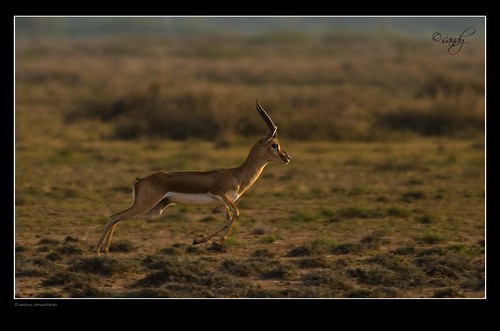
Camels were not the only mammals we saw. There were Chinkaras aplenty at one desert enclave before Osiyan; we spent a quarter of an hour with the herd getting pictures. We passed Osiyan and its famous Jain temple, a desert cafe, more camels, more questions on their social life, more curt responses from Kailash and one final, all-settling retort: "Yahaan sirf paltu oonth miltein hain!" (You only get domesticated camels here!). Kailash had presented an iceberg that wrecked my interest in the ship of the desert.
I had never come across such a large gathering of any living species, not even ants or termites, and it appeared that the cranes weren't done gathering. Tiny specks appeared on the horizon, growing in size. They assumed the shape of a line, then a triangle, then descended towards the field with vigorous, almost violent flapping of wings in the manner of air brakes, hopped and settled as drops in that ocean of grey. More cranes joined the flock in coordinated victory formations. The awe-inspiring atmosphere thus created might have seemed to some octogenarians like a repeat of the Battle of Britain with the RAF and Luftwaffe squadrons swarming the sky for aerial supremacy.
 |
| The Demoiselles of Khichan |
Heading from Jodhpur to Jaisalmer we took the road less travelled towards Phalodi. You don't have to be born with a compass in the head to realize that the route you are taking is circuitous. Yet, our quest justified this digression. Fewer tyre treads had ensured the roads were in better shape, yet it was not our ride that purchased our concentration but the scenes outside. Though this was not my first visit to a desert, the Thar compelled us with a different sensuality, dotted as it was with settlements of thatch-roof huts (called jhopdis).
 |
| Desert Cafe on the way to Khichan |
Catching our attention from time to time were Black Shouldered Kites, Indian Rollers, Grey Francolins, Shikras and Grey Shrikes. We passed camels feasting on acacias, which evoked the question (to our driver Kailash): "Yeh oonth paltu hain ya jungli?" (Are these camels domesticated or wild?), to which his answer was always in favour of the former.
Camels were not the only mammals we saw. There were Chinkaras aplenty at one desert enclave before Osiyan; we spent a quarter of an hour with the herd getting pictures. We passed Osiyan and its famous Jain temple, a desert cafe, more camels, more questions on their social life, more curt responses from Kailash and one final, all-settling retort: "Yahaan sirf paltu oonth miltein hain!" (You only get domesticated camels here!). Kailash had presented an iceberg that wrecked my interest in the ship of the desert.
 |
| A Chinkara on the way to Khichan |
We opened packets of savories and I reflected on the reason that had brought us on this path. A few years ago my good friend and fellow Green Ogre Sahastra had visited a little-known village in Rajasthan, Khichan, famous for the flocks of Demoiselle Cranes (Anthropoides virgo) it hosts every winter. In a two-part post published on this blog he had piqued my interest in this spectacular avian congregation (whetted by the fact that the species had been christened by Queen Marie Antoinette herself). While I firmed up my itinerary I got yet another reminder from Sahastra: "Don't miss Khichan." And so we sped north by northwest while our eventual destination lay northwest of Jodhpur. A signpost for Khichan pointed right and a sense of guilt crept in for I had dragged my friends along on this wild crane chase. However, I was confident that we would take back something special from this detour.
A Nilgai showed up on the pale arid patch as we arrived close to Khichan and soon we heard the clamour that the flock of Demoiselles presented. Stepping out of the car for better shots, I saw a flock hurriedly take off and then turn back and land. Thrilled, I counted 50 to 70 birds and went trigger happy on the shutter release. Our driver said there were more ahead. Up ahead was a water body, beyond which was a larger flock of Demoiselles with smaller flocks joining them every few minutes. Circumnavigating the water body we got closer to the flock and my mental algorithm kicked in, giving me an estimate ten times the previous number.
A Nilgai showed up on the pale arid patch as we arrived close to Khichan and soon we heard the clamour that the flock of Demoiselles presented. Stepping out of the car for better shots, I saw a flock hurriedly take off and then turn back and land. Thrilled, I counted 50 to 70 birds and went trigger happy on the shutter release. Our driver said there were more ahead. Up ahead was a water body, beyond which was a larger flock of Demoiselles with smaller flocks joining them every few minutes. Circumnavigating the water body we got closer to the flock and my mental algorithm kicked in, giving me an estimate ten times the previous number.
 |
| A growing flock of Demoiselle Cranes |
 |
| An approaching cloud of Demoiselle Cranes |
 |
| And they kept coming.... |
A chat with young Jethmal from the village taught us that there are four such large water bodies in Khichan. At the appointed time, 10 AM, the birds arrive to feed at the feeding house, where they roost. Jethmal said the birds were fed 10 to 15 quintals of grain a day.
We turned back to get more pictures of the cranes while maintaining a respectful distance in order to avoid disturbing them. Some of the cranes acted like sentries -- they formed the front line of the flock and seemed edgy. I nicknamed one Long John Silver as it was missing a foot. The last thing we wanted was an alarm call from one of these lookouts. We couldn't have enough of the sea of grey at Khichan, yet we had a schedule to keep up. The numbers kept swelling and my last estimate was about two thousand cranes in the area, though more of them were still flying in.
We turned back to get more pictures of the cranes while maintaining a respectful distance in order to avoid disturbing them. Some of the cranes acted like sentries -- they formed the front line of the flock and seemed edgy. I nicknamed one Long John Silver as it was missing a foot. The last thing we wanted was an alarm call from one of these lookouts. We couldn't have enough of the sea of grey at Khichan, yet we had a schedule to keep up. The numbers kept swelling and my last estimate was about two thousand cranes in the area, though more of them were still flying in.
 |
| Flying in formation |
 |
| Long John Silver, the crane without a foot |
As we were leaving, a group of foreign tourists arrived. Indeed, the Demoiselle Cranes had put Khichan on the tourist map. I won't be surprised if more and more wayfarers choose the road less travelled from Jodhpur to Jaisalmer via Khichan. Promising to return, I left for Jaisalmer.
 |
| The platform in the background from where tourists can enjoy views of this magnificent congregation |
Text and Photos: Anand Yegnaswami