We’ve moved! Here’s where you can find us

The Green Ogre is now at https://www.greenogreindia.org
Showing posts with label kutch. Show all posts

Encounter: Rufous Tailed Shrike

Often, the stupidest questions elicit the most enlightening answers. Such was my initiation to the little featherball known as the Rufous-tailed Shrike. I'm glad I asked, though...


I am responsible for one of the dumbest questions in Birdingdom. This is a belated confession.

One fine February evening we were happily maneuvering a pot-holed road in Rae Bareli as GS scanned the acacia bushes beside the road for birds. Suddenly he exclaimed, “Rufous-tailed Shrike!" (Beams with excitement, asks driver to stop.)

I saw the bird and inquired, “Why is this Rufous-tailed Shrike?” It was actually three questions:

Why is this bird a shrike?
Why is it a Rufous-tailed Shrike?
What are you so excited about?

You must have realized that I had figured it was a bird. I also had a passing familiarity with the color rufous.

Prickled by the question but managing to keep his composure (the sighting helped), GS snapped, “Observe.”

This I did.

Lanius isabellinus is a small shrike with a hooked bill adapted for tearing flesh. It has a grey or sandy-brown mantle, a prominent rufous tail and grey-brown ear coverts. The male has a white patch at the base of the primaries (this is absent in the female) and the female has faint dark scaling on the breast and flanks. The bird in the last picture seems to be a first winter specimen since it has the overall coloration of the female (including the faint dark scaling on the breast), lacks the white patch at the primaries, but has the dark black lore of the male. The bird in Sandeep's photo (the lead pic) is an adult female (lacks the white patch on the primaries).
In winters the bird frequents wooded country along canals, riparian tracts and acacia vegetation along small roads. It breeds in the highlands of Baluchistan, southern Siberia and the Daurian steppes of central Asia.

The Rufous-tailed Shrike eats smaller birds, lizards and rodents and has the gruesome habit of impaling its prey on thorns and barbed wires. It is usually found atop bushes and small trees – a prominent perch for hunting. The bird we saw flew down and picked up a large ant (see pic below).
Going by the field guide that we were using, the shrike had no business to be there. However, one cannot really fault the birding guides for this as the basic information regarding winter and summer ranges of migrants is quite archaic – some of it survives from the days of Salim Ali and the British ornithologists. Bird checklists for some districts in UP are last updated by the district collectors and amateur British naturalists (A O Hume was the Collector of Etawah and the district is an exception, thanks to Gopi’s fieldwork. The checklist is quite current with 400+ birds). Most siting data continues to be reported from IBAs and established sanctuaries but very few birders visit the offbeat places, which are not well-known or are simply off-track. This leads to over-reporting from certain parts while creating birding blind-spots at the same time.

The grand old man of Indian ornithology was wise enough to avoid bias and made sure that he birded in places like Bastar, Bahawalpur, Districts of United Provinces, Afghanistan, etc. where few people venture today. He had birded in Rae Bareli and has reported the Siberian Crane from there. In my multiple visits to Samaspur, a bird sanctuary in the district, I have never encountered birders. The sanctuary staff tells me that such visits are fewer than a dozen in a year.

Moreover, the migrants can shift the wintering range based on factors like temperature, cropping pattern and rainfall. This is both seasonal as well as gradual shifts over time. This makes it all the more necessary for the data gathering to be extensive and well-planned.


The shrike sighting turned out to be good birding education. The presence of this elegant little predator indicated that the migratory season was well underway. Moreover, migrants can often be found in areas in which they have not been recorded earlier either due to a shift in range or gaps in information. So it's good birding practice to keep looking for them. This is where initiatives like MigrantWatch are both welcome and necessary since they enrich our knowledge about these lovely avian tourists as well as track shifts in arrival times and geographical spread.

Incidentally (now that I am on serial confession mode), I am also responsible for one of the most stupid answers in all Birdingdom. More on that later. Patience, dear reader. Or patientez s’il vous plait, in case you are Francophone.

Text and photographs by Sahastrarashmi (taken in Rae Bareli, Uttar Pradesh)
Lead photo by Sandeep Somasekharan (taken in Kutch)

Encounter: Rufous-tailed Scrub Robin

It had given me the slip in Kutch, but in Oman I caught up with the Rufous-tailed Scrub Robin


Last month a travel assignment took me to the Sultanate of Oman. I spent four days on the road from Muscat watching the arid gravel desert fleet past, then sampled the crisp night air of the Jebel Shams mountain, spent a night in the dunes and was then driven at 140 km along the coast from Sur to Muscat. In the sapping 46-degree heat, I expected birds to drop dead from the sky, but they didn't. Instead, sparrows seemed to flourish, as did mynas and bulbuls near date palm-fringed oases. On the road I passed wheatears and lapwings, swifts and sand martins, munias and Egyptian vultures, but none quickened my pulse like one lifer that I encountered on my last blazing afternoon just 500 metres from the pale-blue Gulf of Oman.


We were hurrying back to the air-conditioned refuge of our four-wheel-drive near Bimmah Sinkhole, when a little brown job stopped to regard me from the scant shade of a bare thorn bush. It was close enough to get me to forget the heat for a moment, then two or three, and then for a full five minutes as my body gently surrendered moisture to the roasting desert air. Open-mouthed as it attempted to lose body heat, the bird allowed me to get quite close.  


The bird, which had a melancholic musical call, was somewhat similar to the bush robins I had seen in the Himalayas and in habit reminiscent of the Cetti's Bush Warbler but with the tail held upright. At first I thought it might be the Rufous-tailed Wheatear that I had met in Kutch. But the bird's posture ruled out chat, flycatcher, thrush, wheatear and warbler, and I deduced that the little chap had to be a robin of some kind. Though I had no idea which one, since I didn't have a field guide to the birds of Oman. 


I did the next best thing -- I watched it, made mental notes and some on paper. The bird had a prominent white supercilium and a white under-eye patch. A dull black stripe began behind the nostrils and stopped at the eye. When it flitted from bush to bush it revealed a rich rufous tail that fanned out occasionally in the manner of a redstart. But then again the tail went right back to the upright angular position. I shot a picture to aid my identification efforts. When I got home, a little Googling solved the mystery.


This was a Rufous-tailed Scrub Robin (Cercotrichas galactotes), also known by several common names including Rufous Bush Robin. It occurs from the European Mediterranean south to the Sahel and east to Pakistan, where it is known to breed. The bird is also a passage migrant in Kutch, Gujarat.


I had missed the bird in Kutch, but here in Oman it gave me an exclusive audience.


Text and photograph: Beej

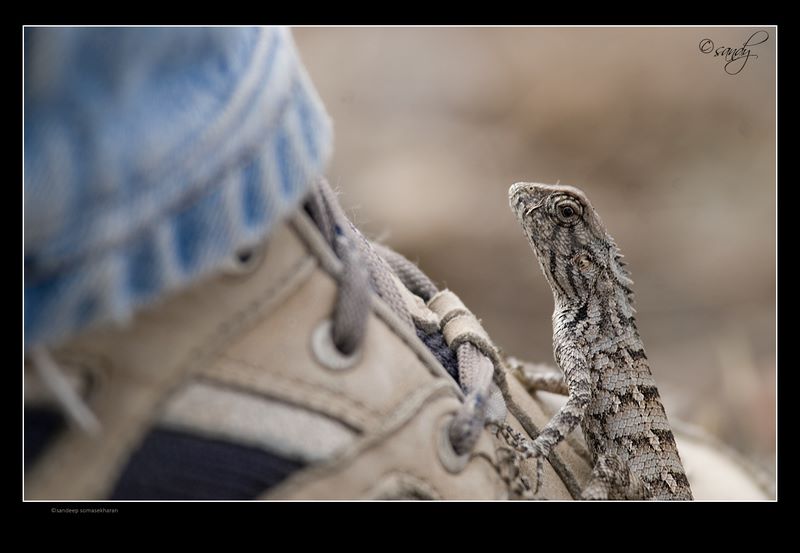
Wordless Wednesday - Don't shoe me away!


Photograph: Sandeep Somasekharan
All rights reserved
View all Wordless Wednesday posts at The Green Ogre
View Sandeep's Flickr photostream

Raptor Friday - The Montagu's Harrier

Birds of the scrubland, harriers are unmistakable for their flight - close to the ground, with the wings held in a high-upstroke V, and the eyes directed downward looking intently for prey.
A male Montague's Harrier on the hunt
I have seen Montague's Harriers (Circus pygargus) frequently in and around Mysore but on most occasions, my sightings were of the plain, lacklustre female. It took me a trip to Kutch to see them in abundance. They were everywhere in the scrublands, along with Pallid (or Pale) Harriers (Circus macrourus). On our route to Dholavira (an Indus Valley archaeological site), our Tata Sumo was cruising at around 90 kph along the highway when a Montague's Harrier flew across the road, dead in front. Realizing the danger to its life at the last instance, it fanned out its tail and spread its wings, braking in mid-air. It lost a couple of feathers in the process but managed to alter the flight direction and ascend a couple of feet in the air to safety. It was all over in a second or two. 


Another evening in Kutch, we saw nearly 40 of these birds flocking from the horizon towards the grasslands after the sun had set. There was absolutely no light for me to photograph them, so I sat and watched as they circled around and settled into the grass for the night, one by one. This was the first instance that I observed social behavior of this nature in any raptor.


Eye contact with a crescent of grace...
This year I had a couple of encounters with this species in Mysore. The closest was two weeks ago when the guy in your picture flew up from behind my friend's parked car. I spotted him and fired away (he hadn't yet seen me). Just behind the car our eyes met, and he braked in the air once more (not so violently as in Kutch), changed direction and flew off with effortless ease...


Underwing details
Text and photos by Sandeep Somasekharan

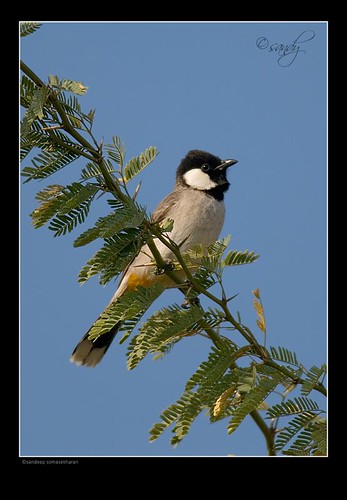
Encounter - White-eared Bulbul

A prim little bulbul that's completely at home in the desert

In Horse With No Name, Neil Young sang: "In the desert, you can't remember your name." It's sort of what you feel when you see a bulbul in the desert, comfortable among the spare vegetation.


Meet the White-eared Bulbul, locally common in the salt desert but rare elsewhere in India. We found parties of these birds in every little oasis of greenery, picking away at insects and consuming available plant nectar. In Kutch, where there are few large trees, stands of exotic Prosopis juliflora have begun to make their presence felt in the desert vegetation. Hopping among these low trees are these bulbuls with a difference - their strikingly contrasted pied heads make them resemble slightly oversize Great Tits. Their crests are short, and their musical fluting calls are similar to those of other bulbuls. But what sets them apart is the sulphur-yellow vent. In overall coloration, the White-eared Bulbul is very similar to the Himalayan Bulbul, but the latter's range ends at the foothills (while the White-eared Bulbul's begins in central and northwestern India and stretches westward to Arabia). Also, the Himalayan Bulbul's Elvis Presley hairdo is tell-tale.  


Photograph: © Sandeep Somasekharan

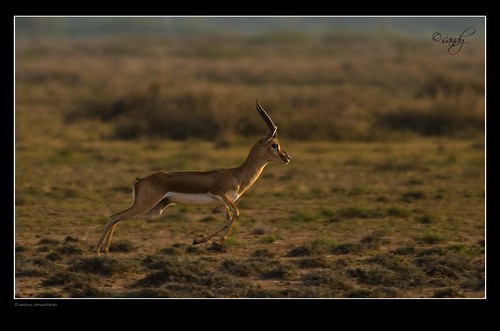
Encounter: Chinkara or Indian Gazelle

“Eye, gazelle, delicate wanderer, Drinker of horizon’s fluid line.” – Stephen Spender Very near the end of a long, fruitless afternoon tailing invisible bustards in Naliya grassland of Kutch, we were in no mood to savour the sunset muddying the windmill-stippled horizon. Forget the fact that we had, during that day, picked out chestnut-bellied sandgrouse camouflaged among the tinder-dry tussocks. Or watched a jungle cat hunt a spiny-tailed lizard. Or, as dusk neared, blinked our eyes to the silhouettes of nearly fifty or so Pallid and Montagu's harriers settling down to roost in the grass. Such selfish ingrates! But then, our eyes were drawn to a troika of little ungulates chasing each other in single file across the yellow grass. The Chinkara or Indian Gazelle (Gazella bennettii), more of a newsmaker for its association with a certain trigger-happy Bollywood hunk. We saw them on more than one occasion, and always in groups of three - we couldn't quite ascertain if the ménage à trois was the regular marital arrangement with the Chinkaras, or if they were just respectable double-income one-kid family parties. Males are slightly larger than females and have longer, thicker horns. Mostly they trot, but when approached they break into a light, easy lope that chews up the miles faster than you can count them. The dipping sun lit this fellow nicely, gilding his fawn coat to a glaze as Sandy's shutter whirred and clicked greedily. Something to remember the evening by. Photo copyright: Sandeep Somasekharan. All rights reserved

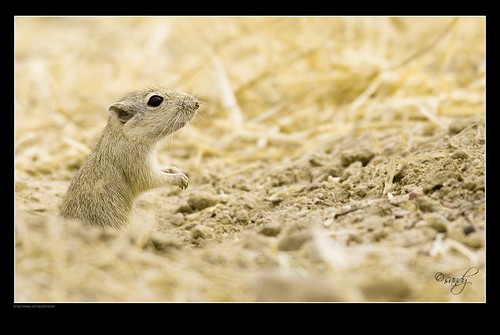
Encounter - the Indian Desert Jird

In January, on our visit to Kutch, we drove 300 km from the CEDO camp to Dholaveera, where the remnants of a Harappan archaeological site quietly awaits visitors amid the salty drifting dust of the Great Rann of Kutch. The site is fabulous, and I was miffed that the caretaker did not allow me to videograph it. But photographs were allowed, and our dear shutterbug Sandy lost no opportunity to snap up the excavated ruins. On our way back, we noticed a warren of little burrows in the loose earth. Like little tricks of light, puffs of dust grew beady black eyes and scurried out of the ground. Everybody else caught sight of the culprit and sighed sighs of discovery. I rubbed my eyes, missed the target, and rubbed my eyes again. I took my glasses off, put them on again, took them off again and rubbed my eyes again. Still, nothing. And then, as suddenly as I had missed it, I saw it - a little, fawn, rat-like fellow chomping on a green leaf and dragging it into the burrow - the Indian Desert Jird (Meriones hurrianae). This diurnal rodent lives in huge colonies and is a great food source for many predators, including desert cats, jungle cats, jackals, mongooses and many raptors. Indian Desert Jird (Meriones hurrianae) All photographs copyright Sandeep Somasekharan. Used with permission.

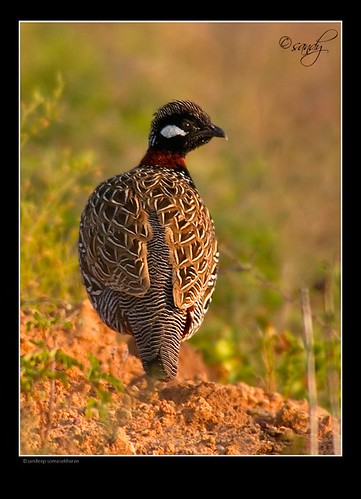
Encounter - Black Francolin

All right, shoot me. I have never had any luck with the Black Francolin. When other birders talked of it as if it were domestic poultry, I would clear my throat and look west until the conversation had drifted past. Not any more. Kutch offered me the best-ever sighting of this handsome fowl. The CEDO folks drove us towards the Naliya grassland and all the while we looked for the elusive bustards. This, they told us, was the habitat of the Great Indian Bustard and the MacQueen's Bustard. We combed the grassland but saw none. But in the early morning light, as we trailed a large flock of Eurasian Griffons, we saw a movement in the shin-high grass. As our driver Mangal cut the engine, the suspect emerged from his cover and lorded over the path ahead of us for a glorious three seconds. Then he obliged us by moving into the light and showing off for a bit, completely unperturbed. Sandy, who was in the passenger seat next to the driver, fired away. And that's how we got this picture. And that's how when the Black Francolin comes up in conversation, it's my turn to gloat. Photograph © Sandeep Somasekharan. All rights reserved

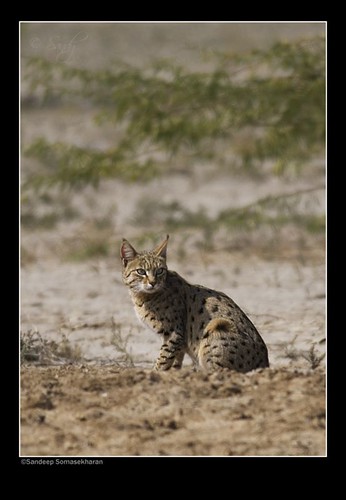
Encounter - The Indian Desert Cat

Meet a shy and secretive felid of the Indian deserts


In January, the Banni grassland of Kutch rustles like a tinderbox. The tussocks of grass are dry, the soil is powdery and fine, and mirages turn the horizon into a kaleidoscope of illusions. You can, therefore, be forgiven for seeing things that do not exist here. It is exactly this illusion that the creatures that inhabit this arid wonderland hope you will succumb to. Rub your eyes and they're gone. And so, while our Tata Sumo cross-countried through the fringes of the Great Rann of Kutch, we saw bustards that were actually common cranes, and wild asses that were anything but. After a while, we learned not to let our hearts stop at the sight of Indian gazelles (chinkaras) loping through the fawn-coloured landscape like motion grabs from Animal Planet. And while we peeled our eyes for the endemic Desert Fox, another creature crossed our path. Felis silvestris ornatus - the Indian Desert Cat. It melted out of the stippled earth and slunk away towards its burrow, apparently borrowed from an Indian fox. We gasped. And clicked away. 


Photograph © Sandeep Somasekharan. All rights reserved. Used with permission.

Hiatus in the Rann of Kutch

I have just returned from a 7-day birding tour of the Great Rann of Kutch. Seven days, in truth, are hardly enough to explore this vast and varied landscape. The Rann, a salt marsh that is inundated for a few months every year during the monsoon, dries up completely around November and turns into an expanse of shimmering salt pans that run into kilometres and kilometres. The Luni, a desert river that is born in Rajasthan, loses itself in the Great Rann. There are seasonal rivers that gush in full flow during the monsoon but are completely devoid of water for the rest of the year. Their elaborately eroded banks and beds make for stunning landscapes. There are seasonal grasslands, home to the Great Indian Bustard and its smaller cousin, the McQueen's Bustard. Just after the monsoon, when the grass is lush and high, the male Lesser Florican is seen leaping high into the air to court his mate. We came across huge flocks of Common Cranes and a variety of raptors, including Eurasian Griffons, Cinerous Vultures, Common and Long-legged Buzzards, Pallid and Montagu's Harriers, Steppe Eagles and Imperial Eagles and Common Kestrels. We made trips back in time as we collected fossils beside an extinct volcano and visited Dholavira, an archaeological site of the Harappan period that dates back more than 5,000 years. And to imagine that this sentient civilization flourished three thousand years before Christ would be born. And then to imagine that the ammonite fossils of the Jurassic era we collected were already fossils at that time. All that imagination can leave you feeling small and insignificant. A detailed report with pictures and videos will follow. Until then, apologies for the hiatus and thanks for your patience. Species list
  1. Grey Francolin Francolinus pondicerianus
  2. Black Francolin Francolinus francolinus
  3. Indian Peafowl Pavo cristatus
  4. Common Shelduck Tadorna tadorna
  5. Gadwall Anas strepera
  6. Spot-billed Duck Anas poecilorhyncha
  7. Common Teal Anas crecca
  8. Northern Shoveler Anas clypeata
  9. Common Pochard Aythya ferina
  10. Common Hoopoe Upupa epops
  11. Indian Roller Coracias benghalensis
  12. Common Kingfisher Alcedo atthis
  13. White-throated Kingfisher Halcyon smyrnensis
  14. Pied Kingfisher Ceryle rudis
  15. Green Bee-eater Merops orientalis
  16. Asian Koel Eudynamys scolopacea
  17. Greater Coucal Centropus sinensis
  18. Rose-ringed Parakeet Psittacula krameri
  19. House Swift Apus affinis
  20. Spotted Owlet Athene brama
  21. Rock pigeon Columba livia
  22. Laughing Dove Streptopelia senegalensis
  23. Red Collared Dove Streptopelia tranquebarica
  24. Eurasian Collared Dove Streptopelia decaocto
  25. Common Crane Grus grus
  26. Common Moorhen Gallinula chloropus
  27. Chestnut-bellied Sandgrouse Pterocles exustus
  28. Bar-tailed Godwit Limosa lapponica
  29. Whimbrel Numenius phaeopus
  30. Eurasian Curlew Numenius arquata
  31. Common Redshank Tringa totanus
  32. Marsh Sandpiper Tringa stagnatilis
  33. Common Greenshank Tringa nebularia
  34. Green Sandpiper Tringa ochropus
  35. Wood Sandpiper Tringa glareola
  36. Terek Sandpiper Xenus cinereus
  37. Common Sandpiper Actitis hypoleucos
  38. Little Stint Calidris minuta
  39. Temminck’s Stint Calidris temminckii
  40. Curlew Sandpiper Calidris ferruginea
  41. Broad-billed Sandpiper Limicola falcinellus
  42. Ruff Philomachus pugnax
  43. Ruddy Turnstone Arenaria interpres
  44. Crab-plover Dromas ardeola
  45. Eurasian Oystercatcher Haematopus ostralegus
  46. Black-winged Stilt Himantopus himantopus
  47. Grey Plover Pluvialis squatarola
  48. Little Ringed Plover Charadrius dubius
  49. Kentish Plover Charadrius alexandrinus
  50. Lesser Sand Plover Charadrius mongolus
  51. Yellow-wattled Lapwing Vanellus malabaricus
  52. Red-wattled Lapwing Vanellus indicus
  53. Heuglin's Gull Larus heuglini
  54. Pallas's Gull Larus ichthyaetus
  55. Brown-headed Gull Larus brunnicephalus
  56. Black-headed Gull Larus ridibundus
  57. Gull-billed Tern Gelochelidon nilotica
  58. Lesser Crested Tern Sterna bengalensis
  59. Whiskered Tern Chlidonias hybridus
  60. Black-shouldered Kite Elanus caeruleus
  61. Black Kite Milvus migrans migrans
  62. Eurasian Griffon Gyps fulvus
  63. Cinereous Vulture Aegypius monachus
  64. Short-toed Snake Eagle Circaetus gallicus
  65. Pallid Harrier Circus macrourus
  66. Montagu’s Harrier Circus pygargus
  67. Shikra Accipiter badius
  68. Oriental Honey-buzzard Pernis ptilorhyncus
  69. Common Buzzard Buteo buteo
  70. Long-legged Buzzard Buteo rufinus
  71. Tawny Eagle Aquila rapax
  72. Steppe Eagle Aquila nipalensis
  73. Imperial Eagle Aquila heliaca
  74. Common Kestrel Falco tinnunculus
  75. Red-necked Falcon Falco chicquera
  76. Little Grebe Tachybaptus ruficollis
  77. Little Cormorant Phalacrocorax niger
  78. Great Cormorant Phalacrocorax carbo
  79. Little Egret Egretta garzetta
  80. Western Reef Egret Egretta gularis
  81. Grey Heron Ardea cinerea
  82. Great Egret Casmerodius albus
  83. Intermediate Egret Mesophoyx intermedia
  84. Cattle Egret Bubulcus ibis
  85. Indian Pond Heron Ardeola grayii
  86. Black-crowned Night Heron Nycticorax nycticorax
  87. Greater Flamingo Phoenicopterus ruber
  88. Glossy Ibis Plegadis falcinellus
  89. Black-headed Ibis Threskiornis melanocephalus
  90. Black Ibis Pseudibis papillosa
  91. Eurasian Spoonbill Platalea leucorodia
  92. Great White Pelican Pelecanus onocrotalus
  93. Painted Stork Mycteria leucocephala
  94. Black-necked Stork Ephippiorhynchus asiaticus
  95. Rufous-tailed Shrike Lanius isabellinus
  96. Bay-backed Shrike Lanius vittatus
  97. Long-tailed Shrike Lanius schach
  98. Southern Grey Shrike Lanius meridionalis
  99. House Crow Corvus splendens
  100. Large-billed Crow Corvus macrorhynchos
  101. Small Minivet Pericrocotus cinnamomeus
  102. Black Drongo Dicrurus macrocercus
  103. White-bellied Drongo Dicrurus caerulescens
  104. Marshall's Iora Aegithina nigrolutea
  105. Common Woodshrike Tephrodornis pondicerianus
  106. Oriental Magpie Robin Copsychus saularis
  107. Indian Robin Saxicoloides fulicata
  108. Black Redstart Phoenicurus ochruros
  109. Common Stonechat Saxicola torquata
  110. Pied Bushchat Saxicola caprata
  111. Brown Rock-chat Cercomela fusca
  112. Variable Wheatear Oenanthe picata
  113. Desert Wheatear Oenanthe deserti
  114. Isabelline Wheatear Oenanthe isabellina
  115. Red-tailed Wheatear Oenanthe chrysopygia
  116. Brahminy Starling Sturnus pagodarum
  117. Rosy Starling Sturnus roseus
  118. Common Myna Acridotheres tristis
  119. Bank Myna Acridotheres ginginianus
  120. White-naped Tit Parus nuchalis
  121. Sand Martin Riparia riparia
  122. Dusky Crag Martin Hirundo concolor
  123. Barn Swallow Hirundo rustica
  124. Wire-tailed Swallow Hirundo smithii
  125. Red-rumped Swallow Hirundo daurica
  126. White-eared Bulbul Pycnonotus leucotis
  127. Red-vented Bulbul Pycnonotus cafer
  128. Grey Hypocolius Hypocolius ampelinus
  129. Rufous-fronted Prinia Prinia buchanani
  130. Grey-breasted Prinia Prinia hodgsonii
  131. Plain Prinia Prinia inornata
  132. Graceful Prinia Prinia gracilis
  133. Zitting Cisticola Cisticola juncidis
  134. Common Tailorbird Orthotomus sutorius
  135. Common Babbler Turdoides caudatus
  136. Lesser Whitethroat Sylvia curruca
  137. Desert Warbler Sylvia nana
  138. Orphean Warbler Sylvia hortensis
  139. Indian Bushlark Mirafra erythroptera
  140. Ashy-crowned Sparrow Lark Eremopterix grisea
  141. Rufous-tailed Lark Ammomanes phoenicurus
  142. Greater Hoopoe Lark Alaemon alaudipes
  143. Greater Short-toed Lark Calandrella brachydactyla
  144. Sand Lark Calandrella raytal
  145. Crested Lark Galerida cristata
  146. Sykes’s Lark Galerida deva
  147. Purple Sunbird Nectarinia asiatica
  148. House Sparrow Passer domesticus
  149. Chestnut-shouldered Petronia Petronia xanthocollis
  150. White Wagtail Motacilla alba
  151. Yellow Wagtail Motacilla flava
  152. Tawny Pipit Anthus campestris
  153. Long-billed Pipit Anthus similis
  154. Baya Weaver Ploceus philippinus
  155. Indian Silverbill Lonchura malabarica
  156. Grey-necked Bunting Emberiza buchanani
  157. House Bunting Emberiza striolata