All rights reserved
See all Wordless Wednesday posts

 |
| A mother and calf crossing the road at Chinnar |
 |
| Little ones like this might be cute, but never try to approach them as momma will be around |
 |
| The herd at Parambikulam |
 |
| A female baya weaver feeds a juvenile (right) |
 |
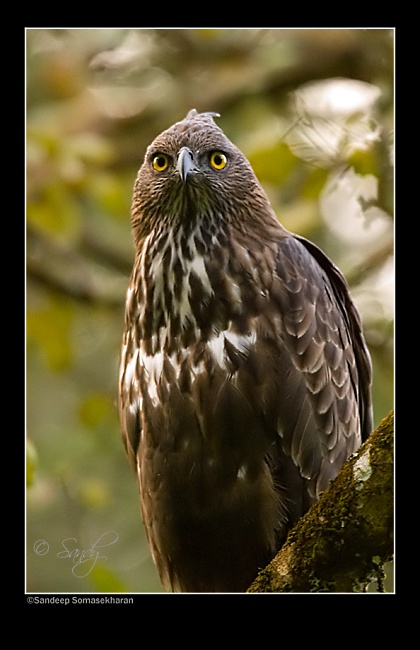
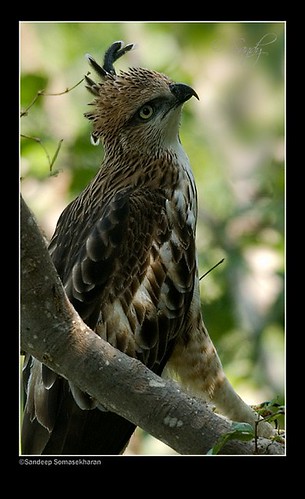
| Formerly thought to occur only in the Himalayan foothills, the Lesser Fish-Eagle has now been confirmed as a resident breeder along the Cauvery River in Karnataka as well as river islets in Kerala, both in southern India |
 |
| The extent of white in the Lesser Fish-Eagle's plumage are a distinguishing mark to identify it against the closely related Grey-headed Fish-Eagle |

 “Eye, gazelle, delicate wanderer,
Drinker of horizon’s fluid line.”
– Stephen Spender
Very near the end of a long, fruitless afternoon tailing invisible bustards in Naliya grassland of Kutch, we were in no mood to savour the sunset muddying the windmill-stippled horizon. Forget the fact that we had, during that day, picked out chestnut-bellied sandgrouse camouflaged among the tinder-dry tussocks. Or watched a jungle cat hunt a spiny-tailed lizard. Or, as dusk neared, blinked our eyes to the silhouettes of nearly fifty or so Pallid and Montagu's harriers settling down to roost in the grass.
Such selfish ingrates!
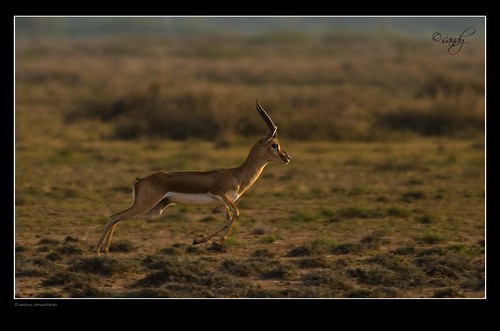
But then, our eyes were drawn to a troika of little ungulates chasing each other in single file across the yellow grass. The Chinkara or Indian Gazelle (Gazella bennettii), more of a newsmaker for its association with a certain trigger-happy Bollywood hunk. We saw them on more than one occasion, and always in groups of three - we couldn't quite ascertain if the ménage à trois was the regular marital arrangement with the Chinkaras, or if they were just respectable double-income one-kid family parties.
Males are slightly larger than females and have longer, thicker horns. Mostly they trot, but when approached they break into a light, easy lope that chews up the miles faster than you can count them.
The dipping sun lit this fellow nicely, gilding his fawn coat to a glaze as Sandy's shutter whirred and clicked greedily. Something to remember the evening by.
Photo copyright: Sandeep Somasekharan. All rights reserved
“Eye, gazelle, delicate wanderer,
Drinker of horizon’s fluid line.”
– Stephen Spender
Very near the end of a long, fruitless afternoon tailing invisible bustards in Naliya grassland of Kutch, we were in no mood to savour the sunset muddying the windmill-stippled horizon. Forget the fact that we had, during that day, picked out chestnut-bellied sandgrouse camouflaged among the tinder-dry tussocks. Or watched a jungle cat hunt a spiny-tailed lizard. Or, as dusk neared, blinked our eyes to the silhouettes of nearly fifty or so Pallid and Montagu's harriers settling down to roost in the grass.
Such selfish ingrates!
But then, our eyes were drawn to a troika of little ungulates chasing each other in single file across the yellow grass. The Chinkara or Indian Gazelle (Gazella bennettii), more of a newsmaker for its association with a certain trigger-happy Bollywood hunk. We saw them on more than one occasion, and always in groups of three - we couldn't quite ascertain if the ménage à trois was the regular marital arrangement with the Chinkaras, or if they were just respectable double-income one-kid family parties.
Males are slightly larger than females and have longer, thicker horns. Mostly they trot, but when approached they break into a light, easy lope that chews up the miles faster than you can count them.
The dipping sun lit this fellow nicely, gilding his fawn coat to a glaze as Sandy's shutter whirred and clicked greedily. Something to remember the evening by.
Photo copyright: Sandeep Somasekharan. All rights reserved
 As a child, this was one of my three mystery birds (the others were the Red-wattled Lapwing and the Indian Cuckoo). Near Palakkad, in northeastern Kerala, where I spent most of my summer vacations, moonlit nights and rainy afternoons would reverberate with the unending call of this bird. My grandparents told me the bird was crying out: 'Kezhekku edha? Kezhekku edha?' ('Where's the east, where's the east?'). But the bird behind the call remained a mystery. Sometimes, I would run out in the middle of a meal when I heard its call from the mango trees behind my grandfather's house. Usually, I saw nothing but a shadowy shape flitting away, with the call trailing behind it.
I was about 14 when I had my first chance encounter with the Brainfever Bird. It had just rained in the afternoon. I was strolling through the newly sown paddy fields looking for Sparrow Larks when I saw a greyish bird flapping weakly above my head. The paddy fields were like a clearing between two groves. The bird took its time covering the distance and entered the grove ahead of me. It was an acacia grove and the only purpose it really served was to provide solitude to clandestine lovers and liquor bootleggers. Of course, the kids were told that it was full of wild boar and therefore dangerous.
Alone, with a pair of binoculars, I entered the grove. I didn't come across any clandestine lovers, bootleggers or wild boar. There were no other birds in that grove except some jungle crows and yellow-billed babblers.
The calls grew louder and they came from everywhere. There was more than one bird. I followed the calls for about 15 minutes and wandered right to the end of the grove. Then I saw it, clinging to a casuarina tree and calling. This was it - the mystery brainfever bird. And a few hundred feet ahead of it, on another tree, was another individual. And then a third broke into song above my head. The acacia grove was teeming with them.
Since, I have seen Common Hawk-Cuckoos (Cuculus varius) very often. They kept me up all night at Auroville, and then again up at Didana in the Garhwal Himalaya. This picture came out of a trip to BR Hills, when Sandy shot the guy as he pretended not to notice. Mimicking a shikra or some such hawk, it had sailed off the canopy and perched on an outlying bough.
I could imagine what was on the mind of the sahib who christened this bird as he lay in bed, tormented by malaria and humidity, listening the Common Hawk-cuckoo scream 'Brain fever, brain fever' in febrile crescendo. Its call, performed ad nauseam, can drive the most patient birdwatcher mad.
Look at me!
Photograph: © Sandeep Somasekharan. Used with permission.
As a child, this was one of my three mystery birds (the others were the Red-wattled Lapwing and the Indian Cuckoo). Near Palakkad, in northeastern Kerala, where I spent most of my summer vacations, moonlit nights and rainy afternoons would reverberate with the unending call of this bird. My grandparents told me the bird was crying out: 'Kezhekku edha? Kezhekku edha?' ('Where's the east, where's the east?'). But the bird behind the call remained a mystery. Sometimes, I would run out in the middle of a meal when I heard its call from the mango trees behind my grandfather's house. Usually, I saw nothing but a shadowy shape flitting away, with the call trailing behind it.
I was about 14 when I had my first chance encounter with the Brainfever Bird. It had just rained in the afternoon. I was strolling through the newly sown paddy fields looking for Sparrow Larks when I saw a greyish bird flapping weakly above my head. The paddy fields were like a clearing between two groves. The bird took its time covering the distance and entered the grove ahead of me. It was an acacia grove and the only purpose it really served was to provide solitude to clandestine lovers and liquor bootleggers. Of course, the kids were told that it was full of wild boar and therefore dangerous.
Alone, with a pair of binoculars, I entered the grove. I didn't come across any clandestine lovers, bootleggers or wild boar. There were no other birds in that grove except some jungle crows and yellow-billed babblers.
The calls grew louder and they came from everywhere. There was more than one bird. I followed the calls for about 15 minutes and wandered right to the end of the grove. Then I saw it, clinging to a casuarina tree and calling. This was it - the mystery brainfever bird. And a few hundred feet ahead of it, on another tree, was another individual. And then a third broke into song above my head. The acacia grove was teeming with them.
Since, I have seen Common Hawk-Cuckoos (Cuculus varius) very often. They kept me up all night at Auroville, and then again up at Didana in the Garhwal Himalaya. This picture came out of a trip to BR Hills, when Sandy shot the guy as he pretended not to notice. Mimicking a shikra or some such hawk, it had sailed off the canopy and perched on an outlying bough.
I could imagine what was on the mind of the sahib who christened this bird as he lay in bed, tormented by malaria and humidity, listening the Common Hawk-cuckoo scream 'Brain fever, brain fever' in febrile crescendo. Its call, performed ad nauseam, can drive the most patient birdwatcher mad.
Look at me!
Photograph: © Sandeep Somasekharan. Used with permission.
 Sálim Ali didn't call it the Idle Schoolboy for nothing. If, uninitiated, you hear its song in a damp nook of the forest, you may be pardoned for suspecting the presence of spirits, or maybe goat-hoofed Pan playing his merry pipes. The call is eerily like human whistling, so much that it wanders up and down the scale and has a deep, penetrating quality that carries it afar.
That said, the Malabar Whistling Thrush (Myophonus horsfieldii) is more often heard than seen. To say it is shy would be an understatement. Most first-time birders are content to catch a glimpse of a dark, crow-like bird in quick, darting flight. Or perhaps skulking away into the undergrowth.
But then, Luck sometimes knows how to gift-wrap a Whistling Thrush.
I saw my first individual in the Nilgiris. It was perched on a low tree overhanging a stream, and pouring out its song. I have heard it several times since, most memorably one moonlit dawn in Muthodi. And then, once, we saw it briefly in BR Hills.
But the best sighting of all produced this picture. Sahastra, Sunita, Sandy and I were driving through BR Hills. I was at the wheel, and we were approaching K Gudi when Sahastra hissed 'Dark bird, dark bird' from the back seat and asked me to stop. Sandy had already got his lens lined up. I switched off the engine and we coasted slowly around the bend. I braked, and the bird emerged from the shrubbery. The bird was closer than any of us have ever seen a Malabar Whistling Thrush. The blue-black spectacle was breathtaking, and behind my head I could hear Sandy clicking away.
When we resumed breathing, the bird opened its pink mouth to screech, then scuttled back into the undergrowth. It wasn't a lifer for any of us, yet it was the sighting of a lifetime.
Photo: © Sandeep Somasekharan. Used with permission
Sálim Ali didn't call it the Idle Schoolboy for nothing. If, uninitiated, you hear its song in a damp nook of the forest, you may be pardoned for suspecting the presence of spirits, or maybe goat-hoofed Pan playing his merry pipes. The call is eerily like human whistling, so much that it wanders up and down the scale and has a deep, penetrating quality that carries it afar.
That said, the Malabar Whistling Thrush (Myophonus horsfieldii) is more often heard than seen. To say it is shy would be an understatement. Most first-time birders are content to catch a glimpse of a dark, crow-like bird in quick, darting flight. Or perhaps skulking away into the undergrowth.
But then, Luck sometimes knows how to gift-wrap a Whistling Thrush.
I saw my first individual in the Nilgiris. It was perched on a low tree overhanging a stream, and pouring out its song. I have heard it several times since, most memorably one moonlit dawn in Muthodi. And then, once, we saw it briefly in BR Hills.
But the best sighting of all produced this picture. Sahastra, Sunita, Sandy and I were driving through BR Hills. I was at the wheel, and we were approaching K Gudi when Sahastra hissed 'Dark bird, dark bird' from the back seat and asked me to stop. Sandy had already got his lens lined up. I switched off the engine and we coasted slowly around the bend. I braked, and the bird emerged from the shrubbery. The bird was closer than any of us have ever seen a Malabar Whistling Thrush. The blue-black spectacle was breathtaking, and behind my head I could hear Sandy clicking away.
When we resumed breathing, the bird opened its pink mouth to screech, then scuttled back into the undergrowth. It wasn't a lifer for any of us, yet it was the sighting of a lifetime.
Photo: © Sandeep Somasekharan. Used with permission