We’ve moved! Here’s where you can find us

The Green Ogre is now at https://www.greenogreindia.org
Showing posts with label drongo. Show all posts

The next time you ignore a drongo...

A birding lesson from the field: Don't pass up a drongo -- or any black bird with a forked tail


Towards the end of our Parambikulam tramway trek, as I dragged my weary feet past a tree on which was perched a dark bird with a telltale fork at the end of of its tail, Beej stopped and whispered, "What is it?"


"Drongo," I muttered dismissively, and walked on.

"Never rule out a bird unless you are sure," Beej growled and started looking at it through his field glasses. I raised my camera and lens, which weighed a ton in my tired arms, and fired a couple of shots desultorily. Realization sank in the same moment as Beej exclaimed, "Drongo-cuckoo!"


Nearly six months later in Dandeli, history repeated itself with a different set of characters. Arun walked past a black, fork-tailed bird on an open perch and I was quick to take note of it, thanks to the ticking off from Beej earlier. It turned out, as it were, to be a Drongo-Cuckoo.


And so, in order to ensure that no birder steps past a Drongo-Cuckoo again, here are some notes from the field:
Note that the black bird on the left shares a profile similar to the bird on the extreme right - each has an "unkempt" tuft of hair above its brow. Both are cuckoos. The bird in the centre, also with a forked tail, is a drongo. In this case, it's a Black Drongo - the white rictal spot is diagnostic.
1) Head: This bird's head was of an odd shape - with a ruffled, unkempt tuft reminiscent of the Common Hawk Cuckoo or Brainfever Bird, to which it is related. 


2) Bill: The beak is small and slender. All drongos have thick, strong bills that end in a slight downward curve. The Drongo-Cuckoo's bill juts out of its head like a nail out of a pin-cushion, with the sharp side outwards.


3) Tail: The tail, on closer examination, shows barred markings on the outer feathers. This might be harder to spot when you view the bird against the light or in well-lit trees. And, anyway, this is the last thing that you will notice.
Two forked tails, and each tells a different story. The barring on the Drongo-Cuckoo's tail sets it apart, while the Drongo has an unmarked fork, though the depth and definition of the fork can vary with the species
And once you are identify a Drongo-Cuckoo correctly, you will never mistake it for a drongo again!
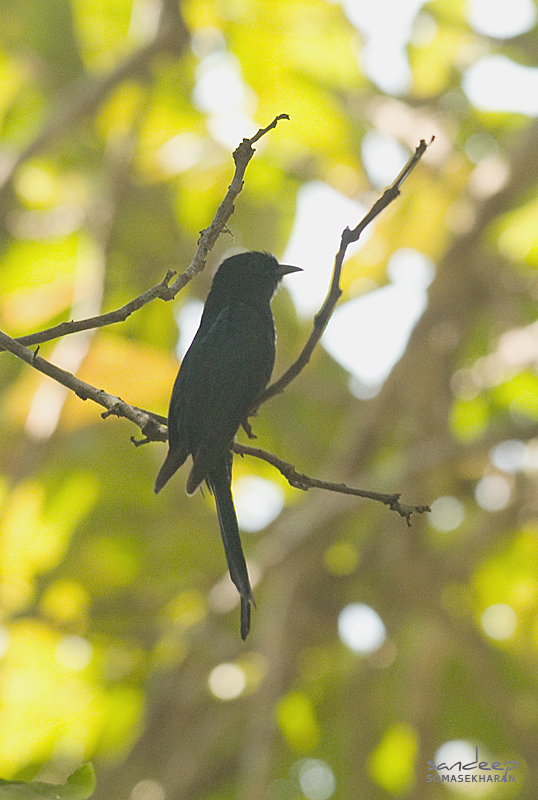
So, which one do you think this is?
Maybe a closer look would help?


Text and photos: Sandeep Somasekharan
Also read: Encounter - Asian Drongo-Cuckoo

Horsing around Horsley Hills!

Horsley Hills, where I had started birding five years ago, beckoned again early this year. And rewarded me with an enriching morning

On the last weekend of March this year, after almost five years, I revisited the place of my first ever birding trip - Horsley Hills near Madanapalle in Andra Pradesh. I had actually gone to the famed Rishi Valley School in Madanapalle on a short visit with my parents. Although I could not do any birding there on the first day, I decided to take my parents to Horsley Hills early next morning and try and squeeze in a couple of hours of birding.

We were at Horsley hills by 7:30 AM. It was going to be a short outing, and as we needed to get back to the school by noon, I wanted to make full use of the time there. After parking the car, I strayed away from my folks and birded with my trusty old binocs. I also carried my camera hoping to get nothing more than a few record shots especially of the yellow-throated bulbul that is found here. The Yellow-throated Bulbuls, although hard to find elsewhere, are known to be pretty common in these hills.

Soon enough, I started seeing the common birds such as sunbirds and tailorbirds going about their early morning business of finding food around the gardens planted by the AP tourism department.


Later, as I walked near one of the hotel buildings, I saw a drongo perched on a tree. I thought to myself, Black Drongo. But then, there was something different about this drongo. It wasn't exactly black; it was greyish with a bluish tinge on its feathers and lacked the white rictal spot that distinguishes a black drongo from other drongos. But the tail was long and deeply forked just as in the Black Drongo. The only thing this bird could be was an Ashy Drongo, overstaying its winter visit.


As I strained to get a good look at the drongo high up in the Jacaranda tree, I spied a movement from the corner of my eye. In the darkness of the trees and shrubs was perched a male Blue-capped Rock Thrush. Whenever I tried to get close enough for a good look, it moved away further behind the hotel buildings. I dogged it for a while slowly until it came to rest on a tree. Here it remained motionless for a while. This was enough for me to take a good look and also manage a shot with my cam.


Only after I was done with the thrush did I realize that it had led me right behind the buildings where it was a bit rocky but with shrubs, grass and plenty of tree cover as well. I looked around saw a pipit. As identification of pipits is tricky and because I did not have my field guide with me, I took a couple of shots of the obliging bird to ID it at my leisure. Days after reaching home and after hours of painful examination, I narrowed down on two species - Olive-backed Pipit (Anthus hodgsoni) and Tree Pipit (Anthus trivialis). I think it's the Olive-backed because I couldn't find any clear makings on the upperparts. Even so, I can't be one hundred percent sure which pipit I saw.


The next bird that I saw drove me crazy for a while. I had a tough time trying to find out the features that would help me later id the bird. I started jotting down its appearance in my mind. It was blue. A slaty blue. Well, that was it. There was no other clearly defined marking on its body except that its primaries were a little darker. And what a bird it was! 

It moved from tree to ground, ground to rock, rock to balcony, balcony to roof! I felt its movements were similar to those of a myna or a thrush. I took a couple of good looks at it, took a shot for identification and moved on. Later, when I checked the field guide, I realized that this was a Blue Rock Thrush.


Tired of chasing after the rock thrush, I headed back to the gardens. Here I spent time with some Oriental White-eyes playing hide and seek.


It was now quite late in the morning and we were famished. We decided to go to the restaurant where they had buffet breakfast served just outside the entrance of the building. I was happily hogging away when I saw a small bird flutter about in the tree next to us. I reached for the camera and looked through the view finder.


Perched on a twig was a very pretty small white bird with dark blue over its head, face and back. This was the Ultramarine Flycatcher, a rare winter visitor prolonging its stay in the south. I spent a good fifteen minutes with this bird before it decided to forage elsewhere. The same area was then taken over by coppersmith barbets and I enjoyed watching them feed on berries from the tree. Unfortunately, as the light was not great for photography, I could only manage a single shot.


It was almost noon, and we decided to leave. Mom drove since I was tired. I had seen quite a number of birds in just a couple of hours. Yet I was a bit disappointed that I was not blessed with a sighting of the Yellow-throated Bulbul. 

But Gaia was really in a good mood that day, I guess. As the car slowed at one of the hairpin bends, I saw a small flock of white-and-yellow birds moving about in the shrubs close to the road. I got down and scanned the bushes. There, flitting around a small dense tree, was a pair of Yellow-throated Bulbuls!


And as I had hoped, I also got a record shot!


Text and photos: Arun

Encounter: Asian Drongo-Cuckoo

Is that a drongo? Or a cuckoo? Or a bit of both? Meet the Asian Drongo-Cuckoo

The barring on the tail is a clear diagnostic while identifying the Asian Drongo-Cuckoo
Sometimes, a birding glut can leave you quite satiated. On the second day of our trek in Parambikulam along the Cochin Forest Tramway, Sahastra, Sandy, Rohit and I had been regaled by a party of Great Hornbills early in the morning and had enjoyed a pleasant encounter with a Black-crested Bulbul (or the Flame-throated Bulbul, as some taxonomists suggest it be named). It was also the morning when we had been unsettled by a spine-chilling encounter with a lone tusker (which Sandy described earlier). We had reached a point where we were no longer stopping for Black-naped Orioles or Asian Fairy-Bluebirds. And completely ignoring White-bellied Treepies. 

The day was getting warmer and we had already walked a good six kilometres. The birding party kept its tired eyes on the ground, kicking up a noisy racket of rustling teak leaves. Ahead of us, a mixed flock of drongos, nuthatches and sunbirds kicked up a fuss all of their own. Just then I saw another black, fork-tailed bird perched on an exposed bough in the dense shade of a tree beside the river. 

“Bronzed Drongo,” said Sandy dismissively and took another leaf-crushing step forward. I wasn't convinced. After all, the jungle can throw up infinite veiled surprises. In the tradition of my good birding mentors Sunita and Jennifer, I decided to do what a human observer can do best under such circumstances – take a long, hard look while the bird offers you the opportunity of a view. 

I considered the drongo-like bird carefully, taking it apart in bits. Something about the bird's aspect – the jizz, as birders (and twitchers) call it – appealed to my better senses. This was no drongo, screamed an irate voice in my head. This is something masquerading as a drongo. But how could I call its bluff? 

I ruled out Black Drongo entirely – the white rictal spot was absent. The tail was curved, yes, but was it perhaps too curved? I recalled seeing Bronzed Drongos in moult at Muthodi – with one set of curved tail feathers pushing out under the older fork, giving the bird an unusual double-tailed appearance. Was it, then, a young Racket-tailed Drongo? The peaked tuft above the upper mandible of the beak was absent – that's what gave Racket-tails their distinguished appearance. It wasn't the Spangled Drongo either – the tail-feathers weren't twirled. And the bill... hey, the bill! This bird had a straighter bill very unlike most drongos.

I strained my eyes to view it better with my ancient Russian-made binoculars (I've used them since 1989). The eye was black, unlike in most drongos. I glanced quickly at the bird's tail. Now it perched in a darker part of the canopy, but I could discern the barring in the tail. An ancient memory of some photograph I had thumbed in a book tickled a synapse. And then it struck me that we were looking at a lifer.
From this angle the bird looked very like a drongo, except for the shape of the head and the straight, sharp, cuckoo-like bill
This was the Asian Drongo-Cuckoo (Surniculus lugubris), an excellent mimic of drongos but not a drongo at all. This bird was a brood-parasite of some species of babblers in its range. It has a patchy range across which it is not really uncommon. Some taxonomists identify the peninsular race as a distinct species called the Fork-tailed Drongo-Cuckoo (Surniculus dicruroides), which was perhaps the bird we were now admiring. 

Sandy, suddenly interested in our new find, clicked a couple of pictures, muttering soft curses about the light as he shook his head. He was just aiming for another shot when the bird took off and its flight pattern, very like a cuckoo, confirmed our sighting. Sure, the light could have been better but we bagged the bird and went away feeling full of the joy of ticking off another lifer.

Text by Beej
Photos by Sandeep Somasekharan