We’ve moved! Here’s where you can find us

The Green Ogre is now at https://www.greenogreindia.org
Showing posts with label western ghats. Show all posts

In the kingdom of the Lion-tailed Macaque

In Valparai the endangered Lion-tailed Macaque inhabits tracts of dense evergreen forest hemmed in by tea plantations. It lives, literally and alarmingly, on the edge


We were driving down from Valparai along one of the remaining patches of tropical evergreen rainforests, soaking up their sounds and feel. We'd had a very good weekend trip, despite not getting to sight anything special besides a couple of Nilgiri Tahr on our way up. The road leading up to Valparai cuts through critical habitat of the Lion-Tailed Macaque and Great Hornbill. We had seen boards screaming "Lion Tailed Macaque are active here. Please drive carefully" and were discussing Kalyan Varma's roadkill photo that had been etched into our minds. 


Ladder-like bridges between canopy trees had been fashioned to ensure that the arboreal primates move freely without having to get down on the road. The extensive clearing of rainforests in Valparai had been started by the British administrators and kept up zealously by their Indian sucessors. Many of those areas are privately owned tea estates now. What remains of rainforests are islets, isolated but protected fiercely by the Nature Conservation Foundation. 


We stopped at a bend on sighting a female scarlet minivet sallying to catch insects. As we were about to get back in the car, Swaheel spotted a primate standing on a near horizontal tree branch, at eye level, about 15 metres away from the road above the downhill slope. "LTM," someone whispered. The animal stared at us for a second or two and walked unhurriedly into the canopy. We thought that was all, happy for the sighting but then we heard movement. Treetops were swinging and black forms moved in and out of branches. And there materialized LTMs of all sizes, and suddenly the forest came alive with whoops and squeaks. We were in the middle of a huge troop of monkeys. They moved down the road. We parked and followed them, careful not to step off the road.
We reached another clearing and were waiting for the monkeys to emerge from the canopy when suddenly Swaheel hissed in my ear: “There, there!" I looked and saw nothing – the canopy was thick with little light penetrating it. He pointed closer and I saw a huge male on all fours on a broken branch. A finger of light illuminated his white mane. Soon, there were macaques everywhere. They were of all ages and sizes -- babies clinging to mothers, juveniles, large males. I spotted another individual barely 3-4 meters from the ground and we spent a satisfying photographic moment.   Vehicles passed us. We had prior warning from Bijoy who had told us the area was very disturbed and we should refrain from attracting a crowd under any circumstances. So, every time we heard a vehicle approach, we pretended to be taking a leak! 


The monkey on the branch was reasonably well camouflaged. We left him alone. Others were trying to cross a gap between trees. What followed was an amazing display. The LTMs on this side of the gorge climbed to the tip of the outcropping branch one at a time. They would shake the branch to make it sway to provide ample thrust for launch. Then the monkey would leap, sailing through the air and latching onto branches on the other side.


They did this one by one -- the first one missed the branch on the other side, and we could hear a crash as it got a foothold further down. Each one of the others made the jump smoothly, including the last one – a mother with a clinging baby.


At this point a minibus from Chalakudy arrived, blaring music, and stopped to partake of the scene. Its occupants pointed at the LTMs and shouted despite our pleas for silence. That was enough irritation for the monkeys, which retreated further into the forest. 


We drove for another 300 meters from that point when we came to a clearing -- and the very verge of the dense evergreen forest. We were in a tea plantation, and it gave us the impression that these threatened primates were living, literally, on the edge. LTMs seldom cross through these plantations, which means they are boxed into these last stretches of evergreen forest with no way out, hoping that whatever little habitat they have would not run out of space, shelter and food.


Text and photos: Sandeep Somasekharan

Encounter: Indian Giant Squirrel

Fluffy and tubby, the Indian Giant Squirrel is a treat to watch anywhere you may wander in the forests of peninsular India from the Western Ghats all the way to Madhya Pradesh


The first tell-tale giveaway of its presence is a crashing and rustling of treetop branches followed, sometimes, by a glimpse of a ruddy brown shape scampering through the high branches. Occasionally, you might hear a loud, percussive call that you can't match to any bird you know of. There's your culprit -- the Indian Giant Squirrel (Ratufa indica).

Popularly called the Malabar Giant Squirrel in the south, it is the largest species of squirrel in the world. Placed in the family Sciuridae in the order Rodentia, these furry mammals can grow up to 3 feet long (including the extremely long tail) and weigh up to 2 kg. This arboreal creature is found in deciduous, moist deciduous and evergreen forests of peninsular India.

Though the squirrel is fairly common throughout the Western Ghats and its foothills, until my trip to Dandeli in northwestern Karnataka I'd had only two fleeting glimpses of the giant squirrel. At the Kulgi Nature Camp (where we Ogres stayed) and at the timber depot in the town centre, the squirrels were so unafraid that they went about their activities without a second look at us. After a while I grew getting tired of their antics. Showoffs!

The Indian Giant Squirrel is usually found in the upper canopy and rarely leaves the comfort of trees. It moves along the canopy from one tree to another through interconnecting branches and, in situations where there are gaps in the canopy, it leaps from the end of one branch to a neighboring tree. They have been known to leap 5 to 6 meters from one tree to another. It uses its long tail for balance. When frightened, this squirrel has the habit of lying flat on a branch, motionless, or hiding behind the trunk. These squirrels are mostly active during morning and evening, avoiding the heat of the day. They can be seen lying flat on a branch catching up on their siesta. They are also known to sleep in the nest if the weather is too cold or rainy.


The Indian giant squirrel is heard more often than seen. Its call is a loud and penetrating series of chucks. Thanks to the other Ogres, I recognized the call for the first time in Dandeli. although I had heard it before.

Indian giant squirrels are omnivorous, feeding on fruits, berries, flowers, bark, eggs, insects etc. Adults are solitary and sometimes found in pairs. The female gives birth to two pups after a month's gestation period. The nests are large and spherical, made with twigs and leaves, and are built on the thin branches for safety from larger predators. According to Prater, an individual squirrel may build several nests within a small area and use them as sleeping quarters.

Two individuals we saw at Dandeli perched low on a (barely) leafless tree and fed on berries. They did not appear to be disturbed by us standing directly below and observing them. They seemed oblivious to aerial attack as well. It was amusing to watch them grasp the berries in their front paws and chomp away while they clung to the branch with their hind-paws.


The squirrels' coats may vary from red to brown to black on the upperparts while underparts may be light cream or white.  Their populations are so fragmented and isolated that several races can be distinguished by colour schemes. This has also given rise to disagreement among biologists regarding subspecies.

Even though the giant squirrel is fairly common in our forests, the most immediate threat to the species is habitat degradation due to logging and encroachment of forest land for agriculture. Sensing the threat, the 130 sq km Bhimashankar Wildlife Sanctuary was created in 1984 at Ambegaon near Pune, Maharashtra.


As we left the squirrels to eat in peace, I couldn't help but imagine that, with their paws clasped together, they were imploring us to help save their kind.


Text and photos: Arun
Read all Encounter posts

Encounter: Malabar Grey Hornbill

The next time you hear a chuckle from the treetops or endearing squeaks and musical caws, look out for the Malabar Grey Hornbill. Or maybe a whole flock!


What's so different about the Malabar Grey Hornbill (Ocyceros griseus) compared with the other three hornbills found in the Western Ghats? The casque, of course. Rather, the absence of it. Although the attention-grabbing casque -- the horn in hornbill -- is not present in this southern species, the bright orange bill (in males) makes up for it and you realise the true meaning of the word "Hornbill". The bill is shaped exactly like a cow's horn, which is the literal meaning of its family name, Bucerotidae. This it uses mainly to feed on fruits and berries although they also catch small vertebrates. All hornbills are grouped under the order Coraciiformes, which includes rollers, bee-eaters and kingfishers.


Malabar Grey Hornbills, like most other hornbills, are sexually dimorphic -- males have a bright orange bill with a yellow tip, while females have a yellow bill with a black base. The plumage of both sexes are mainly greyish with a broad white supercilium running down to  the neck.


While the Indian Grey Hornbill occurs in the plains, Malabar Grey Hornbills birds are endemic to the Western Ghats. They are believed to mate for life and are secondary cavity nesters, which means they use existing tree cavities and do not excavate their own for nesting. These nesting sites are used year after year. As with many other hornbills, females imprison themselves in the cavity while nesting and undergo a complete moult, losing all their body feathers. They emerge after the eggs hatch. During this time it is up to the male to feed her through a narrow slit in the cavity. Perhaps one of the reasons for the hornbills' long bills may be to pass food through this slit. Of course, this is my surmise and I am open to correction.


After a fleeting glimpse of this bird at Agumbe three years ago I observed them to my heart's content at Dandeli earlier this year. As we (the Ogres) were busy observing the larger Malabar Pied Hornbills at the timber depot in the heart of Dandeli town, a few of these birds landed on fruiting trees nearby and posed for us. It was interesting to observe them feeding on berries.


Although these birds are relatively common in the Western Ghats and are listed by the IUCN as LC (Least Concern), their rapidly shrinking habitat is a cause for worry.


Text and photographs: Arun
Additional photograph: Sandeep Somasekharan


Read more Encounter posts
Love hornbills? So do we. Don't miss our Hornbill Week archive

Encounter: Bombay Caecilian, an amphibian epiphany

Its serpentine structure and moist, clammy skin gives the caecilian the appearance of a frog masquerading as a snake. Chances are you've seen this intriguing amphibian before but never taken a second look at it!
The head of the Bombay Caecilian, showing the tiny tentacles, mouth and the eyes. Note the ring-like folds on the skin and the whitish secretion of mucus
During our three days at the Agumbe Rainforest Research Station, breakfast conversations with station manager Prashant always yielded something interesting. On the morning of the day we were leaving I asked him casually about his work, and he mentioned in his characteristic unassuming manner that he had been part of the discovery and documentation of some species of Caecilians.

Caecilians! My ears perked up at the word. I hadn't heard it in a long time and something told me we were very close to an epiphany of sorts.

“Aren't they legless amphibians?” I asked.

“Yes,” he said laconically.

“And do you get them around here?”

“Yes.”

“Wish we could see them...” I murmured hopefully.

“I could show you one,” he said helpfully. “I have a pet.”

For the rest of the day we were at our best behaviour, grinning and glancing at Prashant hopefully every time we passed him. After lunch he asked us to wait outside a hut that probably served as a storage room for specimens. In its dim murkiness we saw him digging around in a bucket.


The caecilian's sinuous movements are very like a snake's
He came out of the hut holding a slender, purplish-black creature that resembled a snake at first glance. But unlike a snake's skin, which is dry and scaly, this animal's shiny body surface appeared to secrete mucus that rubbed off in white gobs on Prashant's hands. He invited me to touch it, and the skin felt soft, cool, slippery and moist under my fingertips. It was like touching a frog masquerading as a snake. This mucus is believed to be mildly toxic to predators, though that doesn't prevent pigs, snakes and chickens from eating some of the smaller caecilians.


Mucus, secreted by the caecilian's skin, keeps it moist while its mild toxicity is thought to deter predators
Though their snakelike appearance can be deceptive, caecilians are legless amphibians related to frogs, toads and salamanders. Their serpentine body structure is an adaptation for a burrowing lifestyle. They live among leaf litter and loose soil and can be found under fallen trees and rocks. There are 26 recorded species of caecilians in India, of which 25 are endemic and about 20 of these are found in the Western Ghats. Other caecilians have also been discovered from forests in Manipur and Nagaland in northeast India. 

The species we were admiring was the Bombay Caecilian (Ichthyophis bombayensis), which occurs in the Western Ghats. It was nearly a metre long – I had expected caecilians to be much smaller -- and the body is annulated (the skin is ringed with folds) as in worms. The two tiny eyes, barely more than dark spots sheathed by skin, are surrounded by pale white rings. This caecilian's eyesight is perhaps limited to distinguishing between darkness and light. The mouth has rows of small teeth that are adapted for holding and cutting prey, which primarily consists of earthworms, termites and small invertebrates that live in the soil. There are two tentacles close to the mouth and this has perhaps given rise to the myth that these are venomous two-headed snakes -- in Kerala they are known as iruthalamoori (literally, two-headed bullock) and killed because they are commonly mistaken for snakes (some resemble the similarly coloured shieldtail snakes).


Snake in the grass? Sadly, many caecilians are easily mistaken for snakes and therefore killed
Caecilians are oviparous, which means they lay eggs. It's hard to tell males and females apart externally, but males have a concealed copulatory organ, the phallodaeum, which can be inserted like a pseudo-penis into the aperture of the female during copulation. Fertilization takes place inside the female's body. As with most amphibians, caecilian eggs are strung together in gelatinous threads, like beads in a necklace. The female caecilian protects her clutch of eggs by coiling her body around them. The larvae are aquatic and free-swimming -- like tadpoles. 


If you happen to visit a plantation of areca, banana or coffee with moist, humus-rich soil and compost pits, look out for caecilians. Just remember that like all amphibians they are highly sensitive to depletion of soil quality and are therefore important environmental indicators.


Prashant treats us to a ampbibian epiphany

As we watched the caecilian with fascination, Prashant put it down on the ground. It moved swiftly through the grass and began looking for a place to hide away from the sunlight. He then put it back in its bucket and announced, "Show is over!"


Thanks, Prashant. We're all really grateful to you for introducing us to this intriguing amphibian. We have one more reason to keep our eyes glued to the ground in a rainforest. The birds can wait!


References:
A Field Guide to the Caecilians of the Western Ghats, India by Gopalakrishna Bhatta, Department of Zoology, Sri JCBM College, Sringeri, India


Text and additional photos: Beej
Lead photos: Sahastrarashmi
Read more Encounters and more posts from our Agumbe Diaries

Encounter: Golden Frog

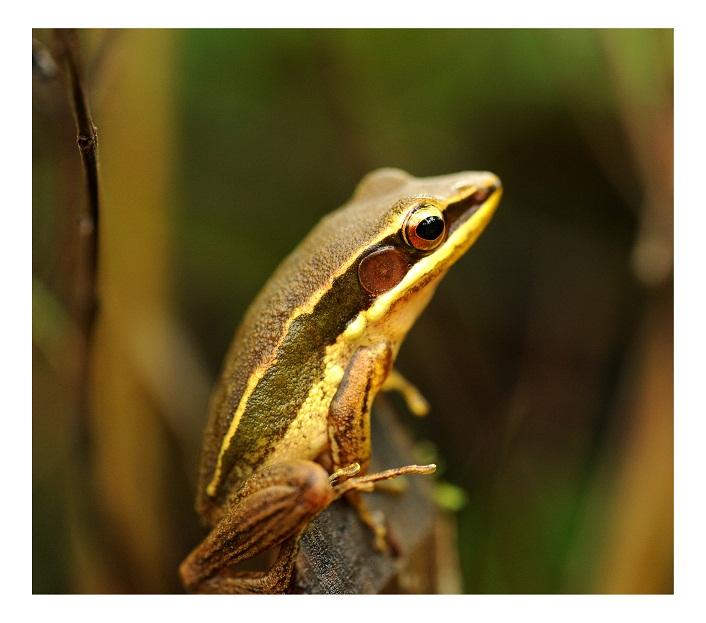
Our very own Golden Frog, a Western Ghats endemic, gave us the cherished privilege of a long and uninterrupted audience

At the outset let me state that the frog we encountered is not to be confused with the Panamanian Golden Frog (Atelopus zeteki), which was last seen and filmed in the wild in 2007. The entire known population in the wild is now assumed extinct and the frog survives only in captivity. Our Golden Frog (Hylarana aurantiaca) is luckier, but the Sword of Damocles of the amphibian world, the fungal infection chytridiomycosis, hangs over its head too.
Frogs have an extremely permeable skin, through which they can absorb oxygen into the bloodstream. Oxygen first dissolves in a thin water film on the surface of the skin and then from there into the blood. This feature, which evolved to aid their amphibious lifestyle, is now one of the reasons for the rapid decline of frog populations around the globe. The permeable skin makes them highly susceptible to toxins in the water. So evolved is this feature in frogs that a lungless frog has been discovered in 2007 in the rainforests of Borneo, Indonesia. The Bornean Flat-headed Frog (Barbourula kalimantanensis) has no lungs and this 7 cm long frog breathes entirely though its skin. The absence of lungs helps it attain a flatter body shape -- a key adaptation to survival in its habitat, fast-running mountain streams, since it aids streamlining and reduces drag. But it is already threatened due to rise in water toxicity due to mining.

We first encountered the Golden Frog during a late evening “frogging” session at ARRS. They were perched on leaves and calling (the vocal sac is internal) but in the feeble torchlight it was very difficult to make out the distinctive coloration, especially the yellow-orange back bordered by two golden streaks – the characteristics that gives them their regal name. The next day I saw a couple of them on the same bushes beside a small monsoonal wetland right outside our cottage and as the excited Ogres scanned the bushes we realized that there at least 20 of them right there. As we photographed them, the frogs maintained the calm and composure of meditating Zen monks. There was no alarm, no anxiety and no visible discomfiture. In fact, as the successive monsoon fronts arrived -- the sequence of mist, drizzle, heavy shower, sunshine, mist played out though the day -- they hardly seemed to move. I observed one of them seated in position for almost three hours. They also seemed to be quite gregarious, seated on leaves, twigs, stems and branches of the bush close to each other.

Hylarana aurantiaca is found in moist evergreen forests, swamps and coastal regions bordering the southern Western Ghats and is probably a Western Ghats endemic since the population found in Sri Lanka is suspected to belong to a separate, yet undescribed, species. It is described as a semi-arboreal and semi-aquatic frog. The frogs we came upon at the ARRS (which has a population of over 200-300 Golden Frogs) were typically perched on small bushes – on stems and twigs – and on large leaves close to the ground. There was a small disused water-logged paddyfield nearby so the bushes were technically at the edge of a shallow water body. Their IUCN status is Vulnerable.

The frog is small in size -- approximately 4 cm from the snout to the vent. The toes are dilated into discs and the middle digit of the toes is longer than the other two. It has three digits on each limb and the webbing is barely noticeable. The skin can be smooth but is often granulated especially on the back due to scattered conical tubercules. The nostril is close to the snout and the tympanum is quite distinct, almost the size of the eye, only slightly smaller.

Hylarana aurantiaca’s distinct feature is a chocolate-brown/olive-green band that runs from the tip of the snout along the flanks to the hindlegs. The eye, nostril and tympanum are all situated on this band. This band is bordered by a bright yellow, almost golden streak running all along the upper border and till the foreleg along the lower border. The back, which is essentially bordered by these two Midas-touched streaks is orange/orange-yellow or olive-brown. The back and the limbs have no barring but for some dark splotches. The eye is black and bulging, the eyelids bright orange. The underparts are creamy white and the skin is a translucent glowing orange when it is lit up by the sun.

Currently, around the world, most of the roughly 5,000 species of frogs are in decline, and we have a very real risk of losing species that are not yet discovered. In India, while 12 new species of tree-frogs were discovered by a team led by S D Biju of Delhi University, Systematics Lab, Delhi, another initiative to re-discover 50 lost amphibians of India (LOST! Amphibians of India Initiative) has yielded just five re-discoveries so far, the prized one being Chalazodes Bubble-nest Frog (Raorchestes chalazodes), unrecorded since 1874. Researchers estimate that we may have lost up to 13% of our amphibians already.

We Ogres cherish the time we spent with the Golden Frogs at ARRS. They were trusting, accessible and -- pardon me for anthropomorphising -- extremely friendly. It was a privilege to observe and photograph them from so close. The Golden Frog is a lovely representative of a species that has a special place in our hearts – be it as a Frog Prince or as a metaphor in Matsuo Basho’s famous Frog Haiku.

Text and Photographs by Sahastrarashmi
Enjoy more Agumbe Diaries

Encounter: Bicoloured Frog

It's tiny and blends in completely with the leaf litter but once you spot it, the Bicoloured Frog is unmistakable

The southwest monsoon has just set in and the entire forest is dripping wet. The dimly lit floor is an abstract mosaic of rust, maroon, brown, beige, green and black – leaves in all stages of decomposition, slowly turning into soggy mulch. An occasional vein of green moss on a tree buttress glows iridescent under a rare shaft of sunlight. Fungi sprout everywhere feasting on death and decay. Every tentative footstep encounters leeches – tiny cold-blooded filaments swaying in the stagnant and humid air, relentlessly in the hunt for the iota of warmth that our feet radiate, setting them off on a determined somersaulting advance. Rotting twigs and branches give way at the slightest footfall and the soft murmur of rain on the dense closed canopy is a permanent hum in a forest which is otherwise silent, at least until nightfall provides the cue to lovesick frogs and crickets.

We are on the lookout for the Hump-nosed Pit Viper but instead we sight the Bicoloured Frog. It, too, is wet and soaked, motionless until it notices us with its large, round, red eyes, which are well adapted to sight in the semi-darkness of the rainforest. 


True to its name, the predominant impression of the Bicoloured Frog (Clinotarsus curtipes), is the neat division of the colouration of the upper and the lower halves of its body. The upper half (which has been described as grey or brown) is cream-coloured, tinged with yellow resulting in a very light shade of brown that matches the surrounding leaf litter. The lower half of the body is glistening black with no banding on the limbs. Seen in dimmer light the glistening back gives the impression of deep beige. 


The nostrils are very close to the mouth and the tympanum, present on the black half of the body and hence not very easily seen, is as large as the eye. The size is approximately 7 cm and the snout is pointed. The backs of all the four or five frogs that we encountered bore randomly distributed black spots, providing excellent camouflage in the leaf litter. The spotting on the back may or may not be present on individual frogs though all the frogs that we encountered had them.

While we photographed the frog – almost lying on the ground for an eye-level view (an act of extreme gallantry considering the omnipresent, ever-flipping thirsty-for-blood leeches) the frog was moderately alarmed and tried to move away, on one occasion walking up using its limbs, but was not unduly shy, never taking more than one hop. Clinotarsus curtipes seemed to be fairly common but none happened to be in breeding colors yet.

The IUCN status is Near Threatened, primarily on account of habitat loss. Clinotarsus curtipes is a terrestrial leaf-litter frog but has webbed toes and enters the water only during the breeding season. It adapts well and is found in different forest types -- evergreen, semi-evergreen and deciduous. In the breeding season the frog acquires a ruddy disposition with the black receding out from the sides and the underside becoming very dark, almost black. The vocal sac is internal. As in a lot of frog species the female is larger than the male. J C Daniel notes that the dispersal of young frogs is very orderly and almost battalion-like. 
The spots, like the stripes of the tiger, can be distinctive and are used to identify individual frogs during density surveys. The spots are also a good aid to locate the frog since an uncannily well synchronised set of polka dots hopping on the forest floor give away an otherwise excellent camouflage.


Read more Agumbe Diaries
Text and photographs by Sahastrarashmi 
Photograph of the breeding male by L Shyamal (Wikipedia Commons)


Encounter: Blue-eyed Bush Frog

On a dark, wet monsoon night in Agumbe we met the very kissable blue-eyed prince of frogs
A Blue-eyed Bush Frog vocalising with its throat sac puffed out
If the name Philautus neelanethrus does not suggest a blue-blooded prince to you, an audience with the aforesaid certainly will, assuming that you will be granted one. The Blue-eyed Bush Frog inhabits the deep, dense evergreen rainforests of the Western Ghats and was described to science as recently as 2007 from the Sharavathi Valley. 

This diminutive frog, less than 3 cm long, acquires a yellow colouration during the breeding season (though in the picture it appears redder) and has a beautiful golden eye with a horizontal pupil, completely encircled by an iridescent blue ring. It owes its name to this lovely blue eye-ring. It is usually found on mid-height bushes perched on leaves. In the non-breeding season, its colour is creamy.

Our rendezvous with the blue-eyed prince occurred on a wet, rainy night at the Agumbe Rainforest Research Station. We heard the call -- one among many enigmatic mating croaks that filled up the inky monsoon night: treek tink-tink-tink. Once located, like a true celebrity, it seemed uncomfortable with the attention and stopped calling. 

After a short break, it called again and we scrambled for a view. I was lucky to get this one shot of the prince before being banished from his august presence. 

Text and photo by Sahastrarashmi 
Excellent pictures of this frog can be viewed at AMOGHAVARSHA and Sharath’s websites.


This post is the first of our Agumbe Diaries. Look out for more about monsoon in the rainforest.


Encounter: Asian Drongo-Cuckoo

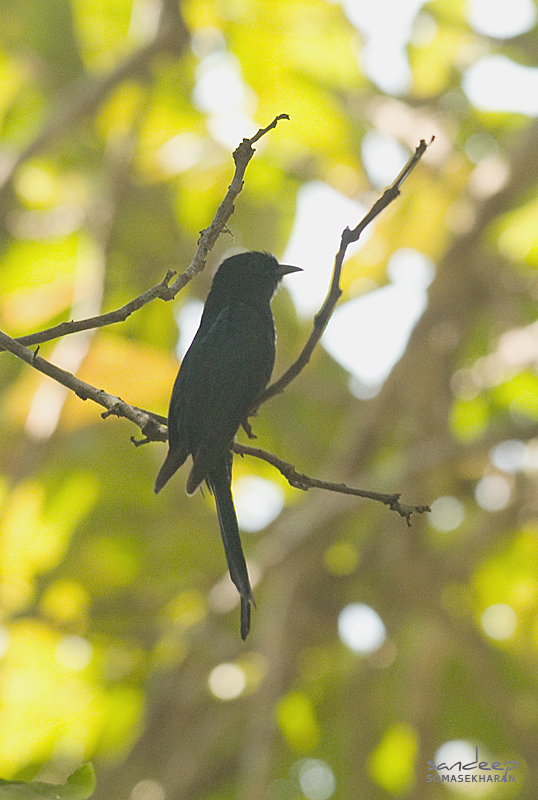
Is that a drongo? Or a cuckoo? Or a bit of both? Meet the Asian Drongo-Cuckoo

The barring on the tail is a clear diagnostic while identifying the Asian Drongo-Cuckoo
Sometimes, a birding glut can leave you quite satiated. On the second day of our trek in Parambikulam along the Cochin Forest Tramway, Sahastra, Sandy, Rohit and I had been regaled by a party of Great Hornbills early in the morning and had enjoyed a pleasant encounter with a Black-crested Bulbul (or the Flame-throated Bulbul, as some taxonomists suggest it be named). It was also the morning when we had been unsettled by a spine-chilling encounter with a lone tusker (which Sandy described earlier). We had reached a point where we were no longer stopping for Black-naped Orioles or Asian Fairy-Bluebirds. And completely ignoring White-bellied Treepies. 

The day was getting warmer and we had already walked a good six kilometres. The birding party kept its tired eyes on the ground, kicking up a noisy racket of rustling teak leaves. Ahead of us, a mixed flock of drongos, nuthatches and sunbirds kicked up a fuss all of their own. Just then I saw another black, fork-tailed bird perched on an exposed bough in the dense shade of a tree beside the river. 

“Bronzed Drongo,” said Sandy dismissively and took another leaf-crushing step forward. I wasn't convinced. After all, the jungle can throw up infinite veiled surprises. In the tradition of my good birding mentors Sunita and Jennifer, I decided to do what a human observer can do best under such circumstances – take a long, hard look while the bird offers you the opportunity of a view. 

I considered the drongo-like bird carefully, taking it apart in bits. Something about the bird's aspect – the jizz, as birders (and twitchers) call it – appealed to my better senses. This was no drongo, screamed an irate voice in my head. This is something masquerading as a drongo. But how could I call its bluff? 

I ruled out Black Drongo entirely – the white rictal spot was absent. The tail was curved, yes, but was it perhaps too curved? I recalled seeing Bronzed Drongos in moult at Muthodi – with one set of curved tail feathers pushing out under the older fork, giving the bird an unusual double-tailed appearance. Was it, then, a young Racket-tailed Drongo? The peaked tuft above the upper mandible of the beak was absent – that's what gave Racket-tails their distinguished appearance. It wasn't the Spangled Drongo either – the tail-feathers weren't twirled. And the bill... hey, the bill! This bird had a straighter bill very unlike most drongos.

I strained my eyes to view it better with my ancient Russian-made binoculars (I've used them since 1989). The eye was black, unlike in most drongos. I glanced quickly at the bird's tail. Now it perched in a darker part of the canopy, but I could discern the barring in the tail. An ancient memory of some photograph I had thumbed in a book tickled a synapse. And then it struck me that we were looking at a lifer.
From this angle the bird looked very like a drongo, except for the shape of the head and the straight, sharp, cuckoo-like bill
This was the Asian Drongo-Cuckoo (Surniculus lugubris), an excellent mimic of drongos but not a drongo at all. This bird was a brood-parasite of some species of babblers in its range. It has a patchy range across which it is not really uncommon. Some taxonomists identify the peninsular race as a distinct species called the Fork-tailed Drongo-Cuckoo (Surniculus dicruroides), which was perhaps the bird we were now admiring. 

Sandy, suddenly interested in our new find, clicked a couple of pictures, muttering soft curses about the light as he shook his head. He was just aiming for another shot when the bird took off and its flight pattern, very like a cuckoo, confirmed our sighting. Sure, the light could have been better but we bagged the bird and went away feeling full of the joy of ticking off another lifer.

Text by Beej
Photos by Sandeep Somasekharan

A homecoming to Iruppu Falls

A chance trip to Iruppu Falls at the foot of the Brahmagiri peak in southern Coorg brought back a rush of old trekking memories
The falls, not yet at their most splendid, are captivating
In 2006, a little after my broken humerus had regained its sense of humour, I ventured on a drive to Iruppu Falls from Bangalore with my still rather newly-wed wife and camper extraordinaire Sahastrarashmi, whom I'd known for about a year. Along with us were four others.
The Lakshmanatheertha flows towards the temple after descending from Brahmagiri at Iruppu Falls
We freshened up at the rooms behind the very serene Rameswara temple at Lakshmanatheertha (Rama's brother Lakshmana is believed to have meditated here) and passed the falls, after which we began our climb to Brahmagiri with great aplomb. Having driven all night and having stayed up sleepless with excitement for unnumbered nights before that, I was pretty blown. A kilometre into the steep climb I realised with anguish that the five heavy bird books that I was carrying in my backpack were an unnecessary and foolhardy choice of reading material, especially considering the fact that there was not going to be any electricity up there at Narimala. 


Behind every ambitious but unsuccessful climber is a woman who knows better. Anitha propped me up by my divine behind every time I skidded back under the weight of my burden. When I reached Narimala, we pitched tent. I passed into a deep, snoring slumber and woke up only just before sundown when dinner had been cooked. That was that (read more about that trip here).


In March this year, I happened to visit Iruppu Falls again quite by chance on a writing assignment for Outlook Traveller with photographer Jyothy Karat


It was a strange sort of homecoming for me, though this time climbing the peak was not on the agenda. On my last visit the temple wore a serene, old-world charm. Five years later it had been given a concrete facelift of which the management was doubtless very proud. The temple office even controlled our access to the falls. Though we reached there at 7 AM, we were turned away and asked to return an hour later. 


The Rameswara temple  at Lakshmanatheertha in Iruppu has got itself a concrete makeover though the old temple looked far more tranquil
Returning as appointed, we lingered about the falls, taking pictures and marvelling at the butterflies mud-puddling beside the rock pools -- Jays, Blue Mormons, Paris Peacocks, Malabar Banded Peacocks, Bluebottles... Nabokov would have run amok! 


A few men enjoying a pounding shower under the falls began to perform for the camera (or the cameraperson, I imagined). After humouring them for a few shots, Jyothy got down to business, trying to click women bathing (fully dressed, of course) under the cascade. One of those splendid shots made it to Outlook Traveller's May 2011 issue along with my travelogue


An ant-mimicking spider (Mymarachne) overwhelms a cricket nearly five times its size
On the steps leading up to the falls, a great breakfast battle raged on -- an ant-mimicking jumping spider (Myrmarachne) was overwhelming a brown cricket with its venomous bite. The encounter must have lasted a good ten minutes until the dogged little predator beheaded the immobilised cricket, which was at least five times its size.


Around us the day warmed, though we were still ensconced in the cool comfort of the forest. A Crested Serpent Eagle whistled from high above as it soared on a thermal. Great lianas hung like enormous pythons over the stepped walkway. Wood spiders sealed the gaps in the canopy with giant, invisible orbs.


Ancient lianas cleave the view
An Asian Fairy Bluebird's chirrupy gurgle sought me out but the bird itself was a shadowy presence concealed in dense foliage. Racket-tailed and Bronzed Drongos flitted in the glades. Malabar Whistling Thrushes hopped on the path ahead, unruffled by our presence. Punch-drunk sunbirds brawled over blossom nectar while peaceable White-eyes cheeped feebly from the tender, sun-drenched treetops. 


Bright red Coral blossoms dropped spent from the canopy in the aftermath of a morning feeding frenzy as mynas, sunbirds, orioles and starlings tucked into a nectar binge. On the earthy path black ants with piercing bites (as I discovered with agony while trying unsuccessfully to photograph them) marched in steady lines. 


Iruppu is still fairly wild despite the rush of pilgrim-tourists and sundry merry-makers. Yet, the odd plastic bottle still bobs in the stream and the rocks are slippery with effluent soap, shampoo and oil from the bathers. Trash appears to be collected regularly, for we did not see too much litter on the path. 


Everywhere, the forest department has erected signs persuading tourists to be on their best behaviour. Despite the noble intent behind them, most were hilarious. And since those are best seen to be believed, I'll leave you to enjoy them. 


Tigers on honeymoon are perhaps on a meatless diet, eh?

Shikari Shambhu redux

Perhaps the macaque ought to wear its loins in the right place

Thanks to Jyothy Karat for her picture of the ant-mimicking jumping spider
Text and other photographs by Beej

On the Wing - The Great Hornbill


Nothing can prepare you for the awe-inspiring spectacle of a Great Hornbill, flying wild and free in its ancient forests
The swooshing sound of the Great Hornbills' wingsweeps resonates in the silence of the forest

The Great Hornbill (Buceros bicornis) is found in the Western Ghats and the Himalayan foothills in India as well as in the thick rainforests of Sumatra, the Malay Peninsula and Thailand extending north all the way up to Nagaland in India, as well as Nepal.

These large omnivorous birds do not have many natural predators. However, they are near threatened due to habitat loss from excessive deforestation as well as from poaching (their meat is considered unsuitable for consumption) as their large bills are coveted as trophies. Apart from its huge bill and colorful plumage, the bird is recognizable for its loud and sonorous call, which has earned it the Malayalam name “Malamuzhakki” -- one who makes the hills reverberate. 

 Great Hornbills are known to be monogamous and have a peculiar breeding habit that restricts their ability to proliferate in large numbers. Hornbill pairs partner for life and the death of either partner results in the surviving partner going mate-less for the rest of its life.


Exhibiting great dexterity, a Great Hornbill tosses a berry in the air before swallowing it
While hornbills have a lifespan of around 35 years or more, due to their selective breeding and nesting habits this longevity does not offer a significant advantage for their survival. Females nest in tree hollows while the male helps seal the cavity from outside. The male takes the responsibility of providing food to the incarcerated female. The male makes several daily trips to gather fruits, berries, reptiles and insects for the female. The male stores the fruits in the crop (a sac in its throat) and regurgitates them at the nest, following this regimen until the chick has grown significantly and it is time for the female to emerge from the nest cavity. Since the female has to rely on the male during this time, his death due to hunting or poaching would result in the death of the female and the offspring as well. Great Hornbills are known to return to the same tree cavities year after year and the loss of the tree means the pair would have difficulty in breeding again. There are few trees that satisfy the nesting requirement of hornbills and deforestation has become a major reason for the bird's dwindling numbers. 

Seeing the decline in numbers of the Great Hornbill, several conservation programs have been commenced to protect and revive this intriguing species.

Text: Anand Yegnaswami
(See Sandy's blog post on his meeting with the Great Hornbill)


These lovely images are best printed with HP Laserjet