
 |
| The barring on the tail is a clear diagnostic while identifying the Asian Drongo-Cuckoo |
Sometimes, a birding glut can leave you quite satiated. On the second day of our trek in Parambikulam along the Cochin Forest Tramway, Sahastra, Sandy, Rohit and I had been regaled by a party of Great Hornbills early in the morning and had enjoyed a pleasant encounter with a Black-crested Bulbul (or the Flame-throated Bulbul, as some taxonomists suggest it be named). It was also the morning when we had been unsettled by a spine-chilling encounter with a lone tusker (which Sandy described earlier). We had reached a point where we were no longer stopping for Black-naped Orioles or Asian Fairy-Bluebirds. And completely ignoring White-bellied Treepies.
The day was getting warmer and we had already walked a good six kilometres. The birding party kept its tired eyes on the ground, kicking up a noisy racket of rustling teak leaves. Ahead of us, a mixed flock of drongos, nuthatches and sunbirds kicked up a fuss all of their own. Just then I saw another black, fork-tailed bird perched on an exposed bough in the dense shade of a tree beside the river.
“Bronzed Drongo,” said Sandy dismissively and took another leaf-crushing step forward. I wasn't convinced. After all, the jungle can throw up infinite veiled surprises. In the tradition of my good birding mentors Sunita and Jennifer, I decided to do what a human observer can do best under such circumstances – take a long, hard look while the bird offers you the opportunity of a view.
I considered the drongo-like bird carefully, taking it apart in bits. Something about the bird's aspect – the jizz, as birders (and twitchers) call it – appealed to my better senses. This was no drongo, screamed an irate voice in my head. This is something masquerading as a drongo. But how could I call its bluff?
I ruled out Black Drongo entirely – the white rictal spot was absent. The tail was curved, yes, but was it perhaps too curved? I recalled seeing Bronzed Drongos in moult at Muthodi – with one set of curved tail feathers pushing out under the older fork, giving the bird an unusual double-tailed appearance. Was it, then, a young Racket-tailed Drongo? The peaked tuft above the upper mandible of the beak was absent – that's what gave Racket-tails their distinguished appearance. It wasn't the Spangled Drongo either – the tail-feathers weren't twirled. And the bill... hey, the bill! This bird had a straighter bill very unlike most drongos.
I strained my eyes to view it better with my ancient Russian-made binoculars (I've used them since 1989). The eye was black, unlike in most drongos. I glanced quickly at the bird's tail. Now it perched in a darker part of the canopy, but I could discern the barring in the tail. An ancient memory of some photograph I had thumbed in a book tickled a synapse. And then it struck me that we were looking at a lifer.
I strained my eyes to view it better with my ancient Russian-made binoculars (I've used them since 1989). The eye was black, unlike in most drongos. I glanced quickly at the bird's tail. Now it perched in a darker part of the canopy, but I could discern the barring in the tail. An ancient memory of some photograph I had thumbed in a book tickled a synapse. And then it struck me that we were looking at a lifer.
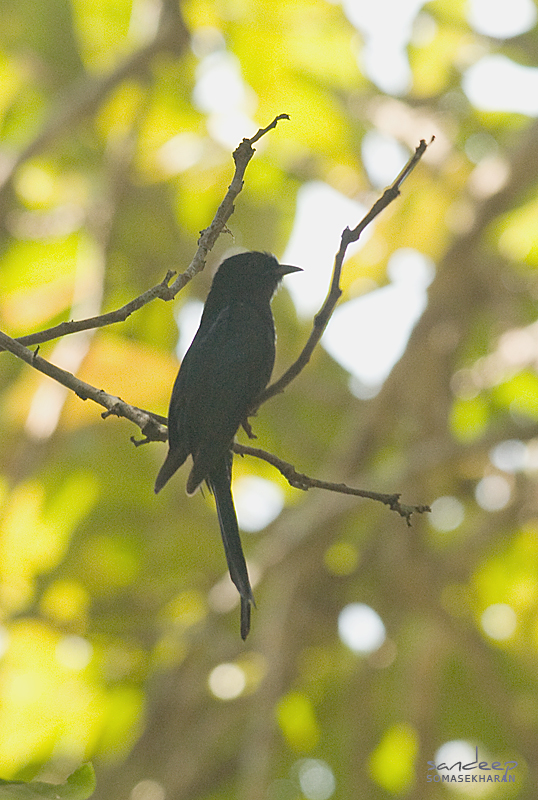 |
| From this angle the bird looked very like a drongo, except for the shape of the head and the straight, sharp, cuckoo-like bill |
This was the Asian Drongo-Cuckoo (Surniculus lugubris), an excellent mimic of drongos but not a drongo at all. This bird was a brood-parasite of some species of babblers in its range. It has a patchy range across which it is not really uncommon. Some taxonomists identify the peninsular race as a distinct species called the Fork-tailed Drongo-Cuckoo (Surniculus dicruroides), which was perhaps the bird we were now admiring.
Sandy, suddenly interested in our new find, clicked a couple of pictures, muttering soft curses about the light as he shook his head. He was just aiming for another shot when the bird took off and its flight pattern, very like a cuckoo, confirmed our sighting. Sure, the light could have been better but we bagged the bird and went away feeling full of the joy of ticking off another lifer.
Text by Beej
Photos by Sandeep Somasekharan


