On broad soaring wings, the mighty White-bellied Sea Eagle patrols the coastline, plunging every now and then into the ocean for fish or sea snakes. Its aerobatic displays can make test pilots envious. If you see one, stop and watch.

I remember that day more than four years ago. We were heading to the beach from college after a long, tiring day. As we walked along the narrow road chatting, I caught sight of a huge white bird, black underwing, soar just above us. As I looked up in awe, another followed suit bearing excess baggage in its talons -- a snake! I had just seen a pair of White-Bellied Sea Eagles returning after successfully hunting a sea snake!

For the first time in months, disregarding the slip disc I had suffered, I ran to locate the eagle’s perch. My friends ran after me to make sure I didn't collapse from the exertion. The pair of raptors flew into a walled compound bordering the beach. Scanning about for a good five minutes, I found both birds on an open perch. One, presumably the female, was feeding on the snake. The other, probably the male, was slightly smaller in size as is the case with most raptors.
After this encounter I saw them several times during my two-year college sojourn. They nested on a tall casuarina tree on the beach, very close to the water. It was an enormous construction of more than 3 feet diameter and was approximately 40 feet above the ground near the top of the tree. Although I saw the birds build and maintain the nest, I never saw them exhibit any behavior that accounted for raising chicks such as fetching food or lingering near the nest.
This December, more than two years since I left college, I paid the site a visit with my camera. And this time I did see some activity near the nest. While walking down the same narrow road towards the beach, I told my friend Amith that I hoped to see something interesting. Almost immediately he exclaimed, “Snake!” I turned to see a huge rat snake slither across our path. I considered this a sign of luck. With a wide grin I continued walking. On reaching the beach, we found sandpipers foraging close to the water. While I was trying to get close to them Amith said, “Isn’t that the bird you are looking for?”
I looked up and saw the sea eagle flying in with a fish in its talons. As we watched, it made for the clump of trees that housed the nest.
On reaching the trees we saw the nest and its owner perched next to it. I am not sure what happened to the fish - did it store it to be eaten later or pass it onto a chick in the nest? Presently, its partner flew in from behind the trees with something in its talons. I shot a picture and reviewed it on the LCD screen -- a small, half-eaten snake.
This bird then headed out to sea and returned within a couple of minutes, landing close to the nest. Then the first bird took off. At any given time one bird remained near the nest. They took off and landed so many times that I lost track of the take-offs and landings. Although all this activity near the nest made me curious, I had no way way of confirming occupancy.
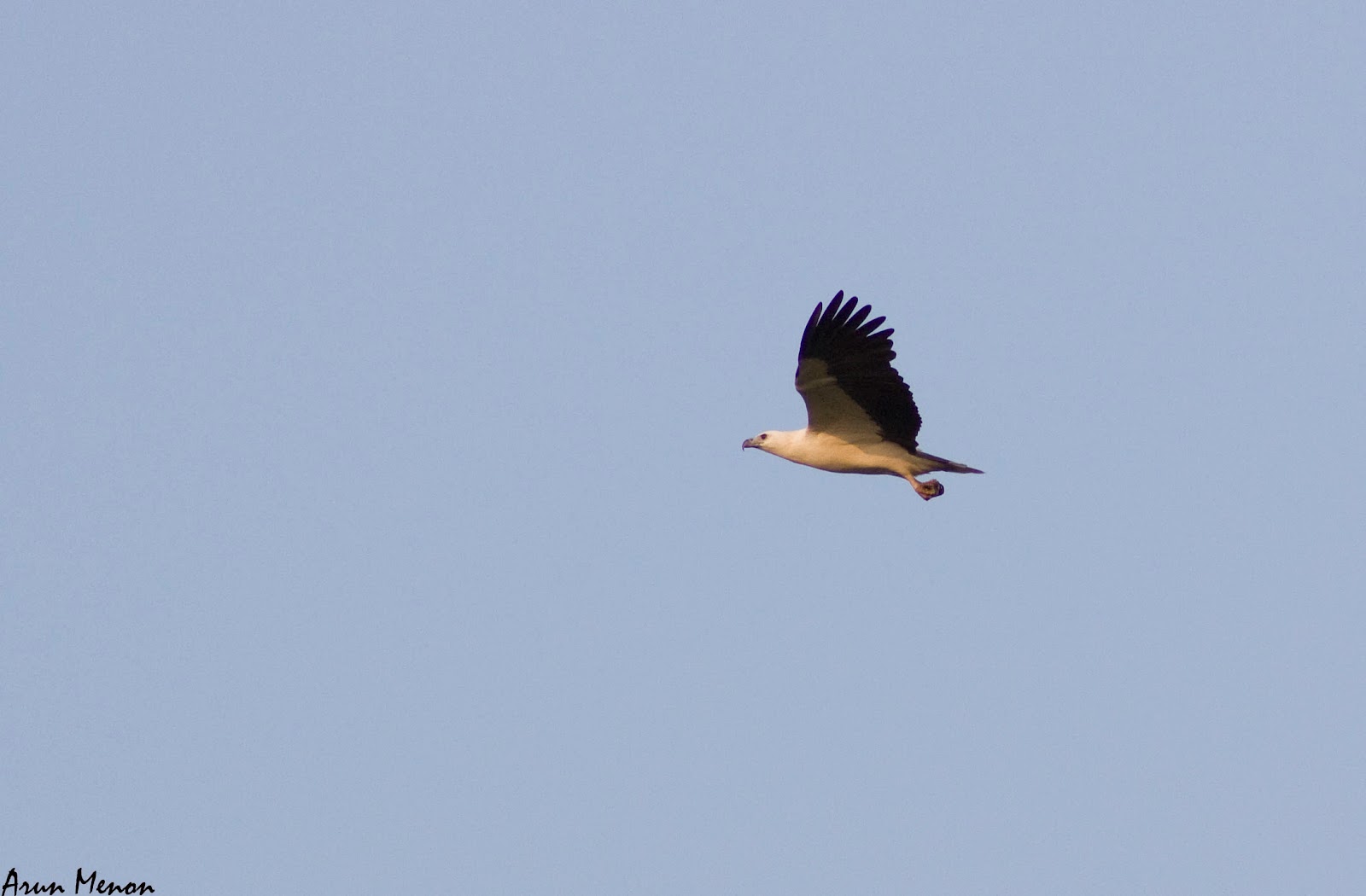
White-bellied sea eagles are ashy above with a white head, neck and underparts. The scientific name Haliaeetus leucogaster roughly translates to 'sea eagle with white stomach' (hali = salt, aeetus refers to eagle, leuco = white and gaster refers to stomach). The underside of the wings are white-bordered with broad black covering the primaries and the outer and inner secondaries. The secondaries are broad and appear bulged against the line of the wing. The wedge-shaped tail has a stiff black band across it. While sailing, the wings almost always maintain a wide 'V' shape.
Salim Ali, in The Book of Indian Birds, states that if undisturbed, White-bellied Sea Eagles occupy the same locality or nest for years together. Though scores of visitors to the beach don't seem to bother the pair for now, I am concerned for the future as there are not many lofty trees left along that stretch of beach. I hope they remain undisturbed for years to come and successfully raise future generations.
I remained there, observing the Sea Eagles until darkness crept in. I bade them goodbye and I guess they heard me, for one of them waved back.
Text and photos: Arun
Read more posts in The Green Ogre's Raptor Friday series

I remember that day more than four years ago. We were heading to the beach from college after a long, tiring day. As we walked along the narrow road chatting, I caught sight of a huge white bird, black underwing, soar just above us. As I looked up in awe, another followed suit bearing excess baggage in its talons -- a snake! I had just seen a pair of White-Bellied Sea Eagles returning after successfully hunting a sea snake!
For the first time in months, disregarding the slip disc I had suffered, I ran to locate the eagle’s perch. My friends ran after me to make sure I didn't collapse from the exertion. The pair of raptors flew into a walled compound bordering the beach. Scanning about for a good five minutes, I found both birds on an open perch. One, presumably the female, was feeding on the snake. The other, probably the male, was slightly smaller in size as is the case with most raptors.
After this encounter I saw them several times during my two-year college sojourn. They nested on a tall casuarina tree on the beach, very close to the water. It was an enormous construction of more than 3 feet diameter and was approximately 40 feet above the ground near the top of the tree. Although I saw the birds build and maintain the nest, I never saw them exhibit any behavior that accounted for raising chicks such as fetching food or lingering near the nest.
 |
| The eagle with a fish |
I looked up and saw the sea eagle flying in with a fish in its talons. As we watched, it made for the clump of trees that housed the nest.
 |
| The eagle on its nest |
This bird then headed out to sea and returned within a couple of minutes, landing close to the nest. Then the first bird took off. At any given time one bird remained near the nest. They took off and landed so many times that I lost track of the take-offs and landings. Although all this activity near the nest made me curious, I had no way way of confirming occupancy.
 |
| The eagle carrying the thin body of the half eaten snake |
 |
| 'V' shaped wings while sailing |
I remained there, observing the Sea Eagles until darkness crept in. I bade them goodbye and I guess they heard me, for one of them waved back.
 |
| Waving goodbye |
Read more posts in The Green Ogre's Raptor Friday series
Also see our Encounter series