We’ve moved! Here’s where you can find us

The Green Ogre is now at https://www.greenogreindia.org
Showing posts with label forest department. Show all posts

All's not well in the bat-cave

If we as a people so revere nature, why do we go to so much trouble to disfigure it?
The view from Kavala Caves, Dandeli
Is there a legit word ending in “phobia” for the fear of being ripped off? Whatever it is, it was on our minds when we set out early in the morning from Dandeli's Kulgi Nature Camp for a safari. Safaris are always dubious deals – at the outset you are force-fed the disclaimer that every sighting banks on “good luck”, which is thereafter effectively neutralised by the grunting and gnashing diesel vehicle that ferries you around the forest.

Our destination that morning was Kavala Caves, 25 km inside the forest and accessible only by a 2 km walk from a waterhole where the jeep track ends. Part of that walk also descends into a valley from where you can see and hear the roaring rapids of the dark and beautiful Kali river.
The Kali is a gorgeous, gushing torrent of darkness
Birders can be exasperatingly enthusiastic morning persons and our poor “guide” hadn't bargained for that when he fixed our itinerary the night before. Well before the appointed hour we roused his recumbent self with hollers and heavy knocking. To the end that he very evidently forgot to brush, and every time he turned to us to proffer guidance we shrank back, nearly asphyxiated.

When we left, the camp was still in darkness and pale veins of dawn light were draining the ink from the sky. In the murky forest we passed the odd shadowy elephant and several feral buffaloes that played tricks with our eager eyes. As the day brightened we saw spotted deer, jungle fowl, peacocks and a solitary barking deer.  


Our walk to the caves took longer than usual, much to our impatient (and perhaps hungry) guide's chagrin. En route, we stopped to chase butterflies, admire a displaying Black-naped Monarch and an Elliot's Forest Lizard. Our first sighting of Malabar Pied Hornbills occurred on this walk. There were enough sunbirds, ioras and swifts en route to delay us further. Then we argued over a Shaheen Falcon's identity, some of us contending that it might have been a Black Baza. Morning light and its myriad tricks! 


In the mouth of the cave, which has effectively been transformed into a shrine
Winding steps led us down to the cave. As we approached it, a familiar haunting reek of disused attics assailed us -- the rank odour of bat droppings. These were limestone caves and the interiors should have been white or, at least, whitish in appearance. But then again, caves with stalagmites and stalactites have long awakened religiosity in kindred souls and, true enough, the stalagmites here are worshipped as Shivalingams. 


Stalactites darkened with soot


The interiors of a limestone cave are usually white or whitish, unlike these darkened by oil and smoke from offerings
On Mahashivaratri, which falls every year in February or March, thousands of pilgrims are allowed into the national park. And they bring along votive offerings in incense sticks, oil for lamps, cotton wicks, coconuts, bananas, flowers, earthen lamps, milk in sachets and packed refreshments to nourish them on their pilgrimage. And how did I know all of this? Just by looking around. 
The inside of the shrine houses a stalactite that is worshipped as a Shivalingam, and our guide quickly got down to business and was perhaps slighted when we did not join in
Our guide was also possessed of sudden devotion inside the cave and he lit the incense sticks that he had brought along. Later, when I brought up the matter with him, he seemed offended that I should place the welfare of sundry forest creatures over the appeasement of the Almighty. If only our forest staff could be trained to differentiate among simple priorities.


We traversed parts of the cave on bended knee, and sometimes all fours
The task of cleaning up after religious rituals is left to the Lord who, having other things on His agenda, never gets round to it. Over the years, garbage has accumulated in and around the caves. Carrying it all back to Dandeli is an idea that has never occurred to those responsible for the park's maintenance, and the caves' distance from the nearest camp doesn't help its cause.
Pligrims have dumped leftover grain under a tree outside the caves
Once inside the caves, parts of which we traversed crawling on all fours, we were aghast to observe that the interiors were blackened with soot. The smooth limestone structures were discoloured from so many years of touching. It was also hot and humid and we started to feel slightly claustrophobic.
Pilgrims have left behind litter of every description
As we emerged from another part of the cave towards the light, we disturbed several roosting bats, which flitted in and out uttering tiny shrieks -- perhaps the only human-audible sounds in their ultrasonic repertoire. None of us were bat experts, and we couldn't determine the species. The bat had large ears, a longish, slightly upturned snout and a dark brown stripe on the sides of the throat. I managed a decent photograph, which might help us identify it.


Bats inside the cave
We returned from the caves struck by their beauty but appalled at how they had been ritually defiled. This experience was in stark contrast to one I enjoyed at Mercer Cavern, a limestone cave in California, which I had visited in 2001. While those caves had no bats, they were nearly pristine, illuminated thoughtfully in white and beige and pink, with only one calcite structure reserved for visitors to touch and feel. Unfortunately, even if we get round to addressing our problems, we will always have too much of religion to deal with.


Text and photos by Beej
Read other posts from Dandeli

Oh fish, no hooks, no line, no net!

Or how to spice up your dinner with an old pan, a tattered towel and a lump of cooked rice!
The Chalakudy River brims with fish
I've waded in murky ditches to catch guppies, chased shrimp in paddyfields and baited crabs with my fingers. Despite being an intrepid piscivore (hailing as I do from Kerala) I've never fished for sport, or for the pot. I have ideological reasons for that, though they have never stopped me from watching anglers pursuing golden mahseer with a tiny nudge of voyeuristic longing in my chest, or from enjoying Norman McLean's A River Runs Through It


Fishing doesn't bother me as such, but I'm troubled by the legality of fishing inside a protected wildlife reserve. Every once in a way you can see how forest department staff bend the rules ever so slightly to their advantage. What's with a few tiny fish anyway, eh? The streams are just rippling with them.


On our trip to Parambikulam in January we walked the 18 km length of the erstwhile Cochin Forest Tramway -- now a broad path, littered with rusty bridges, cutting right through the heart of the beautiful sanctuary. At the end of the trail is a guest house where we were put up for the night. It had no amenities apart from a room with three narrow cots to accommodate four tired bodies. But the gurgling Chalakudy river was our pleasure palace -- we lounged in it and let the stress of the day's long, hot walk dissipate into the all-consuming water. There were Nilgiri Langurs in the trees, and dragonflies, butterflies and damselflies to occupy our attention on the ground. Underwater, fish tickled our feet, evoking nervous schoolgirl-like giggles from four grown men.


Presently Manoharan, one of the three forest guards who had accompanied us, came down to the river and remarked at how it was brimming with fish. They were the young of a large river fish, he said, which was very palatable. Clearly, that was no academic observation. We watched with surprised interest as he got down to work. He had no line, no hook, no fly or net. He took a shallow pan and fastened its mouth with a thin cotton towel that Mallus call thorthu. He gouged a really small hole in the taut cloth and placed a ball of cooked rice at the bottom of the pan, which he then placed in the river where the fish were swarming. We sat back and watched as the pan filled up with fish attracted to the bait. They stampeded in through the hole but were unable to escape once in. 


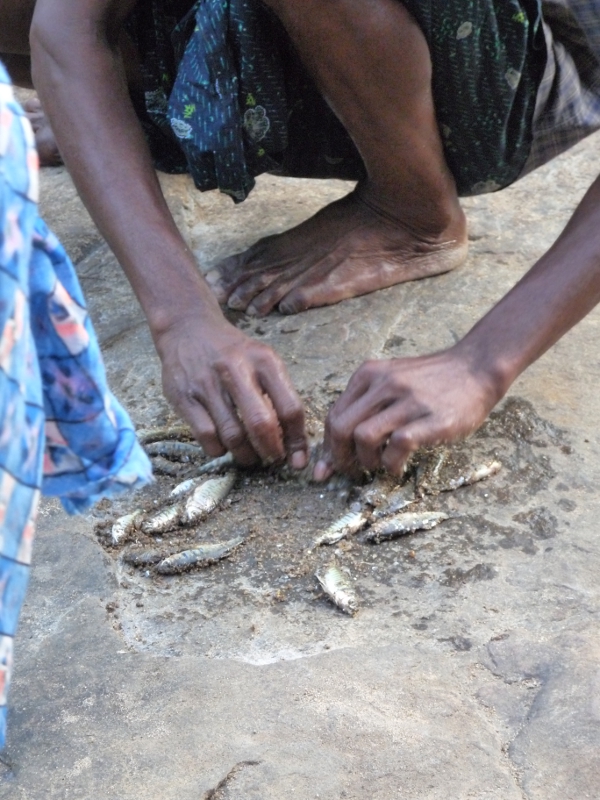
When the pan was sufficiently crowded with fish, Manoharan scooped it quickly out of the river. He must have caught at least a dozen small fish. His companion scooped a hole in the sandy bank and emptied the pan. Struggling, the fish gasped in the shallow puddle until life ran out. Meanwhile, our man expertly gilled and gutted his catch, shaving off the scales by rubbing the fish with river sand against a slab of rock. He pinched the heads off and tossed them into the river for its cannibalistic kin to dine on. Dismembered, the fish looked hauntingly inert, both in the aluminium mug that held them, as well as in the river that had once rippled with life.


If it was any consolation, we didn't get to eat any.


The pan is placed in the stream

In a few seconds the fish begin to bite

Gasping for air on the sand, the fish are left to die

Certified dead, and ready to be cleaned

That's the day's catch - enough to make a fiery side-dish

Sand and rocks are made for descaling fish

Look at how the scales come off

The heads are pinched off and tossed into the river

Ready for the pot

Text and photos by Beej

Mumbai's trash flows from urban jungle to national park

There's a good reason to keep humans out of forests: Trash!

Some people stood here to enjoy the scenery, and left behind evidence of ample enjoyment


At birdsofbombay, Sunjoy Monga posted about a cleanup drive in Sanjay Gandhi National Park. A tireless team comprising schoolchildren and other volunteers recovered a large amount of trash from the national park, which is a virtual ghetto inside the city. 


And guess what most of the trash consisted of? Booze bottles - some half-full, others half-empty. Empty foil packets of wafers and gutkha - that awful-smelling stuff that some people sprinkle into their mouths from an elevation of half a foot. Now, this is must be a truly amazing way to celebrate Wildlife Week, no? 


When the Forest Department wakes up from its stupor, maybe it will give us some sober answers. I've seen this happen in every national park that I have visited - Bandipur, Mudumalai, Nagarahole, Bhadra, Periyar. For most of us urban chameleons, national parks offer a perfect hideaway from the city. But what some people do when they go there is unpardonable. 


Most national parks have effete, unconvincing signboards emblazoned with some weak cliche about saving our forests. Few of them offer the real reasons why you should not travel with stuff that tends to become trash. And if you do, why you should take your trash home. Most forest department workers are not educated about this aspect in the first place, so enforcement is not even on the horizon. 


Was it illiteracy or plain insensitivity that led people to litter below a signboard entreating them not to do so?
I once travelled on a safari in Bandipur with a bunch of engineering college students. One of them was playing music on a Walkman so loud that all of us could hear the screech of the playback singer's sibilants and the thump of jhankaar beats. I'm sure the animals heard him, too, a mile away. And, helped ably by the rattle and trundle of the diesel van that took us on the safari, we saw nothing but jungle fowl and the backside of an elephant. 


At Muthodi, my friends and I came across a group of surly drunks at the Shegekan Guest House. We hoped to stay here in order to have convenient access to the sholas. The Forest Department put us up at the dormitory downhill, denying us permission to stay at the guest house because someone connected to a minister had booked the place. Driving up, we heard the tinkle of bottles even before the guest house came into view. 


And, even as we stood watching Crimson-backed Sunbirds in that horrible garden planted with many exotics including a Christmas Tree, a couple of unsavoury characters argued loudly on the balcony, their beers and rums having gotten the better of them. We grumbled to the caretaker but got nothing except a helpless smile. And steel tumblers of coffee, at our expense. I stepped close to him unwittingly, and - sniff, sniff - my nose discovered the reason for his nonchalance. Booze makes quick friends. And if you have a quarter bottle to spare, rules melt like an ice cube in a glass of neat double malt.