We’ve moved! Here’s where you can find us

The Green Ogre is now at https://www.greenogreindia.org
Showing posts with label raptor friday. Show all posts

Raptor Friday: The White Tiger of the shores

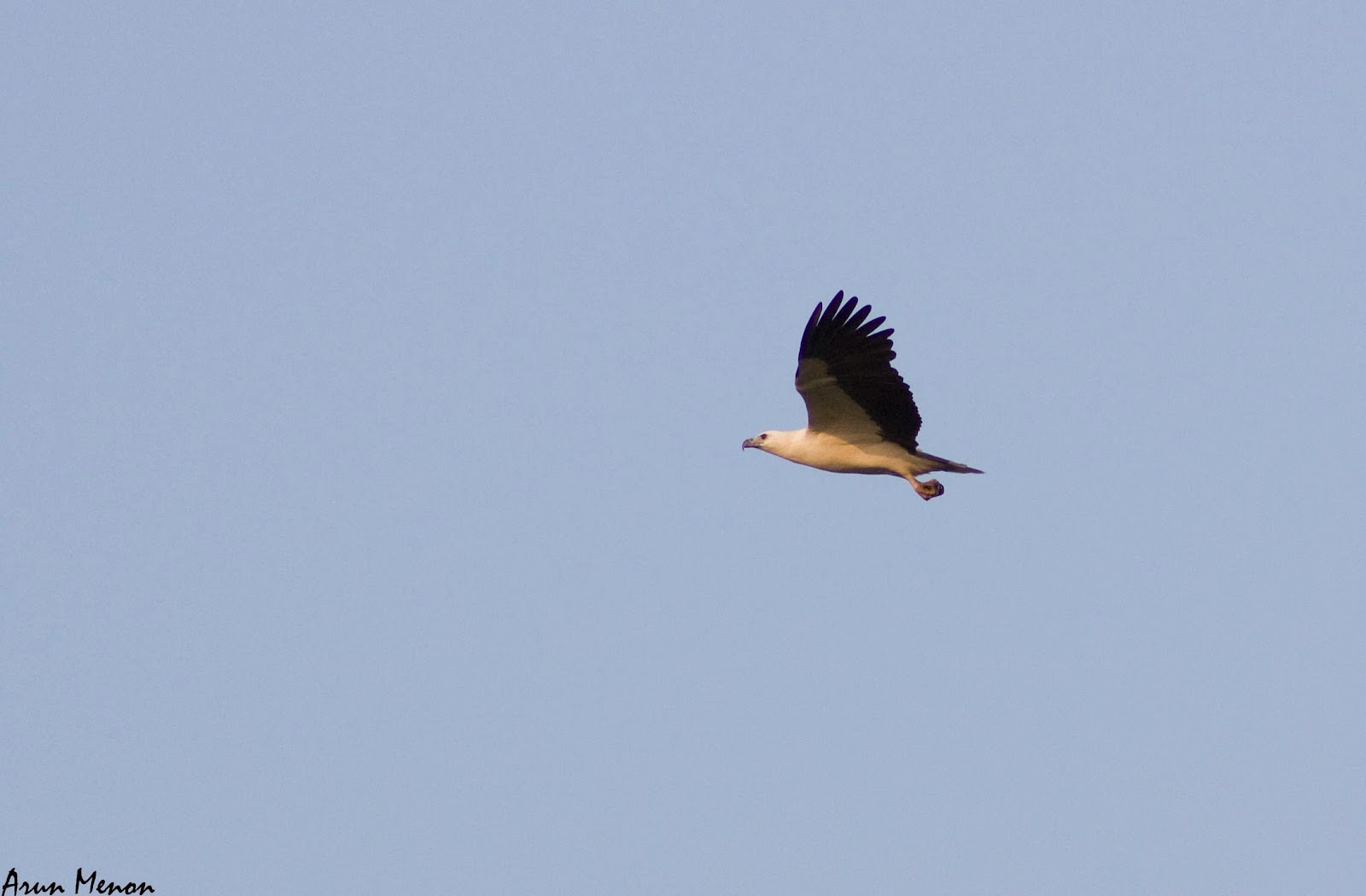
On broad soaring wings, the mighty White-bellied Sea Eagle patrols the coastline, plunging every now and then into the ocean for fish or sea snakes. Its aerobatic displays can make test pilots envious. If you see one, stop and watch.


I remember that day more than four years ago. We were heading to the beach from college after a long, tiring day. As we walked along the narrow road chatting, I caught sight of a huge white bird, black underwing, soar just above us. As I looked up in awe, another followed suit bearing excess baggage in its talons -- a snake! I had just seen a pair of White-Bellied Sea Eagles returning after successfully hunting a sea snake!


For the first time in months, disregarding the slip disc I had suffered, I ran to locate the eagle’s perch. My friends ran after me to make sure I didn't collapse from the exertion. The pair of raptors flew into a walled compound bordering the beach. Scanning about for a good five minutes, I found both birds on an open perch. One, presumably the female, was feeding on the snake. The other, probably the male, was slightly smaller in size as is the case with most raptors.


After this encounter I saw them several times during my two-year college sojourn. They nested on a tall casuarina tree on the beach, very close to the water. It was an enormous construction of more than 3 feet diameter and was approximately 40 feet above the ground near the top of the tree. Although I saw the birds build and maintain the nest, I never saw them exhibit any behavior that accounted for raising chicks such as fetching food or lingering near the nest.


The eagle with a fish
This December, more than two years since I left college, I paid the site a visit with my camera. And this time I did see some activity near the nest. While walking down the same narrow road towards the beach, I told my friend Amith that I hoped to see something interesting. Almost immediately he exclaimed, “Snake!” I turned to see a huge rat snake slither across our path. I considered this a sign of luck. With a wide grin I continued walking. On reaching the beach, we found sandpipers foraging close to the water. While I was trying to get close to them Amith said, “Isn’t that the bird you are looking for?” 


I looked up and saw the sea eagle flying in with a fish in its talons. As we watched, it made for the clump of trees that housed the nest.
The eagle on its nest
On reaching the trees we saw the nest and its owner perched next to it. I am not sure what happened to the fish - did it store it to be eaten later or pass it onto a chick in the nest? Presently, its partner flew in from behind the trees with something in its talons. I shot a picture and reviewed it on the LCD screen -- a small, half-eaten snake. 


This bird then headed out to sea and returned within a couple of minutes, landing close to the nest. Then the first bird took off. At any given time one bird remained near the nest. They took off and landed so many times that I lost track of the take-offs and landings. Although all this activity near the nest made me curious, I had no way way of confirming occupancy.
The eagle carrying the thin body of the half eaten snake
White-bellied sea eagles are ashy above with a white head, neck and underparts. The scientific name Haliaeetus leucogaster roughly translates to 'sea eagle with white stomach' (hali = salt, aeetus refers to eagle, leuco = white and gaster refers to stomach). The underside of the wings are white-bordered with broad black covering the primaries and the outer and inner secondaries. The secondaries are broad and appear bulged against the line of the wing. The wedge-shaped tail has a stiff black band across it. While sailing, the wings almost always maintain a wide 'V' shape.


'V' shaped wings while sailing
Salim Ali, in The Book of Indian Birds, states that if undisturbed, White-bellied Sea Eagles occupy the same locality or nest for years together. Though scores of visitors to the beach don't seem to bother the pair for now, I am concerned for the future as there are not many lofty trees left along that stretch of beach. I hope they remain undisturbed for years to come and successfully raise future generations.


I remained there, observing the Sea Eagles until darkness crept in. I bade them goodbye and I guess they heard me, for one of them waved back.
Waving goodbye
Text and photos: Arun
Read more posts in The Green Ogre's Raptor Friday series
Also see our Encounter series

Raptor Friday: Crested Serpent Eagle

What's the fuss about the Serpent Eagle's crest? At first glance, it isn't even there. But wait and watch...
I first ran into the Crested Serpent Eagle (Spilornis cheela) in BR Hills on my first-ever trip with Beej, Sahastra and Sunita, and I wondered why those who named this bird thought it was crested. Why not Bulge-eyed Serpent Eagle? To me, the Changeable Hawk-eagle (Nisaetus cirrhatus) -- earlier known by its well-deserved name of Crested Hawk-Eagle -- ought to have benefited from any title that contained "crest".
Majestic in flight
This dark-plumaged forest eagle had no visible crest though even without it, the bird was captivating: the huge yellow eyes sported a don't-mess-with-me stare, with a proud hooked beak and heft to match. And the ease with which it zipped in and out through the forest trees! Juveniles, I understand, are paler to the extent of being almost white, and have a white and black pattern on the back of the head. When in flight, the underside of the flight feathers and tail feathers show distinct black-and-white bands.

It took me a few sightings to realize the name was not in vain. A few times I saw the hint of a crest when wind ruffled the head feathers, and I was lucky to capture one such moment from a distance.
Any doubts about the crest?
I have spotted Crested Serpent Eagles increasingly in the suburbs of Mysore after my first sightings, which were in dense forests. Once I saw one in a mango grove, taking off from a tree upon seeing us. Another time, a juvenile was being mobbed by crows near Infosys Mysore campus. Essentially, though, they are forest birds, keeping themselves to mid-canopy on the lookout for snakes, as their name suggests.
A juvenile mobbed by crows on the outskirts of Mysore
A raptor is handsome in a deadly way and the Crested Serpent Eagle is no exception. Handsome to us and deadly to snakes, and thankfully, pretty common in reasonably forested localities. Hope it stays that way...

Text and photos: Sandeep Somasekharan
All rights reserved
View other posts in our Raptor Friday series

Raptor Friday: Long Billed / Indian Vulture.

Vultures are the most misunderstood of birds despite the fact that Hindu mythology associates them with virtue rather than evil. In the last decade, our callousness has led to a huge decline in their numbers. But it isn't too late, we think...


Vultures are not really everybody's favourite birds. Traditionally, they have been associated with war, death and doom. Pathetic imitations of vulture calls have been used in popular cinema to signal the entry of villains, possibly to convey the impression that "now the vultures shall feed." Little do we realise that these birds face a fragile future, driven as they are to the verge of extinction.

I had heard a lot about Indian Vultures (Gyps indicus) and one fine morning I drove to Ramanagaram, near Bangalore, to see them. My first sighting was of a bird mobbed by crows flying away from one of the huge monoliths on which they typically nest.
An Indian vulture all hunched up, perhaps mulling over the future? Don't miss the "vulture paint" on the rock ledge
As my friend and I walked beside the rock trying to spot the birds I noticed some construction activity (later I learned a resort was being built nearby). The much talked about 'Sholay' village is also being planned near this place as the movie was shot here in the 1970s. It was evident that the activity due to resort construction has disturbed the vultures roosting there. Where there used to be about 20 vultures I couldn't spot even one. Looking around I finally saw two birds perched on a ledge a fair distance apart.
The desolate landscape adds to the melancholy mood
The ledge in itself was ornately decorated with "vulture paint" -- stripes of white formed by the birds' droppings over time. We waited till past 8 am, when we assumed the thermals would become stronger. Precisely at 8:15, the vultures took off one by one. Spreading their thick wings they lifted off with seemingly impossible ease, considering their bulk.


A vulture soaring inspires awe
The Long-billed Vulture is smaller and less heavily built than the Eurasian Griffon (Gyps fulvus), and its head and neck are darker, and the beak paler, in comparison. Also, the lack of white tips to the median coverts is one way to identify them.

Vultures, hardy birds that thrived on carrion, have been driven to the verge of extinction: nearly 99% of the population has been wiped out due to the use of Diclofenac, a veterinary drug administered to livestock. Vultures that feed on the carcasses would die of renal failure brought about by the drug. Though Diclofenac has been banned, farmers still have access to variants of the drug used for humans and hoarded stock. 

The Indian Vulture is no phoenix but let's hope, pray and spread awareness so that it may rise again.

Text and photos: Sandeep Somasekharan
See our other posts on vultures and Diclofenac

Raptor Friday - Last Hope for Disappearing Vultures

There are enough roadkills, but why are vultures absent from our skies? An independent filmmaker explores the reasons
Himalayan Griffons engage in a scuffle
Several animals are killed in road accidents but we hardly see any vultures hovering above and swooping down for a cleanup operation. Ever wondered why? Neloy Bandyopadhyay's film on vulture conservation The Last Hope aims to highlight why these efficient scavengers are absent from our skies. Anand Yegnaswami catches up with the man and his work.

Excerpts from an interview to The Green Ogre:

Could you please share in your words what the film "The Last Hope" was about?

The Last Hope is a film about the relentless struggle of vulture conservationists in India and this subcontinent where activists are fighting a tough battle to protect this great scavenger bird from the brink of extinction. The film is made to create awareness about the importance of the vulture in nature, and against the use of a drug which is the main reason for the [decline] of the vultures.
On the sets of the film
Why did you pick vultures as your subject?

The scenario of the numbers of vultures in India is worrisome. If we don’t take proper action right away, we will probably lose this great bird forever. The vulture doesn’t have the great looks of the tiger, lion or rhino, but from an importance perspective it’s a great bird.

Why are vultures such an important part of the ecosystem and what is the need to protect them?

Vultures play a crucial role in the food chain. They eat carcasses. In India, and the subcontinent, it has been an age-old practice to [dispose of] dead domestic animals in the dumpyard. Vultures can eat an animal the size of a bull within an hour and leave little chance for diseases to spread.


A hide used to film vultures at a carcass without disturbing them
Could you elaborate on the vulture conservation efforts that you came across while making the film?

The killer drug [Dicofenac] has been banned. Some NGOS are working towards vulture conservation. Bombay National History Society is working on a captive breeding programme. However, we have a lot to do to save this species.
Himalayan Griffons
What are the factors hampering vulture conservation? Are there threats other than Diclofenac that pose a danger to the vulture population?

Diclofenac is the main reason. To save vultures we have to ban the use of this drug. Today, Diclofenac meant for humans is being used on cattle.
Long-billed Vultures at a nest
How long will it take for the vulture population to bounce back from the effects of Diclofenac?


Unfortunately, the breeding cycle of vultures is pretty slow. They lay one egg per breeding cycle. We have to take extra precaution and we have to phase out Diclofenac immediately and completely. If we can do that I am sure the vulture population will [be restored] to a substantial number.
During the making of the film
Now that you have completed this film, how do you plan to get the message of conservation across?


Broadcast this film as much as possible.


Neloy works as a IT security consulting manager in Bangalore. He is a nature lover and wildlife enthusiast with a passion for cinematography and photography. In addition to The Last Hope, Neloy has also filmed a documentary on Snow Leopard conservation, An Unavoidable Disagreement.

Anand Yegnaswami is an IT professional and an intrepid nature enthusiast. He has contributed previously to The Green Ogre.


All photographs in this post are the copyrighted property of Neloy Bandyopadhyay and are used here with his kind permission.


This is a special edition of our series Raptor Friday. Read more about vultures and diclofenac in The Green Ogre archives.

Raptor Friday: Brahminy Kite


Though dirt-common, the Brahminy Kite is both gorgeous and majestic if you care to give it a second glance
An adult Brahminy Kite surveys the landscape beneath overcast skies
To quote my good friend Nikhil: "The only mistake the Brahminy Kite ever committed that made him a non-celebrity among birders is that he became a little too common." That sums up the Brahminy Kite (Haliastur indus) for you. Elegant, breathtakingly colorful, and boasting of a close-to-divine place in Hindu mythology and religion, it happens to be only a little too common for people to take a second glance... 

Back in my childhood, my mother used to say that sighting the bird (called Krishnaparunthu in Malayalam) brought luck as it was a harbinger of god's blessings.
A couple shares an intimate moment
The bird, which occurs widely across Asia, has many names. In India it is the Brahminy Kite and Garuda (the steed of Lord Vishnu, the preserver of the Hindu divine trinity). Elsewhere, it is known as the Red-backed Sea Eagle.
An adult Brahminy Kite keeps watch from a high vantage point
Adults have a white head, neck, breast and nape and chestnut-brown wings darkening to black wingtips. The beak is pale yellow, almost ivory-coloured, and the eyes are black. Juveniles have duller, brownish plumage and can be distinguished from the similar-coloured Black Kite by the rounded tail. The call, a shrill "keeew", sounds a little meek for so majestic a bird.
Two juveniles soar - the rounded tail is diagnostic in differentiating it from Black Kites
The Brahminy Kite is found mainly around water bodies, fishing on the wing. They also feed on crustaceans, amphibians, insects, reptiles, birds (including poultry), small mammals and occasionally carcasses.
A good catch to start the morning
The bird has managed to thrive amid rapid urbanization, finding its food in garbage dumps and large open drains.

Text and photos by Sandeep Somasekharan

Raptor Friday - Eurasian Marsh Harrier

Why are male Eurasian Marsh Harriers so hard to come by in winter?
A juvenile, banking in flight

With early winter the wetlands of India become the haunt of a chocolate-brown raptor, some individuals showing an odd facial coloration as if affected by leucoderma. This, to the uninitiated, is the Eurasian Marsh Harrier (Circus aeruginosus), also known as the Western Marsh Harrier.


A closer look at a juvenile
I have often seen this bird in wetlands, sailing above the reeds, eyes fixed below, concentrating on the happenings in the reeds. It hovers momentarily above spots where prey is spotted, and makes a dive towards the target.  This behaviour, which appeared to some observers that the bird was in search of something it had lost, earned it the name Kari thappi - Malayalam for "one who is searching for coal". 


A juvenile conducts a thorough search over a swamp
Juveniles exhibit a chocolate-brown body, brown eyes and a bleached throat and crown. As the bird ages its plumage darkens and the underwings develop white bases to the primary flight feathers. The eyes start to turn yellow. Females, though, take longer to develop this jaundiced-eye look but compensate with their larger size.  


In males the proportional contrast between the wingtips and the rest of the wing is extensive, offering one of the best identification characteristics for this bird while it is in flight. I have seen juveniles and females aplenty, but never an adult male.
Adult female in flight

This winter, however, I didn't spot a single Marsh Harrier. I'm not sure what made them skip their regular haunts. Perhaps they were dissuaded by the disturbance of their habitats around Mysore thanks to the widening of the Outer Ring Road. Or maybe it was because the rainy season was late and prolonged. Whatever be the case,  I can't wait for winter. This time I'll scour every possible field to sight a male.


Text and photos: Sandeep Somasekharan
All rights reserved

Raptor Friday - The Lesser Fish-Eagle

Formerly thought to be a resident of the Himalayan foothills, the Lesser Fish-Eagle has pleasantly surprised us by nesting along rivers in southern India

Formerly thought to occur only in the Himalayan foothills, the Lesser Fish-Eagle has now been confirmed as a resident breeder along the Cauvery River in Karnataka as well as river islets in Kerala, both in southern India
The Lesser Fish-Eagle (Ichthyophaga humilis) was believed to be a resident of the Himalayan foothills until recently when there has been a flurry of sightings along the Cauvery river in Karnataka. Other recent reports also confirm that the bird is a resident in southern Kerala (see notes below).


Let me tell you before I begin that 'lesser' is a relative term, to be taken literally only when comparing this raptor to the Grey-headed Fish-Eagle (Ichthyophaga ichthyaetus). In no way should this bird be mistaken for a diminutive creature as it is more than two feet tall when perched, with an impressive wingspan.
All of my three sightings have been in the Ranganathittu Bird Sanctuary near Mysore. The bird would perch on a branch overlooking the river, appearing pensive. On all three occasions, when our boat drew close the bird took off, never to be seen again that day. To watch it fish remains a dream unfulfilled.
The extent of white in the Lesser Fish-Eagle's plumage are a distinguishing mark to identify it against the closely related Grey-headed Fish-Eagle
As its name suggests the Lesser Fish-Eagle feeds on fish and is hence found mostly along riversides. The head is grey, the chest brown and the wings are a deep brown. The belly and thighs are white and the tail is dark. In the field, the primary distinguishing feature to tell it apart from the Grey-headed Fish-Eagle is to observe the area where the white parts of the bird end. In the Lesser Fish-Eagle, the white area ends abruptly at the beginning of the tail. In the Grey-headed Fish-Eagle, it extends all the way to the tip of the tail where it terminates in a thick, dark band. 


Both the Lesser Fish-Eagle and the Grey-headed Fish-Eagle are listed as vulnerable (VU) in the IUCN Red List.


Notes:
1. The latest issue of the journal Indian Birds (Vol. 7, No. 1), April 25, 2011 carries a comprehensive report on the breeding of the Lesser Fish-Eagle in Cauvery Wildlife Sanctuary, Karnataka, India. The report is authored by Dinesh Ramarao, Dipu Karuthedathu, Mohanram K, Prakash H L, Raju A K, Sreekumar H, Srikanth Kumar and Vinay Das


2. A separate report in the same issue of the journal, by C Sashikumar, C K Vishnudas, S Raju, P A Vinayan and S Kannan, informs us that the Lesser Fish-Eagle is a breeding resident in Kerala including reservoir islets in the Parambikulam and Periyar forest areas.


Text and photos by Sandeep Somasekharan
All rights reserved

Raptor Friday: The Shaheen Falcon

Two Ogres compare notes about their respective sightings of a fast-flying falcon. Was that a Peregrine or a Shaheen?


Sandy: I saw it fly at a height where it looked like a fast-moving orange-and-black speck in the sky. The wing-flapping wasn't anywhere near furious, but every flap propelled it further ahead with amazing thrust. I managed a shot, and later identified it as a Shaheen Falcon (Falco peregrinus peregrinator). Since then I have enjoyed multiple sightings of the bird as it zipped past or perched on trees high up with no intention of leaving the place for a long time.


Arun: There is a lot of confusion between the Peregrine Falcon (Falco peregrinus calidus) and the Shaheen Falcon among newbie birders, despite the fact that both are quite distinctive in appearance. The different naming conventions followed by guidebooks and websites only deepen the confusion. Grimmett and Inskipp refers to both races as the Peregrine Falcon, while differentiating them as two sub-species. Salim Ali and Rishad Naoroji list them as two species.


The Shaheen Falcon, a resident of the Indian subcontinent, is smaller than the Peregrine Falcon, which is a winter visitor. It has a rufous wash on the underside with black speckles, whereas the Peregrine's underside is white with black speckles. The black hood over the head, the yellow ring around the eyes (similar to most other falcons), huge talons and a no-nonsense beak make these birds look mean and menacing, but they are more famous for something else! Yes - the dive!


A Shaheen shows off its wingspan near Bangalore
The birds are known to hunt other birds, at times even smaller raptors, in mid-air. They dive at a breakneck speed of over 300 kmph, the fastest recorded among birds while taking prey in mid-air in most cases. Hunts take place at dawn and dusk mostly, when the prey is most active, though night-time predation of migratory birds has also been observed. They are seen in a wide variety of habitats, and reign supreme as master hunters -- Shaheen in Persian means king of birds.

A Shaheen Falcon photographed at Dandeli

Text and Photographs: Sandeep Somasekharan and Arun Menon

Raptor Friday - The Shikra

I have a faint memory of my grandmother telling me about a small bird that swooped down from the trees and picked up the young chickens that she reared on her little farm. She called it "eramullan" in Malayalam. I had always wondered what it might have been but I never had a chance to see it considering that my visits were brief ten-day affairs. 
An adult, probably male (from the orange eyes), stretching on its perch on an early morning
An immature, with the underside plumage showing indications of transition 
 
My first brush with the Shikra (Accipiter badius) was at Mysore. I saw it perched on the branch of a small tree at Kukkarahalli Lake. The bird also goes by other names, such as Little Banded Goshawk, Little Banded Sparrowhawk, Indian Sparrowhawk, Northern Shikra, Shikra Goshawk, etc. Though I had seen the bird in photos my first sighting was so close that I got a very good look at its hooked beak and severe-looking talons.

An adult male, clearly an older one as indicated by the red eye
An adult, probably male, in flight
Ever since I have seen the Shikra everywhere -- atop the terrace of the building next door, on electric poles, coconut trees, circling above... The flight pattern is like that of other Accipiters -- a series of quick wing-flaps followed by a glide.   

The Shikra exhibits two plumages, primarily. The young ones have brown upperparts and are heavily barred with yellow eyes. As they mature, the upperparts turn uniform slate-gray and the underside becomes heavily barred with horizontal rufous stripes. The mesial stripe becomes less distinct as the bird ages. The male, as it becomes older, develops a red iris while the female, larger in size as with most raptors, have deep yellow or yellow-orange eyes.

A fully grown female
Shikras feed on a variety of prey. I have seen them pick up winged termites immediately after the rains, chase pigeons unsuccessfully, swoop down upon Calotes lizards and -- on one occasion -- I saw it attack a grey francolin (Francolinus pondicerianus). In the last case, the francolin made a desperate attempt to get away by taking to its wings, though I couldn't see what became of the chase that ensued.

An adult, older male perched on a gate in the outskirts of Mysore 
 
Shikras are hardy birds that have managed to survive the threats of urbanization. They are found all over the varied landscape of the Indian subcontinent, except on the upper reaches of the Himalayas. 

Trivia - the Indian Navy has named one of its helicopter carriers INS Shikra. The word is derived from the Hindi "Shikara", meaning "hunter".

Text and photos by Sandeep Somasekharan

Raptor Friday - The Common Kestrel

The Common Kestrel (Falco tinnunculus) is a migratory falcon that visits the subcontinent in winter; though the bird is resident in the Himalayas and to a smaller extent in the Western Ghats. My first sighting was of a female, beyond the hills of Ooty, as she hovered along the slopes trying to locate her prey. Since then, every year I have had at least one close encounter with this fascinating falcon, the closest being in March 2009 when a female allowed me to stay within a few metres for about half an hour.

The female, identified by the overall barring and black moustachial stripes. As in the case of many raptors, females are larger than males 
Identifying the Common Kestrel is simple as the bird has unique features. Compared with the similar-looking Lesser Kestrel, this bird has two moustachial drop stripes running down from the eyes and, as the name suggests, it is larger. The male has a blue-grey head and is less heavily barred than the female. The yellow ring around the large eyes make the bird appear quite handsome.


The handsome male is distinguishable by the grey head and tail feathers and dark chestnut upperparts speckled with black
While hunting the kestrel spreads the tail like a Black Kite and flaps its wings, hovering continuously in one spot, appearing to be almost stationary as it tries to locate its prey in grasslands and scrublands. Having zoned in on a quarry, this little raptor then swoops down upon it.

A kestrel hovers as it scans the ground for prey
The kestrel's prey includes rodents, insects, reptiles, amphibians and smaller birds. Though it is classified as LC (Least Concern) on the IUCN Red List, its range may be threatened due to extensive habitat loss as grasslands and scrublands are converted to residential areas and for agriculture.