We’ve moved! Here’s where you can find us

The Green Ogre is now at https://www.greenogreindia.org
Showing posts with label ramanagaram. Show all posts

Raptor Friday: Long Billed / Indian Vulture.

Vultures are the most misunderstood of birds despite the fact that Hindu mythology associates them with virtue rather than evil. In the last decade, our callousness has led to a huge decline in their numbers. But it isn't too late, we think...


Vultures are not really everybody's favourite birds. Traditionally, they have been associated with war, death and doom. Pathetic imitations of vulture calls have been used in popular cinema to signal the entry of villains, possibly to convey the impression that "now the vultures shall feed." Little do we realise that these birds face a fragile future, driven as they are to the verge of extinction.

I had heard a lot about Indian Vultures (Gyps indicus) and one fine morning I drove to Ramanagaram, near Bangalore, to see them. My first sighting was of a bird mobbed by crows flying away from one of the huge monoliths on which they typically nest.
An Indian vulture all hunched up, perhaps mulling over the future? Don't miss the "vulture paint" on the rock ledge
As my friend and I walked beside the rock trying to spot the birds I noticed some construction activity (later I learned a resort was being built nearby). The much talked about 'Sholay' village is also being planned near this place as the movie was shot here in the 1970s. It was evident that the activity due to resort construction has disturbed the vultures roosting there. Where there used to be about 20 vultures I couldn't spot even one. Looking around I finally saw two birds perched on a ledge a fair distance apart.
The desolate landscape adds to the melancholy mood
The ledge in itself was ornately decorated with "vulture paint" -- stripes of white formed by the birds' droppings over time. We waited till past 8 am, when we assumed the thermals would become stronger. Precisely at 8:15, the vultures took off one by one. Spreading their thick wings they lifted off with seemingly impossible ease, considering their bulk.


A vulture soaring inspires awe
The Long-billed Vulture is smaller and less heavily built than the Eurasian Griffon (Gyps fulvus), and its head and neck are darker, and the beak paler, in comparison. Also, the lack of white tips to the median coverts is one way to identify them.

Vultures, hardy birds that thrived on carrion, have been driven to the verge of extinction: nearly 99% of the population has been wiped out due to the use of Diclofenac, a veterinary drug administered to livestock. Vultures that feed on the carcasses would die of renal failure brought about by the drug. Though Diclofenac has been banned, farmers still have access to variants of the drug used for humans and hoarded stock. 

The Indian Vulture is no phoenix but let's hope, pray and spread awareness so that it may rise again.

Text and photos: Sandeep Somasekharan
See our other posts on vultures and Diclofenac

Remembering Simon and Garfunkel in Ramanagaram

The wind blew down from the hillock and hissed in my ear: "I am a rock"
A stray spell of sun lit up Ramanagaram's famous rocks
It wasn't a winter's day, as Paul Simon would have had it. But it had rained all night and the morning presented a stipple of sleepy raindrops on our windshield as Arun, Anitha and I arrived in Ramanagaram. It was meant to be just a walk among the rocky hillocks, a stretch of tired limbs away from the restraining roads and crammed pavements of the city. But for me it turned out to be a much-needed meditation.


On rocks. And Paul Simon and Arthur Garfunkel.


The Ramanagara rocks are believed to be some of the oldest granite massifs in the region. Captivating as they are, they have caught the eye of artists and filmmakers. Parts of David Lean's A Passage to India were filmed here (as well as in Savanadurga, which is not far as the vultures fly). More famously, some of the most dramatic sequences in Ramesh Sippy's epic Sholay were shot here.
A pool of rainwater had invited a chorusing party of frogs
More recently some bright sparks, inspired perhaps by Mount Rushmore, wanted to carve faces into these hills. It took some irate resistance from concerned citizens to get them to drop the idea. I blanched to imagine the faces of our politicians (would Yeddy be among them?!) defiling the sanctity of this disturbed but still enchanting landscape. Insidiously, a private property has sprung up near Ramadevarabetta, the largest hillock that is crowned by a temple dedicated to Lord Rama.


As we climbed the steps leading up to the temple, we encountered nature's crafty masque of potential domestic violence at its most gruesome, in which the roles (to my wife's immense satisfaction) were reversed.
The tiny orange male can be seen on top of the female, whispering his famous last words of courtship
At the centre of enormous invisible orbs, evil-looking female giant wood spiders lay in wait for wind-blown prey. Around them, their tiny beaus attempted to seek an opportune moment for an intimate interview, in which they had to move quickly to fertilise her or risk being inducted into her digestive system. Often, male spiders satisfy more than their mates' lust. The ravenous female is known to devour the male even as she is mating with him. Burp, it would seem, is an equally dangerous four-letter word in arachnid vocabulary.


While the spiders wove their orbs, the cloudy sky began to weave music in my head. While the songs of Sholay were no doubt playing at the back of my companions' minds, my mind's ear drifted to Simon and Garfunkel.


Scoured by wind and water, the rock facades betrayed only slightly the grainy lament of untold endurance. As I gazed upon the cliff that had been portrayed as the villain Gabbar Singh's den, I thought how aloof and forbidding these rocks looked, their bare, naked shanks thrusting skyward out of woolly socks of vegetation at their feet. And yet, they were witness to hopeful love. Vultures of three species nested in their crannies and ledges. Swifts tittered as they circled the outcrops. A pair of Shaheen Falcons courted at the rock's bald summit.


At the peak of their popularity, Paul Simon and Arthur Garfunkel issued the song "I am a rock", which was originally from Paul Simon's Songbook, released in 1965. It is a rare track, not easily found except in thoughtfully arranged compilations. After the duo fell out, their personalities and tender sentiments lived on in their music. 


Poets and songwriters (Simon was both) are often known to treat their own work with scorn, and such was the fate that "I am a rock" suffered when Simon publicly disdained the song. In an interview he said: "It is discomforting, almost painful, to look back over something someone else created and realize that someone else was you."


The last verse goes thus:

I have my books 
And my poetry to protect me; 
I am shielded in my armor, 
Hiding in my room, safe within my womb. 
I touch no one and no one touches me. 
I am a rock, 
I am an island. 


And a rock feels no pain; 
And an island never cries.


In our everyday battle to win nature back from those who thoughtlessly defile her, these rocks, which have resisted molestation for millennia, shall certainly guide our way. We need to brace ourselves for the future with equal parts tenderness and imperviousness.


And if the song has already started playing in your head, listen on...


Text and photographs by Beej

Encounter - Indian Black Eagle

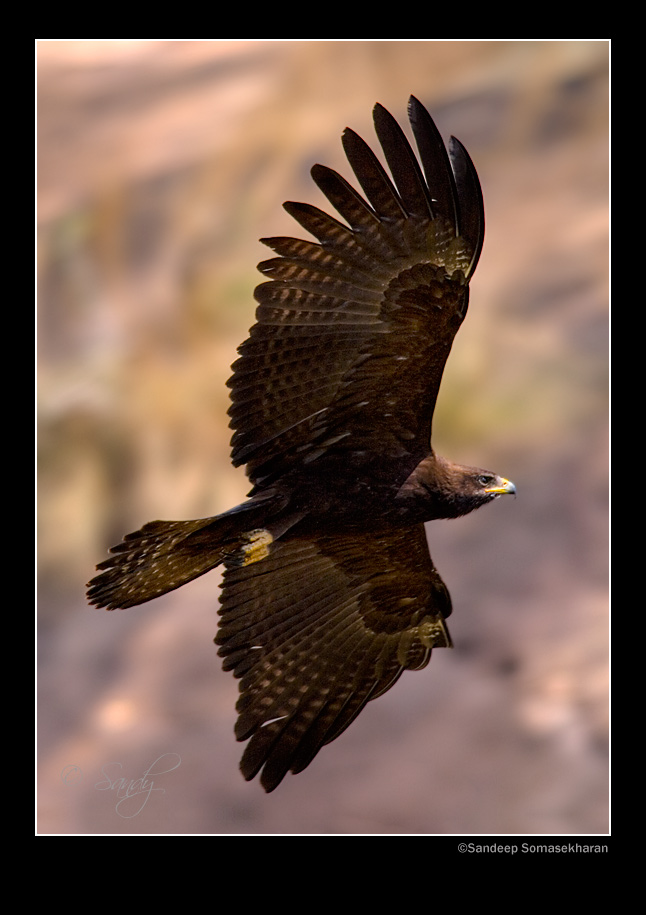
To the Soliga people, the Indian Black Eagle is known by the evocative name of kaanana katthalu - the darkness of the forest


The Mighty Black. For most of my birding career, this majestic forest raptor has been elusive. My first sighting of the Indian Black Eagle (Ictinaetus malayensis) was not in the Western Ghats where it is more commonly seen, but in Horsley Hills, in the Eastern Ghats. We had a view of a distant, unmarked dark eagle alighting on a rock. And so it stayed until we found this magnificent hunter again, soaring above the treetops at BR Hills. 


Dr. Prashanth, who has spent a great part of his career at VGKK and knows the Biligirirangans very well, accompanied us on one of our best visits to his "home" forest. We saw the Black Eagle several times on that visit, most memorably when we were driving up to Bedaguli. Our eyes were already full of Blue-bearded Bee-eaters and Fairy Bluebirds, but the sight of the day was, quite literally, waiting round the bend. Just before the coffee estate began, a large individual chose to melt out of the dark canopy into the blazing blue sky ahead of us. It must have been about 50 metres from the car, and we gasped in unison. 


Imposing in its size and carriage, and soaring majestically into the valley. Later, Prashanth told me that the Soligas call the bird Kaanana-katthalu (literally, 'Darkness of the Forest'). Wondrously poetic and founded on the Soligas' unparalleled jungle wisdom. Sandy (Sandeep Somasekharan) has been particularly lucky company as far as raptors are concerned. As with the Changeable Hawk Eagle, with him I have had some fabulous views of the Black Eagle. He was with us at Bedaguli but things happened too quickly to bring in the photographic evidence. He caught this guy (in the picture) at Ramanagaram when he went there looking for vultures. The vultures were AWOL, but this compensated for Sandy's bad day. And how!  


Photograph © Sandeep Somasekharan. All rights reserved.