Dandeli, post-monsoon, is a completely different forest. Quieter, darker, denser, and offering a whole new birding experience that left us unsatisfied
A misty morning welcomed us as we got down at the VRL bus stand at Dandeli and through the veil of vapor we could see three Malabar Pied Hornbills (Anthracoceros coronatus) flying towards the sylvan surroundings of the Dandeli Bus Stand. The portent was promising and looking forward to a lifer-rich three days we headed towards the Kulagi Nature Camp in the Dandeli-Anshi Wildlife Sanctuary. While the fog was still thick, reducing the visibility to less than 50 meters, we peered eagerly looking for some life outside.
 |
| Giant Wood Spider on the way to Kavala Caves |
On the way we spotted a Common Woodshrike (Tephrodornis pondicerianus) on an overhead power cable, though it took us a while to ID it through the mist. The black eye patch was evident, the beak and head seemed to concur, yet the colors didn’t seem to match. Jennifer mentioned that there is a race of Common Woodshrikes that is grey unlike the commonly seen brown variety. We moved on and spotted a Stork-billed Kingfisher (Pelargopsis capensis), some munias on a powerline on the way, and arrived at Kulagi Nature Camp.
 |
| Malabar Pied Hornbill in flight |
At the camp we spotted a pair of Asian Fairy Bluebirds (Irena puella) and marvelled at the busy sorties of the Crested Tree Swifts (Hemiprocne coronata) and Alpine Swifts (Apus melba). Chestnut-headed Bee-eaters (Merops leschenaulti) were busy with their aerial maneuvers and offered us quite a sight while we were chalking out the plan for the day. Sandy brought out his camera to take a picture of a Chestnut-headed Bee-eater, to the sad knowledge of a glitch. The Nikon D300 was not powering on and Sahastra offered his Nikon D700. Being a full frame camera, the D700 shrank the effective focal length of Sandy’s lenses by a factor of 1.5. Yet this was better than having nothing and we moved on to finalize the logistics for the next two days.
 |
| A Chestnut Headed Bee-eater |
We found Dastagir, the guide who had accompanied us to the Nagzari waterfall trek the last time we were at Kulagi, and he was more than eager to join us again. It was, however, at the office at the camp that we faced our greatest challenge. As we had intended to go birding along the Kavala Caves trail the next day we spoke to the staff at the office who, though initially helpful, started putting up one caveat after another and our birding trip seemed in jeopardy as we were told that the safari vehicle would not start if the quorum of nine was not met. We were seven and human; had we been earthworms we could have tried the slice-and-regenerate approach to make up the numbers. Rather flustered, we walked towards the birding trail.
It was already close to noon and we were not looking forward to much as we entered the birding trail, which at this time of the year was lush green compared to the dry brown we had found it to be in April. We spotted the Black-hooded Oriole (Oriolus xanthornus), Velvet-fronted Nuthatch (Sitta frontalis) and Chestnut-bellied Nuthatch (Sitta castanea). We spent some time observing the Black-rumped Flameback (Dinopium benghalense) and, as Jennifer explained, looking at the throat is an easy way to identify this bird -- it has a clear black throat.
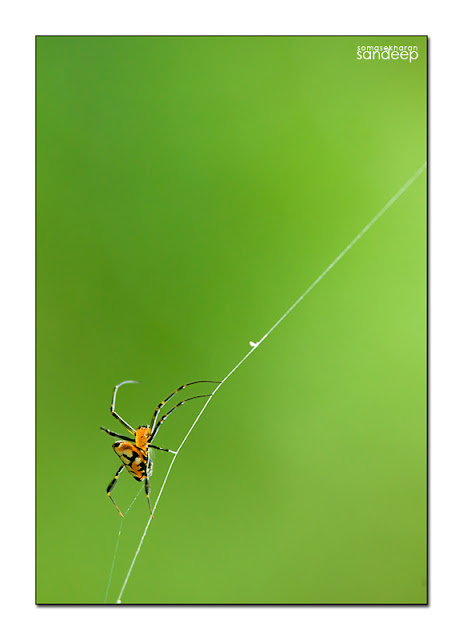 |
| A spider weaves a web of deceit |
After a rather pedestrian lunch at one of the canteens (which we swore not to repeat), we came back to see an exhibition of live snakes as a part of the Wildlife Week. The friendly forester handled the Forsten’s Cat Snake (Boiga forsteni) -- so named for its prominent feline eyes. The mildly venomous snake, no threat to a full-grown human, presented me with my first experience with handling snakes, which I had been looking forward to for a long time. Arun stepped in and shared some of his knowledge on handling snakes – moving our palm along the snake’s underbelly gives the snake the feeling of being in motion, he said. We also saw and felt the Green Vine Snake (Ahaetulla nasuta) and the difference in the temperament of the two was stark. The Cat Snake was more active and mobile, while the Vine Snake, an ambush hunter, stayed mostly still.
 |
| Forsten's Cat Snake - Wildlife Week at Dandeli |
Meanwhile, we settled the terms for our trek to Kavala Caves the next day. We birded near the camp for the evening as there was a huge cloud build-up and it started to rain.
 |
| Look into the eye of the cat snake and thou shalt be turned to stone |
Day 2 started early for us by and we were raring to go by 6 AM, but due to the mist and other operational procedures we started only by 6:45.
We took the jeep to get into the sanctuary and were to trek from a trailhead that began at a watchtower near a water body. On the way to the watchtower we spotted a Crested Serpent Eagle (Spilornis cheela) perched on a tree; the crest was visible as it turned its head right. After observing it for a while we drove on and, as we reached the trailhead, spotted a Lesser Adjutant (Leptoptilos javanicus) in the pond. It lingered for a while and then took off and perched on a tree. The bird has white undertail coverts that form a runny pattern on its back. As the bird flew we could see that flies with its head retracted (unlike Painted Storks) and it was marked with black under the wing.
We observed Black-headed Munias (Lonchura malacca) and spotted a White-rumped Shama (Copsychus malabaricus) in a bamboo thicket. This was a male as it was jet black (the female is duller) and it had a chestnut belly and often twitched its tail like a robin. Its melodious call ends with a drop in pitch -- like a question. We observed them for some time and moved on. We spotted several spiders -- the two species we could identify were the Giant Wood Spider (Nephila maculata) and Black Wood Spider (Nephila kuhlii); there were also some species of Arigope spiders. Up in the canopy we saw Common Wood Shrikes, Velvet-Fronted Nuthatches and Bronzed Drongos.
Closer to the Kavala caves Arun and Bijoy spotted the Grey-headed Canary Flycatcher (Culicicapa ceylonensis).
 |
| Velvet-fronted Nuthatch |
On our way back we saw the Heart-spotted Woodpecker (Hemicircus canente) and the Brown-capped Pygmy Woodpecker (Dendrocopos moluccensis), a rather small woodpecker with brown streaks along the underparts. On the drive back we spotted some chitals (Axis axis) -- a stag and two does -- near what appeared to be an artificial salt lick.
 |
| Asian Brown Flycatcher |
After lunch we arranged for a vehicle to take us to the Bommanahalli backwaters where we were hoping to findwading birds. We were disappointed when we reached -- there was nothing except Grey Herons (Ardea cinerea), Great Egrets (Ardea alba), Little Cormorants (Phalacrocorax niger) and White-throated Kingfishers (Halcyon smyrnensis). There were a lot of frogs, though. We headed back to camp for birding.
Back at the camp we headed back to the Bird Trail and spotted Black-lored Tits (Parus xanthogenys), Small Minivets (Pericrocotus cinnamomeus) and Bronzed Drongos (Dicrucus aeneus) but the highlight was a spotting by Bijoy -- a Banded Bay Cuckoo (Cacomantis sonneratii) being fed by a Common Iora (Aegithina tiphia). This was the first time I had observed brood-parasitic behaviour. We headed towards the Timber Trail where we saw a Green Vine Snake, which had some warts along its belly. It looked like rain and we cut short our walk and headed back to plan the next day. We were looking at good birding options and Sahastra suggested that our chances of finding birds 30 km away were the same as that of finding them next to our camp. This prophecy saved the next day for us as we headed out to the watchtower overlooking the Nagzari Valley.
 |
| Crested Serpent Eagle |
On a dry tree near the check dam we found a mixed flock including Pompadour Green Pigeons (Treron pompadora), Heart-spotted Woodpecker, Bronzed Drongo, Brown-capped Pygmy Woodpecker, Common Woodshrike, Scarlet Minivet (Pericrocotus flammeus). At the watchtower we observed the Brown-headed Barbet (Megalaima zeylanica), Golden-fronted Leaf Bird (Chloropsis aurifrons), Bar-winged Flycatcher Shrike (Hemipus picatus), Velvet-fronted Nuthatch, Plain Flowerpecker (Dicaeum concolor), Purple-rumped Sunbird (Nectarinia zeylonica) and Crimson-backed Sunbird (Nectarinia minima) from a close distance. The elevation of the overlook near the watchtower was just perfect for us to watch these birds at eye level. We then covered the Bird Trail from the opposite direction.
 |
| A Malabar Grey Hornbill |
We checked out and headed towards the Timber Depot hoping to spot some hornbills. On the way we saw two jackals crossing the road. The Timber Depot was lush green and we did find two Malabar Grey Hornbills (Ocyceros griseus) calling, and we were told that there are more birds to be seen further up the road near a meadow. The locals mentioned that the hornbills would arrive in huge flocks around 6:30 PM and also suggested the possibility of finding flying squirrels and deer. That got our hopes up but a hike into the forest beside the meadow was disappointing. As we passed time in an excruciating wait, Jagadeesh brought our attention to a blind snake being consumed by ants; the snake’s predicament was pitiable and painful, though we watched in marvel at the coordinated attack of the ants. The formic venom took effect and the blind snake was soon subdued.
 |
| Some species get to monkey around and no one can complain |
It was dark and we left the Timber Yard in sober spirits. The omen of spotting the Pied Hornbills on our arrival apparently had no bearing on the bird life we were going to spot during the trip. After some struggle to find a reasonable dining place in Dandeli we boarded the bus to Bangalore.
Triplist:
- Grey Junglefowl (Gallus sonneratii)
- Indian Peafowl (Pavo cristatus)
- Lesser Adjutant (Leptoptilos javanicus)
- Little Cormorant (Phalacrocorax niger)
- Grey Heron (Ardea cinerea)
- Great Egret (Ardea alba)
- Pond Heron (Ardeola grayii)
- Oriental Honey Buzzard (Pernis ptilorhyncus)
- Indian Black Eagle (Ictinaetus malayanus)
- Brahminy Kite (Haliastur indus)
- Crested Serpent Eagle (Spilornis cheela)
- Red Wattled Lapwing (Vanellus indicus)
- Spotted Dove (Streptopelia chinensis)
- Pompadour Green Pigeon (Treron pompadora)
- Emerald Dove (Chalcophaps indica)
- Banded Bay Cuckoo (Cacomantis sonneratii)
- Common Hawk-Cuckoo (Hierococcyx varius)
- Asian Drongo-Cuckoo (Surniculus lugubris)
- Asian Koel (Eudynamys scolopaceus)
- Blue Faced Malkoha (Phaenicophaeus viridirostris)
- Greater Coucal (Centropus sinensis)
- Alpine Swift (Apus melba)
- Crested Tree Swift (Hemiprocne coronata)
- Stork Billed Kingfisher (Pelargopsis capensis)
- White-Throated Kingfisher (Halcyon smyrnensis)
- Chestnut Headed Bee-Eater (Merops leschenaulti)
- Green Bee-eater (Merops orientalis)
- Malabar Grey Hornbill (Ocyceros griseus)
- Malabar Pied Hornbill (Anthracoceros coronatus)
- White-cheeked Barbet (Megalaima viridis)
- Coppersmith Barbet (Megalaima haemacephala)
- Brown Headed Barbet (Megalaima zeylanica)
- Brown Capped Pygmy Woodpecker (Dendrocopos moluccensis)
- Lesser Yellownape (Picus chlorolophus)
- Rufous Woodpecker (Celeus brachyurus)
- Black Rumped Flameback (Dinopium benghalense)
- Greater Flameback (Chrysocolaptes lucidus)
- Heart Spotted Woodpecker (Hemicircus canente)
- Common Woodshrike (Tephrodornis pondicerianus)
- Large Cuckoo-shrike (Coracina macei)
- Long-tailed Shrike (Lanius schach)
- Ashy Woodswallow (Artamus fuscus)
- Common Iora (Aegithina tiphia)
- Small Minivet (Pericrocotus cinnamomeus)
- Scarlet Minivet (Pericrocotus flammeus)
- Bar Winged Flycatcher Shrike (Hemipus picatus)
- Black Hooded Oriole (Oriolus xanthornus)
- White Bellied Drongo (Dicrurus caerulenscens)
- Bronzed Drongo (Dicrucus aeneus)
- Greater Racket Tailed Drongo (Dicrurus paraiseus)
- Asian Brown Flycatcher (Muscicapa dauurica)
- Grey Headed Canary Flycatcher (Culicicapa ceylonensis)
- Black Lored Tit (Parus xanthogenys)
- Chestnut Bellied Nuthatch (Sitta castanea)
- Velvet Fronted Nuthatch (Sitta frontalis)
- Red Whiskered Bulbul (Pycnonotus jocosus)
- Yellow Browed Bulbul (Iole indica)
- Brown Cheeked Fulvetta (Alcippe poioicephala)
- Asian Fairy Bluebird (Irena puella)
- Oriental Magpie Robin (Copsychus saularis)
- White Rumped Shama (Copsychus malabaricus)
- Orange Headed Thrush (Zoothera citrina)
- Jungle Myna (Acridotheres fuscus)
- Chestnut Tailed Starling (Sturnia malabarica blythii)
- Indian Myna (Acridotheres tristis)
- Golden Fronted Leafbird (Copsychus saularis
- Plain Flowerpecker (Dicaeum concolor)
- Thick-billed Flowerpecker (Dicaeum agile)
- Purple Rumped Sunbird (Nectarinia zeylonica)
- Crimson Backed Sunbird (Nectarinia minima)
- Scaly Breasted Munia (Lonchura punctulata)
- Black Headed Munia (Lonchura malacca)
- White-browed Wagtail (Motacilla maderaspatensis)
- Grey Wagtail (Motacilla cinerea)
- Tickell's Blue Flycatcher (Cyornis tickelliae)
- Black-naped Monarch (Hypothymis azurea)
- Rose-ringed Parakeet (Psittacula krameri)
- Malabar Parakeet (Psittacula columboides)
- Plum-headed Parakeet (Psittacula cyanocephala)
- Vernal Hanging Parrot (Loriculus vernalis)
Text: Anand Yegnaswami
Photos: Sandeep Somasekharan
Read more posts from our Dandeli series


