We’ve moved! Here’s where you can find us

The Green Ogre is now at https://www.greenogreindia.org
Showing posts with label Alaska. Show all posts

A ramble through Alaska - Portage Glacier, Anchorage

Concluding Anand Yegnaswami's sojourn in Alaska, this episode sees him face to face with a Grizzly and learning something new about the gender of Santa's red-nosed reindeer


Refreshed from a rather uneventful third day of our trip we emerged from our slumber gung-ho about what was to be our first experience of a fjord. We had read in school textbooks about Norwegian fjords and here was our ticket to experience one from a cruise boat.
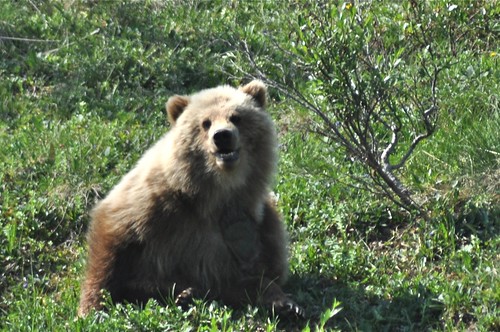
A brown bear
The cruise we had booked promised fascinating views of glaciers and wildlife that included sea-lions, puffins and whales. The Czech acquaintances Rajarshi made the previous day had shown us captivating images from the cruise taken a day earlier. Had someone heard us praying, they might have assumed us to be sexist expecting parents but we prayed hard for the sun.


As we emerged from the hotel still praying, the ice-cold drizzle left us bedraggled and washed away our hopes of the fjord experience. It wasn’t a surprise when the cruise operator told us it was impossible to provide cruise services on such a wet and windy day.  We were done with Seward and as we headed out I learned from chatting with the lady at the gas station that the day before had been the 14th sunny day of the year. I left grumbling about the weather. Zeus was off my worship list.
Portage Glacier with the Blue Ice visible
We opened the glove compartment to look at the guide and found Plan B smiling at us – we settled on Portage Glacier and the Alaska Wildlife Conservation Center. The weather seemed to have come out of its fickle bout and we enjoyed our drive until we reached the glacier. Having caught wind of my recent affront, Zeus sent a freezing downpour accompanied by a breeze so strong that the tandem strike could have frozen the marrow in our bones. We braved the weather and moved on to the Alaska Wildlife Conservation Center.
Bisons at the Alaska Wildlife Conservation Center
At the Conservation Center we saw significant acreage allocated for the rehabilitation of wild animals. Moose, elk, brown bear, Bald Eagles, bison, coyote, musk ox and lynx formed the group of animals that have found refuge here. We heard about the injured Bald Eagle that was too hurt to be safely released back into the wild. I was pained at the plight of a bird of prey so majestic that was now hopping along a solitary branch of a tree stump and would never again spread its mighty wings. Having seen the commendable conservation efforts at the wildlife center we headed for Anchorage.


The Seward Highway 1 that flanks Cook Inlet is known to offer Beluga whale sightings and we kept our eyes wide open and shouted “Beluga” for everything that moved only to quickly realize our folly and melt into sheepish grins. By the time we reached Anchorage our throats were parched from the screaming while our eyes were dreary from having seen none.
Anchorage, Alaska
Anchorage is one of the coziest cities I have visited during the beginning of fall, not temperature-wise but temperament-wise. The city, built by army engineers, is organized well into streets and avenues with buildings bristling with character. The three previous days of recluse living with inadequate social interaction made the visit to Anchorage a treat. I have never enjoyed crowds so much. 


We lapped up the cultural gallimaufry with gusto as we saw different races, nationalities and ethnicity converge on the city while we went looking for souvenirs. We saw totem pole replicas with carvings of raven, bear, and whales. We saw artwork on ivory from whales and even baleen, which raised our eyebrows on the legality of the sale of these items. The trip to Alaska illustrated the power of nature to sustain communities in the severest of weather conditions. 


There is, however, a thin line between sustenance and exploitation. Will the pressure of population take its toll on this paradise? From our interaction during the trip we learnt that most of the population in Alaska is transient, they travel to Alaska for work during the summer and leave before winter. Probably the inhospitable winter is in a way a boon for conservation. We left for the airport.

Sculpture in Anchorage asserting the significance of nature in Alaska
At the airport we chatted up a gentleman from Colorado who was returning from a visit to his girlfriend’s family near Anchorage. He brought in a very interesting piece of information from the Caribou farm he had stayed in. He mentioned emphatically that “male Caribous lose their antlers by December 15." Which means Rudolph is a female!

I took back more than just souvenirs, pictures and memories from Alaska.


Text and photos by Anand Yegnaswami
Read all posts in the Alaska series

Ramble through Alaska - Exit Glacier

At Exit Glacier, not far from the top of the world as the puffin flies, we stayed at a historic hotel and stayed clear of bears


We were drained from the previous day’s drive to the Arctic that ended only at 3 AM on Day 3 of our trip at Seward, Alaska. Seward is a tiny town in the southern part of Alaska in the Kenai Peninsula, named after William H Seward who negotiated the purchase of Alaska. The town offers access to the Kenai Fjords National Park and the Exit Glacier, which were in our itinerary for the next two days. We had stayed at the Hotel Van Gilder -- a historic hotel in Seward.

Exit Glacier
Built in the early 20th century, Hotel Van Gilder has seen the metamorphosis from an office building, hotel, women’s dormitory to its final use as a historic hotel. We were impressed with its interiors and furnishings, which gave us the feeling that we were indeed staying at a place of historic significance. The interiors, with their Italian feel, reminded me of another place where I had stayed at Miami Beach.
Hotel Van Gilder, Seward, Alaska
We had a three-hour nap as we had to get to the Harding Ice Field Trail to begin our hike. The weather was not benign and there was a continuous drizzle. A rather gloomy day compared to the heaps of sunlight we had received the day before. When we got to the visitor’s center for the Exit Glacier we could hear a lot of talk about bears in the area, and we made the necessary enquiries on how to evade bears, which included making a lot of noise and trying to look larger than the bear by spreading out the limbs high, or using a pepper spray (which we didn’t have). We then proceeded with caution. We passed a few hikers on the way back and some warned us about bears in the area. After about 30 minutes into the hike Raghavan and I decided we didn’t want to be hugged by any bears. I was reminded of a lesson my high school English text book about a hiker who was attacked by a bear that took out his scalp with one blow. Rajarshi was nonchalant about the bear threat and decided to continue all alone. 

A cruise ship at Resurrection Bay
We hung around for short hikes at the base of the glacier and were pained to read about how it had receded over the past years. Back at Seward Raghavan and I ate and headed out to explore the town's streets, a journey that took us to Resurrection Bay. Back at the hotel we were joined by Rajarshi who related his hike experience, the friends he had made, and a black bear he had spotted along the glacier.
Colorful mural on the wall of a restaurant
We ended the day with a visit to a local watering hole where we caught up with the friends Rajarshi had made during the trek -- two from the Czech Republic and one from Japan -- and we exchanged notes on our travels and headed back hoping we could catch glimpses of puffins, sea lions and whales during our cruise at the Kenai Fjords National Park.

Text and photos: Anand Yegnaswami
Lead Photo: Public Domain


Read previous posts in the Alaska series

Ramble through Alaska - the Arctic Circle

Leaving Mt Denali behind we left with optimism for the Arctic Circle, into the ragged latitude of the midnight sun


Disappointed with the weather at Denali National Park that denied us a view of Mt Denali on the first day of our trip to Alaska, we looked for an suitable alternative and found it in the Arctic Circle.

We headed out of Denali National Park early morning towards Fairbanks en route to the Arctic Circle. Aware that we could not hope for lavish feasts on the way we stocked up on food. It was a hastily planned jaunt with many unknowns, all of which added to the sense of adventure. 

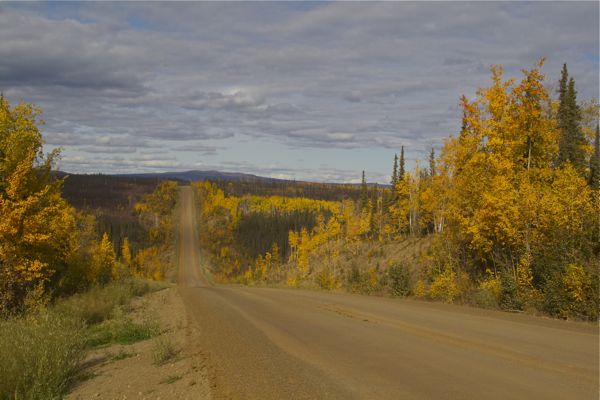
The unpaved road dotted with aspens
First, we had approximated distances as we had used paper maps for planning. Moreover, we had little knowledge of the pockets of civilization and amenities we might find on the way. Additionally, we did not have a complete picture of the road conditions. Yet, the temptation to seek exploratory salvation grabbed caution from our senses and threw it into the air. We were on our way to seek a place in the plaque for the ones who crossed over to the frontier of the midnight sun.
The tundra close to Denali National Park
The Arctic Circle is an imaginary circle of latitude that runs around the earth at 66 ½ degrees north of the equator. Due to the axial tilt of the earth the regions north of this circle experience at least one 24-hour day (in summers) and one 24-hour night (in winters) during the year. The Arctic Circle is not a single geo-spatial coordinate; it is a number of geo-spatial coordinates strung together, and we were hoping to cross over into the Arctic on the Dalton highway that connects Fairbanks with the offshore drilling region near Prudhoe Bay. All we could learn from our limited research was that there would be a signpost by the highway indicating the Arctic Circle.

We crossed Fairbanks and further north got onto an unpaved road that significantly slowed us down. Soon we were driving along the Trans-Alaskan Pipeline, which connects the offshore platforms in Prudhoe Bay in the Northern extremity of Alaska with the Southern Alaskan port of Valdez (rather infamously known for the 1989 oil spill involving the tanker vessel Exxon Valdez at Prince William Sound). Raghavan added a trivia that the Mother Ship of the smokers in the movie Waterworld was named Exxon Valdez. The day was clear and sunny and our thoughts went back to Mt Denali, for on a day like this the peak would have been clearly visible, yet the landscape around our route specked with aspens made the drive to the Arctic a visual treat. 

The Trans-Alaskan Pipeline
We crossed the mighty Yukon River and entered the tundra, which was dotted with fascinating land formations including a cluster of rocks shaped like fingers called Finger Mountain.
Rock formations on the way to the Arctic Circle

Finger Mountain
Just after noon we reached the rather nondescript Arctic Circle. We could not appreciate the faunal value of the region, though we were spellbound at the artistic landscape that told of nature's craft of creating visual masterpieces. The vegetation in the tundra supports Caribou and with them follow Brown and Grizzly bears; yet the highway we took was a trifle compared to the expanse of the tundra and therefore diminished our chances of spotting wildlife.
Board indicating the Arctic Circle on the Dalton Highway
On the way back the sun painted the scenery with vivid hues and just before it went down we got a glimpse of the Northern peak of Denali from George Parks highway. Inundated with zeal infused by a lively day we looked forward with hope for the next day’s foray – the Exit Glacier in the Kenai Peninsula.

A glimpse of Mt Denali from George Parks Highway
Text and photos: Anand Yegnaswami


Previously in this series: Part 1 - Ramble through Alaska

Encounter: Looking up the Moose's nose

Someone once told not to look a gift horse in the mouth checked the dental signature of a Moose instead and discovered 12 molars, 12 premolars, 6 incisors and 2 canines. Oh dear, a moose is actually a deer, as Ogden Nash evidently knew!

Confronted by a mouse or moose,
You turn green, she turns chartroose.


- OGDEN NASH
From "GOOD-BY NOW OR PARDON MY GAUNTLET"


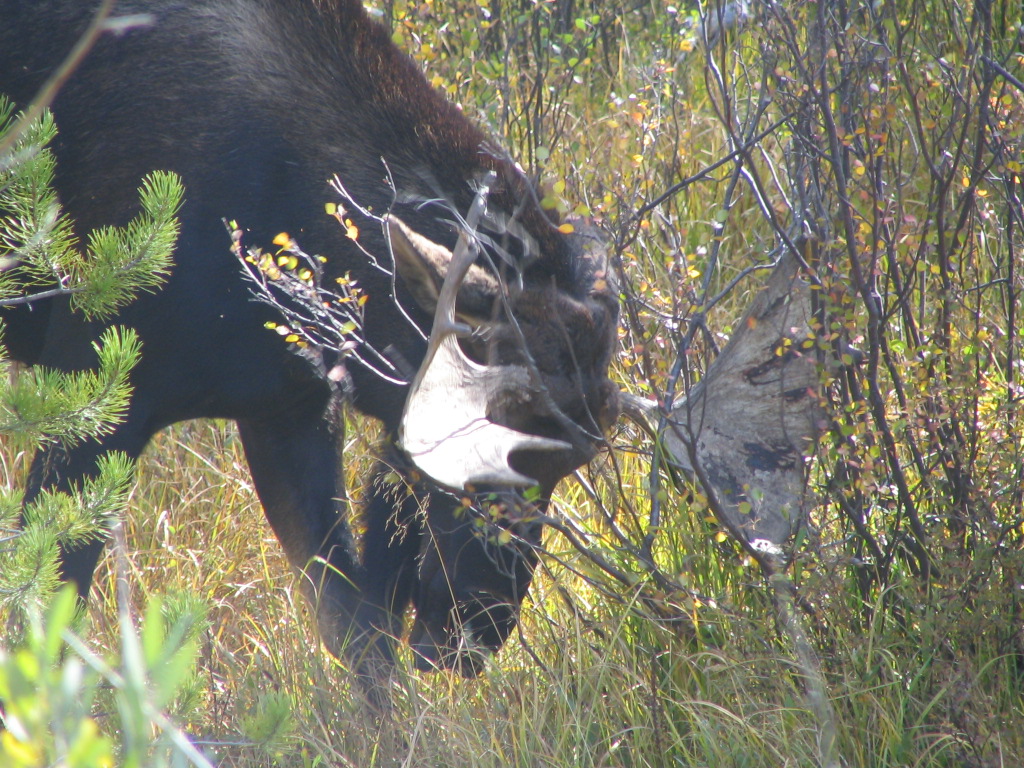
My first encounter with the Moose (Alces alces) was in the Rockies in Colorado. It was mid-September and Fall was round the bend. We chanced upon a bull while driving through the Rocky Mountain National Park. As we clicked pictures it was joined by a cow.

Moose rubbing its antlers against the brush signifying the beginning of the breeding season
Four years later I encountered the moose again in and around Denali National Park, Alaska, around Labor Day. Fall arrives early in the northern reaches and the park officials warned that it was rutting season for the moose and any close encounters with a bull were fraught with risk as the beasts are most aggressive then. We saw a few moose from a distance (not including a skull at one of the interpretation centers).

Moose are the largest deer and often the personification of raw power. They are even considered dim-witted if I were to go by a character in a comic series I used to read two decades ago. They are widely distributed in the northern reaches of USA, Canada, Scandinavia and Siberia. A race known as the Shiras Moose is found in the higher altitudes of America's lower latitudes. Once the bull moose has mated it sheds its antlers to conserve energy for winter and regrows them next season. Cows do not sport antlers.


A bull moose
Someone once told not to look a gift horse in the mouth decided to check the dental signature of the moose instead and discovered 32 teeth – 12 molars, 12 premolars, six incisors and two canines. Add to that formidable palmate antlers and a thousand pounds in body weight, and we have a beast we do not want to mess with. The moose also has a pendulous appendage called the “bell” -- a loose flap of dewlap-like skin that hangs below its throat. 

Moose are herbivores and their natural predators are bears and wolves. They have been hunted and humans have found use for everything from their meat to their scat -- which, believe it or not, is often used in making jewelry.

Natural predation and game hunting has had little impact on moose population and this majestic beast continues to roam the northerly landscapes of the northern hemisphere.


And just by the way, Ogden Nash, who wrote those lines about the moose, also wrote this one about the elk, in which, of course, he also referred to the caribou -- and the moose! 


Enjoy!


Moose makes me think of caribou,
And caribou of moose,
With, even from their point of view,
Legitimate excuse.
Why then, when I behold an elk,
Can I but think of Lawrence Welk?


Text and lead photo: Anand Yegnaswami
Other photos: Wikimedia Commons

The Green Ogre Weekend Update July 31

Alaska, Gaia and birds whose presence is dwarfed by their voices -- that's what The Green Ogre was all about this week 

It's the last day of July with the monsoon still in full force over the subcontinent. In the rainforests of Agumbe, the frogs must still be calling, their trails of spawn must have hatched into little tailed tadpoles, and the snakes must be making merry at the abundance of chow. Over in Bangalore, pelicans have joined cormorants and herons in our lakes, feasting on the seasonal glut of fish. And here at The Green Ogre, we've been housebound, office-bound and our mindwalks have been extra vivid with the afterglow of unrealised dreams. The bright side: deprived of the outdoors, we sat down to write. 

Andy recalled his ramble through Alaska's Denali National Park and his encounters with moose, elk, caribou and grizzlies. In weather that was all but conducive to hiking, his friends and he flirted with the possibility of catching a glimpse of the mist-shrouded Mount Denali. Interestingly, they drove through the city of Wasilla on the same night that its former mayor and Alaska's then governor Sarah Palin was announced as John McCain's running mate in the 2008 US Presidential Election.

On Tuesday the birds came back to The Green Ogre. Recollecting a drive through his native land of Rae Bareli before the birding bug had bitten him, Sahastra described in all self-deprecation his first encounter with the Rufous-tailed Shrike. Many passers-by must have walked past the bird that day without as much as glancing at it. However, to a birder, its presence there at that time of the year was an epiphany: it was way out of its known range. Such are the serendipitous joys that await the birdwatcher, even in his or her backyard.


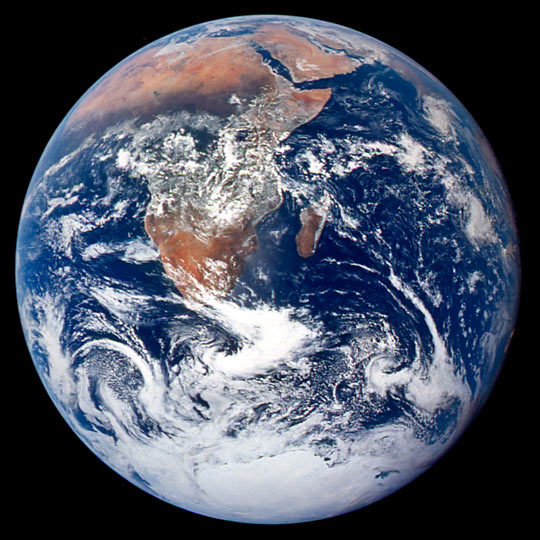
July 26 was the 92nd birthday of James Lovelock, who proposed the enchantingly controversial Gaia hypothesis. Offering an appreciation of the man and his work, Sahastra wrote: "Gaia as an idea has both scientific and spiritual sides. This is welcome since it helps us connect science to worldliness and makes us feel complete again. Many paint James Lovelock as a hermit scientist who never followed institutional science, has no specialization and worked in a remote corner of the British countryside rather than in a state-of-the-art lab. Lovelock said that it is precisely due to these attributes that he could think large, be moved by his own curiosity and inspiration and break the boundaries between disciplines. Eventually, inspired by the first space images of the beautiful blue planet with swirling clouds, he was able to theorize the self-regulation of Earth – true to his instinct, he called it a living earth."
Among the most commonly heard but ignored birds of our urban landscape is the Coppersmith Barbet. Its penetrating took-took call is an indelible constituent of park birdsong. Indeed, the Coppersmith's penchant for monotony makes it the heavy metal percussionist of bird songsters. How much have you seen of the little bird, though? Take a good look, for Sandy has an excellent photographic profile of this little whiskered noisemaker.

Look out for more good stuff next week. Enjoy your weekend!

A ramble through Alaska

Moose, elk, grizzlies and caribou are on Anand Yegnaswami's mind as he recalls a trip to Alaska's Denali National Park

Alaska was a part of Russia until 1867 when US Secretary of State William H Seward played a key role in purchasing it for $7.2 million. It is believed that the Russians were keen on the sale as having the Americans in their backyard would be a deterrent against the English. Most Americans felt that it was foolish to buy this barren patch of land and mockingly referred to the deal as “Seward’s Folly”. Mr Seward it appears was a man of profound foresight for despite the criticism he had mentioned that his greatest achievement was “the purchase of Alaska – though it will take people a generation to find it out.” Five generations later, I had an opportunity to seek out the truth myself.
The Thursday before Labor Day 2008, shortly before 11:30 pm (Alaska Time), Raghavan and Rajrishi from SFO, and I from Seattle landed at Anchorage’s Ted Stevens International Airport, picked up our rations at a nearby grocery store, and headed to Denali National Park.

Denali, which means “the tall/high one” in the Athabaskan language, is the highest peak in North America. The region around Denali, designated as the Denali National Park, is abundant in fauna. However, we were also hoping for a clear day to catch a glimpse of the peak itself, which is covered by clouds for most of the year.

Back at Anchorage, we were out on the Glenn Highway headed for Wasilla. Shortly after midnight of August 2008 (Alaska Time), John McCain announced Alaska governor Sarah Palin as his running mate for the 2008 Presidential Elections. I would like to think it was a mere coincidence that we passed by the town that day, for the quest we were actually on was Denali.
The road to Denali was desolate and serpentine with frequent changes in elevation. Quite often we would see light on the horizon and mistake it for the Northern Lights (Aurora Borealis). Whether this was the effect of fatigue from the long travel or a case of highway hypnotism we do not know. However, we made the same mistake knowing well that we could not expect to see the auroral phenomenon at that time of year. We saw some moose beside the highway in the early hours of the day and just about daybreak we reached the Park Visitor Center.

The Denali National Park is the only US National Park that does not allow personal vehicles inside the park. However, the authorities have ensured that ample shuttle buses are available to travel within the park. Shuttle buses are available for Toklat River (6.5 hours round trip), Eielson Visitor Center (8 hours round trip), Wonder Lake (11 hours round trip), Kantishna  (13 hours road trip). Our plan for Day 1 was the Eielson Visitor Center option as the duration seemed reasonable and we had planned to upgrade it to a Wonder Lake trip if Mt Denali was visible. Though we made enquiries about the Discovery Hiking Tour for day 2,  they were sold out. It was a cloudy day and it seemed unlikely that Mt Denali would be visible, yet we crossed our fingers and got into the bus.
Moose in Alaska (Douglas Brown/ Flickr)
On the trip to the Eielson Visitor Center, we passed a few solitary moose. The bus driver forewarned us to keep a safe distance from them while we were in the park, since it was the rutting season and solitary males were known to be very aggressive. After crossing the Savage River we came across a herd of caribou (Rangifer tarandus). Also known as Reindeer in Europe, these deer are both migrant and resident. The migrant herds are known to travel up to 5,000 kilometers in a year. The reindeer are food species for a variety of carnivores including wolverine, wolves, brown bear and Grizzly and we were about to meet one such foe. 
Further ahead of the Savage River we came across a mother Grizzly Bear (Ursus arctos horribilis) and her cub. Grizzlies are found in copious numbers in this region, though the irony is that they do not reproduce often. Females mate only from the age of five and they do not mate until a few years after the cubs leave, or are killed. The Grizzly Bear has very high nutritional needs as it needs to keep itself nourished through long periods of hibernation. Its diet includes berries, fish and large mammals such as moose, elk, bison, caribou and sheep. We were getting a good idea of the food chain of the region. Next we saw Dall sheep (Ovis dalli) as small white specks climbing high up on the mountain face.
Grizzly Bear in Alaska (dgrice/ Flickr)
Moving on we saw several shrubs that seemed to be ravaged by some form of pestilence. Our driver explained that the shrubs were denuded due to the feeding frenzy of the Snowshoe Hare (Lepus americanus), which are predominant in the region. The landscape at Denali National Park is eerie on a cloudy day towards the end of summer. The mountains are stripped bare of snow, with dark patches exposed by the erosion caused by melting ice. Yet the tundra can surprise you with an occasional patch of bright red or yellow in these otherwise dreary surroundings.

Ahead we encountered Arctic Fox (Vulpus lagopus) by the side of the bus. At the Eielson Visitor Center we had to decide whether to proceed to Wonder Lake or head back to the Denali Visitor Center as the day had been rather cloudy. We chose to catch a shuttle back. We had just emerged from the visitor center when we froze. The mist was thick but we could see that the dark figure that hopped a few feet away from us was not really the cuddly kinds. We stood still as the Grizzly cub hopped towards a trail below us and were concerned that the mother might appear any moment. However, these concerns were belied as we got into the shuttle towards the Toklat River.
At the Toklat river a Grizzly foraged near the river bed. We tried to get close for a photo when a moose came calling. Not wishing to be the moose’s bunny for the day we got back to the shuttle, only to realize that the clouds were clearing. 

Were we destined to catch a glimpse of Mt Denali today? We changed our minds and caught a shuttle back to the Eielson Visitor Center.

However, by the time we reached Eielson Visitor Center the weather had worsened. Disappointed, we sat before a table with the map of Alaska. Giving up hope to see Mt Denali, we decided to spend Day 2 making a foray to the Arctic Circle.

Text and photographs by Anand Yegnaswami
Other images sourced from Flickr (as credited)